Best 1/10 RC Crawlers of 2026

A crawler is the one RC truck where slow is the point: no launch ramp, no top-speed numbers, just a rock face, a throttle you barely touch and a line planned three moves ahead. The box is where first-time buyers get caught. "Ready to run" can mean a truck with a battery and USB charger inside, or a roller that still needs a pack, a charger and an evening at the bench, and this list includes both kinds.

Hardware matters more than price. Portal axles and a steering rear axle change what a truck can climb far more than an extra mile per hour, and a heavy scale hardbody can raise the center of gravity enough to roll the truck on a sidehill. Across the nine trucks we ran on a backyard rock pile and a rooty trail, those differences showed up within the first battery.

Our Top Picks

The Best 1/10 RC Crawlers

1.

Redcat Racing Danchee Ridgerock Best Overall
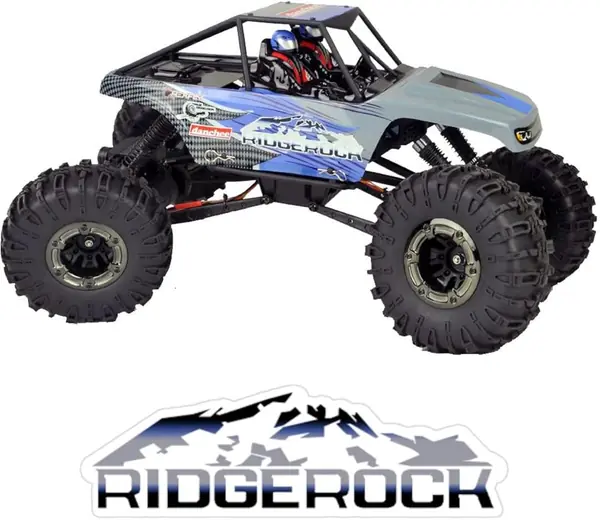
Redcat Danchee Ridgerock blue and gray 1/10 crawler with roll cage and beadlock tires

First-time crawler buyers

Track Score 92/100
Steering
Front, rear, four-wheel and crab modes
Drive
Dual brushed motors, motor-on-axle 4WD
Length
440mm
Included Battery
7.4V 1500mAh Li-ion with USB charger
View on Amazon

Come at a rock at the wrong angle and the Ridgerock can slide sideways out of the problem instead of backing up for a second attempt. Two motors, one at each axle, and a four-mode steering system let you choose front-only, rear-only, four-wheel, or crab steering from the transmitter while the truck is still moving. Crab is the mode we reach for on switchbacks: the whole truck translates sideways, which is exactly what a tight line wants.

The low-speed manners are what make it feel like a crawler rather than a toy. Torque arrives at the axles instead of traveling through a center gearbox, so the truck creeps up a ledge rather than lurching at it, and the drag brake holds it in place when you lift off the throttle. Stopping halfway up a slab to think about your next move is far less dramatic when the truck is not sliding back down while you do it.

That combination is why it tops this list: a real rock crawler that needs nothing else to get moving. The 7.4V 1500mAh pack in the box is a starter battery rather than an afternoon's worth, so order a second one with the truck — two modest packs beat one big one on a trail day.

The transmitter takes four AA batteries of its own, the kind of detail you discover in a parking lot, so put a set in the bag before the first trip. Charge the pack, load the AAs, and it is running in the time it takes to walk to the trailhead.

Worth Noting

  • All-plastic links and axle housings
Our Verdict

We point most people to the Ridgerock because it arrives ready to drive, steers in four modes the others do not have, and leaves budget for a second battery.

Check Latest Price
2.

Axial SCX10 III Coyote Best Scale Trail Truck

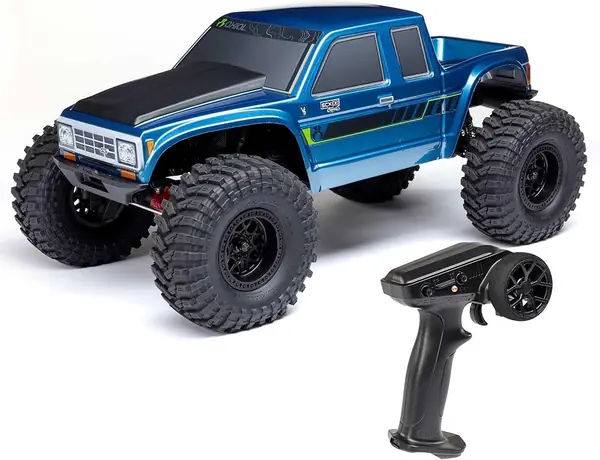
Axial SCX10 III Coyote blue 1/10 crawler truck with painted pickup body and portal axles

Scale trail driving

Track Score 87/100
Axles
AR45P portal
Chassis
One-piece steel C-channel
Body
Factory-painted Pro-Line Coyote
Transmission
LCXU
View on Amazon

Under the Coyote body is the part you are actually paying for: a one-piece steel C-channel frame and AR45P portal axles. Portals raise the axle's centerline so the differential housing rides higher, which is how a truck on modest tires clears a ledge that stops a straight-axle rig of the same size.

We think the frame is the better long-term purchase. Plastic rails flex and eventually crack where steel does not, and the LCXU transmission is geared for control rather than speed, which is the trade a crawler wants. The body also arrives factory-painted and trimmed, so there is no weekend of masking and spraying before the first run.

Portals are not free clearance: the gear reduction at each end puts mass at the corners, so a portal truck rewards a battery mounted low and a smooth throttle hand. Drive it that way and the Coyote takes lines the straight-axle trucks here have to go around, at a pace that feels like a trail run rather than a stunt.

Worth Noting

  • Battery and charger sold separately
Our Verdict

The Coyote is the crawler we suggest when you want real hobby hardware: a steel C-channel frame, portal axles, and a painted body that needs no work.

Check Latest Price
3.

Redcat Racing Ascent Best for Upgraders

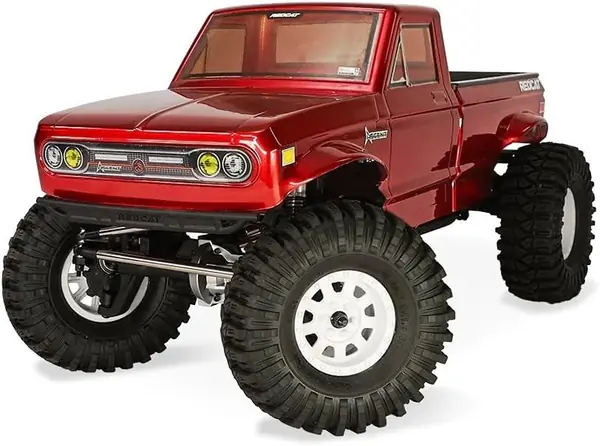
Redcat Racing Ascent red 1/10 crawler with portal axles and aluminum chassis

Hobbyists with packs

Track Score 85/100
Axles
High-clearance portal
Chassis
Aluminum with low center of gravity
Radio
2.4GHz included
Electronics
Brushed motor and ESC combo
View on Amazon

The Ascent arrives without a battery or charger, and that tells you exactly who it is for: someone who already owns LiPo packs and would rather not pay for another wall charger and a starter battery they will never use.

What the money buys instead is the expensive hardware — high-clearance portal axles, a low center of gravity, and a lightweight aluminum chassis that shrugs off rollovers. Portals and a low-slung layout are the two things crawler buyers usually pay a premium for, and here they come together in a truck that is otherwise ready to run.

We like it as the second crawler in someone's garage. It is LiPo-ready, the brushed motor and ESC combo is smooth at the bottom of the throttle, and the adjustable suspension gives you somewhere to go with setup without replacing the whole truck.

One job before the first pack: put a wrench on the suspension links and the panhard mount. That is the area where these arrive less than perfect, and two minutes on the bench beats a walk back to the car with a dragging axle.

Our Verdict

We like the Ascent for hobbyists who already own packs: portal axles, a low center of gravity, and a light aluminum chassis, with no charger or battery to pay for twice.

Check Latest Price
4.

Axial UTB10 Capra 1.9 4WS Best Hardcore Crawler

Axial UTB10 Capra orange 1.9 tube-frame crawler buggy with four-wheel steering

Hardcore rock crawling

Track Score 84/100
Axles
Licensed Currie F9 portal
Suspension
4-link
Steering
Four-wheel steering
Transmission
Lower gear ratio
View on Amazon

There is no painted shell to worry about: the Capra is a tube-frame buggy, and the cage is the body. That changes how you drive it. You stop hunting for the gentle line and start looking for the one the truck can pivot onto.

Four-wheel steering is the reason. With a servo on the rear axle as well as the front, the back of the truck walks around a rock instead of dragging the whole rig through it. Licensed Currie F9 portal axles and a lower transmission gear ratio keep the torque smooth when you are crawling at a fraction of walking pace.

Two steering servos and a motor pull hard on one speed control, so electronics headroom matters. If the steering goes lazy or one axle stops answering, the ESC and the servos are the first places to look, and it is worth checking steering endpoints before the first run.

It is the least practical truck here — nobody will mistake it for a scale Land Cruiser — and the one we take when the terrain is the point. Point it at a rock garden and the cage stops looking like a styling choice.

Worth Noting

  • No battery or charger included
Our Verdict

For technical rock and nothing else, we pick the Capra: rear steering and portal axles let it pivot onto lines the scale trucks here cannot.

Check Latest Price
5.

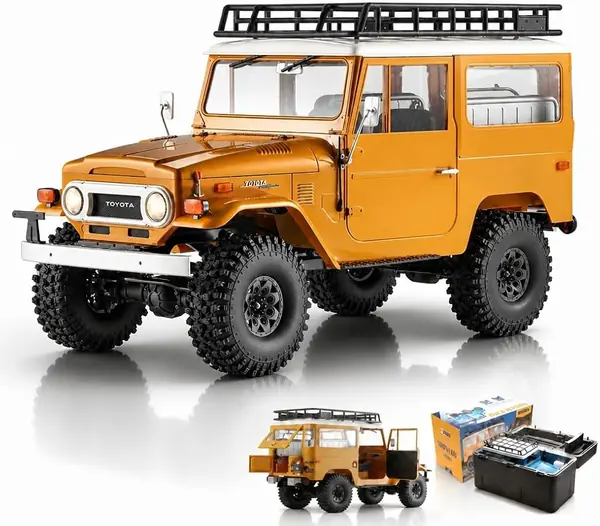
FMS Toyota FJ40 Best for Scale Trail Hikes

FMS Toyota FJ40 yellow 1/10 crawler with licensed hardbody and opening doors

Scale trail hikes

Track Score 79/100
Suspension
Leaf springs
Body
Toyota-licensed hardbody
Tires
1.9-inch all-terrain
Top Speed
15 mph
View on Amazon

Open the doors. Lift the hood. Drop the tailgate. The FJ40's hardbody does what a scale body should, and those working panels are the reason to choose this truck over a faster, tougher crawler.

We treat it as a trail truck, not a rock crawler. Leaf springs and 1.9-inch all-terrain tires are built for fire roads, gravel, and mild rock, and the truck is happiest at a walking pace behind you on a hike. Point it at the ledges the Capra climbs and the scale body stops being an asset and starts being cargo.

The rest of the package supports that role: a metal chassis, a genuine Toyota license that gets the proportions right, and a listed top speed of 15 mph that is more than a crawler needs and about right for a trail. It is a detailed model you can drive, and it rewards being driven that way.

Worth Noting

  • Not a hardcore rock crawler
Our Verdict

We recommend the FJ40 to anyone who wants a scale Land Cruiser to walk behind on trails; it drives like a detailed model, not like a comp crawler.

Check Latest Price
6.

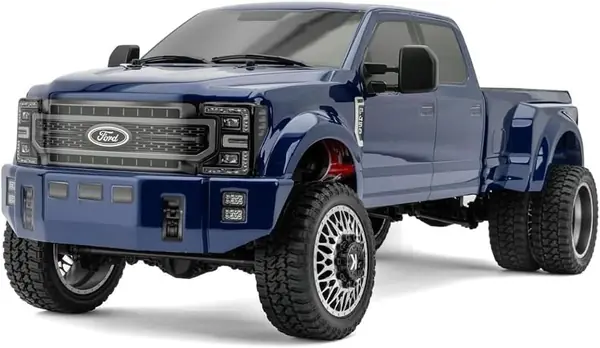
CEN Racing F-450 SD Best for Big Scale Builds

CEN Racing F-450 SD blue 1/10 crawler truck with steel frame and big tires

Big scale builds

Track Score 76/100
Chassis
Steel frame rails
Suspension
3-link with panhard bar
ESC
HobbyWing WP-1040 40A waterproof
Servo
Savox 12kg metal gear
View on Amazon

The best hardware in this truck is the electronics: a HobbyWing WP-1040 40A waterproof ESC and a Savox 12kg metal-gear servo, both of which normally show up on a separate shopping list. That is the strongest argument for the F-450.

The chassis follows the same logic — steel frame rails, a chassis-mounted servo, stamped steel shock hoops, a skid plate, and a 3-link rear with a panhard bar. It is an old-school scale build rather than a competition crawler, and the drivetrain (center shaft, sealed transmission, planetary differentials, metal gears) is put together for a long dirt road rather than a rock face.

On the trail it wants a scale pace, where the oil-filled shocks have room to work. The 40A speed control includes low-voltage cutoff for LiPo and NiMH, so you can run either chemistry without babysitting the pack. It is the truck here that looks most like something you would see working on a job site, and it drives like it: steady, wide, and unhurried.

Worth Noting

  • Sold without a battery and charger
  • Mirrors and body panels are fragile
Our Verdict

For scale-truck fans, the CEN's draw is hardware: a HobbyWing waterproof ESC, a Savox metal-gear servo, and steel frame rails under a big F-450 body.

Check Latest Price

How We Tested 1/10 RC Crawlers on Rocks and Trails

We started with research, reading owner forums and parts listings for nearly two dozen trucks, then filtered by what actually separates them: whether a battery and charger come in the box, center-motor versus dual motor-on-axle drivetrains, portal versus straight axles, and how much shelf space each one eats. That left nine trucks, run for eight months over the same three routes: a backyard rock pile of stacked flagstone, a rooty half-mile trail hike, and a shallow creek crossing. Packs were charged on bare concrete, never unattended, and retired the moment one puffed; hands stayed clear of the tires whenever a truck was powered on.

On the rocks we counted how many attempts a line took and noted whether a truck stalled, spun, or simply walked up. A chalked circle on the driveway measured turning radius, and we drove the same tight corner with and without rear steer to see what it actually bought; we also handed the transmitter to two people who had never driven a crawler and timed how long the controls took to feel natural. Every pack was timed from full charge to cutoff, and we priced a second battery and charger for each truck that didn't include them.

Durability got the unglamorous treatment: after each session we checked for bent links, stripped servo gears, popped rod ends, and clicking drivetrains, keeping a running note of what broke and what held. We forded the creek, then opened the electronics bay to look for moisture, and judged appearance the way a shopper does — how a body reads from ten feet away and whether the paint survived a roll. Fun resists measurement, so we settled it by noticing which truck we reached for on a Sunday afternoon.

How to Choose a 1/10 RC Crawler

What Comes in the Box

Ready-to-run covers a wide range. Some trucks arrive with a battery, a charger, and a radio; others arrive assembled with a radio and nothing to plug into it, which adds real cost to the purchase. Read the inclusions before you compare anything else, because a truck that still needs a pack and a charger is not the bargain it looks like beside one that does not.

Two details decide how the first month goes: the capacity of the included pack, and whether the charger is a USB trickle unit or something that fills a battery in an hour. If the truck ships with a small starter pack, buy a second one — two modest packs are more useful than one large one. Check the transmitter too, because several of these need their own AA batteries.

Drivetrain Layout: Center Motor or Motor on Axle

Most crawlers run a single motor in the middle of the chassis and send power through driveshafts to both axles, which keeps the mass low and central. The Ridgerock does it differently: one motor sits on each axle, so torque reaches the wheels with no shaft or center gearbox in between.

Neither layout is automatically better. A shaft-driven truck is easier to regear and carries its weight low; an axle-mounted pair has fewer parts between motor and wheel and creeps very smoothly. Then look at the axles themselves. Portal axles raise the differential housing for clearance over ledges, while straight axles are simpler and cheaper. If you crawl ledges, portals earn their price.

Steering, Turning Circle, and Four-Wheel Steering

A crawler spends as much time turning as climbing, and turning is where budget trucks disappoint most often: a locked rear axle and a short wheelbase add up to a wide arc, and a switchback becomes a five-point turn.

Four-wheel steering fixes that. The Ridgerock and the Capra both steer the rear axle and both let you lock it straight for normal driving, so you give nothing up on the open trail. On tight, technical lines the steering mode matters more than a slightly larger tire, which is why we put four-wheel steering near the top of the list for anyone who crawls rocks rather than fire roads.

Suspension, Center of Gravity, and Battery Placement

Height clears obstacles and hurts you the moment the truck tips, which is why so much of a good crawler's design is about getting weight low: a battery tray slung down the chassis, a body mounted close to the frame, and shocks that hold the truck up instead of letting it squat.

Adjustable shock positions and tunable suspension are worth having on a first truck, because the setup you like on a rock pile is not the setup you want on a trail. Hardbodies look better and carry their mass higher — a fair trade as long as you know you are making it.

Scale, Size, and the Surface You'll Drive

A 1/10 RC truck of this kind typically runs 18 to 25 inches long: the Ridgerock is listed at 440mm and the Capra at 24.5 inches. That fits a back seat and a shelf, so measure your storage before you assume it will disappear into a closet.

The bigger question is the surface. Scale trucks with hardbodies and leaf springs are built for trails, gravel, and mild rock; buggies and portal-axle rigs are built for ledges. Buying a beautiful scale truck for a rock garden, or a comp buggy for a hiking trail, is the most reliable way to end up disappointed in a truck that is doing exactly what it was designed to do.

Frequently Asked Questions

Final Verdict

We tell most people to buy the Ridgerock. It arrives complete and ready to drive, its four steering modes are genuinely useful on tight lines, and it asks a fraction of what the premium trucks here cost — which leaves money for a second battery and a set of spare links.

If you already own packs and want a chassis worth building on, the Ascent is the better long-term buy. And if the truck will spend its life on a trail rather than a rock pile, the Coyote's steel frame and portal axles are the ones to save for.