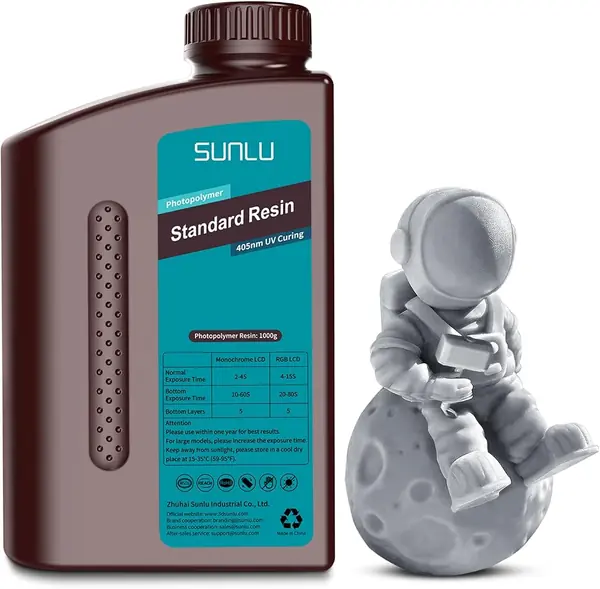
Best 3D Printer Resins of 2026

Resin is for the things filament can't do: the chipped edge of a miniature's blade, a bracket whose threads catch on the first try. The bottle in the vat decides whether that detail survives the wash, the cure and the first drop. A soft resin rounds the edges off, and a brittle one snaps the ankle of a figure that tips over.

Two things are easy to miss. The resolution on the label describes your printer as much as the bottle, and a gray that looks right in the vat can cure to a different gray, so a test coupon from each new bottle is worth the few minutes. Tabletop miniatures, functional parts and a flexible resin for pieces that need to bend are all covered, judged on cured detail, how the part feels in hand and how the room smelled during the print.

Our Top Picks

The Best 3D Printer Resins

1.

ELEGOO ABS-Like 3.0+ Resin Best Overall
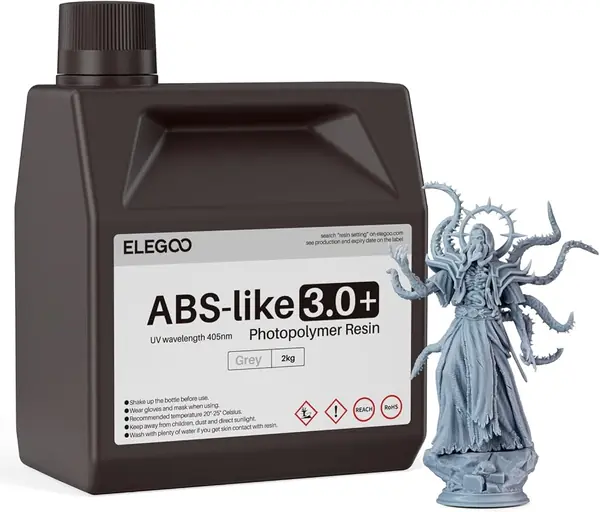
ELEGOO ABS-Like 3.0 Plus grey 3D printer resin in a 2000 g bottle

Everyday printing

Track Score 96/100
Color
Grey
Bottle Size
4.41 lb
Formulation
ABS-Like 3.0 Plus
Heat Resistance
Up to 55°C
View on Amazon

Fifty-five degrees Celsius is not the sort of number that sells a bottle of resin, but it is the one that settled this pick for us. That is the temperature ELEGOO rates cured ABS-Like 3.0 Plus parts to keep their shape and mechanical properties at, and it translates into something you notice in the hand: printed brackets and figures feel like molded styrene rather than the waxy, slightly soft pieces that come off plain standard resin.

It behaves well in the machine, too. The resin is fluid enough to level out in the vat quickly and to flow back over the release film between layers, which keeps layer times short, and the gray is opaque enough that fine features read clearly under the work light before any primer goes on. Detail holds on small parts — rivets, panel lines, the thin edge of a bracket — without the mushiness that makes you want to print everything at a larger scale.

Then there is the arithmetic of the bottle. Two kilos costs roughly what a single kilo of Siraya Tech's Fast resin does, so this works out at about half the cost per gram of our favorite miniatures resin while giving up very little in detail. For anyone printing most weeks, that difference shows up as fewer reorders and fewer half-empty bottles going stale on the shelf.

We recommend it so widely because it covers the widest range of jobs: miniatures, brackets, props that get handled, anything that might sit in a warm room. The exception is the detail obsessive with a 12K or 14K machine and a shelf of untouchable display pieces — a standard 8K resin matches that output for less. Everything that gets picked up, mounted, or dropped is this bottle's job.

Worth Noting

  • Thin unsupported sections can still snap
Our Verdict

We recommend the ABS-Like 3.0 Plus as the default bottle for most printers: parts hold up to handling, detail stays crisp, and two kilos keep you printing.

Check Latest Price
2.

Siraya Tech Fast ABS-Like Best for Miniatures

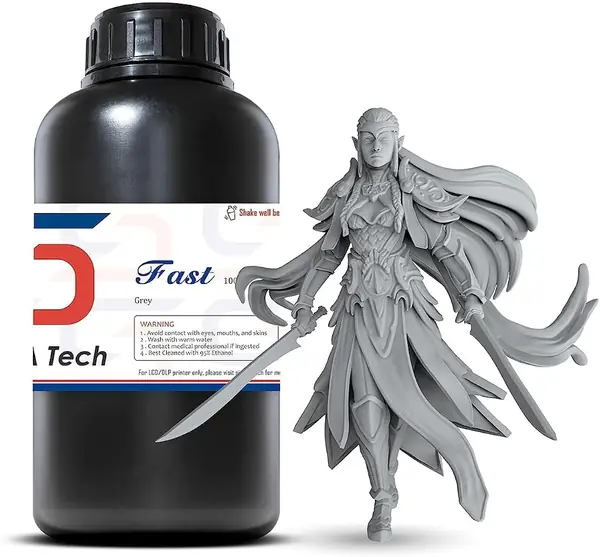
Siraya Tech Fast ABS-Like grey 3D printer resin in a one-kilogram bottle

Tabletop miniatures

Track Score 95/100
Color
Grey
Bottle Size
2.2 lb
Curing Wavelength
405 nm
Printer Resolution
8K capable
View on Amazon

When a print has to survive being handled, this is the bottle we reach for. Siraya Tech's Fast ABS-Like cures stiff but not glassy, so a thin blade or a locating peg flexes a little before it gives, and small parts come out with their edges intact. It is a 405 nm resin rated for 8K-class detail, and it runs the same in LCD and DLP machines.

That combination makes it our pick for miniatures and other small parts that get picked up, painted, and dropped. The toughness is the whole point: printed figures hold a tabletop pose without chipping, and the surface takes primer and paint without beading. The matte gray also shows every flaw, which we count as a feature — if your exposure is off, you see it on the first print instead of the tenth.

What you pay for that is money and volume. It is the priciest of the everyday resins here per gram, roughly double the cost per gram of our top pick, and it comes only in one-kilogram bottles, so a full table's worth of terrain eats one quickly. Both are fair trades for miniatures and small mechanisms; neither makes much sense if you are printing scenery in bulk.

Worth Noting

  • Supports take real force to remove
Our Verdict

For miniatures and other small parts that get handled, Siraya Tech Fast is the bottle we trust; the toughness is worth the higher cost per gram.

Check Latest Price
3.

ELEGOO Upgraded 8K Standard Resin Best for Fine Detail

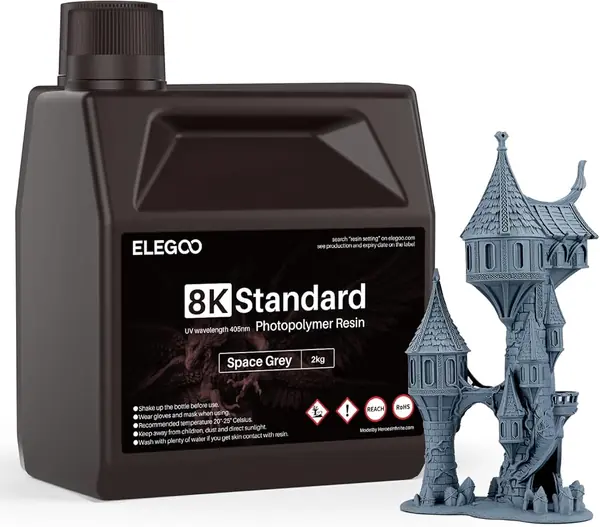
ELEGOO Upgraded 8K Standard 3D printer resin, space grey, 2000 g bottle

Fine detail

Track Score 94/100
Color
Space Grey
Bottle Size
4.41 lb
Curing Wavelength
405 nm
Printer Resolution
8K/12K/14K/16K
View on Amazon

Standard resin still has one job nothing else does quite as well: pulling fine detail off a high-resolution screen. ELEGOO's Upgraded 8K Standard is rated for 8K through 16K machines, it is a 405 nm formula that behaves the same in DLP and LCD printers, and the two-kilo bottle keeps the cost per gram close to the budget resins.

What you trade for that detail is toughness. Cured, this is hard and glassy; thin ankles, weapon hafts, and mounting pegs snap rather than bend. The fix we use is a blend — roughly one part of a tough or flexible resin to four parts of this one — which keeps almost all of the sharpness and gives the part enough give to survive a fall off the table. Mixing is a step worth planning for rather than discovering mid-project.

We keep it for display pieces, terrain, and masters that will be molded rather than handled, and we point anyone whose printer out-resolves their current resin toward it. If what you print gets played with, the ABS-Like 3.0 Plus above is the better place to put your money, because no amount of mixing discipline makes a glassy resin into a tough one.

Worth Noting

  • Gray yellows and dulls with age
Our Verdict

Choose the 8K Standard when detail comes first and the print will live on a shelf; pair it with a tough resin if it has to survive handling.

Check Latest Price
4.

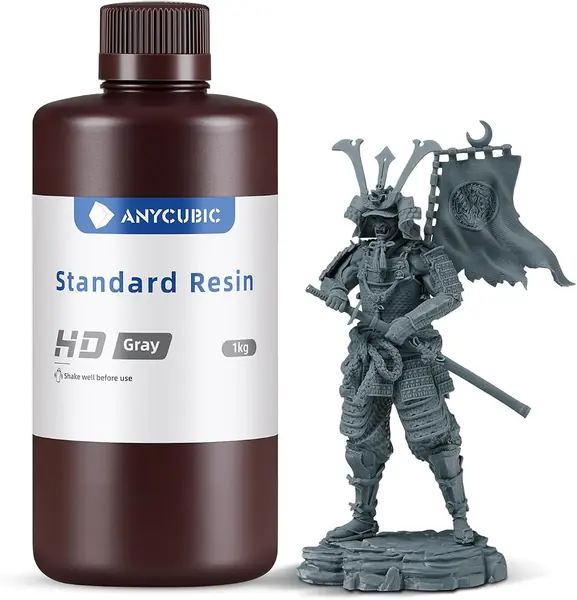
ANYCUBIC Upgraded 8K Standard Resin Best Budget

ANYCUBIC Upgraded 8K HD grey 3D printer resin in a one-kilogram bottle

First bottle

Track Score 93/100
Color
HD Gray
Bottle Size
2.2 lb
Curing Wavelength
405 nm
Printer Resolution
4K/6K/8K/12K
View on Amazon

Cheapest per gram of anything we recommend, and still sharp. ANYCUBIC's Upgraded 8K Standard is the bottle we suggest to someone buying a first liter and not wanting to spend much finding out whether they enjoy resin printing. It is a 405 nm formula rated for 4K through 12K machines, and the HD gray holds fine features — fur, armor trim, the ribs on a small chassis — well enough that you will not feel held back while you learn.

The pigment is dense and settles between sessions, so stir it in the bottle rather than shaking it hard, and give the vat a minute for bubbles to rise before you start. Cleanup is ordinary IPA work. The one-kilo bottle is the right first purchase precisely because it is small: you finish it around the time you have learned what your printer likes, and then you can decide whether to move up to a tougher resin.

Worth Noting

  • Fumes get heavy in a small room
  • Cures brittle so thin parts snap
Our Verdict

Our budget pick: the lowest cost per gram here still delivers 8K-level detail, which makes it the easy first bottle for a new printer.

Check Latest Price
5.

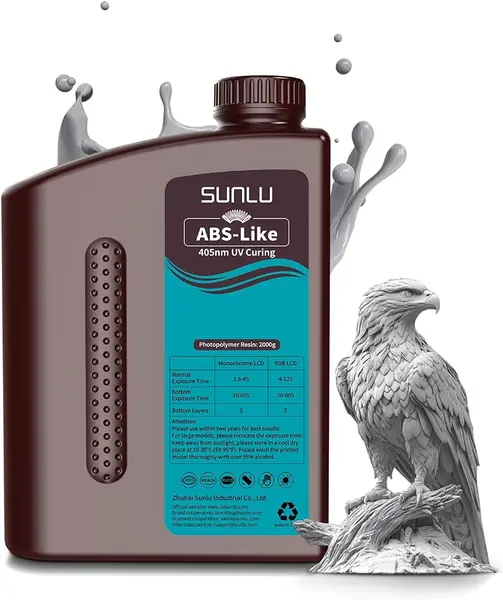
SUNLU ABS-Like Resin 2000g Best Big-Bottle Value

SUNLU ABS-Like grey 3D printer resin in a 2000 g bottle

High-volume printing

Track Score 92/100
Color
Grey
Bottle Size
4.41 lb
Curing Wavelength
405 nm
Printer Resolution
2K/4K/6K/8K
View on Amazon

Two kilos is the argument here. SUNLU's ABS-Like comes in a bottle that carries a full project — a set of bodies, a batch of chassis parts, a weekend of terrain — without a reorder, and the formulation is the tough kind: rated for 2K through 8K LCD, DLP, and SLA machines at 405 nm, with low shrinkage so the parts you designed come out the size you drew.

We found it the most forgiving ABS-like of the value-priced bunch. It shrugs off knocks that crack standard resin, it cures with a slight give rather than a snap, and it prints consistently from bottle to bottle, which matters more than any single spectacular result when you are working through two kilos. Detail is good rather than exceptional — this is a working resin, not a display one — and that is exactly the trade you want at this price. If you print most weeks and hate running out mid-project, this belongs on the shelf.

Our Verdict

A two-kilo bottle of tough, low-shrinkage ABS-like resin at a mid-range price — the sensible buy for anyone printing parts in volume.

Check Latest Price
6.

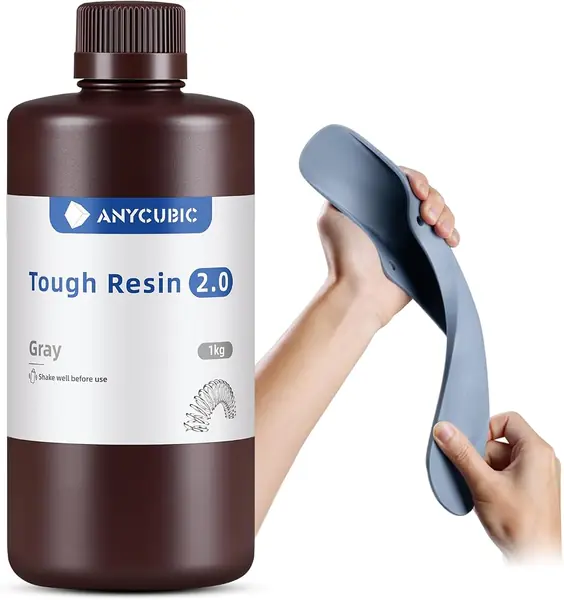
ANYCUBIC Tough Resin 2.0 Best for Functional Parts

ANYCUBIC Tough Resin 2.0 grey 3D printer resin, one-kilogram bottle

Functional parts

Track Score 91/100
Color
Grey
Bottle Size
2.2 lb
Curing Wavelength
365–405 nm
Printer Resolution
4K/8K
View on Amazon

Joints, brackets, snap fits, a peg that has to hold a body shell in place — this is the resin for parts that do a job rather than sit on a shelf. ANYCUBIC's Tough 2.0 is built for impact and flexural strength, and its stated curing range covers 365 to 405 nm, the widest of anything here, so it will run in practically any LCD, DLP, or SLA machine.

In the vat it is well behaved: low viscosity, quick to level, and it holds fine detail better than a tough resin has any right to. The trade shows up at the surface — parts come out with a slightly tougher, less glassy skin than standard resin, which is exactly what you want on a working part and a little less crisp on a display piece.

Where it earns its keep is after curing. Parts take a drill and a tap without cracking, they hold threads, and they flex under a hard knock instead of shattering the way standard resin does. We also keep it around as a toughening partner: a fifth of a bottle stirred into a brittle standard resin changes how the finished part behaves.

Set against the ABS-Like 3.0 Plus above, this is the more rigid kind of tough — it resists impact rather than bending like rubber. If you need a part that moves and returns to shape, a flexible resin is the right tool; Tenacious below is the one we use for that. That is the line we draw: rigid-tough for parts that take a hit, flexible for parts that have to move.

Worth Noting

  • Costs more per gram than standard resin
Our Verdict

Buy the Tough 2.0 for joints, brackets, and anything you will drill or screw; it takes abuse that standard resin will not.

Check Latest Price
7.

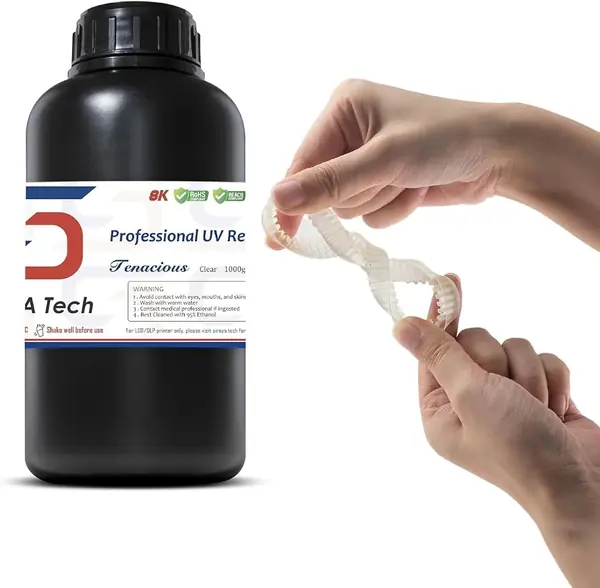
Siraya Tech Tenacious Best for Flexible Parts

Siraya Tech Tenacious clear yellow flexible 3D printer resin, one kilogram

Flexible parts

Track Score 90/100
Color
Clear Yellow
Bottle Size
2.2 lb
Curing Wavelength
405 nm
Flexibility
Bends 180° without breaking
View on Amazon

Most of the Tenacious we have used never went into a vat on its own. A fifth of a bottle stirred into a brittle standard resin turns prints that snap into prints that bounce, which is why one bottle goes a long way. It is a 405 nm photopolymer that mixes cleanly with other 405 nm formulas, and it is the additive we keep on the shelf for exactly that reason.

Printed alone, it does something no other bottle here can: thin sections bend right over — Siraya Tech claims 180° — and come back without tearing. That makes it the pick for flexible grips, living hinges, thin stems, and anything that has to survive a drop onto concrete. It wants a warm room; the maker recommends printing at 25°C or above, and below that it gets thick and slow.

We treat it as a repair kit rather than a daily resin. Buy a bottle if standard resin keeps failing you on thin parts, or if you need something that flexes on purpose. Kept capped and out of the light, it will still be doing its job several kilos of cheaper resin later, which is the way to think about the outlay.

Worth Noting

  • Highest cost per gram in this group
  • Softer surface detail when printed alone
Our Verdict

Keep a bottle of Tenacious to toughen brittle resin or print parts that must flex; it is a specialist, not an everyday resin.

Check Latest Price
8.

SUNLU Fast Curing Standard Resin Best for Cheap Practice Prints

SUNLU fast-curing standard grey 3D printer resin, 1000 g bottle

Cheap practice prints

Track Score 89/100
Color
Grey
Bottle Size
2.2 lb
Curing Wavelength
395–405 nm
Compatible Printers
LCD, DLP, SLA
View on Amazon

The least expensive bottle we recommend, and a perfectly reasonable place to start. SUNLU's fast-curing standard resin is rated 395–405 nm for LCD, DLP, and SLA printers, it pours thin and levels fast, and its low shrinkage keeps small parts dimensionally honest — the two things that matter most when you are printing terrain, props, or a first batch of test pieces.

The smell is what we noticed first: sharper than the low-odor ABS-like formulas here, so in a small room you will want the window open and a fan moving air. Otherwise it behaves. Layer lines sand out, the gray takes paint well, and a kilo stretches further than you expect because the resin is fluid enough to leave very little behind in the vat.

Worth Noting

  • Hard brittle parts snap when dropped
Our Verdict

A sensible first bottle: it pours thin, cures fast, and costs little enough that you can burn through a kilo learning your exposure settings.

Check Latest Price

How We Tested the Best 3D Printer Resins

We built the shortlist from spec sheets first: curing wavelength, the printers each bottle claims to work with, bottle weight, and cost per gram. That filtered a long list down to 14 bottles, which we bought ourselves and ran through four printers — three LCD machines and one DLP — over five months. Every pour, wash, and support removal happened in a ventilated workshop, gloved and with safety glasses on.

Each bottle printed the same three tests: a miniature with a thin sword and small facial features, a bracket with screw bosses, and a coupon with thin rails and a snap fit. We looked under a magnifier to see whether the smallest rivets survived the wash and the cure, checked whether first layers held to the plate without a raft, and timed how long supports took to pull and whether the tips tore out divots.

Strength got tested by handling: cured miniatures dropped from counter height onto a concrete floor, coupons flexed until something gave, screws driven into the printed bosses. Odor was judged the way you'd judge it at home — lid off, window open, walking back into the room twenty minutes later. For color, we printed coupons from the top and bottom of the same bottle, cured both, then primed and painted half of each to see how the finish took paint.

We also tracked cure time and surface tackiness at the maker's stated exposure, how much resin a failed print wasted, and what washing left behind in the IPA. Waste resin got cured solid and disposed of according to local rules; nothing went down a drain. The eight that made the list were the bottles that behaved the same on the final ounce as the first.

How to Choose a 3D Printer Resin

Match the resin type to the job

Standard resin cures hard and glassy, which is why it holds detail so well and why thin parts snap. ABS-like formulas give the cured part a little flex before it fails, and tough resins push further in the same direction — they take impact and hold a thread. Flexible resins bend on purpose.

Buy standard for display pieces, masters, and terrain, ABS-like for anything that gets handled, and tough for joints and brackets. If you print both, one bottle of each beats a single compromise bottle, and a rough rule is that the tougher the resin, the softer the fine surface detail.

Resolution labels describe the printer as much as the bottle

An 8K, 12K, or 14K label is a claim about how fine a resin can hold detail on a screen of that resolution. Put 14K resin in a 4K printer and you get 4K output, because the pixel size of your screen sets the ceiling. What the better bottles genuinely buy you is lower shrinkage and denser pigment, so fine features do not blur or pull away from the model.

Match the resin to your machine rather than to the biggest number on the label, and spend any difference on toughness or on a bottle size that suits how much you print.

Smell is a formulation and a room problem

Every resin here off-gasses something, and low odor means less rather than none. How much you notice depends on the bottle and on the room: a spare bedroom with the door shut will smell like a resin printer no matter what the label promises.

Print near a window or under extraction, keep the lid on the vat between jobs, and store bottles sealed. If fumes are your main complaint, choose an ABS-like or tough formula and move the printer somewhere you do not sleep.

Buy the bottle size your printing justifies

Cost per gram drops fast as bottles get bigger, and a two-kilo bottle is usually the best balance for a hobbyist who prints most weeks. A single kilo makes sense while you are still experimenting with exposure settings or want to try a formulation before committing to a larger bottle.

Anything bigger only pays off if you will finish it within a few months of opening. Resin that sits half-used for a year is money in a puddle, so buy the smaller bottle and reorder.

Check the wavelength and calibrate exposure

Every photopolymer resin here cures in the 365–405 nm band that LCD, DLP, and SLA printers emit, so compatibility is rarely the problem — settings are. Treat the maker's recommended exposure as a starting point and run an exposure test for each new bottle, because a gray standard resin and a clear flexible one need very different numbers.

Keep the printer in a warm room. Cool resin thickens, layer times stretch, and adhesion gets unreliable, which is usually blamed on the bottle rather than the temperature.

Frequently Asked Questions

Final Verdict

For most printers, the bottle to buy is ELEGOO's ABS-Like 3.0 Plus. It prints detail well enough for miniatures and props, it survives the handling that breaks standard resin, and the two-kilo bottle keeps the cost per gram in budget territory instead of premium.

Buy Siraya Tech Fast instead if your prints get handled constantly and paying more per gram for extra give at the joints is worth it. Go with ANYCUBIC's 8K Standard if the budget is the deciding factor and the prints are headed for a shelf, and keep a bottle of Tenacious around for the parts that have to bend.