Best 1S LiPo Batteries of 2026

A 1S pack is the cheapest part of a tiny whoop and the part most likely to end a session early. Charge four, fly the first one clean, and by the second punch-out the voltage can be sagging into the 3.2s with time still on the clock, even on a pack with only a dozen cycles. The right cell won't make you a better pilot, but it holds throttle through the back half of a flight instead of browning out mid-corner.

The plug matters more than the label. BT2.0 and PH2.0 aren't interchangeable, and a bigger cell won't rescue a session choked by a weak connector. Treat the C-rating as headroom rather than horsepower; across 18 packs flown indoors, around backyard gates and on a hungry 75mm build, voltage under a hard pull was the number we watched. The six here cover both plug families and both standard and LiHV chemistry.

Our Top Picks

The Best 1S LiPo Batteries

1.

BETAFPV Lava II 1S 320mAh LiHV Battery Best Overall
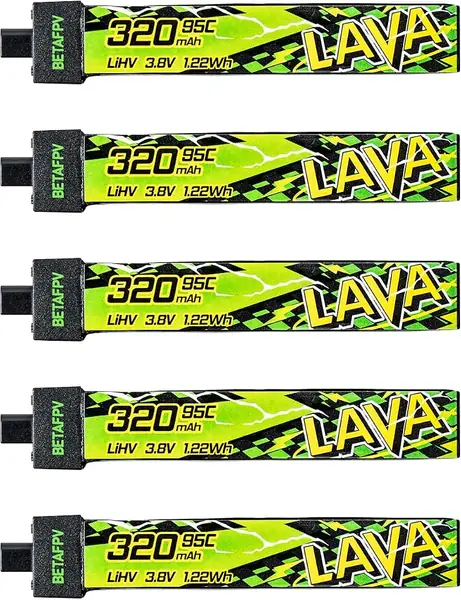
BETAFPV Lava II 1S 320mAh LiHV battery five-pack with BT2.0 connectors and green and yellow wrap

65mm FPV whoops

Track Score 93/100
Capacity
320mAh
Connector
BT2.0
Discharge Rate
95C
Max Charge Voltage
4.35V (LiHV)
View on Amazon

A 95C label and a 4.35V ceiling promise something about the end of a flight rather than the start of one. BETAFPV's Lava II is a 320mAh cell weighing 8.2 grams and measuring 64 by 10 by 6mm — the size class a 65mm frame like the Air65, Meteor65 Pro or the Cetus kit expects — and it comes on a BT2.0 plug, five to a box. The chemistry is what separates it from a standard pack: a LiHV cell tops out at 4.35V instead of 4.2V, so each run begins with more voltage in hand and takes longer to sag to the point where the quad goes soft.

That is why this is the pack we recommend first. On our 65mm builds it was the one still pulling through the back half of a pack, and the difference shows up in the throttle: the low-voltage warning arrives later and the final thirty seconds still have something left. BETAFPV's Z-folding construction is impossible to verify from the outside; the voltage ceiling and the 95C rating are not, and together they are why this one flies better than the cheaper 300mAh BT2.0 sets here.

Two practical notes before you order. The packs arrive at storage voltage around 3.85V, so plan on a charging session rather than a flight straight out of the box. And a BT2.0 connection is stiff — pull it apart by the connector body, not the wire, or you will be resoldering a lead onto a whoop board long before these cells wear out.

Worth Noting

  • Requires a charger with a 4.35V HV setting
Our Verdict

Our default 1S pack: the 95C cell and 4.35V ceiling keep a 65mm whoop pulling to the end of the run, and five to a box covers a session.

Check Latest Price
2.

BETAFPV BT2.0 300mAh 1S Battery 8-Pack Best Bulk Pack

BETAFPV BT2.0 300mAh 3.8V 1S LiPo batteries, eight-pack for Tiny Whoop drones

Full flying sessions

Track Score 87/100
Capacity
300mAh
Connector
BT2.0
Discharge Rate
30C/60C
Pack Count
8
View on Amazon

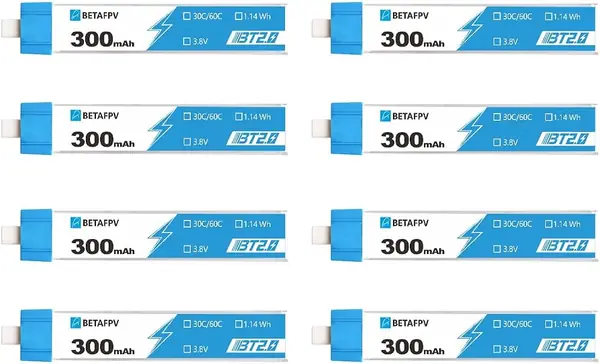
Eight packs in one box changes a flying session more than any single line on the label. These are 300mAh, 3.8V, 7.59 grams each, on BT2.0 plugs rated for 9A continuous — light enough that they barely alter how a 65mm whoop handles, and numerous enough that you can fly a set down and swap instead of standing around watching a charger. We think that is the right way to buy for most people starting out: one small pack is a short flight, and the box is what turns it into an afternoon.

The 30C continuous, 60C burst rating is the number to understand going in. It is fine on a stock or mildly tuned 65mm, but put these behind hotter motors and you will feel the voltage drop earlier in the run and the punch fade sooner. Buy them for the count and the low weight; the top-end response is the part you trade away, and on a stock whoop you will not miss it.

Worth Noting

  • 30C continuous rating sags sooner than 95C packs
Our Verdict

A full session in one box is what this eight-pack buys, and we recommend it for stock 65mm builds where 30C is enough.

Check Latest Price
3.

Crazepony 450mAh 1S BT2.0 Battery 6-Pack Best for Brushless Whoops

Crazepony 450mAh 3.8V 1S LiPo battery six-pack with BT2.0 connectors

1S brushless whoops

Track Score 84/100
Capacity
450mAh
Connector
BT2.0
Discharge Rate
150C
Pack Count
6
View on Amazon

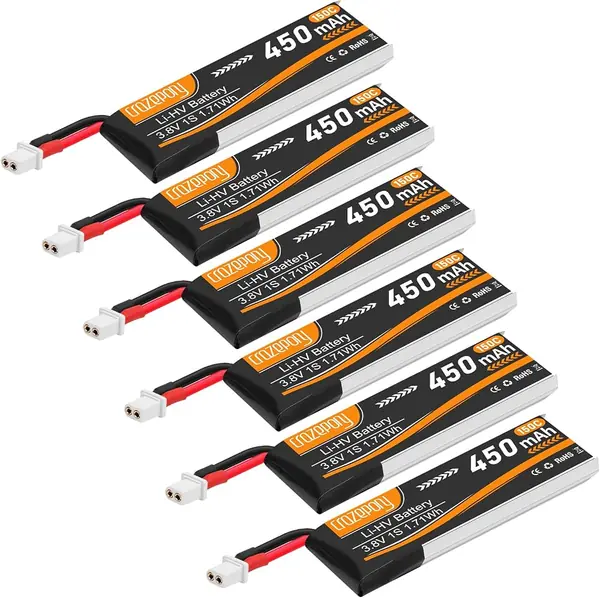
Crazepony answers the same question as our top pick with 130 more milliamp-hours and a much larger C number: 450mAh, 3.8V, 150C, 12.5 grams, 60 by 18 by 7mm, six to a box with BT2.0 plugs on the charge and discharge side.

The weight is the first thing we noticed. Going from an 8.2-gram Lava II to 12.5 grams on a 65mm frame is a visible change in the corners — the quad carries more momentum, stops a little slower, and a small whoop has less motor to spare for the difference. What you get back is duration, plus a cell that holds its pull to the end of the pack rather than going soft at the two-minute mark.

Where it earns its place in our bag is a 1S brushless whoop already set up around 450mAh packs, where capacity and discharge headroom combine and the weight penalty is built into the tune. On a light 65mm the Lava II is the better match. If your build is the heavy one, this is the six-pack we reach for first.

Worth Noting

  • 12.5 g is heavy for a 65mm whoop
  • Higher cost per pack than most here
Our Verdict

Fit these to a 1S brushless whoop already on 450mAh packs, where the capacity and 150C headroom outweigh the extra weight.

Check Latest Price
4.

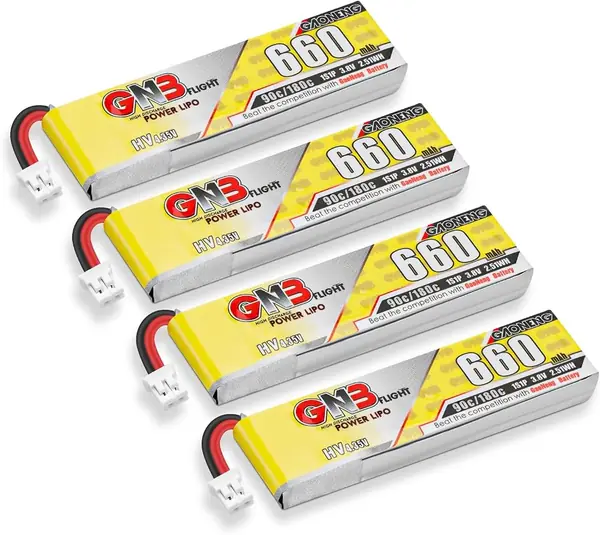
Crazepony 660mAh 1S PH2.0 Battery 4-Pack Best for 75Mm Whoops

Crazepony 660mAh 3.8V 1S LiHV battery four-pack with JST-PH 2.0 plugs

75mm whoop builds

Track Score 83/100
Capacity
660mAh
Connector
JST-PH 2.0
Discharge Rate
90C, 180C burst
Weight
15.15 g each
View on Amazon

Six hundred and sixty milliamp-hours is a different ambition from the rest of this group: this is a flight-time cell rather than a punch cell. It measures 60 by 17mm, weighs about 15 grams, and uses the JST-PH 2.0 PowerWhoop plug, with Mobula7 75mm, the Tinyhawk series, EZ Pilot and Snapper7 listed among the fitments. Four to a box, 90C continuous with a 180C burst rating.

These are the packs we load on a 75mm frame when duration is the goal. The bigger props and motors of that class can actually use the capacity, and 15 grams is not the penalty at 75mm that it is at 65mm. Hanging one on a small whoop turns a light quad into a heavy one — it will still fly, but the corners get sloppy and the motors work harder for every gram. Buy these for a 75mm build and keep them out of the 65mm case.

Worth Noting

  • About 15 g taxes a 65mm whoop
Our Verdict

Longer flights are what we come to the 660mAh for; it is the 75mm specialist here and the wrong cell for a 65mm frame.

Check Latest Price
5.

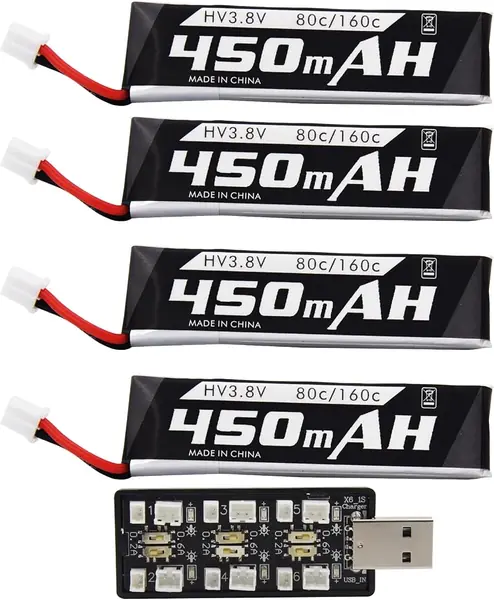
Blomiky 450mAh 1S Battery 4-Pack with Charger Best Kit With Charger

Blomiky 450mAh 3.8V 1S LiPo four-pack with a six-port USB charger board

First PH2.0 setups

Track Score 82/100
Capacity
450mAh
Connector
JST-PH 2.0
Discharge Rate
80C, 160C burst
In The Box
4 batteries and a 6-in-1 charger
View on Amazon

The charger is what earns this kit a place. Blomiky ships four 450mAh 3.8V packs with a six-port USB board that takes both PH2.0 and 1.25 plugs, which matters because a first whoop often arrives with one lead and no spare ports. The batteries are 12 grams each, 80C continuous with a 160C burst, and the fitments listed are the older EZ Pilot, Tinyhawk and Freestyle-era quads. For someone assembling a PH2.0 setup from nothing, we think the bundle is the least fussy way in.

As cells, these sit mid-pack against the Crazepony 660mAh and the Lava II — 450mAh at 80C is respectable rather than remarkable, and four packs is a modest session for a whoop that flies a few minutes at a time. Check the plug before you order: these are PH2.0, so they will not go near a BT2.0 board without a rewire. What you are buying is a complete, matching set with no separate charger purchase, and on a first build that is worth something.

Worth Noting

  • 0.2A charge setting is slow for 450mAh packs
Our Verdict

The easiest start for a PH2.0 whoop is this bundle — four 80C packs and a matching six-port charger, with nothing else to buy.

Check Latest Price
6.

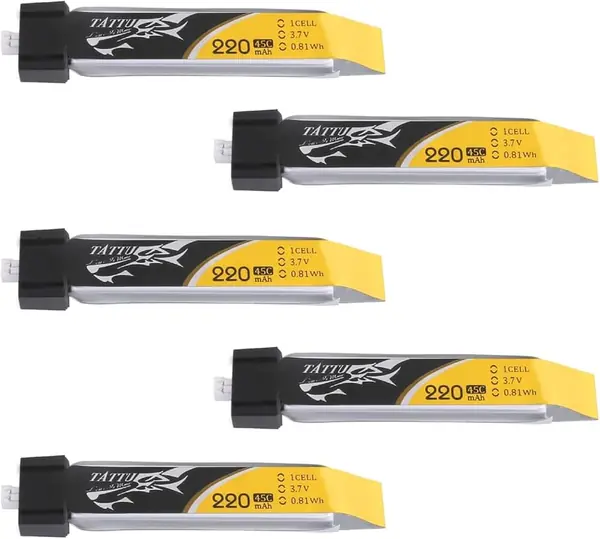
Tattu 220mAh 1S LiPo Battery 5-Pack Best for Blade Inductrix Quads

Tattu 220mAh 3.7V 1S LiPo battery five-pack with Eflite ultra-micro connectors

Blade Inductrix quads

Track Score 81/100
Capacity
220mAh
Connector
Eflite ultra-micro
Discharge Rate
45C, 90C burst
Weight
5.5 g each
View on Amazon

Blade's Inductrix, Nano QX and the UMX park flyers use an Eflite ultra-micro plug that almost nothing else does, and this Tattu pack is built for exactly that socket. It is 220mAh at 3.7V, 5.5 grams, 51 by 12 by 6mm, rated 45C continuous with a 90C burst, and sold five to a box.

Light is the point at this size: a 220mAh cell keeps a brushed Inductrix near its flying weight, and five of them cover a session of short hops around the living room or a calm evening in the driveway. It will not help you if your quad runs a BT2.0 or PH2.0 board, because the plug simply will not mate — this is a replacement pack for one specific family of ultra-micro aircraft, not a general-purpose whoop cell.

We keep this set for the Inductrix and the UMX drawer. Next to the 95C and 150C packs here the 45C label looks modest, but a brushed Nano QX draws a fraction of what a 1S brushless whoop pulls, so the cell is matched to the airframe instead of outgunned by it, and the cost per pack is the lowest here.

Worth Noting

  • Eflite ultra-micro plug fits few modern whoops
Our Verdict

For Blade Inductrix and UMX aircraft we keep this set: the Eflite connector and 5.5-gram pack fit where nothing else here will.

Check Latest Price

How We Tested 1S LiPo Batteries

We built the shortlist from spec sheets rather than marketing copy: every candidate had to state its connector, chemistry, capacity, and discharge rating, and it had to fit a frame we actually fly, from 65mm whoops up to 75mm builds. Packs that hid their plug type, or that would have forced us to buy new charge leads, got cut early. That left 18 packs, flown for four months.

Each one was charged on a lithium-polymer charger set to its chemistry — 4.2 volts per cell for standard LiPo, 4.35 for LiHV — on a concrete floor with someone in the room the whole time. We weighed every pack on a kitchen scale and checked whether it sat flat in a 65mm battery bay or turned into a strap fight on the 75mm. Flying happened in a garage, around gates in a backyard, and in open air where we could hold full throttle long enough to see what a pack does under load. We landed the moment voltage under load touched 3.2 volts, well clear of the 3V floor.

After each session we logged resting voltage, recharged, and noted how far out of balance the cells came back. We also clocked the voltage drop during a full-throttle punch, first on a fresh pack and again at the halfway point; the gap between the two told us more than any C-rating printed on the wrapper. Across four months we counted cycles, watched for swelling, and retired anything that went soft.

Compatibility we checked by hand: whether a plug seated firmly, whether it needed an adapter, and whether our existing charge leads and parallel boards would take it. Value came down to cost per usable pack, not the sticker on the multi-pack.

How to Choose 1S LiPo Batteries

Start With the Plug, Not the Cell

Three plug families cover almost every 1S aircraft you will meet. BT2.0, the 1.0mm banana, is what current 1S brushless whoops use and is rated for 9A continuous; JST-PH 2.0, the PowerWhoop plug, is the older whoop standard and still appears on plenty of 65mm and 75mm frames; the Eflite ultra-micro plug belongs to Blade's Inductrix, Nano QX and UMX line. The trap is the fourth family: Molex and JST plugs on listings that also say 1S LiPo. Those are replacement packs for SYMA and Holy Stone toy quadcopters — 25C cells that will never mate with a whoop board, however good the capacity looks. Read the plug on your flight controller before you read anything else.

Read the C-Rating as Headroom, Not Horsepower

A 95C or 150C figure is a multiplier on capacity, and the number it produces is always far above what a 1S whoop actually draws. What the rating really predicts is voltage sag: a higher-C cell holds its voltage deeper into the pack, which is the difference between a whoop that goes soft at two minutes and one that still answers the throttle at three. We pay for that headroom on brushless, heavier builds and skip it on a stock 65mm, where an efficient airframe will never use what it paid for.

Match Capacity to the Frame

Capacity and weight travel together, and weight is what a small quad feels. A 65mm whoop is happiest on 220 to 320mAh packs in the 5 to 8 gram range; a 75mm build can carry 450 to 660mAh at 12 to 16 grams and will actually use the run time. Going bigger than the frame wants costs you response in the corners and makes the motors work harder to hold altitude. Pick the capacity your frame was designed around rather than the largest number that fits the battery bay.

LiHV at 4.35V or Standard at 4.2V

A 3.8V LiHV pack charges to 4.35V per cell; a 3.7V LiPo stops at 4.2V. That 0.15V is real time at the top of a flight, and it is the main reason the Lava II and the Crazepony 3.8V packs feel stronger than a standard cell of the same capacity. The catch is the charger: you need an HV setting to reach 4.35V. Never push a standard LiPo past 4.2V, and if your charger has no HV mode, an HV pack simply runs like an ordinary one.

How Many Packs Belong in Your Bag

Count packs by how long you want to stay out, not by the sticker on the box. A 65mm whoop flies a few minutes on a small pack, so five to eight cells is a real session; a 75mm on 660mAh packs needs fewer to fill the same time. Multi-port USB boards and parallel boards change that math by letting you recharge everything at once, and independent ports are worth having over a daisy-chained board — a single bad port then costs you one pack instead of the whole set.

Frequently Asked Questions

Final Verdict

There is a clear default here, and it is the BETAFPV Lava II: 95C, a 4.35V ceiling and 8.2 grams is the combination that lets a 65mm whoop keep its punch to the end of a pack, and five to a box is enough to fly without waiting on a charger. Start there unless your airframe says otherwise.

If it does, the choice is quick. A 75mm build wants the Crazepony 660mAh packs for duration, a 1S brushless whoop already on 450mAh cells wants the Crazepony BT2.0 six-pack for headroom, and anyone assembling a first PH2.0 setup without a matching charger should take the Blomiky bundle and skip a separate purchase.