Best Display Cabinets of 2026

When the good pieces have outgrown the bookshelf, a box in the closet defeats the point of owning them. A display cabinet keeps a collection visible and clean at the same time, and whether it does that well comes down to small print: the clear space between shelves, the real depth of each shelf, and whether the doors seal or merely shut.

Measure the shelf gaps before you buy, and treat motion sensors and color modes as extras, not reasons. Over nine months we loaded ten cabinets with diecast cars, figures, china and bottles in a living room, a dining room, a narrow hallway and a basement, checking which interiors gathered dust and whether the LED strips still matched. The six here have shelves that re-space instead of just lifting out, doors that seal and a footprint that doesn't swallow the room.

Our Top Picks

The Best Display Cabinets

1.

BROTTAR 4-Tier Display Cabinet Best Overall

BROTTAR four-tier black display cabinet with glass doors on a wood frame

Living room collections

Track Score 90/100
Dimensions
14"D x 31.5"W x 65"H
Lighting
36W LED, 3 colors, motion sensor
Tiers
4
Door Style
Pop-up glass, handle-free
View on Amazon

Four shelves is fewer than most of the cabinets in this guide, and that is exactly why we chose this one as our default. Four tiers inside a 65-inch frame means each compartment has room for something standing up — a 1:18 car on a stand, a boxed figure, a row of cased slot cars you would rather not lay on their side. The footprint, 14 inches deep by 31.5 wide, disappears against a normal wall.

Press the glass and it pops open: no handles, no protruding hardware, one clean pane across the front. We are also fond of the lighting, a 36-watt LED strip with three color settings and a body sensor that switches on as you walk up and off when you leave, which matters in a room where the case stays on all evening. The back is wood rather than glass, so the light pushes forward onto the collection instead of glowing out the rear.

Before you order, measure your tallest piece against the four-tier spacing, and plan on a second person for the lift and the door hanging — this arrives as a heavy flat pack. What you get for the trouble is the most liveable case here: big enough for a real collection, plain enough to sit in a living room, and lit well enough to be worth leaving on.

Worth Noting

  • Press-to-open glass picks up fingerprints
  • No lock on the doors
Our Verdict

We made the BROTTAR four-tier our default because four tall compartments and press-to-open glass doors fit an ordinary wall better than anything else here.

Check Latest Price


2.

BROTTAR 71" Corner Display Cabinet Best for Corners

BROTTAR 71-inch black corner display cabinet with six triangular glass shelves

Empty room corners

Track Score 89/100
Dimensions
22.4"D x 33.5"W x 70.8"H
Lighting
3 colors with body sensor
Tiers
6 triangular glass shelves
Weight Capacity
100 lb
View on Amazon

An empty corner is the cheapest storage in most rooms, and this BROTTAR is built to claim it. Triangular glass shelves step back into the angle, the side panels are acrylic doors rather than glass walls, and the whole thing stands 70.8 inches tall on a footprint 22.4 inches deep and 33.5 wide.

Six tiers is the most useful layout here for a mixed collection: enough height low down for a 1:18 car, tight enough at the top for rows of 1:64 models. The glass shelves lift out and re-space, which counts for a lot the week a new model arrives an inch too tall for where the last one sat. A 100-pound capacity across the case gives you room to fill it.

What sold us is how little it asks of the room. It reads as deliberate in a corner instead of pushed aside, and the warm, white, and blue LED settings with a body sensor give it presence after dark. The anti-tip kit and the explosion-proof glass door are the details we like seeing on a 71-inch case full of breakables.

Do plan the build. The glass doors are the fiddly part and the printed steps are the weakest link in the package, so budget an evening and a second pair of hands rather than a solo weeknight. Set it in its corner and anchor it before anything goes on the shelves.

Worth Noting

  • Lights and sensor can fail over time
  • Needs a real corner to look right
Our Verdict

For an empty corner, we pick this one: six tiers and a 100-pound capacity in a footprint no wider than a wall cabinet.

Check Latest Price
3.

Lvifur 10-Tier Glass Display Cabinet Best for Big Collections

Lvifur white 10-compartment display cabinet with glass doors and RGB lighting

Diecast and figures

Track Score 87/100
Dimensions
13.8"D x 30.7"W x 70.86"H
Lighting
RGB, 7 static and 5 dynamic modes
Door
Lockable pop-up tempered glass
Compartments
10
View on Amazon

Ten compartments inside a 71-inch frame means a lot of shelving packed close together, which is exactly right for the way small collections grow. We think of this as the case for rows of 1:64 diecast, boxed figures, and individually packaged slot cars rather than for three big showpieces. A keyed lock on the glass door is a genuinely useful addition in a house with children or guests.

Three-sided glass is the other reason it earns a place: glass doors, glass side panels, and a reflective back mean a model near the back edge is still visible from an angle, and the whole cabinet glows instead of sitting dark. Five dynamic light programs and seven static colors cover everything from a soft white for a living room to a rainbow for a game room, and the human sensor handles the on and off without you reaching for a switch.

The shelves lift out but do not re-space, so a tall piece gets its height by taking a shelf out rather than by moving one up — the trade-off for all that density, and the one thing to check against your tallest model before ordering. At just over 100 pounds it is a two-person build, though the glass and frame line up cleanly once you have the floor space cleared.

Our Verdict

We recommend it for collections of small pieces: ten lit compartments, a lock, and three-sided glass that shows off every side of a model.

Check Latest Price
4.

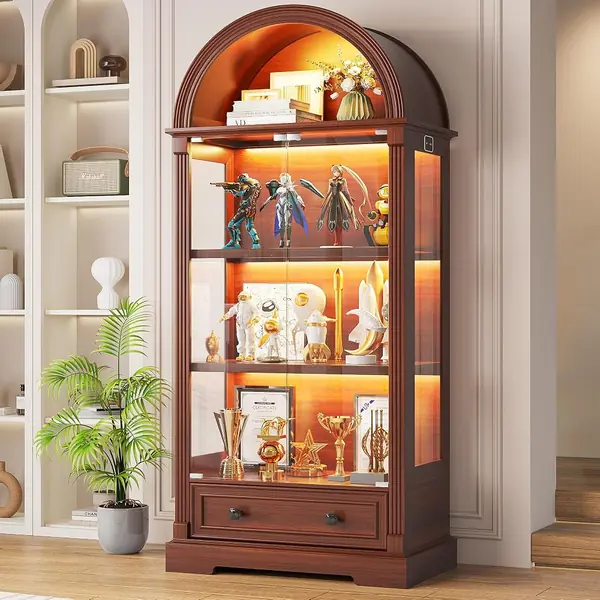
Dystler 72" Arched Curio Cabinet Best Statement Piece

Dystler arched walnut curio cabinet with glass doors and a bottom drawer

Dining rooms

Track Score 86/100
Dimensions
15.7"D x 31.5"W x 72.8"H
Lighting
3 colors with motion sensor
Shelves
3 tempered glass shelves
Storage
1 bottom drawer
View on Amazon

An arched crown, carved Roman-style accents, and a stained walnut finish put this cabinet in a different category from everything else in this guide. It reads as furniture first and storage second, which is exactly what a hallway, dining room, or front room asks for.

We like it best of the group for a room where guests will see it: the curve and the dark finish make it look like something that came with the house rather than something that arrived in a box. The frame is MDF under that stain rather than solid walnut, which is where the premium price goes furthest toward looks rather than heft, and it is still the one we point at when the cabinet is going in a room you actually sit in.

Inside, three tempered glass shelves sit behind press-to-open doors, with a lit arch cubby above and a drawer below for cloths, spare keys, or the small parts that come with a collection. The three-color motion lighting is the same idea the other lit cabinets here use, and it flatters wood and glass more than it flatters plastic figures.

Assembly is the part to plan for. At 91 pounds with a curved top to line up, it is a two-person afternoon, and the printed steps take patience rather than skill. Once it is square and anchored, the doors hang flush and the lighting does the work.

Worth Noting

  • Open top cubby is not dust-protected
Our Verdict

This is the one we choose when the cabinet has to carry a room, and the walnut arch does more for a dining room than any frameless glass tower can.

Check Latest Price
5.

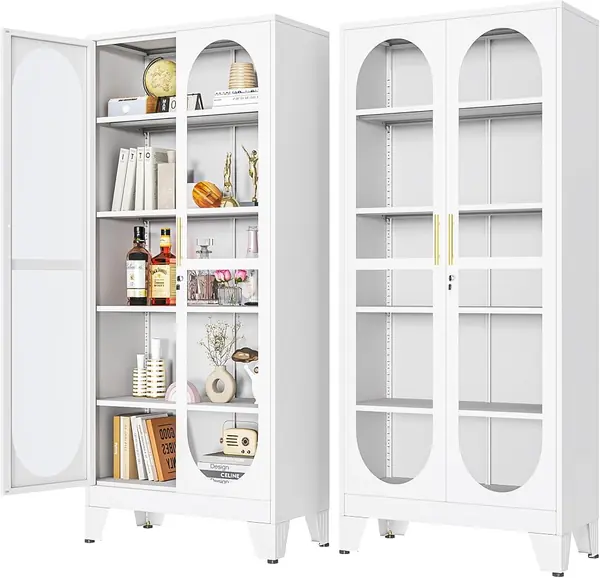
PAOFIN 71" Locking Metal Display Cabinet Best Metal Cabinet

PAOFIN white steel display cabinet with glass doors and four adjustable shelves

Garage or basement

Track Score 85/100
Dimensions
14.96"D x 29.5"W x 70.87"H
Shelves
4 adjustable
Lock
Keyed, three-point
Material
Powder-coated steel and tempered glass
View on Amazon

Steel rather than engineered wood changes what a display cabinet is for. This one belongs where the air is damp, the door gets knocked, and somebody might set a drink down on top of it — a garage, a basement bar, a games room — and after a wipe it will still look like the day it arrived.

Four adjustable shelves give you the re-spacing that most of the glass-and-wood cases here do without, the keyed lock throws three points and keeps hands out, and the magnetically latched glass doors close evenly without a rattle. The powder-coated finish is the practical kind: no grain to scratch, no veneer to lift, and an anti-tip device in the box for the wall behind it.

We like it for exactly the jobs a walnut cabinet would hate, and in white it reads as clean storage rather than as office furniture, which is more than we expected from a steel box. What it is not is a living-room piece; set beside the arched Dystler it looks like what it is. Buy it for the lock, the adjustable shelves, and one of the easier builds in this group.

Worth Noting

  • Industrial look suits a garage more than a living room
Our Verdict

For a garage, basement, or game room this steel case is the pick: it locks, it wipes clean, and it does not swell or sag the way wood can.

Check Latest Price
6.

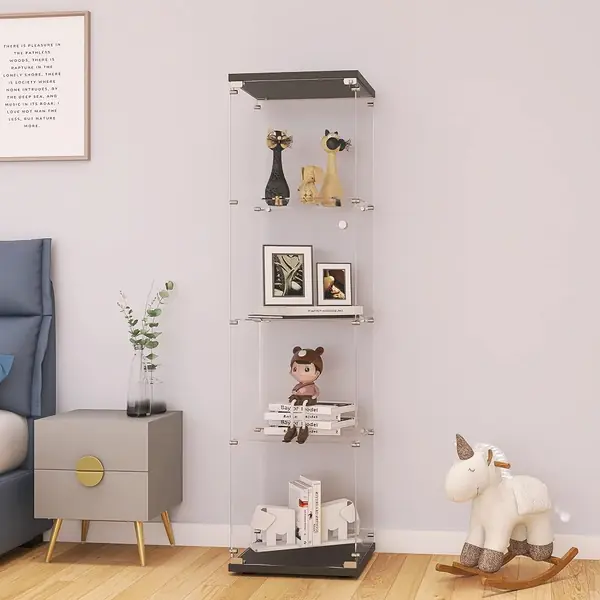
LFT HUIMEI2Y 4-Tier Glass Display Cabinet Best for Narrow Hallways

LFT HUIMEI2Y narrow black glass display cabinet with a single locking door

Narrow hallways

Track Score 84/100
Dimensions
14.4"D x 16.7"W x 64.7"H
Shelves
4, 22 lb each
Door
Single locking glass door
Glass
5mm tempered
View on Amazon

At 16.7 inches wide, this is the only cabinet in the guide that fits a hallway alcove, the strip beside a desk, or a small apartment wall, and at 64.7 inches tall it still gives you four shelves of display. We like the frameless look for tight spaces too: glass on the front, back, and top with a single locking door draws far less attention to itself than a wide wooden case would.

The build wants two people, mostly because the panels have to be held square while the frame goes on, and it rewards patience more than skill. What makes it worth the trouble is the footprint: nothing else here tucks into a 17-inch gap and still gives you four lockable, dust-free shelves.

Worth Noting

  • Glass panels can arrive scratched
  • 22-pound shelf limit rules out heavy pieces
Our Verdict

We keep it on the list for one reason: at 16.7 inches wide it slides into gaps nothing else here will fill.

Check Latest Price

How We Tested Display Cabinets

We built the shortlist from mid-range cabinets, filtering first by footprint — width, depth, and height checked against a wall, a corner, and a hallway gap — then by tier count, door style, and whether the cabinet shipped with anti-tip hardware. Anything with fixed shelves too tight for a standard figure, or with no wall-anchor kit, was cut before we ordered. Ten cabinets came in, and we lived with them for nine months.

The first thing we did with each one was measure: the clear height under every shelf, the usable depth from back panel to door, and whether a shelf could be re-spaced or only lifted out. Then we loaded them with diecast cars, figures, china, and bottles, keeping each shelf within its stated load limit, and checked a month later for glass bowing and for pieces that no longer cleared the shelf above.

Dust was the slowest test and the most telling. At the one-month mark we wiped each interior with a white cloth and compared the film left behind — a weak door seal shows up there long before it shows up in photos. We cycled the lights daily, noted how quickly the motion sensor caught us from across the room, and checked whether the LED strips still matched after months rather than minutes. Keyed and pop-up locks got opened and shut until the latch felt sloppy or stayed crisp.

Every cabinet was built by one person first, stopwatch running and instructions on the floor, then finished by two; we weighed the box before opening it, inspected each glass panel for scratches on arrival, and anchored every tall case into wall studs with its anti-tip kit before it held a single piece.

How to Choose a Display Cabinet

Measure the space between shelves, not the number of them

Six tiers sounds better than four until the tallest thing you own is nine inches high and the case gives you seven. Work out your tallest piece first, then check whether the shelves move. The BROTTAR corner cabinet and the PAOFIN steel case let you re-space shelves; the Lvifur tower has shelves that lift out but sit at fixed heights, so a tall model gets room by removing one.

Depth matters just as much for 1:18 cars and boxed figures. Most cases here run 13 to 15 inches deep, which covers nearly everything, while the corner unit's 22 inches covers all of it and eats more floor.

Doors: pop-up, hinged, or locked

Handle-free press-to-open doors give the cleanest front and the easiest dusting, and almost every glass case here uses one. What they usually do not do is lock. The Lvifur, PAOFIN, and LFT cabinets take a key, which matters in a house with children or guests, and that is worth deciding before you fall for a finish.

Frameless cases show more glass but give the hinges fewer mounting points, so check that the door hangs square before you load the shelves.

Treat the lighting as a bonus, not the reason to buy

Built-in LEDs with motion sensors are the nicest thing about a modern curio cabinet and the part most likely to let you down: the strip is wired into the cabinet and can stop working long before the furniture does. Buy the cabinet you want and enjoy the lights while they last.

If lighting is the deciding feature for you, ask the seller whether a replacement strip is available before you order, and keep a battery puck light in mind as the fallback.

Pick the footprint before the finish

Three shapes cover most rooms: a 31-inch wall cabinet, a 33-inch corner unit, and a 16.7-inch tower for a gap. Measure the wall, add a couple of inches for the doors to swing and for reaching in, and decide whether the case will ever be seen from the side — a corner cabinet with acrylic side doors is wasted flat against a wall, and an arched walnut piece is wasted in a basement.

Anything over 70 inches tall should be anchored. Every cabinet here that ships with an anti-tip kit expects you to use it.

Budget an evening and a second person

These arrive flat-packed at 68 to 108 pounds, and the glass is the last thing to go on. Assembly is usually the worst part of owning one, and hanging the doors is where it peaks. Open every carton and check the glass for scratches before you build, work in the room where the cabinet will stand, and keep the hardware bag labeled.

Two people for the doors and the final lift turns a bad afternoon into a manageable one.

Frequently Asked Questions

Final Verdict

Our pick for most collections is the BROTTAR four-tier: 31.5 inches wide, four compartments tall enough to stand a model up, doors that open with a press, and lights that come on as you walk past. It fits a normal wall, which is the one thing the corner cabinet cannot do.

If you do have an empty corner, buy the BROTTAR 71-inch corner instead — two more tiers, a 100-pound capacity, and the same lighting for a small step up in price. And if the cabinet has to look like furniture in a room you sit in, the arched walnut Dystler is the one worth the premium.