Best On-Road RC Cars of 2026

The first ten minutes with a fast RC car are what you hoped for: the punch off the line, the squat and the speed. Then comes a curb, a wheel and the walk back to the house. Top speed rarely separates a car you drive for a weekend from one you drive for years. Tires, ride height and a chassis that suit your pavement do, along with replacement parts that exist when something finally gives.

Scale matters more than the spec sheet. A big street car is thrilling on a wide lot and miserable in a driveway, while a palm-sized drifter turns a kitchen floor into a track. Over eight months on a cracked cul-de-sac, empty parking lots and a school running track, we ran 12 cars from brushed beginners to brushless bashers, and the seven picks cover street bashing, oval laps, driveway drifting and the ground between.

Our Top Picks

The Best On-Road RC Cars

1.

DIKAVEY RX12 1:12 Rally Car Best Overall
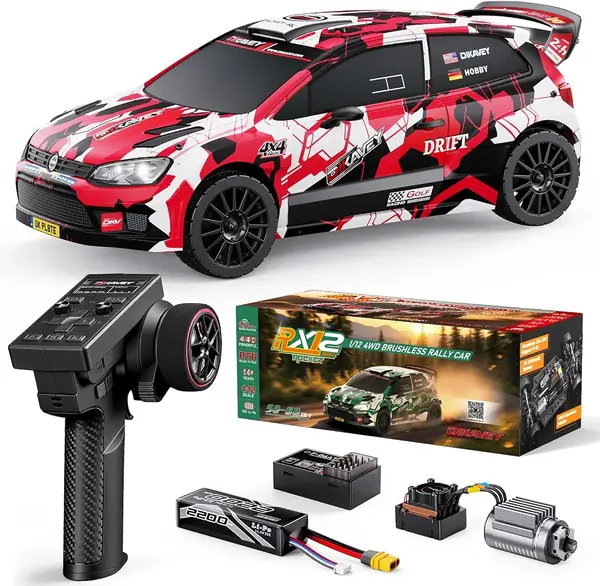
DIKAVEY RX12 1:12 brushless rally RC car in red with a low body

Street and light dirt

Track Score 91/100
Scale
1/12
Top Speed
50 mph
Motor And ESC
2845 3600KV brushless, 35A ESC
Battery
3S 2200 mAh LiPo included
View on Amazon

What stopped us is what sits under the body: a 35A brushless ESC and a 3600KV motor with its own cooling fan, plus a gyro, for less than any other brushless car in this guide. On pavement that combination does exactly what a street driver wants. Squeeze the throttle and the gyro quietly corrects the tail, so the car tracks where you aimed it instead of spinning out from a standstill.

The hardware around that powertrain is more than we expect at this level: a 6061 aluminum chassis, oil-damped shocks, steel CVDs, and a CNC steel differential. The electronics look after themselves too, with overheating warnings and a low-voltage cutoff that pulls power before the pack is damaged. At 3.31 pounds and about 14 inches long, it drops into a backpack for the walk to the nearest lot.

It sits taller than a dedicated street car, and you feel that in a hard corner on smooth asphalt, where the body leans and the tires roll onto their shoulders. That is the rally compromise, and it buys the ability to cut across a dirt shoulder without stopping. Add a second 3S pack before anything else; one is never enough for an afternoon.

Worth Noting

  • Drivetrain gears can strip under normal running
Our Verdict

We point most buyers here: it is the least expensive brushless car in this guide, and the gyro keeps it pointed straight on pavement.

Check Latest Price
2.

CROBOLL RLAARLO 1/10 Rally Car Best 1/10 Platform

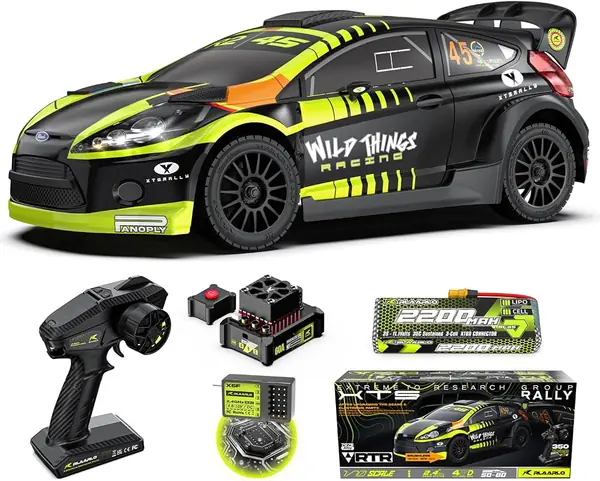
CROBOLL RLAARLO 1/10 rally RC car in green with carbon fiber chassis

Track days and drifting

Track Score 90/100
Scale
1/10
Top Speed
50 mph
Motor And ESC
3650 3300KV brushless, 60A ESC
Radio Range
About 350 m
View on Amazon

CROBOLL sells this as a 1/10 rally car, and the scale is the argument. It is the size most bodies, tires, servos, and shock parts are made for, and this chassis is laid out to be worked on: two ESC trays, two receiver boxes, and a mount that takes a standard-size servo.

What we did not expect was the radio: five channels, roughly 350 meters of range, and a gyro you can dial up for drifting or down for clean laps. On a big lot the range means you can use the whole space, and the gyro makes a slide look deliberate rather than accidental. Under the shell, the 60A ESC and 3650 motor get fans and a metal heatsink, sealed differentials keep grit out of the transmission, and the gears are chrome steel.

It is a large car at about 17 inches long, and it wants a genuine parking lot rather than a driveway, which is the real cost of the scale. The flip side is stability you can lean on: it sits flat and stays pointed at speeds that unsettle the smaller cars here. If you never plan to open the body or adjust the gyro, you are paying for capability you will not use.

Worth Noting

  • Tires wear quickly on abrasive asphalt
  • Wiring arrives untidily routed from the factory
Our Verdict

Anyone who plans to open the car up should start here: 1/10 is the scale most bodies, tires, and servos are made for.

Check Latest Price
3.

RIAARIO 1/10 Brushless Rally Car Best Build Quality

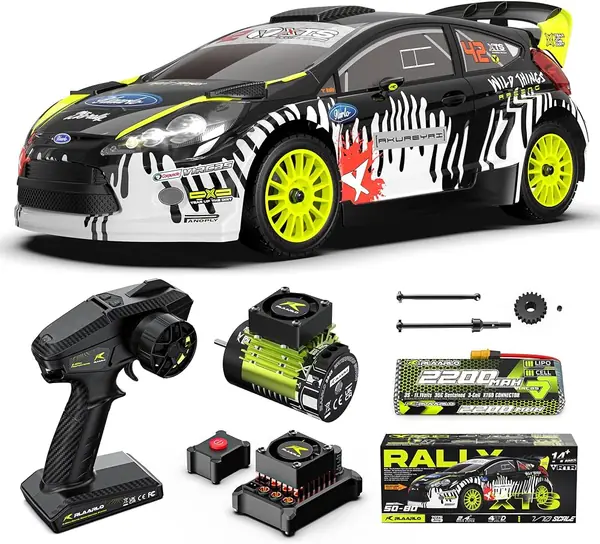
RIAARIO 1/10 brushless rally RC car in black with aluminum chassis

Rough pavement and gravel

Track Score 89/100
Top Speed
50 mph
Motor And ESC
2852 3800KV brushless, 45A ESC
Radio
5-channel, 350 m range
Chassis
2.5mm 6061 aluminum
View on Amazon

RIAARIO builds this around a 2.5mm 6061 aluminum chassis with CNC shock towers, oil-filled shocks, and front and rear anti-roll bars, then hangs a 45A waterproof ESC, a 3800KV brushless motor, and an 11-kilogram servo off it. At 7.25 pounds there is real mass here, and you feel it the first time you set the car down.

On chipped asphalt and hard-packed gravel that weight works for it. The anti-roll bars keep the body flat through a turn, sealed differentials put power down without one wheel spinning away, and the clipless body locks mean a battery change takes seconds rather than a hunt for four pins. The ESC is rated waterproof, which matters on a damp lot after rain.

Of everything here, this is the car we trust most on a surface that is not billiard-table smooth, and that is the whole reason to choose it over the CROBOLL. On a fresh, clean lot the extra bracing buys you less. On the street outside your house it is the difference between a car that comes home in one piece and one that does not.

Worth Noting

  • 45A ESC limits how far you can upgrade
Our Verdict

Take this one if your pavement is broken up: the aluminum chassis and anti-roll bars take a beating and stay planted.

Check Latest Price
4.

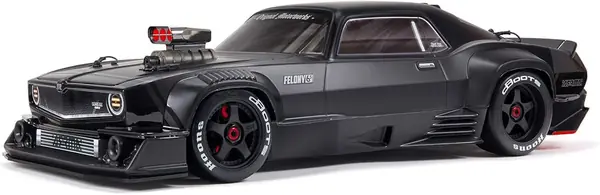
ARRMA Felony 6S BLX Best Street Basher

ARRMA Felony 1/7 black street muscle RC car on dBoots Hoons tires

Big open asphalt

Track Score 88/100
Scale
1/7
Radio
Spektrum DX3 with AVC
Length
38.25 inches
ESC
Spektrum Firma 150A Smart
View on Amazon

At 38.25 inches long and 17.6 pounds, the Felony is the only car here you notice carrying. It is a 1/7 scale street machine with a licensed muscle-car body, and where it lives matters as much as how it drives: a driveway will not do it, and neither will a cul-de-sac with parked cars.

The electronics justify the size. A Spektrum Firma 150A Smart ESC, a DX3 radio with AVC, and dBoots Hoons tires made for asphalt make up a package nothing else here matches for raw power. AVC is the system that keeps a car this strong pointing the right way; it steps in before the tail comes around, which is what makes full throttle on a big lot feel manageable rather than reckless.

It is also the best-looking thing in this guide, and we do not think that is a small part of the appeal. The proportions are right, the body reads as a real car from twenty feet, and it draws people across a parking lot in a way the rally cars do not.

Our reservation is about fit rather than the car itself: this is a lot of vehicle to store, transport, and find room to run. If you have the space, nothing here comes close on presence or power. If you do not, a 1/10 rally car will get used far more often.

Worth Noting

  • Batteries and charger are not included
  • Tires wear quickly under 6S power
Our Verdict

Buy it if you have a big empty lot and want the biggest, fastest street car here; this is the specialty pick of the group.

Check Latest Price
5.

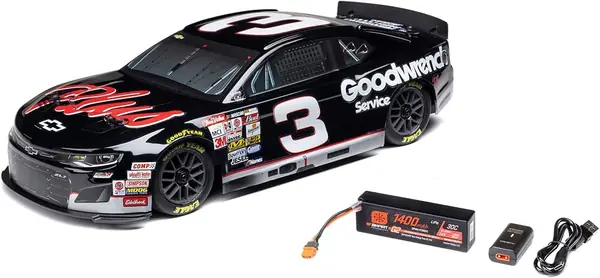
Losi 1/12 NASCAR Race Car Best On-Road Racer

Losi 1/12 NASCAR No. 3 GM Goodwrench Chevrolet stock car in black

Oval racing with friends

Track Score 87/100
Scale
1/12
Top Speed
20+ mph
Motor
MEGA 380 28T brushed
Run Time
About 20 minutes
View on Amazon

This is the only car here built for an actual racing class. The Losi is a 1/12 NASCAR stock car with an officially licensed body and Goodyear Eagle tires, sold ready to run with the battery and charger in the box, and it is designed to be tuned and raced in box-stock form. If you have watched a short oval and wanted a piece of it, this is the closest thing on this page.

Speed is modest on paper, 20-plus mph from a brushed 380 motor, and that is deliberate. A 1/12 stock car on a marked course is about clean lines and repeatable laps, not straight-line shock. Run time is about 20 minutes per pack with an hour to recharge, so a second battery is the first thing to buy. The platform takes tuning and upgrades, which is the point of a spec class: everyone starts from the same place.

Where it falls short is drama. Next to the 50 mph brushless cars here it will feel slow in a straight line, and anyone with a rough or gravelly running surface is in the wrong car entirely. On good asphalt, with a couple of friends and something to mark a course, it is the most authentic racing experience in this guide.

Worth Noting

  • Brushed motor caps speed around 20 mph
Our Verdict

If your idea of a good afternoon is laps rather than top-speed runs, this is the one: a 1/12 stock car built for racing on smooth pavement.

Check Latest Price
6.

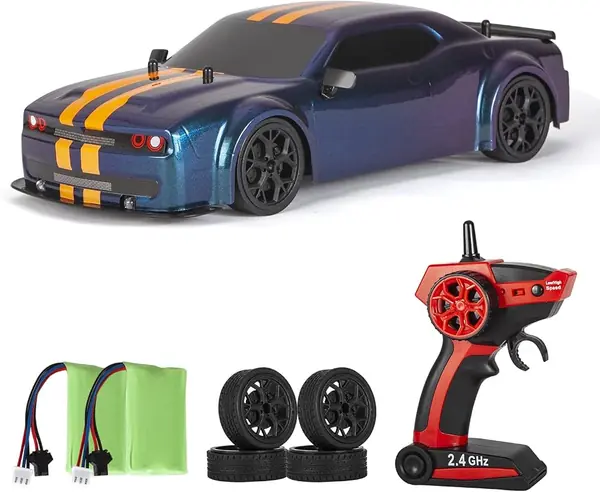
iBliver 1:14 Drift Car Best Budget Drift Car

iBliver 1:14 blue 4WD drift RC car with drift and race tires

Driveway drifting

Track Score 86/100
Scale
1/14
Top Speed
28 km/h
Batteries
Two 7.4V 500 mAh packs
Tires
Four drift and four race tires
View on Amazon

Two sets of tires is the whole idea here. Fit the hard drift set and the car slides on smooth concrete; swap to the rubber racing set and it grips and runs at 28 km/h. The box also carries two 7.4V 500 mAh packs, each rated for about 25 minutes, plus four small barricades you can set up as a course in a driveway.

At 1/14 it is small enough for a garage floor, and the tire swap is what makes it worth owning: one car covers sliding around indoors and grippier running outside. We like that the hard tires come in the box rather than as a separate purchase, since that is the part that turns a touring car into a drift car. It drives like what it is, a toy-grade machine that is much more fun sideways than straight.

Worth Noting

  • Modest 28 km/h top speed
Our Verdict

Our pick for a first drift car: two tire sets, two battery packs, and a course's worth of barricades in one box.

Check Latest Price
7.

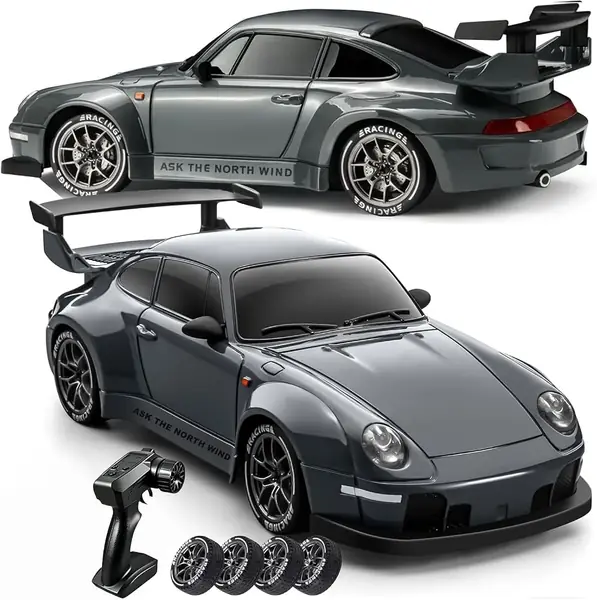
PIWIJOY 1:24 Drift Car Best for Indoor Drifting

PIWIJOY 1:24 gray 4WD drift RC car with LED lights

Indoor drifting

Track Score 85/100
Scale
1:24
Length
7.87 inches
Batteries
Two packs included
Drive
4WD
View on Amazon

At 7.87 inches long this is a desk toy in the best sense: 1/24 scale, four-wheel drive, and small enough that a kitchen floor or a coffee table is a legitimate course. Three zones of LEDs run along the body, which sounds like a gimmick until you are driving it in a dim room and can actually follow the car.

Fit the drift tires first. On hardwood and tile the car rotates on command and holds a slide far longer than its size suggests, and the second set adds grip when you want it to go where you point it. The two packs add up to 50-plus minutes, and the modular battery compartment means a swap takes seconds instead of a screwdriver hunt.

It is a plastic car at a toy price and it drives like one. The steering is crude next to the 1/14 iBliver and the whole thing feels light in the hand, but it has something the bigger cars do not: a footprint small enough to use when the weather or the driveway does not cooperate. As a first drift car for a kid, that trade is a fair one.

Worth Noting

  • Plastic body and gears are the wear points
  • Needs smooth floors to slide properly
Our Verdict

Small, lit, and inexpensive enough to hand to a kid without wincing, this is our favorite tabletop drifter.

Check Latest Price

How We Tested On-Road RC Cars

We started with a shortlist of about 30 cars, cut down by reading spec sheets and owner threads for the things that decide whether a car stays fun: brushless or brushed power, whether a battery and charger come in the box, whether body and suspension parts are actually stocked, and whether the scale fits the space most people have to drive in. That left 12 cars, which we bought and ran for eight months. We drove them the way owners do: short sessions after work, long weekend mornings, and a few lunch breaks that ran long.

Every car got the same first run: a slow lap to feel the steering, then full-throttle passes down a cracked cul-de-sac and across an empty parking lot to see whether it tracked straight or wandered, and how much work the gyro was quietly doing. We crossed gravel shoulders and carpet to check ride height and tires, then swapped drift tires for race tires where both came in the box and ran the same line again to compare grip and wear.

Runtime came from a stopwatch and a full pack run until the car crawled, plus a count of packs in the box against charger refill time. We charged every LiPo with the supplied charger, stayed nearby while it ran, and retired any pack that swelled. For durability we did low-speed curb hits, grippy tires on hot asphalt, and repeated full-lock turns to see what loosened, stripped, or cracked first, and we noted which body shells still looked straight after eight months of scrapes and rolls. The brushless hobby cars here carry 14-and-up labels, so all fast running happened on open pavement away from people and pets.

Before scoring, we priced out what it takes to keep each car running — tires, a second pack, the parts that break first — and judged value against that total rather than the sticker alone. Cars that were quick but fragile, or quick only on a surface we couldn't find, landed lower.

How to Choose an On-Road RC Car

Start With Your Surface

An on-road RC car is defined by its tires and ride height, so that is the first thing to match. Touring and street cars sit low on slick rubber and change direction fastest on clean asphalt. Rally cars sit a little higher on all-purpose tires, which gives up some grip on smooth pavement and buys the ability to cross a gravel shoulder without stopping. Drift cars use a hard, low-grip tire on purpose, so the tail lets go when you ask it to.

The trap is the all-terrain label. A monster truck with knobby tires will run on pavement, but its tall stance and soft suspension make it feel top-heavy and imprecise next to any car on this page, and a low street car will scrape its way up a gravel driveway. Buy the body style for the surface you have, not the one you might visit.

Brushed or Brushless

A brushed motor is the simpler, cheaper choice and typically tops out around 20 to 30 mph, quick enough to be fun on a driveway and slow enough that a curb does not end the afternoon. Brushless motors run cooler, deliver 45 to 50 mph in the cars here, and cost accordingly. They also need more room to slow down.

Our advice is to match the motor to your space rather than to a number on the box. A 50 mph car on a two-car driveway is a wall waiting to happen; a 20 mph car on a full-size lot feels tame after ten minutes. If you are unsure, the brushed Losi is the better first hobby car, and the brushless cars here are for people with somewhere to use them.

Match the Scale to Your Space

Scale decides where a car can run. A 1/24 car is a tabletop and kitchen-floor machine. A 1/14 car is driveway and cul-de-sac size. A 1/12 or 1/10 rally car wants an empty parking lot, and a 1/7 street car needs a genuinely big one plus a way to carry something that weighs as much as a small dog.

Bigger is not automatically better. The 1/10 cars are the ones with the widest body, tire, and servo support, which makes long-term ownership easier. Small scales are cheap to run and easy to store, and a 1/24 car you use every week beats a 1/7 car you use twice a year.

Decide Whether You Want a Gyro

A gyro is a small sensor that watches how the car is rotating and corrects the steering before a slide turns into a spin. On pavement it is what lets a powerful car hold a straight line under hard throttle, and it is what makes drifting controllable instead of random. Most systems let you dial the amount down or switch it off.

For a first car or a dedicated drift car, we think it is worth paying for. For clean laps on a prepared surface, plenty of drivers turn it off, and the cars here that have one let you do exactly that while you learn.

Budget for the Whole Kit

The purchase price is rarely the whole cost. Tires are the consumable that catches people out: asphalt grinds rubber away, and a fast car can wear a set faster than you expect. Batteries and chargers are the other variable. The ARRMA ships without either, while the Losi arrives with a pack and a charger, and the CROBOLL and RIAARIO each include one.

Our rule for a first hobby-grade car is to set aside enough for one spare battery and one spare set of tires at the same time you buy the car. The second pack is what turns a 20-minute session into an afternoon.

Frequently Asked Questions

Final Verdict

For most people, the DIKAVEY RX12 is the car to order. It puts a brushless motor and a gyro in your hands for the least money of the fast cars here, in a 1/12 package you can carry to a lot, and the aluminum and steel hardware means it survives the learning curve.

Two buyers should go elsewhere. If the pavement you actually have is chipped and gritty, the RIAARIO's 2.5mm chassis and anti-roll bars make it the tougher long-term buy. And if you want to race laps rather than chase speed, the Losi NASCAR is the only complete on-road racer in the group.