Best RC Boats for Rough Water of 2026

A glassy morning flatters almost any RC boat. The real test comes when the wind picks up, chop rolls through and the hull flips 60 feet from shore. These four were chosen for that water: they bridge a chop, shed spray and right themselves without anyone wading in.

Hull length and a hatch that actually seals matter more than top speed. A short, fast hull pounds the chop and throws water into the electronics, while a slightly longer one with a gasketed hatch rides over it, something twelve boats on ponds, a wind-whipped lake and a saltwater inlet made clear. Battery life matters too: 40 minutes sounds generous until ten of them go to retrieving a flipped hull.

Our Top Picks

The Best RC Boats for Rough Water

1.

BEZGAR HJ818PRO Best Overall
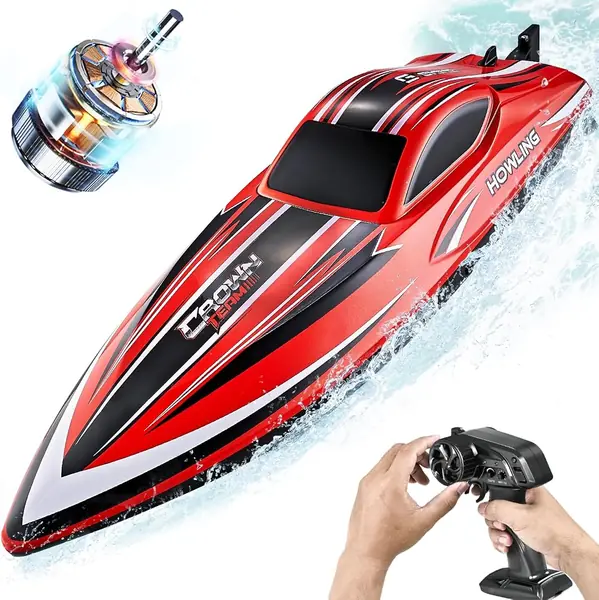
Red BEZGAR HJ818PRO brushless RC speedboat with LED lights and sealed cabin

Choppy open water

Track Score 86/100
Top Speed
55 kilometers per hour
Hull Length
16.06 inches
Motor
Brushless, water-cooled
Control Range
656 ft
View on Amazon

Fifty-five kilometers per hour works out to roughly 34 mph, and in a 16-inch hull that number is the whole point: this is the quickest boat in the guide, and on a windy lake speed is what keeps the bow up and the hull tracking instead of getting shoved sideways by every bit of chop. The 2212 brushless motor is water-cooled and the cabin is sealed against spray, which is the difference between a fun afternoon and a battery full of lake.

What actually earned it the top spot is the radio range paired with the warning. It reaches 656 feet, and the transmitter sounds off before the pack dies, so you can use the width of a lake and still bring the boat home. The one-click flip covers the other half of rough-water duty: when a gust turns it over, you press a button instead of wading in after it. We also ended up fonder of the LED lighting than we expected — on a dull evening the lights are what lets you keep track of a red hull against gray water.

Give the throttle and trim a minute on the bank before you launch: set the steering to neutral and confirm the boat is not sitting in its low-speed mode, because a mis-trimmed hull will not get on plane however much trigger you give it. Do that, and the HJ818PRO is the boat we reach for when the water is wide and the wind is up.

Worth Noting

  • Only one battery pack in the box
Our Verdict

For choppy open water we recommend the HJ818PRO: brushless speed, a 656-foot radio, and a one-click flip that gets you back underway after a capsize.

Check Latest Price
2.

BEZGAR TX123 Best for Families

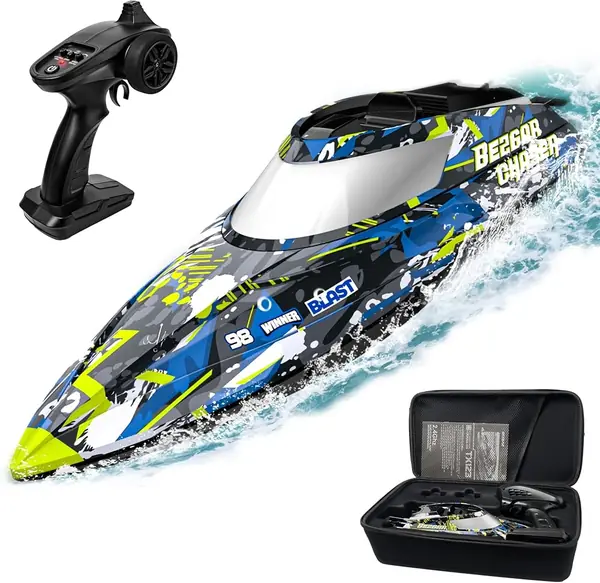
Camouflage BEZGAR TX123 RC speedboat with LED lights and fitted carry case

Family pond days

Track Score 85/100
Top Speed
32 kilometers per hour
Hull Length
14.16 inches
Run Time
Up to 40 minutes
Batteries
Two 1200mAh packs
View on Amazon

A fitted case with mesh pockets and slots for the radio, the packs, and the charger is not why anyone buys a boat, but it tells you what the TX123 is for: it lives in the trunk, runs for an afternoon, and goes home dry. We like it for the family whose rough water is a windy pond or a beach with a little surf, where 20 mph is plenty and a carry case earns its keep every trip.

The 180-degree tumbler hull is the useful part. Flip it in a gust and the recovery function rolls it back over, and the radio tells you when the pack is running down rather than letting the boat die out of range. Two 1200mAh batteries get you up to 40 minutes, which is two proper sessions at the water instead of one short one, and the water-sensing start keeps the propeller still until the hull is actually wet.

Against the HJ818PRO it gives up about 14 mph and two inches of hull, and it is the easier boat to hand to a 12-year-old for exactly that reason. The 2.4GHz radio also lets two of these run at once without stepping on each other, which turns a small pond into a race course.

Worth Noting

  • Some stop running after a few hours
Our Verdict

We point families and first-timers to the TX123: two batteries, a 40-minute session, and a tumbler hull that comes back up on its own.

Check Latest Price
3.

UDI RC Tempo Best for Beginners

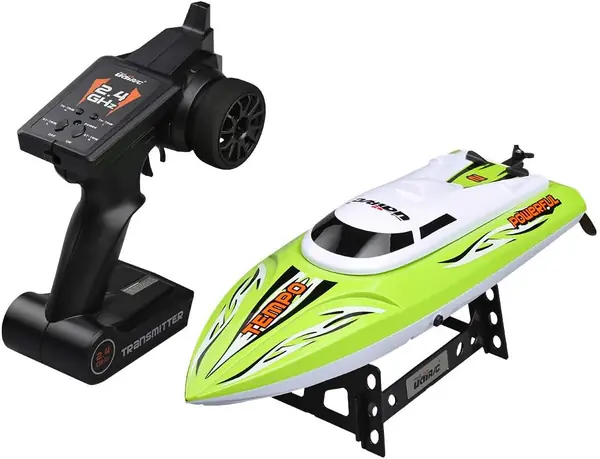
Blue UDI RC Tempo 17-inch speedboat with display stand and spare propeller

First-time boaters

Track Score 84/100
Top Speed
18.64 miles per hour
Dimensions
42.4 x11.4x11.9cm
Hull Material
Impact-resistant ABS
Capsize Recovery
Throttle-trigger self-righting
View on Amazon

Eighteen miles an hour is the slowest top speed in this group, and there is no point pretending otherwise: the Tempo is not the boat for a wide bay on a windy afternoon. What it is, though, is a 17-inch hull — the second largest here — molded from impact-resistant ABS in a sealed, anti-tilt shape, and that length is worth more in light chop than a few extra miles an hour would be.

Recovery runs off the throttle rather than a button: push forward and back and the hull rolls upright, which is one less thing to hunt for on the radio while you are watching the boat. Water circulates through the motor to keep it cool at speed, the transmitter beeps when the pack is down to its last minute, and the box includes a spare propeller and a display stand. The spare prop is the part we appreciate most, because a propeller is the first thing a shallow launch takes out.

Where it fits is the reader moving up from a pool toy who wants a bigger hull without brushless speed or a manual to read first. At 18 mph it also stays controllable in water smaller than a lake, which is more than the fast boats here can claim.

Worth Noting

  • Long charge times cut into a session
Our Verdict

The Tempo trades speed for size and simplicity, and we like it as a first boat for water that only gets modestly rough.

Check Latest Price
4.

aeihopfe 13-Inch RC Boat

aeihopfe 13-inch remote control speedboat with LED lights and lockable hatch

Calmer near-shore water

Track Score 83/100
Top Speed
20 mph
Hull Length
13 inches
Run Time
30 to 60 minutes
Batteries
Two rechargeable packs
View on Amazon

The aeihopfe is the least expensive boat in the guide, and the specification list is why it stayed on it: 20 mph, three throttle modes including a cruise setting, a lockable hatch with a sealing gasket, self-righting, and two packs for a session that runs 30 to 60 minutes depending on how hard you lean on it.

A hatch that actually locks with a gasket around it is the detail that separates this from the pool toys, because spray over the bow is normal on a breezy pond and a sealed cabin is what keeps a wet afternoon from becoming a dead boat. Water cooling for the motor and a 2.4GHz radio round out a package that reads like it costs more than it does.

Size is where it gives ground. At 13 inches it is the shortest hull here, which makes it a boat for a pond with a breeze and a bit of chop rather than a lake with real waves rolling down it — the longer picks ride over water that bounces this one around. Keep it within a couple of hundred feet of shore and the size stops mattering.

Our Verdict

We keep the aeihopfe on the list because it delivers self-righting, three speed modes, and two packs for the least money here.

Check Latest Price

How We Tested (and Flipped) RC Boats for Rough Water

We started the way a shopper does: hull length and beam first, then how the boat rights itself, then hatch gaskets, radio range, whether a low-battery warning is built in, and how many packs come in the box. Twelve boats made the cut, from small pond models to a 16-inch brushless hull.

Testing ran across eight months, mostly on weekend mornings at a lake that kicks up chop by midday, plus a family pond and a saltwater inlet. We ran each boat through its own wake in figure eights to see whether spray ended the run, then opened the hatch and checked a paper towel tucked inside the hull. We deliberately capsized every boat in shallow water and timed the recovery — a radio button, a throttle-trigger sequence, or nothing but the hull's own shape.

We walked the transmitter down the shoreline until steering stuttered to find the range, then ran packs flat to see how much warning the low-battery alarm gave before cutoff. Every session was timed from launch to cutoff, and we counted the packs in each box. Stalled boats were retrieved from shore, never by swimming, and launches happened with hands clear of the prop.

After every run, salt water especially, we rinsed the hull, prop, and gasket in fresh water and opened the drain plug. Then we ran the whole fleet again a month later, watching for stiff gaskets, corroded hardware, and hatches that had stopped sealing. Speeds were clocked on flat water and again in chop, since the second number decides whether a boat is fun or frustrating, and we noted what each one was like to carry, dry out, and store between trips, plus whether the extra pack and the brushless motor justified the step up in price.

How to Choose an RC Boat for Rough Water

Start With Hull Length, Not Top Speed

Length is what lets a hull bridge the gap between wave crests instead of dropping into every one. Under about a foot you are looking at a pool toy; the 13- and 14-inch boats here are pond and near-shore tools, while the 16-inch and up hulls stay composed once boat wakes or a long stretch of open water gets them moving.

One warning: large on a product page sometimes describes the box. A 25-inch speedboat also needs a bigger launch spot and a bigger bag, so match the hull to the water you actually have rather than to the biggest one you can afford.

Learn How It Rights Itself Before You Need It

Every boat here claims capsize recovery, and they do it three ways: a button on the radio, a throttle-trigger sequence, or a hull shape that rolls itself back over. The mechanism matters less than whether you can work it while the boat is upside down 200 feet away.

Practice the recovery in shallow water on your first pack. A sequence you have to recall from the manual is not a recovery, which is why the button and the self-righting hull are the two versions we trust in wind.

Brushless Power, Speed, and What Speed Costs

A brushless motor runs cooler and delivers more speed than a brushed one, and the fast boats pair it with water cooling. Speed is genuinely useful in chop because it lets you drive through a wave rather than get turned by it.

It also costs run time and money. If your water is a pond 150 feet across, 20 mph is more than enough and a 34-mph hull is just a crash on a delay; spend the brushless money when you have open water to use it.

Sealing, Radio Range, and the Low-Battery Warning

A gasketed, lockable hatch and a drain plug matter more on rough water than any other feature, because spray over the bow is normal and a hull full of water ends the day. Check the seal before the first run, not after.

Range figures assume a clear line of sight, so a claimed 656 feet is really a fair-weather number that shrinks behind a car or below a rise in the bank. The feature that actually brings a boat home is a low-battery warning on the transmitter; without one, the first sign of a flat pack is a drifting hull.

Count the Battery Packs

Run time on these boats is measured in tens of minutes, not hours. Two packs at 30 to 40 minutes is a good session; a single pack gets you half of that, and the number of packs in the box is a real difference between two boats that look identical otherwise.

Buy the spare with the boat. A second pack costs far less than a second boat and turns a 20-minute outing into an afternoon.

Frequently Asked Questions

Final Verdict

Rough water rewards length, power, and a way back upright, and the BEZGAR HJ818PRO is the only boat here that gives you all three without asking you to wade in after it. Its 16-inch hull, 55 kph brushless motor, 656-foot radio, and one-click flip are the reasons we hand it to anyone whose water is bigger than a pond.

If the boat will spend more time in a trunk than on a big lake, the TX123's second battery, 40-minute session, and fitted case make it the easier boat to live with, and it is the one we put in a 12-year-old's hands.