The Best RC Crawler Shocks for 1/10, 1/18, and 1/24 Trucks of 2026

A crawler climbs a surprising amount of rock right up until the suspension gives out and the truck starts hopping instead of creeping. Shocks are the cheapest, most reversible change to how a rig plants its tires, and the easiest part to buy wrong: order by overall length instead of eye-to-eye and the springs bind before the truck leaves the bench, or the shock sits three millimeters off.

Oil-filled dampers with real seals hold their feel, internal-spring designs let you tune droop, and threaded bodies with a couple of spring rates set ride height without shims. We measured 15 sets before fitting them to 1/10 trail trucks, 1/18 builds and 1/24 rigs over five months, and the differences showed in the first pack. None of the five picks turns a trail rig into a comp build, but every one keeps the tires on the rock.

Our Top Picks

The Best RC Crawler Shocks for 1/10, 1/18, and 1/24 Trucks

1.

Yeah Racing Desert Lizard 90mm Shocks Best Overall
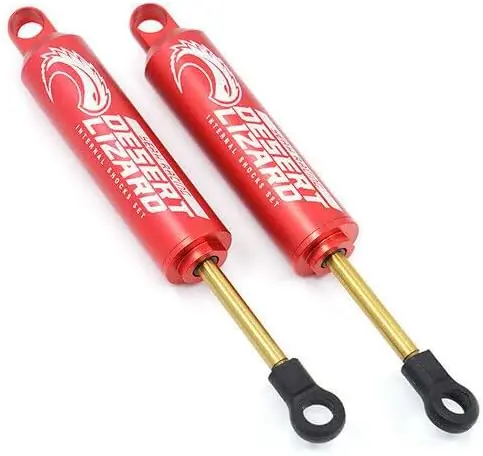
Pair of red anodized Yeah Racing Desert Lizard 90mm crawler shocks with internal springs

1/10 crawler tuning

Track Score 92/100
Length (eye To Eye)
90mm
Setup
Droop or sprung
Shocks Per Pack
2
Springs Included
18
View on Amazon

Eighteen springs, eight machined pistons, and a bag of mounting hardware arrive with a pair of these. That is a tuning kit rather than a spares bag, and it is why the Desert Lizards cost more per corner than anything else we cover. Swapping a piston changes how quickly the shock reacts; swapping a spring changes how much weight it holds up. Between the two you can stand a hardbody up on its coils or let a light lexan shell sit down, using the same shock bodies.

What makes it our overall pick is that the same shock builds two ways. Sprung, the coils carry the truck, which gives you more flex and more travel. In droop it sits lower and leans on the truck's own weight, with less articulation but a steadier stance. We like having both in one box, because the setup that suits a trail truck on a sidehill is not the one that suits a comp rig threading a gate.

Ninety millimeters eye to eye covers a long list of 1/10 chassis: SCX10, HPI Crawler King, GMade Komodo, Vaterra Ascender, and SSD Trail King among them. The internal spring is the crawler detail worth paying for, since the coil sits inside the body where grit and mud cannot pack into it. What you give up for that is access, because a spring change means opening the shock rather than sliding a collar up the body.

Set them up light first. In a crawler, thin oil lets the shaft follow small rocks instead of passing every edge up into the chassis, and adding damping later is far easier than taking it out. The triple O-ring cartridge at the shaft is the part to watch; keep the bodies clean and they stay dry.

Worth Noting

  • Two shocks per pack, so a full truck needs two
Our Verdict

We recommend the Desert Lizard for 1/10 builds that need real tuning: eighteen springs and eight pistons let you build it droop or sprung, and 90mm fits a long list of chassis.

Check Latest Price
2.

INJORA 40mm Big Bore Shocks for SCX24 Best for 1/24 SCX24

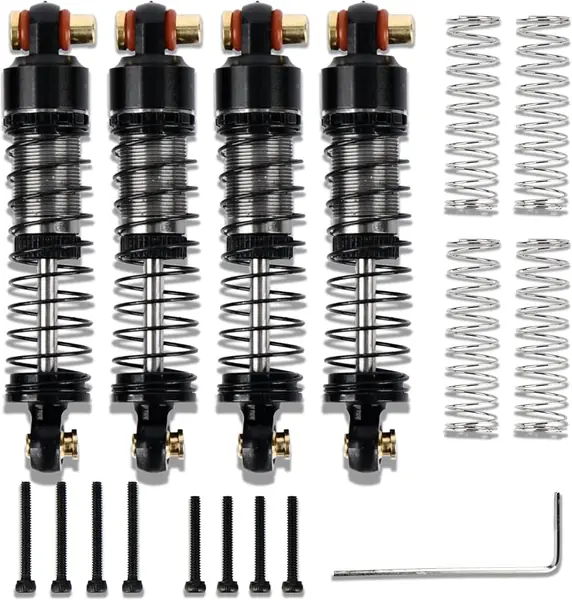
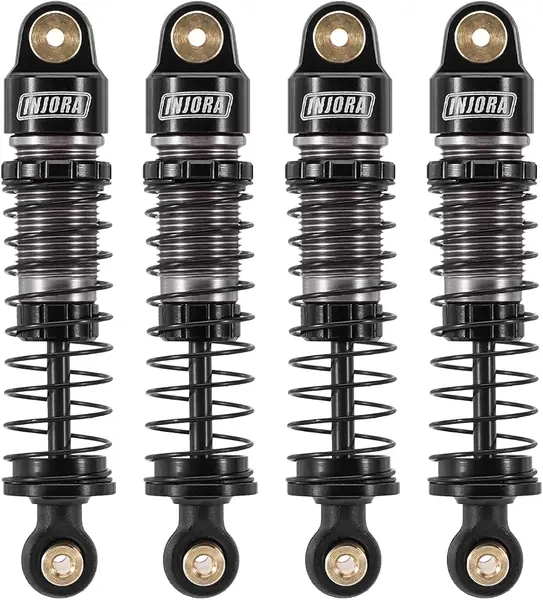
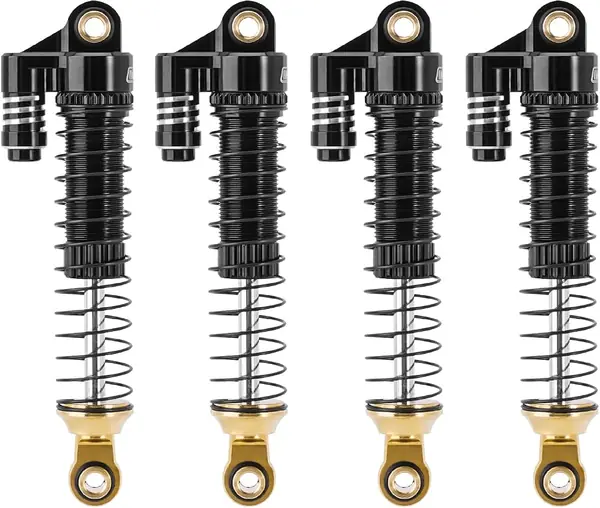
Four black INJORA 40mm big bore aluminum oil shocks for SCX24 crawlers

1/24 SCX24 upgrades

Track Score 91/100
Shocks Per Set
4
Length
40mm
Spring Rates
Two included
Body Material
CNC-machined aluminum
View on Amazon

Stock SCX24 suspension is friction damping, and it feels like it: the truck pogos off a rock and settles wherever it likes. Four real oil shocks with bladder seals change that, letting the axle follow the terrain instead of bouncing away from it. This is the set we point people to for the swap, because one order covers all four corners, and it arrives with threaded collars and two spring rates rather than one fixed coil.

The threaded body earns its keep on a truck this small. A turn of the collar moves ride height without a spring swap, which matters when a couple of millimeters decides whether a bigger tire clears the body. The big bore holds more oil than a thin-bodied shock, and the bladder takes up the shaft's displacement as it compresses, which is what keeps rebound consistent through a long climb instead of fading out halfway up.

Where it can catch you out is stance. Fitted with either spring, these sit the truck taller than stock, and on a build that already rides high that means nose-up and tippy. Wind the collars down before you go hunting for new mounts. Beyond that, installation is straightforward on SCX24 hardware, and the black bodies keep a scale build looking like a truck rather than a parts catalog.

Our Verdict

Our pick for a stock SCX24: four oil-filled aluminum shocks with threaded bodies and two spring rates, all four corners in one order.

Check Latest Price
3.

INJORA 59mm Brass Shocks for TRX4M Best for 1/18 TRX4M

Black INJORA 59mm aluminum TRX4M shocks with brass lower ends and scale reservoirs

1/18 TRX4M builds

Track Score 90/100
Weight Each
0.28 oz
Length (eye To Eye)
59mm
Travel
17mm
Compressed Length
42mm
View on Amazon

Brass at the bottom of a shock is weight you can use. Eight grams a corner against six for the same shock in plain aluminum does not sound like much until you remember where it sits: at the axle, under everything else, exactly where a 1/18 crawler wants its mass when the truck leans onto a sidehill.

The brass version suits TRX4M builds that have already added weight up top, whether that is a hardbody, a roof rack, or a heap of scale accessories. The aluminum shock gives the same 17mm of travel and the same threaded collars, but it cannot pull the center of gravity back down. On a stripped chassis with a lexan shell, brass is ballast you do not need; on a loaded one it is the most effective handling change in the build.

Seventeen millimeters of travel at a 59mm eye-to-eye length keeps a TRX4M articulating without forcing the body into strange angles, and the fit list covers the TRX4M and TRX4MT. Set preload with the truck on its wheels and the battery in, because preload dialed in on the bench is preload you end up doing twice.

Worth Noting

  • Scale reservoir is decorative only
Our Verdict

We take the brass version for TRX4M builds that already added weight up top; the lower ends pull the center of gravity back down where it counts.

Check Latest Price
4.

Qocuzax 1/24 40mm Oil Shocks Best for Budget 1/24 Builds

Set of four Qocuzax 40mm aluminum and brass oil shocks for 1/24 crawlers

Budget 1/24 builds

Track Score 86/100
Shocks Per Set
4
Length
40mm
Weight Each
0.15 oz
Material
Aluminum and brass
View on Amazon

Four oil-filled shocks, aluminum and brass, 4.3 grams each. On a 1/24 crawler that last number is the interesting one, because weight at the axle is what the motor and the servo fight all day, and a shock that adds almost nothing helps before it has damped anything. We treat this as the budget entry into oil damping, and nothing else here costs less for four corners.

Forty millimeters is the SCX24-class length, and the kit is listed for the SCX24, the FCX24M, and most other 1/24 off-road chassis. Nothing in the design is exotic: a big bore body, a brass-and-aluminum mix, a straightforward install. On a light truck that is not a criticism. Light damping and low weight suit a small rig that spends its time on rocks rather than in the air.

Where we are careful is the ceiling. This is a first set for a truck you keep light and slow; a heavy brass-and-hardbody 1/24 on tall tires will want the tuning range of the INJORA 40mm instead. Think of it as the upgrade that gets a stock truck behaving, not the last set you will buy.

Worth Noting

  • 1/24 only, so no use on 1/18 trucks
Our Verdict

This is the budget entry to oil damping: four shocks at 4.3g a corner, light enough that a stock 1/24 truck will not notice them.

Check Latest Price
5.

ARRAROWN 1/10 Front & Rear Shocks Best for Heavy 1/10 Trucks

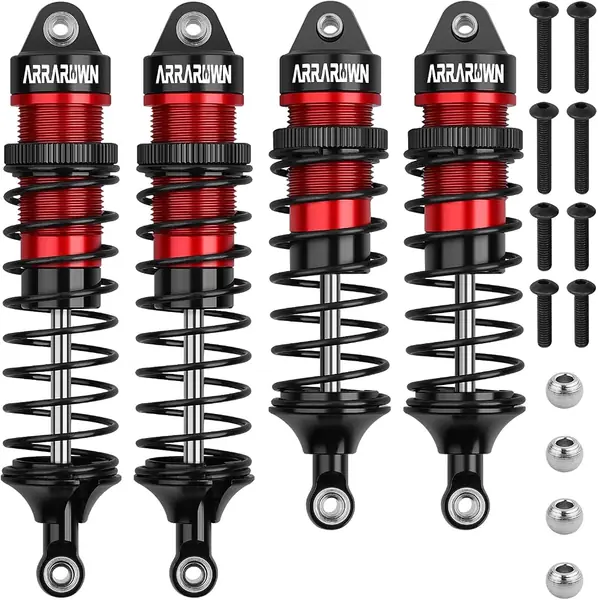
Four black and red ARRAROWN aluminum 1/10 shocks with springs and threaded bodies

Heavy 1/10 trucks

Track Score 85/100
Shocks Per Set
4
Oil
Pre-oiled
Rear Length
About 100mm eye to eye
Front Length
About 90mm eye to eye
View on Amazon

Front and rear are not the same shock here. The front pair measures about 90mm eye to eye and the rear about 100mm, so the set is built for trucks that carry more weight at the back and can use the extra travel there. If your rig runs equal lengths at both ends, half of this set is the wrong length for you.

We like that they arrive pre-oiled, which skips the fiddliest part of the job, and the bodies are threaded with a big bore that holds enough fluid for a heavy 1/10 truck. They are listed as a replacement for the Traxxas 5862 shocks on the 4x4 Slash, Stampede, Rustler, and Hoss, and as fitting a spread of other 1/10 chassis. A 180-day manufacturer warranty comes with them, which is worth knowing if you run them hard.

What we keep them for is a heavy 1/10 trail truck that needs to stop pitching on descents without a premium spend: four shocks, two lengths, pre-oiled, one order. What they are not is a finesse crawler shock. The big bore and the firm spring are built for landings and payload, and a light 1/10 build can end up over-sprung and skittish on the rocks. If you want to tune spring rate and pistons, the Desert Lizard is the better buy.

Worth Noting

  • Front pair runs long on 2WD trucks
Our Verdict

For heavy 1/10 trail trucks we like the split front and rear lengths and the pre-oiled bodies; it is four shocks for less than a pair of our top pick.

Check Latest Price

How We Tested RC Crawler Shocks

We started with spec sheets rather than product photos: eye-to-eye length, mount width, shaft diameter, spring rates included, whether the pack was a pair or a set of four, and whether oil came in the box or had to be bought separately. Anything whose eye-to-eye length we couldn't confirm got cut before it ever shipped. That left 15 sets, which we ran for five months across 1/10 trail trucks, 1/18 builds, and 1/24 rigs.

On the bench, we measured each shock eye to eye with calipers and held that number against the listed length, then weighed it on a kitchen scale to see what it would add at the axle. We filled and bled the oil dampers over a tray, worked the shaft through full travel by hand, and watched for binding at the mounts and ball ends. After bolting them up, we set ride height on the threaded bodies and counted preload turns so we could return a truck to stock later.

The real work happened on a backyard rock pile, a line of paver stones, and an indoor course: slow climbs, side hills, and plenty of backing up to try the same line again. Every few packs we wiped the bodies down and checked the seals and caps for weeping, looked for springs that had walked off their perches or bowed under load, and noted whether the truck squatted, skipped, or stayed planted. We also priced each set the way a buyer would, adding oil and hardware where they weren't included. Shock oil stayed capped on a tray out of reach and we followed the bottle's handling instructions; screws, ball ends, and springs went into a lidded bin, since several of these sets carry a 14-and-up rating.

How to Choose RC Crawler Shocks

Measure Eye to Eye, Not Overall

A shock's usable length is center to center between the mounting holes, which is not the number most product pages lead with. One of the 1/18 sets here measures 66mm overall and 59mm hole to hole, and ordering the wrong one of those two figures leaves the truck sitting on its bump stops or topping out before the axle droops.

Our picks run 40mm on the 1/24 SCX24 class, 59mm on the 1/18 TRX4M, and 90mm on a 1/10 crawler. Take your stock shock off, measure it hole to hole with the truck at ride height, and buy that number.

Oil, Internal Spring, or Friction

Stock shocks on most small crawlers are friction units, a shaft sliding in a dry body, which is why a stock truck bounces and then settles where it likes. An oil-filled damper with a sealed shaft resists consistently through the stroke, and that is what lets an axle follow a rock instead of hopping off it.

Internal-spring designs hide the coil inside the body where grit cannot pack into it, at the cost of a fiddlier spring change; external coils are easier to see and to swap. Buy oil or internal spring, and treat a shock with neither as a cosmetic part.

Spring Rate, Preload, and Ride Height

Two spring rates in the box is the minimum we look for, because the rate that holds up a hardbody will over-spring a lexan shell. Preload is a separate adjustment: winding the collar down changes where the truck sits, not how firm the spring is, and plenty of builds get blamed for the wrong problem because of it.

Set preload with the battery in and the truck on its wheels. If you want a lower stance, a droop build lets the truck ride on its own weight instead of on the coils, and the Yeah Racing set can be assembled that way.

Price the Whole Truck, Not the Pack

Shocks come in pairs and in fours, and the pack size moves the real cost more than the sticker does. Our top pick is sold two to a pack, so a four-corner rig needs two; the INJORA and ARRAROWN sets cover all four corners in one order. Add a bottle of shock oil, since nearly everything here arrives dry or close to it, and compare per corner before you commit.

Materials and Weight at the Axle

Aluminum bodies and threaded collars are the baseline in this group, so the meaningful differences sit at the ends and in the hardware. Brass lower ends put real mass at the axle, and on a crawler that mass is handling rather than decoration: it is the difference between a truck that settles onto a sidehill and one that rolls off it.

Nylon rod ends flex instead of passing impact into the shaft. If your build is already heavy up top, take the brass; on a light shell, take aluminum and spend the difference on springs.

Frequently Asked Questions

Final Verdict

We recommend the Yeah Racing Desert Lizards for most 1/10 crawler builds. The tuning kit and the droop-or-sprung choice let you set a truck up rather than adapt around it, and 90mm covers the common chassis.

For a 1/24 SCX24, the INJORA 40mm set does all four corners in one order and is our pick; on a TRX4M, the brass 59mm is worth the small step up in cost for a lower center of gravity.