Best RC Crawler Transmitters of 2026

A crawler lives at walking pace, which makes the radio in your hands the loudest thing about the drive. The transmitter that ships with a ready-to-run truck handles steering and throttle and little else: no spare channel for the winch you'll add later and no memory for a second rig. A real surface radio gives you drag brake you can dial in, a throttle curve slow enough for a nervous beginner and switches that land under your fingers.

Stated range is an open-air number that a rock garden eats, and receiver protocol quietly sets the price of every truck after this one. We timed steering response rather than trusting our hands, running 14 transmitters on a rock pile, through a muddy creek crossing and around a living-room course for mini crawlers. The nine picks suit how a crawler is actually driven: slowly, precisely, with one finger doing most of the work.

Our Top Picks

The Best RC Crawler Transmitters

1.

Radiolink RC6GS V3 Best Overall
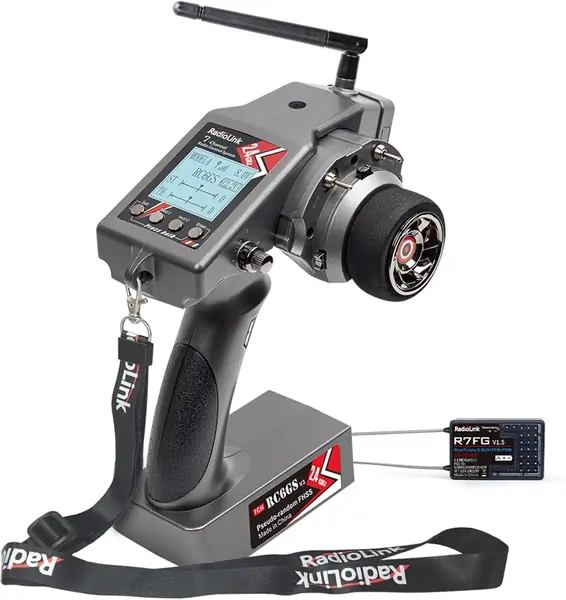
Radiolink RC6GS V3 black seven-channel surface transmitter with R7FG receiver

Accessory-heavy trail rigs

Track Score 95/100
Channels
7
Stated Range
1,900 feet
Included Receiver
R7FG, IPX4 rated
Model Memory
30 models
View on Amazon

Seven is the number that earns this radio its place. Steering and throttle take two channels; Radiolink hands you the other five as one knob, two three-way switches and two momentary buttons, so a winch, a light bar, a two-speed transmission and rear steer can each have their own control instead of being spliced onto one.

The feature we kept coming back to is the cruise control on the SWA switch. Set a slow speed on a loose descent and the truck crawls while both hands stay on the wheel — on a steep, rocky line it is the closest thing here to a second pair of hands. Range is the longest stated in this group at 1,900 feet, and the included R7FG receiver is rated IPX4, so a puddle does not end the run.

Live telemetry is the other practical win: pack voltage and signal strength sit on the screen while you drive, which over a long trail session tells you more than a timer does. Thirty models of memory means a shelf of rigs can share one transmitter, and the dual program mix handles four-wheel steering or a pair of ESCs without extra hardware. The R7FG's gyro is a drifting aid more than a crawling one, and you can leave it off.

What settles it for us is the combination rather than any single line on the spec sheet: the switch count of a radio well above this price, a receiver that shrugs off weather, and a screen that answers the question every trail driver actually has.

Runtime is the trade-off. The radio runs on AA cells and drains them faster than we expected, so rechargeable cells or a lithium pack are worth sorting out before your first long session. Carry spares and it becomes an errand rather than a problem.

Worth Noting

  • Battery door can work loose if knocked
Our Verdict

Our pick for most crawler builds: seven channels with real switches behind them, a splash-resistant receiver, and pack voltage on the screen.

Check Latest Price
2.

Flysky FS-GT5 Best Crawler Drive Modes

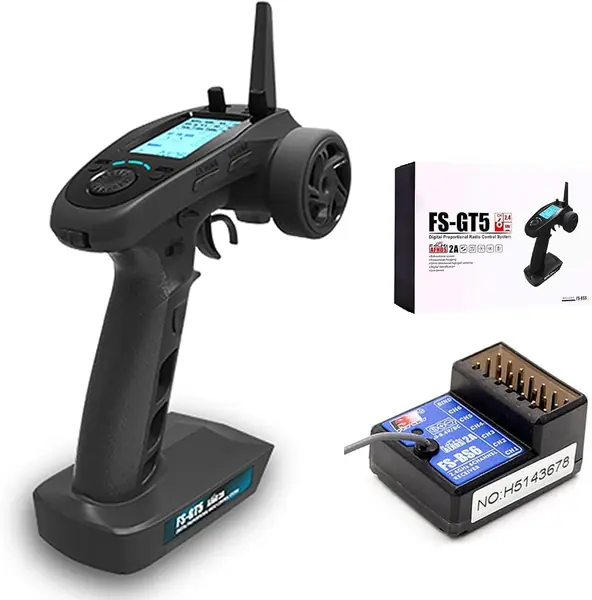
Flysky FS-GT5 black six-channel RC transmitter with FS-BS6 receiver

Technical crawling lines

Track Score 94/100
Channels
6
Included Receiver
FS-BS6
Model Memory
20 models
Crawler Features
CRAWL mode, SVC, ABS
View on Amazon

Flysky built a crawler mode into this radio, and it is the reason we hand the GT5 to anyone driving tight, slow technical lines. The CRAWL setting softens the throttle so the truck creeps instead of lurching off a rock, and the six-setting ABS adjusts the automatic brake to suit the surface. Of everything in this group, it is the most crawler-focused transmitter out of the box.

The shape deserves a mention too: a molded grip, a trigger that falls naturally under the index finger, and a weight that sits still in one hand. Twenty models of memory cover a whole shelf, the menu reads clearly on the first pass, and fail-safe is there for the day a pack sags on a far-off climb. Six channels leave room for lights and a two-speed after steering and throttle.

Flysky does not publish a range figure for the GT5, which is the one gap in its spec sheet. At walking-pace crawling distances that has not mattered for us, but if you like sending a truck up a long switchback out of sight, the Radiolink's stated 1,900 feet is the more reassuring number.

Worth Noting

  • AA cells run down quickly
Our Verdict

If you want the radio doing some of the crawling for you, this is it: a dedicated climb mode, tunable ABS and the best hand feel in this group.

Check Latest Price
3.

Radiolink RC4GS V3 Best Value

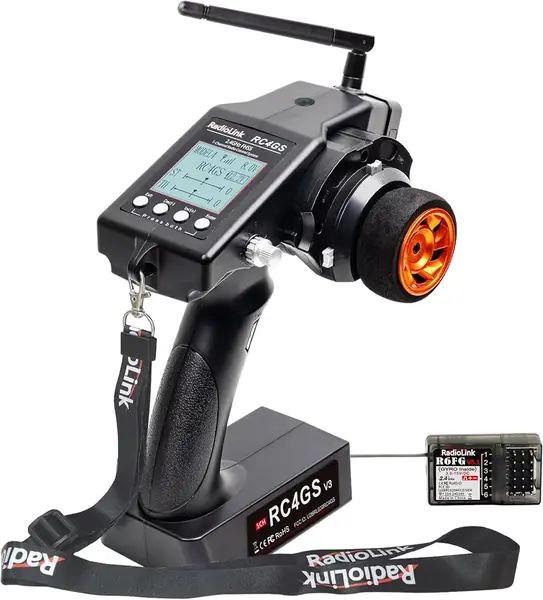
Radiolink RC4GS V3 five-channel RC transmitter with R6FG gyro receiver

First crawler radio

Track Score 93/100
Channels
5
Stated Range
1,300 feet
Included Receiver
R6FG with gyro
Model Memory
30 models
View on Amazon

Five channels, a gyro receiver in the box and a screen full of real settings, for noticeably less than the radio we recommend first — the RC4GS V3 is where we point anyone building a first crawler on a budget.

Five channels cover the standard crawler loadout: steering, throttle, a two-speed, lights and one more function — a winch or rear steer, not both. Thirty models live in memory, and CH3 through CH5 can be mapped to the knob and the push button, so a winch runs proportionally instead of all-or-nothing.

One spec-sheet trap is worth knowing before you order. The radio is advertised with voltage telemetry, but the bundled R6FG is a gyro receiver, not a telemetry one, so pack voltage only appears on screen once you add an R7FG or R8FG. Buy the combo for the channels and the gyro, and add a telemetry receiver when you want the readout.

Range is stated at 1,300 feet — more than enough for a truck you can still see — and the gyro sensitivity is adjustable from the transmitter's knob. It is more use on a drift car than on a trail rig, but leaving it off costs nothing. Binding takes a couple of minutes and the menu is the same clear layout as the bigger Radiolink.

What we come back to is the arithmetic: the money saved here buys a second receiver for the next build, and the two channels you give up are ones a trail truck rarely fills. Step up to the RC6GS V3 when a winch, rear steer and lights all need their own switch at once.

Our Verdict

The value pick in this group: five channels, an included gyro receiver and Radiolink's clear menu system for less than the mid-range radios.

Check Latest Price
4.

DUMBORC X6 Best Budget

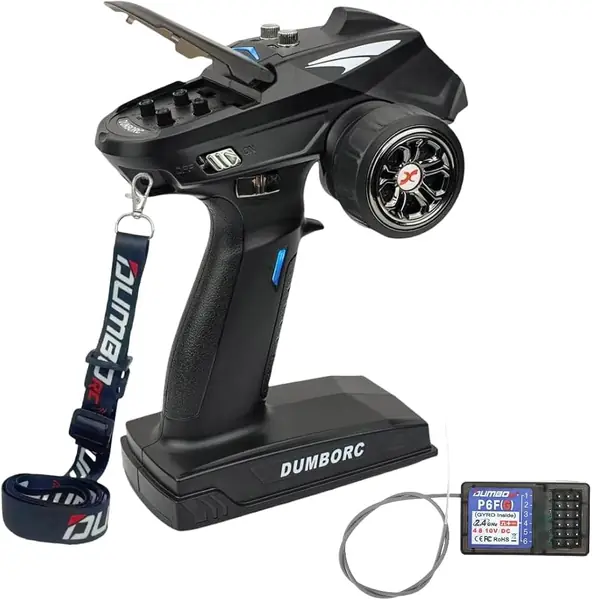
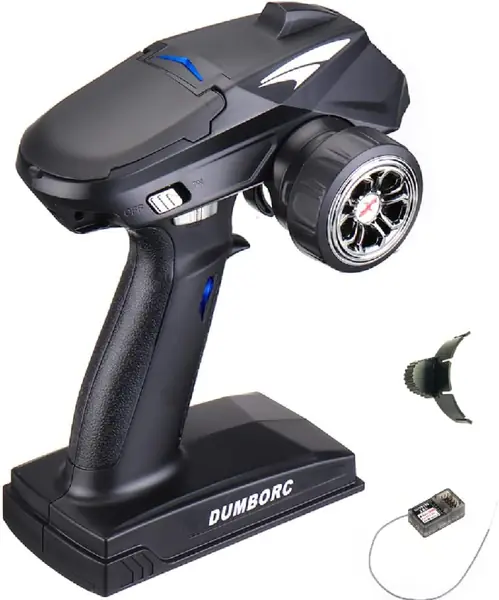
DUMBORC X6 black six-channel RC transmitter with P6FG gyro receiver

Budget first build

Track Score 92/100
Channels
6
Stated Range
500 meters
Included Receiver
P6FG with gyro
Receiver Response
3 ms
View on Amazon

Three ways to power the DUMBORC X6 says a lot about who it is for: four AA cells, a USB port, or a lithium pack through its own socket. Run it on what you already own, switch to a rechargeable pack later, and never buy a different radio to make that change.

Six channels near the bottom of this group's price range is the headline, but the control that earns its keep for us is the throttle speed limit. Wind the top end down and a kid or a first-time driver can work a technical section without launching the truck off a ledge. The P6FG receiver carries a gyro, the low-voltage alarm warns before the radio drops out, and the mix pairs channels one and two for four-wheel-steer builds.

What it does not offer is the Radiolink's channel sprawl. DUMBORC describes setting three channels individually and mixing the first two, so a four-wheel-steer or tank-mix build is easy, while a rig with lights, a winch and a two-speed wants more assignable switches. For a simple trail truck, six channels and a gyro at this money is a straightforward trade.

Our Verdict

Six channels, a gyro receiver and a beginner-friendly throttle limit make this the budget radio we hand to first-time crawlers.

Check Latest Price
5.

MEUS RACING ME-8B Most Channels for the Money

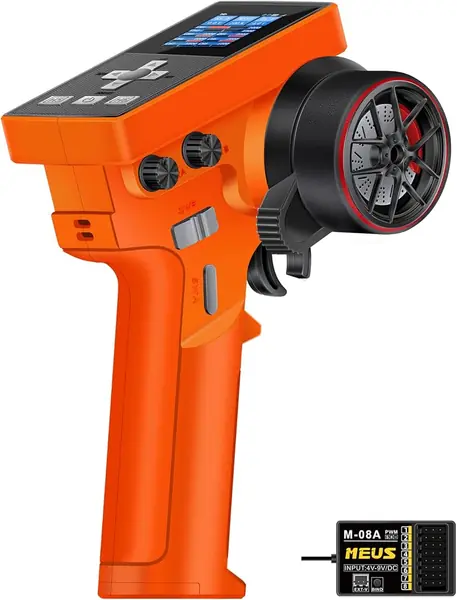
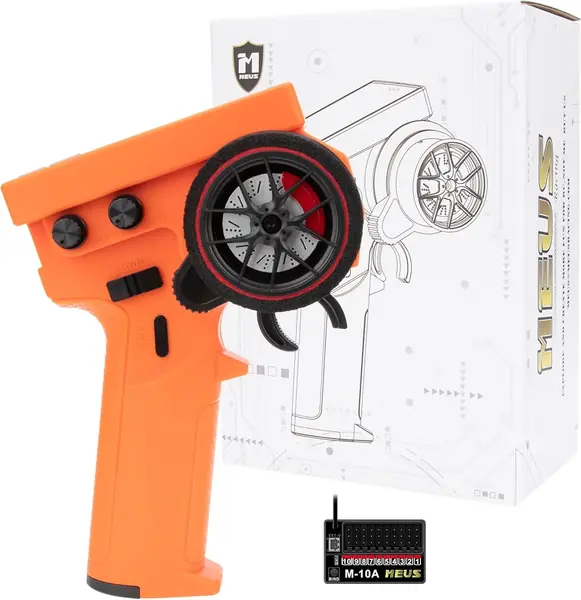
MEUS Racing ME-8B orange eight-channel transmitter with color screen and receiver

Switch-heavy scale builds

Track Score 91/100
Channels
8
Stated Range
300-800 m
Included Receiver
MEUS M-08A
Battery
18650 cell included
View on Amazon

Eight channels and a 2.23-inch color screen for about what the budget six-channel radios cost — the ME-8B's pitch holds up. The screen shows every channel's state at a glance, so you can see that the winch is still powered before you drive away.

The layout is one three-position channel, two knobs and three push buttons on top of steering and throttle, which is enough to give lights, a winch, a two-speed and a set of trailer controls their own switches. An 18650 cell comes with it, so there is no AA habit to feed, and the receiver is small enough to tuck into a tight chassis. Range is quoted at 300 to 800 meters, which is ample for crawling.

Its home is the accessory-heavy end of the hobby. Binding several trucks to one transmitter is quick, and the color display is easier to read outdoors than the monochrome screens on the cheaper radios. It is the radio we reach for when a build has more switches than a trail truck strictly needs.

Worth Noting

  • Menu depth takes an evening to learn
Our Verdict

Eight channels, a readable color screen and an included rechargeable cell for budget-radio money — the pick for switch-heavy scale builds.

Check Latest Price
6.

INJORA T6M Best for Mini Crawlers

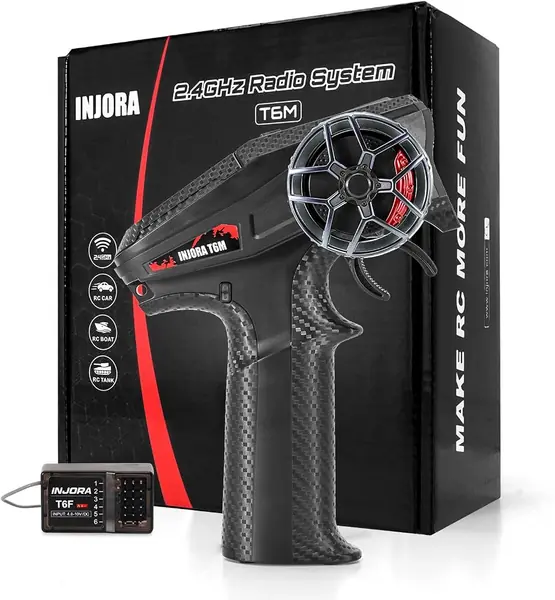
INJORA T6M compact black six-channel transmitter with small receiver

Mini crawlers

Track Score 90/100
Channels
6
Stated Range
400-450 m
Battery
4 AA (not included)
Height
175 mm
View on Amazon

Small is the whole point of the T6M. At about seven inches tall it disappears into a jacket pocket or a glovebox, and the grip suits smaller hands — this is a radio drawn around 1/24 and 1/18 crawlers like the SCX24, where a full-size radio feels like overkill.

Six channels and a 400 to 450 meter range claim in something this size is generous. The auto-off is the detail we appreciate most: the transmitter chimes after 12 minutes at rest and shuts down at 15, so a radio left on the bench does not drain its cells, and the three-stage low-voltage alarm covers 4.4, 7.4 and 10.8 volts.

It belongs with a shelf of small trucks. It binds to several builds, the receiver fits a 1/24 chassis without a fight, and the compact body lives in the bag with the truck instead of on a shelf at home. For a kid's first crawler, that is most of what matters.

Worth Noting

  • Receiver ships without a gyro
  • AA batteries not included
Our Verdict

The compact pick: a pocketable six-channel radio that suits 1/24 crawlers and smaller hands without giving up range.

Check Latest Price
7.

Spektrum DX3 Smart Best for Spektrum Smart Rigs

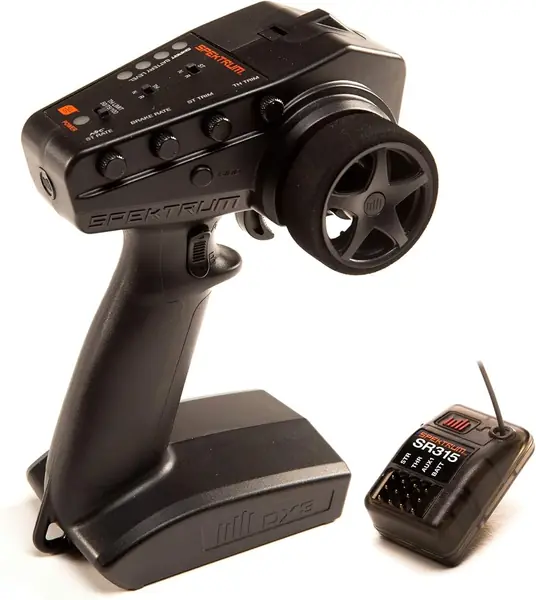
Spektrum DX3 Smart black three-channel transmitter with SR315 receiver

Spektrum Smart owners

Track Score 89/100
Channels
3
Included Receiver
SR315
Telemetry
Smart battery voltage
Wireless Protocol
DSMR
View on Amazon

Three channels, and that is the whole story with the DX3. A crawler that needs a winch, lights, a two-speed and rear steer cannot run them from this radio — but a truck already built around Spektrum Smart batteries and ESCs gets something none of the others here can offer.

That is where the DX3 earns its premium for us. With a Smart pack installed, battery voltage and remaining level show on the transmitter without adding a sensor or a telemetry receiver — the same information the Radiolinks give you, delivered through hardware you may already own. DSMR is Spektrum's long-standing surface protocol, and the SR315 receiver is compact enough for a tight chassis.

The feel is a step above the budget radios: a foam-covered wheel, a grip shaped for a long afternoon, and programming that is simple trim and endpoint work rather than a deep menu. Three channels means steering, throttle and one accessory, so decide which single accessory matters most on that truck.

Linking a new receiver can take a couple of tries before it takes, and the Smart telemetry is only worth having if your batteries and ESC are Smart too — a bigger commitment than a radio swap. Buy it because you are already in that ecosystem, not to start one.

Worth Noting

  • Only three channels, so one accessory per truck
Our Verdict

The right radio if your truck already runs Spektrum Smart gear: battery voltage on the screen with no extra sensor to add.

Check Latest Price
8.

MEUS RACING ME-10B Best for Teaching New Drivers

MEUS Racing ME-10B orange ten-channel transmitter with color screen and receiver

Teaching new drivers

Track Score 88/100
Channels
10
Stated Range
300-800 m
Screen
Color
Channel Layout
1 three-position, 2 knobs, 5 buttons
View on Amazon

Ten channels is the largest count in this group, and five of them are push buttons — the sort of thing you buy when a build has grown a light bar, a winch, a trailer winch and something you have not thought of yet.

Coach mode is what separates it from the ME-8B. It is built for teaching, letting a more experienced driver stay in the loop while someone new learns the throttle, and on a crawler that is a natural fit — the pace is slow enough that a second set of hands helps rather than fights.

Otherwise it is the same shell and the same color screen with two more channels, which leaves us choosing between the two on switch count alone. For a household with several MEUS-equipped trucks, or a parent teaching a kid to crawl, the extra channels and the coaching feature are worth the step up.

Worth Noting

  • Binds only to MEUS Racing receivers
Our Verdict

Ten channels and a coach mode make this the pick for teaching a new driver or running a build with more switches than most.

Check Latest Price
9.

DUMBORC X4 Best for Simple Trail Trucks

DUMBORC X4 black four-channel transmitter with X6F receiver

Simple trail trucks

Track Score 87/100
Channels
4
Stated Range
500 meters
Included Receiver
X6F (no gyro)
Power Options
4 AA, USB, or lithium pack
View on Amazon

Four channels, a 500-meter range claim and a compact body — the X4 is the X6's simpler sibling, and at the bottom of this group's price range it is the radio you buy when the truck is a basher that sees a trail now and then.

The power options are the practical part: four AA cells, a USB port, or a lithium pack through its own socket, with a low-voltage alarm that warns before the link drops. Run it on what is already in the drawer and upgrade later.

What we like is how little fuss there is. The trim knobs are big enough to find with a thumb, the throttle speed limit is the same beginner-friendly control as the X6's, and setup amounts to plugging in the receiver and setting the trims.

Four channels also means lights plus a winch is the ceiling, so this is a radio for a simple trail truck rather than a scale build with a trailer and a two-speed. As a spare for a second rig, or the cheapest way to get proportional control into a budget build, it does the job.

Worth Noting

  • Bundled receiver has no gyro
Our Verdict

The cheapest way into a proportional four-channel radio, and a sensible spare for a second truck.

Check Latest Price

How We Tested RC Crawler Transmitters

We started with a couple dozen surface radios, from budget combos to name-brand smart systems, and cut the field using spec sheets: channel count, which receiver ships in the box, stated range, and what a spare receiver costs. Anything that didn't include a receiver went back on the shelf, since a radio that needs a second purchase before it runs is a different kind of expense. That left 14 units, and each one got eight months.

Every radio started on the bench. We bound it, calibrated the ESC to it before the first drive, set steering endpoints, and confirmed the pack and receiver fell inside the input-voltage ranges the maker lists. Then we drove: the same rock pile, the same creek crossing, and a living-room course of books and cushions for the mini crawlers, switching between two or three rigs to see how model memory handled the swap.

We logged runtime per battery type and how each one charged, whether an AA tray, a USB pack, or a rechargeable cell. Steering response we judged by feel and then timed, walking the truck out through a rock garden until it went sluggish to find usable range rather than lab range. A first-timer set drag brake and a throttle limit on each radio without opening the manual, and we wrote down where the menu lost them. On descents we watched whether the truck held or rolled, and after every creek run we dried the receiver body and its plugs.

Hand feel got its own pass — weight in one hand while the other carried a rig, and whether the third and fourth channels landed where a thumb could find them mid-line. We priced spare receivers for every radio and checked whether it would bind anything beyond its own brand, because that decides what each truck after the first one actually costs.

How to Choose an RC Crawler Transmitter

Count the channels your build actually needs

Steering and throttle take the first two channels; everything after that is an accessory. A trail truck with lights and a winch wants four, a scale build with a two-speed and rear steer wants six, and a rig pulling a trailer can use all ten. We start by counting the switches on the truck, not the channels on the box.

The trap is that a channel count is not the same as assignable control. One six-channel radio here lets you set three channels individually and mix the first two; another spreads a knob, two three-way switches and two push buttons across five channels. Read the switch layout before you assume channel six can run your winch.

Check which receiver is in the box

The included receiver decides what the radio can actually do. Voltage telemetry is the clearest example: one five-channel combo ships with a gyro receiver that cannot feed the voltage readout, so the screen feature only arrives once you add a telemetry-capable receiver from the same brand. Water resistance works the same way — the splash-rated body is the one the maker lists as IPX4.

Size counts too. A full-size receiver case will not fit a 1/24 chassis, so for a mini crawler look for the compact receivers and check the dimensions against the space you have.

What a range figure really means

Range numbers are quoted generously and often in the best case. One maker lists 300 meters on the ground against 800 meters in the air, and that gap is not marketing — the ground figure is the one that applies to a crawler. Since you drive a crawler within sight, any radio here outranges the driver; a huge number matters more for speed runs than for trail use.

We still prefer a published figure to silence. If a radio states no range at all and you plan to run long switchbacks, that is a reason to look at one that does.

Power, batteries and the second truck

Budget radios run on AA cells and go through them, so rechargeable cells or a lithium pack change your running cost more than the purchase does. A few radios here take an 18650 cell or offer USB and lithium options, which is worth having if the radio lives in a bag between runs.

Then there is the recurring cost nobody mentions: every extra truck needs its own receiver. Buy them with the radio, and favor a system whose receivers are inexpensive and easy to find — the Flysky and Radiolink lines both make adding another rig painless.

Frequently Asked Questions

Final Verdict

For most crawler builds the Radiolink RC6GS V3 is the one we point people to: seven channels with real switches behind them, a splash-resistant receiver, and pack voltage on the screen so you know when to turn back. It is the radio that stops a build from outgrowing its transmitter.

If you drive tight technical lines and want the radio helping with the throttle, the Flysky FS-GT5's crawl mode and tunable ABS are worth the step sideways. Building on a tight budget instead, the DUMBORC X6 gets a beginner crawling for very little.