Best Sanding Sticks for Models of 2026

A model's worst moment comes after the glue sets: the parts line up, the shape is right, and a seam runs across the fuselage that no paint will hide. Sanding sticks handle that and the smaller jobs around it, from knocking down a gate nub to thinning an edge or easing a 3D print's layer lines smooth.

Labeling matters more than you'd guess. Out of the sleeve every stick looks the same, and jumping from a coarse grit straight to a polish leaves scratches that show only under paint. Sticks that shed grit on the first pass don't last, and a hundred-piece pack with no usable coarse sticks isn't the bargain it looks like. Over four months on seams, sprue nubs, primer coats and printed parts, the seven picks stood out for grit range, cutting life, labels that stay sorted on a messy bench and tips that handle edges and curves.

Our Top Picks

The Best Sanding Sticks for Models

1.

Honoson 20-Piece Sanding Stick Set Best Overall
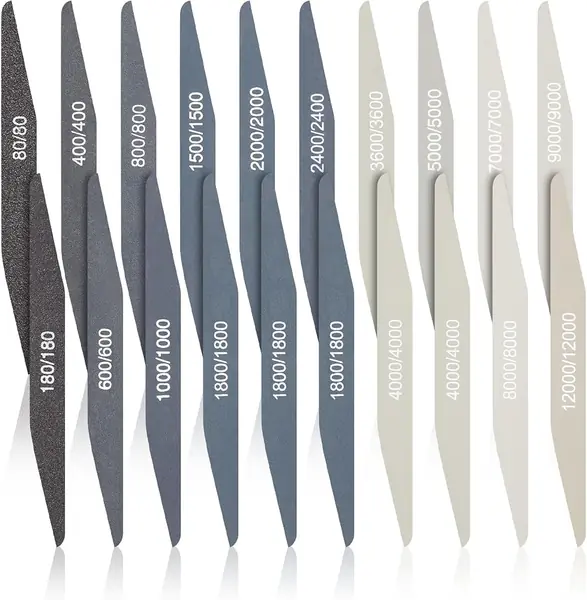
Honoson sanding sticks in twenty labeled grits with angled double-ended tips

Shaping to polishing

Track Score 92/100
Sticks Included
20
Grit Labels
Printed on each stick
Tip Shape
Double angle
Grits Included
20, from 80 to 12000
View on Amazon

A 12,000-grit stick is the reason this box is our default. Most sets in this group stop at 1,500 or 3,000 — far enough to flatten a seam, not far enough to bring clear plastic or resin back to a shine. Honoson runs 20 labeled grits from 80 to 12,000, so one purchase takes a sprue nub down, refines the shape, and polishes out the scratches that shaping leaves behind. That arc, coarse to mirror, is what a model builder actually needs, and no other set here covers it with this few gaps.

The double-angle cut is the second thing that sold us. The angled faces meet a corner and follow a curve instead of rocking across it, and the same stick gives you a straight edge for a long seam. Each stick carries its grit number printed on the body, which sounds trivial until you are four steps into a polish and everything on the bench looks gray.

They are not thin. The body is heavier than a strip of sanding film, which steadies a long pass but keeps the stick out of a narrow panel line — that is a job for a tapered twig. Worth comparing before you buy: the stedi set starts at 400 grit and cannot shape anything, while the Lasnten kit adds a stand and a hundred more pieces for several times the money.

Worth Noting

  • Fine grits wear faster under hard pressure
Our Verdict

We recommend this to almost every model builder: 20 labeled grits from 80 to 12,000 cover shaping and final polish in one low-cost box.

Check Latest Price
2.

stedi 6-Piece Sanding Stick Set Best for Polishing

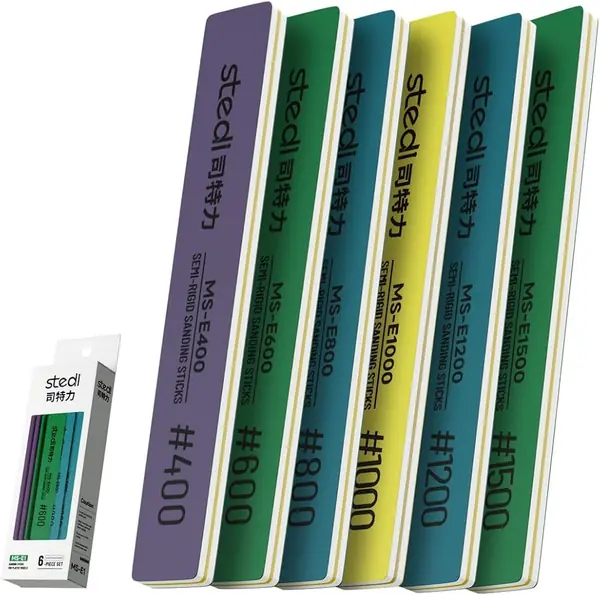
stedi double-sided sanding sticks in six labeled grits for plastic models

Polish-out on plastic

Track Score 91/100
Grit Range
400 to 1500
Sticks Included
6
Abrasive
Aluminum oxide and silicon carbide
Washable
Yes
View on Amazon

Where the Honoson set starts at 80 grit, stedi's starts at 400 and never looks back. Six double-sided sticks run 400, 600, 800, 1,000, 1,200 and 1,500, and that is a deliberate choice rather than a shortfall: these are finishing tools, stepping a surface down to an even haze before paint or clear coat.

What they do, they do cleanly. On styrene we got a uniform scratch pattern instead of the deep gouges a too-coarse stick leaves behind, and each step knocks the previous one back until the surface reads flat under a light. The sticks are washable, so a rinse and a soft brush between grits keeps coarse particles from riding along into the 1,200 stage — the most common way a polish goes wrong at the bench.

The double-sided format means twelve usable faces in a set this small, and every stick is labeled so the sequence stays in order. We treat the 400 and 600 as the workhorses and hold the 1,500 back for canopies, clear parts, and the last pass over anything that will catch the light. It is the set that finishes a model rather than the one that builds it, and at this price it earns a place beside a coarser box.

Worth Noting

  • Nothing coarser than 400 grit for shaping
Our Verdict

We keep this small washable set for the final stages on plastic models, where 400 to 1,500 grit polishes out scratches without gouging.

Check Latest Price
3.

SharingMoment 50-Piece Sanding Stick Set Best Budget

SharingMoment orange sanding sticks with pointed and flat double ends

Bench stock

Track Score 90/100
Sticks Included
50
Grits
120 and 280
Stick Length
5.4 inches
Tip Sections
Flat, round, pointed
View on Amazon

Fifty sticks, each with 120 grit at one end and 280 at the other, works out to a hundred usable faces. That is the point, and it is why we keep a box of these on the shelf: a seam, a glue line, or a locating pin never has to wait on a trip to the hobby shop, and nobody agonizes over burning through a stick.

The shapes do more than the count suggests. Each stick is cut with flat, round, and pointed sections, so the flat side holds a line along a wing edge while the point works a groove or a hole without dragging the whole stick over the detail around it. The orange body is light and stiff, which we liked for one-handed work while the other hand holds the part still.

Where it stops is at 280. Nothing in this box will polish clear plastic or bring primer to a shine, so it belongs at the front half of a two-set bench with something finer sitting beside it. Buy it as a supply rather than a tool and it does exactly what a supply should: it keeps the coarse work moving without a second thought about cost.

Worth Noting

  • Pointed tips crumble under hard pressure
Our Verdict

The box we hand to anyone starting out: 50 double-ended sticks with 120 and 280 grit on every one, cheap enough to use up without thinking.

Check Latest Price
4.

Lasnten 131-Piece Sanding Stick Set Best Complete Kit

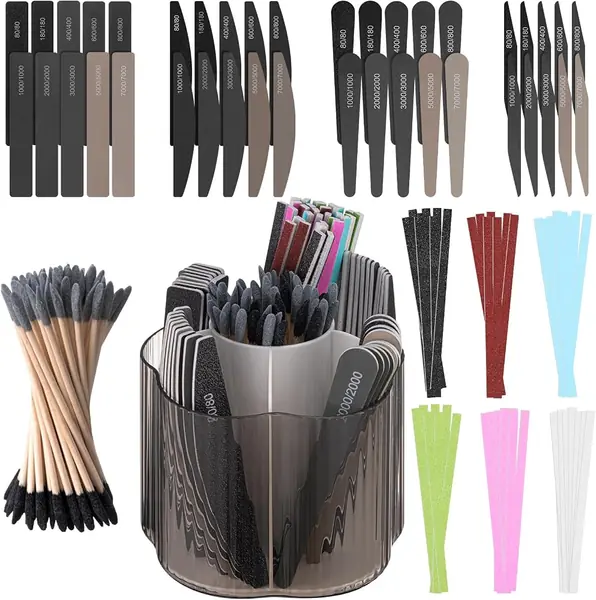
Lasnten sanding stick set with rotating carousel holder and labeled grit sticks

Full bench setup

Track Score 89/100
Grit Range
80 to 7000
Pieces Included
131
Storage
360-degree rotating holder
Component Mix
40 sticks, 30 twigs, 60 slanted twigs
View on Amazon

A rotating holder sounds like packaging until the first time you spin it. The sticks stand upright in a carousel with their grit numbers facing out, and you turn it to the step you need instead of pawing through a bag of gray sticks that all look alike. Six inches of bench is real estate on a crowded desk, and this is the one accessory here we would not give up.

The contents are three formats rather than one: 40 polishing sticks in four shapes across ten grits from 80 to 7,000, 30 sanding twigs, and 60 double-sided slanted twigs. That mix is what makes it a whole-bench purchase — full-size sticks for seams and flat edges, twigs for holes and inside corners, slanted twigs for the angled faces in between.

It is the most expensive set here by a wide margin, and the premium buys quantity and organization more than it buys a better abrasive. Build one kit a month and the Honoson box does the same grit work for a fraction of the money; build constantly and the arithmetic flips, because you stop reordering and stop hunting.

What we keep coming back to is the sorting. Loose sticks end up in a drawer with the labels rubbed illegible, and half the time you are guessing between 800 and 1,000 on a surface that will show every mistake. As a bench system this is the best-organized set here, and the carousel is the piece of it we miss when it is not on the desk.

Worth Noting

  • Holder takes about six inches of bench
Our Verdict

For a bench that needs everything at once, we point to this 131-piece set and its rotating holder that keeps every labeled grit upright and findable.

Check Latest Price
5.

Sanding Detailer Finishing Kit Best Reusable Handle

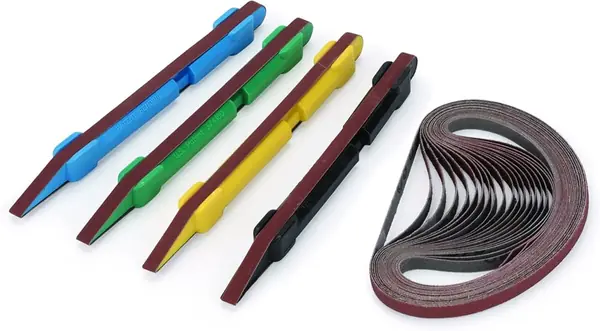
Sanding Detailer kit with four color-coded hex handles and aluminum oxide belts

Fine detail finishing

Track Score 88/100
Grits
240, 320, 400, 600
Belt Size
1/4 x 12-3/4 inches
Belts Included
20
Handles Included
4 color-coded
View on Amazon

The stick itself is the difference here. A spring-tensioned back on a hexagonal plastic handle grips a 1/4 by 12-3/4 inch aluminum oxide belt; rotate the belt to a fresh face when one section dulls, and slide on a new loop when the whole thing is spent. Four color-coded handles and 20 belts — five each in 240, 320, 400, and 600 grit — make up the kit, and a handle that reloads behaves nothing like a stick you throw away.

The profile is thoughtful: tapered at one end for intricate work, flat along one side and rounded on the other, so the same tool handles a straight run, a concave curve, and a corner. The hexagon gives your thumb something to push against and stops the handle rolling off the bench in the middle of a pass.

In use this is the most controlled tool in the group. A taut belt cuts at an even pressure a soft-bodied twig cannot match, and we found it holds a straight line along a molded edge with far less wandering than a loose abrasive. It is the tool for a long, visible run of trim or a wing root, where a slip costs an hour of repair.

Worth Noting

  • Grits stop at 600 with no polishing stage
Our Verdict

A reloadable handle instead of disposable sticks: we recommend it for fine detail work on wood and plastic, where control matters more than grit range.

Check Latest Price
6.

Leriton 70-Piece Sanding Stick Set

Leriton sanding sticks and fine twigs with grit numbers marked on each piece

Small-area cleanup

Track Score 87/100
Grit Range
80 to 7000
Grit Labels
Marked on each piece
Pieces Included
70
Fine Twigs
30 in six grits
View on Amazon

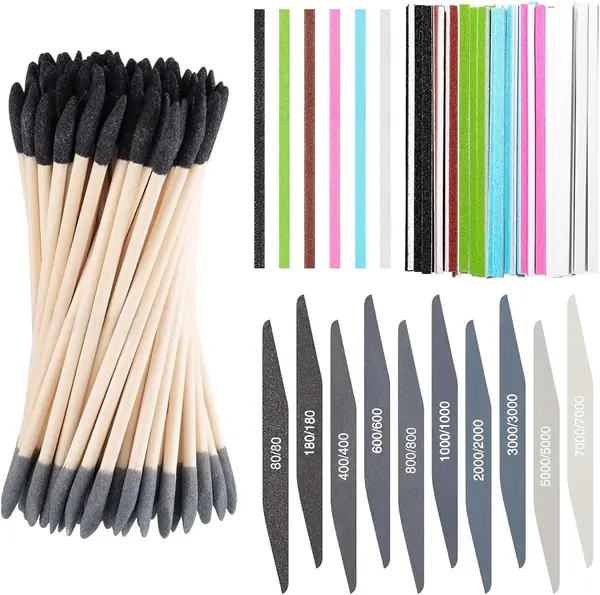
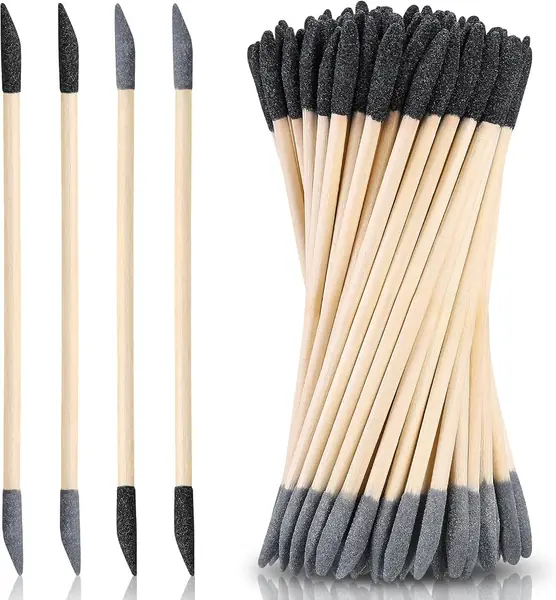
Seventy pieces, and they do not all do the same job. Ten full-size sanding sticks cover the ladder from 80 to 7,000 grit, and 30 fine twigs in six grits take over where a full-width stick cannot fit — a locating hole, a groove, the inside corner of a cockpit tub. Buying the two formats in one box is tidier than buying them apart, and it is cheaper than the kits that also throw in a stand.

That split is what we appreciate most. A stick with some width holds a flat surface flat, and the twigs get into places where a wide stick would sand the surrounding detail as well as the spot you are fixing. Every piece is marked with its grit, so coarse twigs do not migrate into the polishing pile.

Where the set earns its mid-range price is the twig count: 30 of them across six grits, more than the stick-only boxes offer and enough that you stop hoarding the small ones. Honoson covers the same grit ladder for less money as a set of sticks; Lasnten carries far more of everything for a premium. Between those two, this is the one to pick when your sanding happens in places a wide stick cannot reach.

Worth Noting

  • One stick per grit means fast run-out
Our Verdict

We like this set as the middle path: ten full-size sticks across ten grits and thirty fine twigs, without the cost of a full bench kit.

Check Latest Price
7.

Dura-Gold Water Drop Sanding Sticks Best for Curved Surfaces

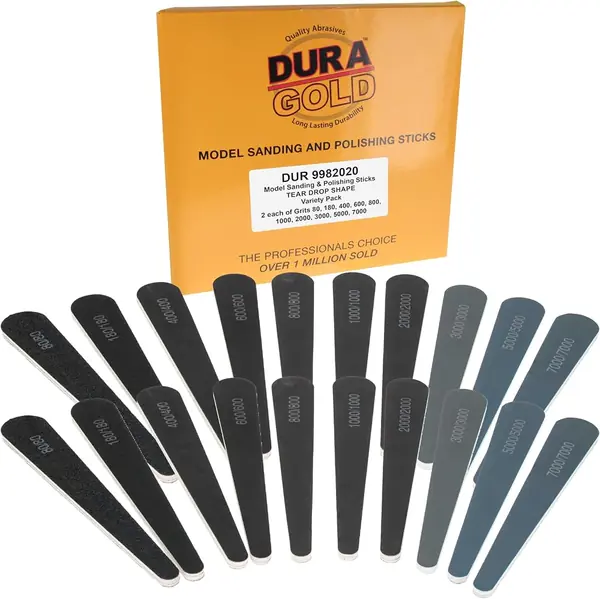
Dura-Gold water drop shaped sanding sticks with tapered cushioned double-sided ends

Curved surfaces

Track Score 86/100
Width
3/4 to 3/10 inch
Length
5 inches
Stick Style
Water drop taper
Grits Covered
10, from 80 to 7000
View on Amazon

The shape is a water drop: five inches long, widening from about 3/10 inch at the tip to 3/4 inch at the back, and 1/6 inch thick. That taper earns its keep on a model. The narrow end works a corner or a curve without the wide shoulder dragging across detail you have already finished, and the wide end covers a seam in a couple of passes instead of ten.

Ten grits run from 80 up to 7,000, and the sticks are double-sided and cushioned, so they give slightly against a compound curve instead of chattering across it. We noticed the give most on rounded fuselage sections and car bodies, where a rigid stick wants to rock up onto one corner and leave a flat spot.

This is the set for surfaces that aren't flat. A firm stick still wins on a straight edge — the belt-driven handle holds a line better than anything soft-backed — but on a rounded shoulder the water drop follows the shape and leaves an even scratch. Ten grits is modest next to the twenty- and seventy-piece boxes here, and the shape is why it holds a place anyway.

Worth Noting

  • Cushioned backing rounds a crisp edge
Our Verdict

Our pick for curved surfaces: the water-drop taper widens from a point to three-quarters of an inch, so one stick handles a corner and a broad panel.

Check Latest Price

How We Tested Sanding Sticks for Models

We started with spec sheets for sanding sticks sold singly, in sets, and in kit boxes, then narrowed to those covering a real grit ladder rather than a handful of near-identical middle grits. Anything that repeated the same grit across every piece, or topped out too coarse to polish, came off the list before we ordered. That left 16 sets.

Testing ran four months on a working bench, in evening sessions with kits in progress: seam lines on aircraft fuselages, gate nubs on miniatures, layer lines on resin prints, and the inside corners a folded paper won't reach. We worked over a tray in a ventilated spot so the fine dust stayed contained, wiped parts down between grits, and kept safety glasses on.

Each set was used the same way. We counted the grit steps between coarsest and finest and checked each surface under a bright light to see whether a jump between steps left scratches behind. We pressed hard into edges to see whether the abrasive stayed bonded or shed onto the part, and noted how many passes it took before a stick went soft and stopped cutting. We dumped each set out of its packaging to see if coarse and fine could be sorted by eye, and pushed every taper into a corner to check whether it held an edge or rounded over. After each session, sets were rinsed in warm water, dried, and used again so we could see how much cutting power came back. We also counted how fast the coarse pieces ran out, since that decides whether a large pack is worth the money.

Seven sets made the list; the ones that didn't usually looked fine in the package and quit cutting by the second evening.

How to Choose Sanding Sticks for Models

Match the grit ladder to the work you do

Shaping happens between 80 and 320 grit, smoothing between 400 and 800, and polishing above 1,000. Most model builders need both ends of that spread, which is why one 20-piece ladder covers more ground than a 50-piece box carrying only two grits. If your sanding starts at primer and paint rather than bare plastic, a 400-to-1,500 set does the whole job and is easier to keep in order.

The common mistake is buying the big coarse pack because the quantity looks like value. You will use three of those sticks and spend the next year wishing the same box had something finer than 280 in it.

Check how the abrasive is bonded

The complaint that follows sanding sticks around is grit that rubs off or leaves a gray residue on the part. A coating that sits on the surface of the stick rather than being properly bonded can shed within a few passes, and the fine grits go first. Sand a scrap of sprue before you commit to a large pack: an even, dulled patch is normal wear, while bare patches and loose grit mean the bond is failing.

We put more weight on a stick that keeps cutting for a dozen passes than on one that cuts fast and sheds. Every stick is a consumable, so count what you get per grit as carefully as you count the total.

Pick shapes for the surface, not the shop photo

Flat and angled sticks hold a plane and meet a corner squarely, which is what you want on a wing root or a long seam. Thin sanding twigs reach into holes, grooves, and panel lines where a wide stick would sand the surrounding detail along with the spot you are fixing. Cushioned water-drop profiles follow compound curves but will round over a crisp edge if you lean on them, so they complement a firm stick rather than replace one.

Labels and storage keep your grits honest

An unlabeled twig is the most reliable way to ruin a finished panel: once the grit dulls, coarse and fine look identical until one of them scratches. Buy a set that prints the number on the body, or mark the ends yourself with a permanent marker and a code you will remember.

A holder is optional, but keeping the sequence upright on the bench is the difference between stepping through grits in order and hunting for the right stick with the part in your hand.

Frequently Asked Questions

Final Verdict

We point most model builders to the Honoson 20-piece set. Twenty labeled grits from 80 to 12,000 handle the entire job — shaping, smoothing, and the final polish that most sets here cannot reach — for about the same money as the budget dual-grit boxes.

If your sanding starts at paint and primer rather than bare plastic, the stedi set's 400-to-1,500 range is the better buy, and its washable sticks make the sequence easy to keep clean. For a bench that needs everything sorted in one order, Lasnten's carousel kit is worth the premium.