Best Single-Action Airbrushes for Hobby Spraying of 2026

A single-action airbrush is the least fussy tool on the bench. The trigger only releases air; you set paint flow once with a knob at the back and spray. That preset is the appeal: prime a dozen miniatures or lay basecoat after basecoat and every pass comes out the same, with one less thing for your hand to manage. You give up adjusting mid-stroke, so the real decisions are nozzle size and how much of an afternoon a color change eats.

Coming from rattle cans, the difference on a humid day is not subtle. Spray pattern width told us more than any feature list across 11 guns used on model primer and basecoat in a garage, thinned color on cakes and water-based foundation at a desk. A fraction of a millimeter at the nozzle separates hairline detail from covering a fuselage in two passes, and the four picks sit on both sides of that line.

Our Top Picks

The Best Single-Action Airbrushes for Hobby Spraying

1.

Paasche H-Set Single Action Airbrush Set Best Overall
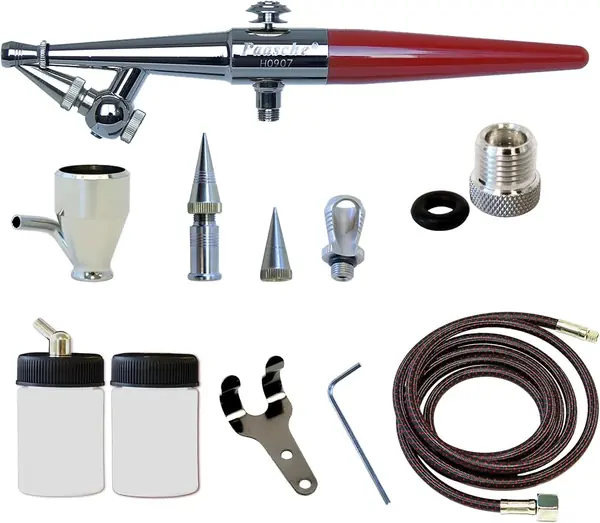
Paasche H-Set single-action siphon-feed airbrush with metal cup and one-ounce bottle

Priming and basecoating

Track Score 91/100
Feed Type
Siphon
Spray Pattern
1/16 inch to 1-1/2 inches
Nozzle Sizes
Three heads: 0.45mm, 0.65mm, 1.05mm
Cup And Bottle
1/4 oz metal cup, 1 oz bottle
View on Amazon

Coverage is what separates the H-Set from everything else in this guide. With the largest of its three heads fitted, it throws a fan up to 1-1/2 inches wide — broad enough to prime a model body or lay a full base coat without the gun crawling back and forth across the panel. Swap in the smallest head and the same brush pulls down to a 1/16-inch line. All three heads ship in the box, along with the wrench for changing them, and we think that range is the whole argument for a hobbyist who wants one gun to handle primer, color, and touch-up work.

Siphon feed is the other half of the design, and it's the part that makes basecoating practical. Paint comes up a tube from a one-ounce bottle hanging under the gun, so you can mix a real batch of primer and keep spraying instead of dribbling in a quarter ounce at a time. A quarter-ounce metal cup comes with it for small mixes, along with a spare storage bottle and a hanger that keeps the bottle upright between passes.

Single action is the point, and Paasche keeps it about as forgiving as it gets: press the lever and air plus a preset paint flow arrive together, with nothing to modulate mid-pass. A beginner gets an even coat before developing any technique, which is exactly why this sits at the top of our list rather than one of the dual-action brushes. The external-mix head helps on the back end too — paint meets air outside the nozzle, so a flush with cleaner and a wipe handles most color changes, and the whole head comes off with the wrench for a proper clean.

Budget for one accessory. A six-foot braided hose is included, but the fittings don't match every compressor on the market, so look at the thread on your machine before the gun ships and add an adapter to the order if it doesn't line up.

Worth Noting

  • Siphon feed needs more pressure than gravity cups
Our Verdict

We think the Paasche H-Set is the single-action airbrush to buy first: three heads, a one-ounce bottle, and a hose in the box cover primer through fine lines.

Check Latest Price
2.

Art of Air Professional Single Action Gravity Feed Airbrush Best for Fine Detail

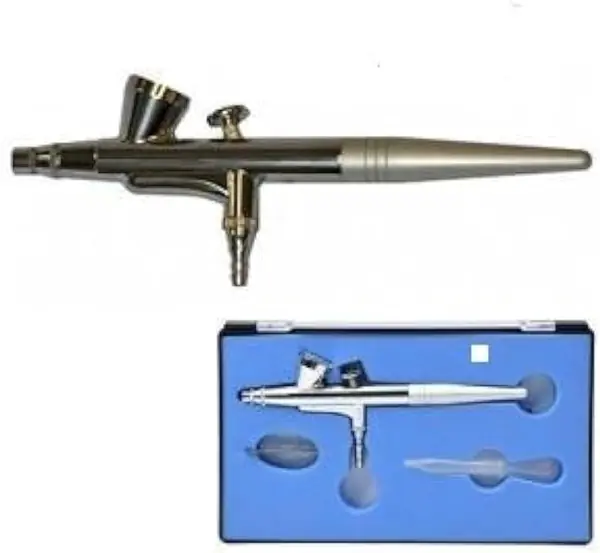
Art of Air single-action gravity-feed airbrush with 0.4mm nozzle and small paint cup

Fine detail work

Track Score 85/100
Nozzle Size
0.4mm
Feed Type
Gravity
Spray Pattern
Hairline to 2.5 inches
Cup Capacity
1/16 oz
View on Amazon

Hairline to 2-1/2 inches is a wider spread than we expect from a gun this small. The Art of Air gets there with a 0.4mm nozzle and a 1/16-ounce cup sitting on top, and everything about it is set up for thin fluid: cosmetic foundations, inks, and the sort of thinned model paint a fine tip can push without spitting.

We like it best as a detail gun. For panel lines, small body parts, figure faces, and touch-ups it lays down a smooth, controllable mist, and the gravity cup self-feeds at low pressure, so a modest compressor keeps up. What it won't do is cover a body shell in one pass — a 0.4mm tip is the wrong tool for thick primer, and the spray never gets wide enough to be efficient across a large panel.

The single-action trigger is what makes it usable for someone new to airbrushing: one press, one preset mix, no needle to feather mid-pass. Set the air and fluid control once and the gun repeats the same coat pass after pass, which is exactly what you want when you're spraying twenty small parts and not thinking about technique. It's sold as a cosmetic brush, and that background shows in the mist quality — fine and even enough to flatter a face and just as useful on a model.

Worth Noting

  • Tiny 1/16 oz cup needs frequent refills
Our Verdict

For small work and thin paint: it lays down a fine, even mist for very little money.

Check Latest Price
3.

Pinkiou Single Action Airbrush Gun Best for Cake and Cosmetics

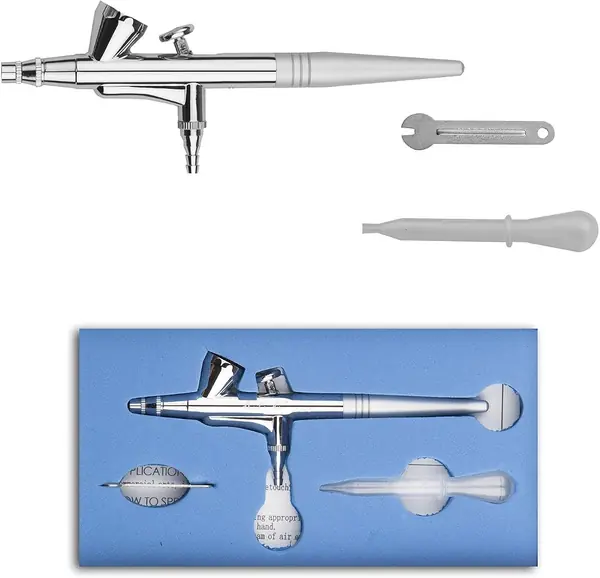
Pinkiou single-action airbrush gun with 0.4mm needle and nozzle for makeup and cake

Cake and makeup

Track Score 84/100
Nozzle Size
0.4mm
Fluids
Water-based foundations
Trigger
Single action
In The Box
Airbrush gun only, no hose or compressor
View on Amazon

Cake decorators, nail techs, and makeup users want the same three things from a gun: a soft, even mist, a fast flush between colors, and a price that doesn't sting. The Pinkiou is built for exactly that crowd — a 0.4mm single-action airbrush gun small enough to hold like a fat pen and light enough that a long session doesn't wear out your hand.

For cosmetic work we like it more than its price suggests. One press delivers air and a preset paint flow, so a soft, even pass repeats easily, and water-based foundations and food colors move through the 0.4mm tip without a fight. There's nothing to adjust mid-pass, which is the whole reason to choose single action for this kind of spraying.

Cleaning is where a cheap gun usually gives itself away, and this one is straightforward: empty the cup, refill with water or solvent, then block the nozzle cover with a finger and spray so the air back-flushes the passage. It's a minute between colors, with no tools and no teardown.

The one thing to plan for is thinning. The cup wants fluid roughly the consistency of milk, so foundations and food colors often need a splash of water before they go in; load it neat and you'll spend the session clearing the tip. For cake and makeup work that's a normal step, not a hardship.

Worth Noting

  • No hose or compressor in the box
Our Verdict

For cake, nails, and makeup, this inexpensive single-action gun gives a soft, repeatable mist and cleans up in about a minute.

Check Latest Price
4.

Crpen 0.3mm Airbrush Gun

Crpen 0.3mm airbrush gun in black with fine needle and nozzle

Cheap backup gun

Track Score 78/100
Nozzle Size
0.3mm
Fluids
Water-based only
Weight
1.76 oz
Compressor Fit
Most handheld airbrush units
View on Amazon

Read the description closely and this is clearly a replacement airbrush gun for a small handheld compressor, not the start of an airbrush setup. The 0.3mm head and fine nozzle are built for detail and light coats, and the body is tiny — barely more than a handle with a small cup on top.

At this price we treat it as a spare. If you already own a portable unit whose head has died, this is the least expensive way to keep it working, and a 0.3mm tip is genuinely useful for small detail and light shading where the bigger guns here are clumsy.

Follow the maker's care notes and it lasts longer: flush the cavity, nozzle, and cup after every session, clean it out if you stop for more than ten minutes, and don't soak it — the soak does more damage than the paint. That's more discipline than one of the cosmetic guns needs, and less forgiving than the Paasche's external-mix head, which wipes clean in seconds.

Two things to know before you buy. The compressor end is where these guns live or die: check that the fitting seals before you fill the cup, because a leaking thread shows up as a weak, sputtering spray that looks like a nozzle fault. And this is a detail gun — it will not prime a body shell, and thinned paint is a requirement, not a suggestion.

Worth Noting

  • Some units arrive not spraying properly
  • Water-based fluids only
Our Verdict

We see this as a spare rather than a first gun: the cheapest way to keep a handheld compressor in service.

Check Latest Price

How We Tested Single-Action Airbrushes

We started by pulling every single-action gun we could find with its nozzle size and feed type actually stated by the maker, then narrowed to 11 that covered both feed styles and the full spread from hairline nozzles to wide-coverage heads, at prices from hobby-cheap to buy-once. Testing ran eight months, and most of it happened where these guns actually live: a ventilated garage bench for primer and basecoat, a kitchen counter for cake and thinned color, a desk for makeup and nail work. The rest was maintenance — tear down, soak, reassemble, spray again.

At the bench we sprayed a strip of cardboard at a fixed distance, measured pattern width at full trigger, then dialed back to see how narrow a line each gun could hold without spitting. We counted fills from each cup or bottle to cover a single primed model, and timed a full color change with a stopwatch — dump, rinse, pull the head, dry, reload — three times per gun. A gun that needed four fills for a job another did in one lost ground on value, not just on convenience.

Air supply separated the field more than anything else: we fitted each gun to two compressors and noted which fittings it needed and how much pressure it took to atomize cleanly. Durability came from repetition — dozens of spray-and-clean cycles per gun, watching for needles that dulled, seals that wept, and presets that crept mid-session. Balance only showed up in long sittings, so we logged two-hour priming runs and weighed each gun in hand. Every solvent went through a gun rated for it, in a ventilated garage with a respirator on; the cosmetic-style guns stayed on water-based fluid only.

How to Choose a Single-Action Airbrush

Start With the Nozzle, Not the Features

Head size sets both ends of what a gun can do. A 1.05mm head, like the largest of the Paasche's three, throws a wide fan for primer and base coats; a 0.3mm or 0.4mm tip gives you a fine line but balks at thick paint. If you're priming model bodies, buy for the wide end and accept that fine lines come from a smaller head you swap in later. If your work is small — figures, nails, cake — a 0.3mm to 0.4mm gun covers it and the wide fan is wasted.

A fine nozzle and unthinned primer are the most common mismatch, and it isn't the gun failing: the paint is simply too thick to pass. Thin to the consistency of milk first, and only then decide the tip is too small.

Gravity Cups and Siphon Bottles

A gravity cup sits on top and lets paint fall into the airstream; a siphon bottle hangs underneath and pulls paint up a tube. Gravity guns run at lower pressure and are easier to flush, which is why most of the small cosmetic-style airbrush guns here use a cup. Siphon bottles hold more — a full ounce on the Paasche — and let you spray a batch without stopping.

Match the cup to the job. A 1/16-ounce cup is right for a face or a handful of parts and wrong for a body shell, where you'll spend as much time refilling as spraying.

What Your Compressor Has to Supply

Every gun here is air-powered, and none includes a compressor. What differs is the connection: the Paasche ships with a six-foot braided hose, while the others arrive bare and expect you to supply the hose and fittings. Before you order, look at the outlet on your compressor — a hose in the box does not guarantee it threads on.

A regulator and a moisture trap matter as much as the gun itself. Without a regulator you can't return to the same spray setting twice, which is most of the appeal of single action in the first place.

Cleaning and Wear

Buy for the cleaning you'll actually do. An external-mix head like the Paasche's wipes clean quickly; a fine 0.3mm or 0.4mm passage needs a flush after every session and a proper clean whenever a color change matters. Don't soak a gun in solvent unless it's rated for it — the small replacement guns are explicit about that.

Budget for cleaner and thinner as ongoing costs, and expect the needle tip and nozzle to be the parts that eventually want attention. A gun you don't dread cleaning is a gun you'll use for the small jobs, not just the big ones.

Frequently Asked Questions

Final Verdict

The Paasche H-Set is the one we point to first, because it is the only gun here that does the whole job: a 1-1/2-inch fan and an ounce of paint for primer and base coats, a small head for lines, and a hose in the box.

Choose the Art of Air when the work is small and the paint is thin, or the Pinkiou if the spraying is cake, nails, or makeup. The crpen earns a place only as a spare for a handheld compressor you already own.