Best 1/43 Diecast Cars of 2026

The ratio is the whole pitch: a 1:43 model is about 43 times smaller than the car it copies, roughly five inches long, so a whole row fits on one shelf. Not every maker holds to it, and side by side a few millimeters of drift shows. Footprint comes first; after that, a good 1:43 model earns its space with crisp panel lines, legible badging, the right shade of paint and an interior you can see into.

We measured each car against the published dimensions of the real one and rolled it across a cutting board to see whether it tracked straight. Mind the age labels: driver helmets, mirrors and wing endplates are choking hazards, so most of these are rated 14 and up and belong on a shelf, not in a toy bin. The six picks mix cased display pieces with models you can actually handle.

Our Top Picks

The Best 1/43 Diecast Cars

1.

Bburago 2025 Ferrari Hamilton #44 Best Overall
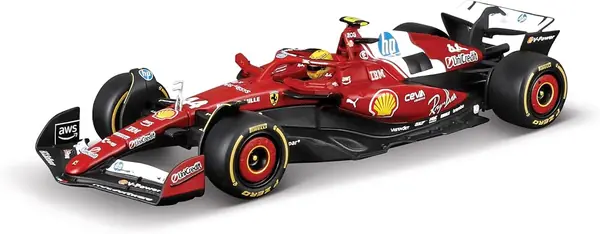
Bburago 1:43 scale 2025 Ferrari F1 car in Hamilton livery with acrylic display case

Modern F1 display

Track Score 93/100
Scale
1:43
Length
5.31 inches
Includes
Acrylic case and driver helmet
Model Year
2025
View on Amazon

The 2025 Ferrari in Hamilton's No. 44 is the model we put at the front of the shelf, and it's the one we reach for first when someone asks where to start. It arrives in an acrylic case with a printed sleeve and the driver's helmet sitting beside the car, so a new collector can display it the same afternoon without buying a plinth or a stand.

At 5.31 inches long it measures what a modern F1 car should at 1:43, and the die-cast body gives it a satisfying weight in the hand. The livery and badging hold up at arm's length, and the helmet is the detail we liked most — it turns the case into a small diorama rather than a car in a box.

It's also the least expensive F1 model in this group, and the McLaren further down asks noticeably more for the same scale and the same style of case. What you're adjusting to is size, not quality: 1:43 puts the whole car in your palm, so plan on a bookshelf or a desk rather than a mantelpiece.

Keep the printed sleeve. It's what keeps dust out of the case seams, and it's how these get stored once a shelf gets crowded.

Worth Noting

  • Labeled 14 and up, so display-only
Our Verdict

Our pick for most collectors: a current-season Ferrari with sharp livery, a metal body, and a helmet in a display case, all for less than the other F1 models here.

Check Latest Price
2.

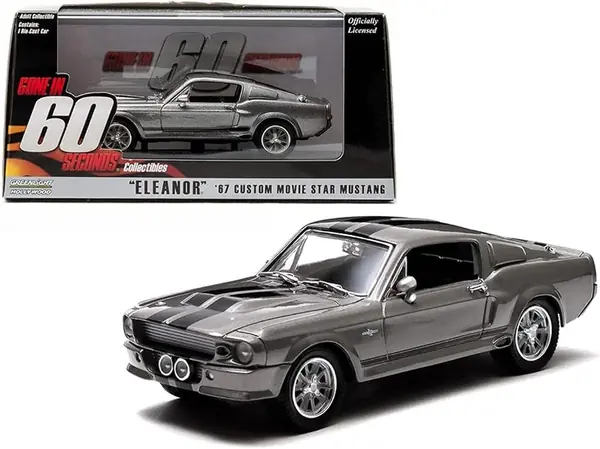
GreenLight 1967 Ford Mustang Eleanor Best Movie Car Replica

GreenLight 1:43 die-cast 1967 Ford Mustang Eleanor in gray with plastic display case

Movie car shelves

Track Score 92/100
Scale
1:43
Includes
Plastic display case
Subject
1967 Ford Mustang Eleanor
Body
Die-cast metal body and chassis
View on Amazon

A movie shelf usually starts here: the gray '67 Mustang fastback from Gone in Sixty Seconds, with the stance and wheels the film car is remembered for. GreenLight builds it with a die-cast metal body and chassis and ships it in a plastic display case, so nothing else is needed before it goes on show.

What we appreciate is that it's a film car modeled as a replica rather than a toy wearing movie paint. The proportions are right, the gray reads as the film car instead of a generic silver, and the case is part of the package rather than an upsell. It's a limited edition as well, which matters if you like knowing a run is finite.

The finish is a step behind the Norev below: the trim and shut lines read clearly from a foot away and soften when you get close. For a shelf piece that's a fair trade at this price, and the gray sits quietly next to the red Formula cars instead of competing with them.

Worth Noting

  • Sold without a manufacturer warranty
Our Verdict

The movie car we recommend first: an instantly recognizable Eleanor in a display case, best for film fans and anyone buying a gift for one.

Check Latest Price
3.

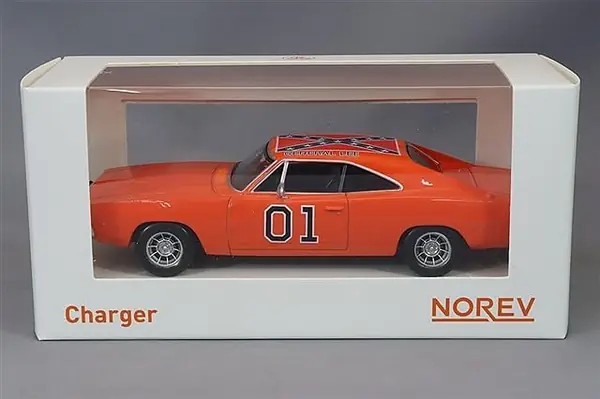
Norev 1969 Dodge Charger General Lee Best Premium Finish

Norev 1:43 scale 1969 Dodge Charger General Lee in orange with 01 door numbers

Premium muscle-car display

Track Score 91/100
Scale
1:43
Subject
1969 Dodge Charger General Lee
Body Style
Two-door coupe
Weight
10.6 oz
View on Amazon

The Charger is the most expensive model here, and the difference shows the moment you lift it out: at 10.6 ounces it's the heaviest car in this group, and the orange paint, the 01 door graphics, and the hidden-headlight nose are finished with a precision the budget picks can't touch. If a shelf is meant to be studied up close, the Norev rewards it.

The Dukes of Hazzard connection is both the reason to choose it and the reason some collectors pass. The roof carries the flag graphic from the show, reproduced as part of the replica rather than as something you can leave off. We treat that as part of the subject — if you want the 1969 Charger shape without the television baggage, look for a plain-livery version instead.

The money goes into paint and mass rather than moving parts, so think of it as a display object: it sits heavy and still and looks better the closer you get. Against the Eleanor it's a clear step up in finish for a clear step up in price.

Worth Noting

  • The priciest model in this group
Our Verdict

For the muscle-car collector who wants the sharpest finish on the shelf, this is the one; the premium is visible in the paint and in the weight.

Check Latest Price
4.

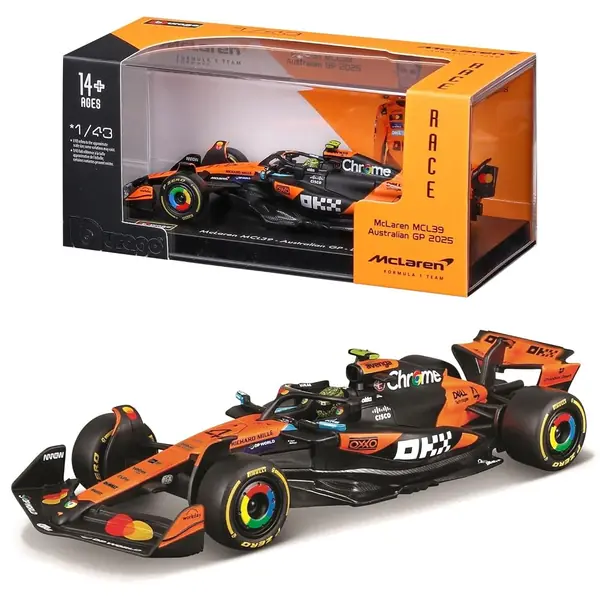
Bburago McLaren MCL39 Norris #4 Best for McLaren Team Fans

Bburago 1:43 scale 2025 McLaren F1 car in orange with helmet and case

McLaren team fans

Track Score 90/100
Scale
1:43
Length
5.79 inches
Includes
Driver helmet and display case
Wheels
Free-rolling
View on Amazon

Same shelf, same scale, different team: the MCL39 is Bburago's 2025 McLaren in Norris's papaya orange, and it's the natural alternative to our Ferrari pick for anyone whose loyalties run orange rather than red.

The recipe is the same — die-cast metal body, plastic detail parts, a helmet in the case — and at 5.79 inches it's the slightly longer of the two, which is how a 2025 F1 car should sit beside our top pick. Nothing in this group comes close to that papaya orange, so it's the car people notice first.

The catch is the price: this is the priciest Bburago in this group, and for a first display car the Ferrari is the smarter buy. What the McLaren adds is the wheels — they roll freely, so it's the one here you can scoot across a desk without feeling like you're breaking a rule.

Our Verdict

One for the McLaren faithful: a 2025 papaya-orange car with a helmet in the case and wheels that roll, provided you already know you want orange.

Check Latest Price
5.

KiNSMART 1953 Cadillac Series 62 Best for Gifts and Layouts

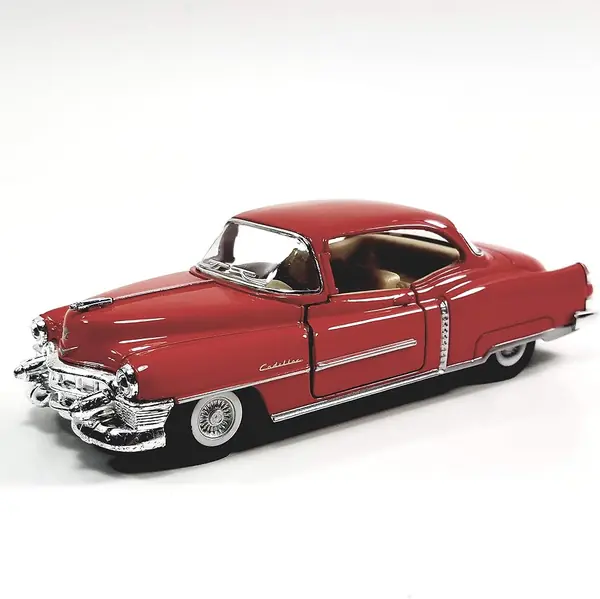
KiNSMART 1:43 die-cast 1953 Cadillac Series 62 in cherry red with opening doors

Gifts and layouts

Track Score 89/100
Scale
1:43 (O scale)
Length
5 inches
Colors
Four color options
Features
Opening doors and pull-back motor
View on Amazon

The train crowd reached 1:43 first: it's O scale, so a 1953 Cadillac like this sits on a model railroad layout as naturally as on a shelf. At 5 inches long it's a match for that job, and the chrome bumpers and glossy cherry red do most of the work from a few feet away.

We like it as a gift and as a desk car rather than as a serious collectible. The doors open, there's a pull-back motor in the wheels, and the tires are rubber — features that make it fun to hand to someone and that none of the display-first models here bother with. Black, eggshell white, and cotton candy pink round out the color choices, which is more variety than the rest of this list offers.

Set it beside the Ferrari and the difference is obvious: this is a cast body with a motor in it rather than a replica built for a case. That's the point of it, though — it's the one model here you won't wince at when someone picks it up.

Worth Noting

  • Toy-grade detail next to the display models
Our Verdict

The budget pick: a bright, chunky 1953 Cadillac with opening doors and a pull-back motor, best for gifts, desks, and O-scale layouts.

Check Latest Price
6.

KiNSMART 1967 Chevy Impala Best for Classic Sedan Shelves

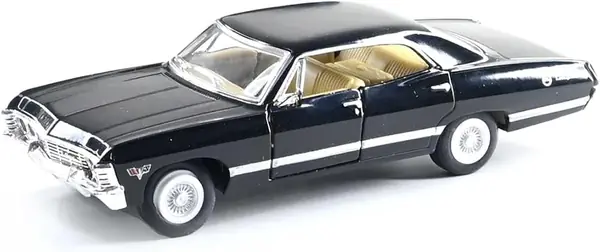
KiNSMART 1:43 die-cast 1967 Chevrolet Impala four-door hardtop in black

Classic sedan shelves

Track Score 88/100
Scale
1:43 (O scale)
Body Style
Four-door hardtop
Color
Black
Action
Pull-back motor
View on Amazon

A black 1967 Impala four-door hardtop is a shape people recognize before they can name it, and KiNSMART's version is the only four-door in this group. For a shelf built around family sedans and TV cars, that's the whole reason to look at it.

The build follows the Cadillac above: die-cast body, pull-back motor, a simple interior. Where the Cadillac leans on chrome and color, this one leans entirely on silhouette, and the black paint is the best thing about it — glossy, even, and the right color for that long roof.

At this money the body style has to be the reason, because the Cadillac does the same pull-back trick with more charm for less. Buy it for the four-door silhouette, or for someone who owned one, rather than as a general-purpose first model.

Worth Noting

  • Sold in black only
Our Verdict

For the four-door fan: a clean black 1967 Impala with pull-back play, worth it only if this is the exact body style you want on the shelf.

Check Latest Price

How We Tested 1/43 Diecast Cars

We built the shortlist from collector forums, retailer listings, and the specs makers publish, then filtered for models that state a true 1:43 scale, spread across price tiers, and covered the subjects collectors actually shop for: open-wheel race cars, movie hero cars, muscle cars, and classic sedans, plus a few pull-back models. That left 15 cars, which we lived with for four months on a dining table, a bookshelf, and a desk.

Each car came out of its box onto a cutting board with a ruler and calipers. We measured length and wheelbase against published dimensions for the real car, then set every model on a marked shelf strip to see how much room a row would take. Through a magnifier we read the badging, counted panel lines, and checked livery decals for alignment across doors and hoods; paint was compared in daylight and under a warm lamp. Then we weighed each one and turned it over in the hand to judge whether the body felt solid or hollow.

We noted whether each model arrived in an acrylic case, a plastic case, or bare, and how firmly it was held inside. Doors were opened and closed repeatedly where they opened, wheels were rolled across the cutting board, and pull-back motors were wound until they ran down. Mirrors, wing endplates, and driver helmets were checked for anything loose enough to come off in a hand, which is why every model stayed out of reach of kids and we read the age label on each box. Gifting got its own pass: several went to friends in tote bags, and we watched how the packaging held up. Finally, we compared each car against others in its price tier to see what the extra money actually bought in finish.

How to Choose a 1:43 Diecast Car

What 1:43 Actually Measures

At 1:43 a model runs roughly 4 to 6 inches long depending on the real car: the 2025 Formula cars here measure about 5.3 inches, the 1953 Cadillac about 5. That's bookshelf territory, not mantelpiece territory, and it's the most common surprise in this category — people order expecting a showpiece and open a box the size of their hand.

If you want one car that fills a shelf on its own, 1:18 is the scale you're after; if you want twenty cars in the space of two paperbacks, this is it. It's also O scale, which is why the same models turn up on model railroad layouts.

Material and Heft

Most models at this level pair a die-cast metal body with plastic detail parts, and the gap between a good one and a cheap one is how much metal you feel. Our premium pick is the heaviest model in this group and it reads that way in the hand; the budget models are lighter and feel closer to a toy.

Weight is not accuracy — a heavy model can still carry soft graphics — so treat heft as a clue rather than a verdict, and look for a metal body with separate plastic detail parts as the combination to check for.

Case, Window Box, or Nothing

Several models here arrive in an acrylic case with a printed sleeve, which solves the two problems a collector actually has: dust and somewhere to put the thing. Others ship in a plastic display case or a plain window box.

A case is worth a little more money, because a bare model on an open shelf collects dust in the panel lines within a month. If yours comes without one, buy the case with the model rather than later — sizes are easier to match while the car is still in its packaging.

Play Features and What They Cost

Opening doors, a pull-back motor, and free-rolling wheels all add play value, and they usually take something back in precision: a body built around a motor and hinged doors tends to have wider gaps and a simpler interior than a sealed display model. That's a fair trade as long as you make it on purpose.

If the car will be handled — at a desk, or by a child old enough for the model — buy the pull-back. If it will live behind acrylic, buy the sealed replica with the sharper panel lines.

Licensed Replicas and Inspired-By Models

An officially licensed model carries the maker's branding and the correct livery, and usually states a current season or model year. An inspired-by model borrows the shape and skips the license, which is part of why it costs less.

For display, the license matters most on race cars, where a livery error is obvious to anyone who follows the sport. Check the branding on the box and the model year in the title: a 2024 car and a 2025 car can look nearly identical in a photo and very different to a fan.

Frequently Asked Questions

Final Verdict

If you're buying one, buy the Ferrari in Hamilton's No. 44. It's the newest car in this group, the finish holds up close, and it arrives in a case with a helmet, so there's nothing else to buy before it goes on a shelf.

Spend more only for a specific reason: the Norev if the finish itself is the point, the GreenLight Eleanor if the car that matters is a movie one, and the little Cadillac if the model is a gift that will get handled.