Best 2WD RC Buggies of 2026

A two-wheel-drive buggy is the cheapest way into hobby-grade RC and one of the more confusing things to buy. One box holds a finished car with a battery and charger; the next holds a few hundred pieces, a body to paint and no radio at all. Start from the ground you actually have and how much building you want to do.

Speed matters less than the parts that take the abuse. Oil-filled shocks keep a buggy from pogoing off every curb the way friction dampers do, the differential and bearings have to survive a dozen packs, and a replacement arm should cost ten dollars, not thirty. The three here cover a first kit build, a car you can charge and drive tonight, and a small-space option that runs indoors.

Our Top Picks

The Best 2WD RC Buggies

1.

Tamiya Fighter NXGEN DT-04 Best Overall
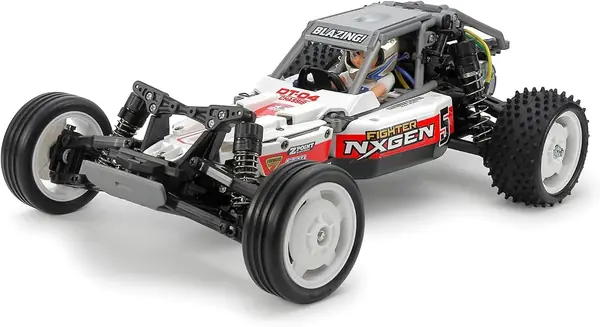
Tamiya Fighter NXGEN DT-04 1/10 2WD buggy kit in white with oil shocks

First-time kit builders

Track Score 88/100
Scale
1/10
Drivetrain
2WD
Wheelbase
265 or 280 mm
In The Box
ESC and 540 torque-tuned motor
View on Amazon

Oil-filled shock absorbers, a three-piece steering rack, revised axle carriers, and a wheelbase you build at either 265 or 280 mm. That's the parts list we expect on a race kit, and Tamiya puts it on the buggy it sells as the entry point for younger drivers — which is most of why we steer new builders to the DT-04.

The wheelbase choice earns its place. Build it short for a tight backyard course and the buggy turns in sharply; build it long and it settles at speed instead of feeling twitchy. One kit covering both means the car a new driver learns on is still worth driving a season later. And because Tamiya molds the body parts in white, a good paint job is a bonus rather than a requirement.

The box carries the electronic speed control and a 540 torque-tuned motor, plus illustrated instructions; the rest of the running gear is on you, which is the part first-time builders underestimate. We like that trade anyway — you finish the build knowing how the steering links and shocks go together, and that's the knowledge your first repair asks for.

The reservation is history: this is the newest design in the group, so there's less long-term experience behind it than the re-released classics carry. The revisions sit in the parts that take the beating — axle carriers, steering links, shocks — which is where we look first anyway. We're comfortable calling it the default.

Worth Noting

  • Battery and radio gear not included
Our Verdict

This is the kit we hand a first-time builder: modern shocks and steering, a speed control and motor in the box, and a wheelbase you can set to suit your own space.

Check Latest Price
2.

Tamiya BBX BB-01 Best Premium Kit

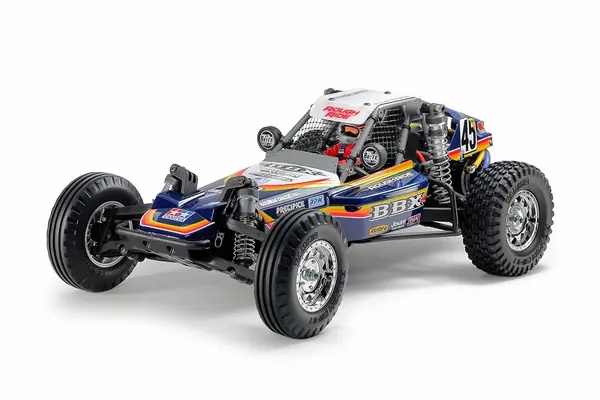
Tamiya BBX BB-01 1/10 2WD dune buggy kit with roll cage and spare tire

Display-worthy kit builds

Track Score 87/100
Scale
1/10
Drivetrain
2WD
Bearings
Full ball bearings
Differential
TA06 oil-filled gear differential
View on Amazon

A three-section polycarbonate body over a visible monocoque frame and roll cage, 1980s dune-buggy livery with retro wheels and tires, metal-plated bead-lock rims, a driver figure, light cases, and a spare-tire mount on the back. Nothing else here looks like a scale model before it turns a wheel.

The money goes where it should underneath: full ball bearings, a TA06 oil-filled gear differential, double-wishbone front suspension, and rear trailing arms borrowed from full-size UTV practice. Those are the parts that decide how a buggy puts power down and how much slop shows up after a season, and they're the reason this kit sits at the top of the price range.

We think the extra is well spent if you want a car that's as satisfying to look at as it is to drive. The fifth-wheel mount is the detail that sold us — the spare rides on the car instead of living in a drawer, which tells you how much thought went into the body. Go simpler if the build is a means to an end rather than part of the fun.

Worth Noting

  • Multi-piece body takes real time to finish
Our Verdict

The pick when the build matters as much as the driving: ball bearings, an oil-filled gear diff, and a dune-buggy shell worth leaving on a shelf.

Check Latest Price
3.

Losi Micro-B 2WD Buggy Best for Indoor Racing

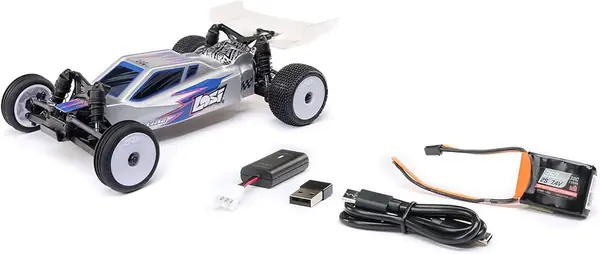
Losi Micro-B 1/24 2WD buggy in silver with oil-filled shocks and radio

Indoor racing

Track Score 86/100
Scale
1/24
Drivetrain
2WD
Run Time
20 minutes per charge
Top Speed
13 mph
View on Amazon

It arrives assembled, with a battery, a charger, and a radio in the box — charge it, switch it on, and drive. At 13 mph it's quick enough to be interesting in a living room and small enough to lap a coffee table, which is exactly the kind of space it's built for.

On low-pile carpet and smooth concrete we had a genuinely good time with it. The aluminum chassis and oil-filled shocks are the right parts for a car this size, and the 2-in-1 ESC and receiver keep the wiring tidy inside a shell that has no room to spare. Those same shocks and that chassis are what give it a fighting chance against a chair leg.

Where it stops is off-road. Losi points it at low-shag carpet, driveways, and smooth concrete, and 13 mph on grass or gravel is a frustration rather than fun. As a first hobby-grade RC car, a kitchen racer for a wet weekend, or a desk-side car that actually handles, we like it a lot — judged as a micro rather than a shrunken 1/10 buggy, it delivers.

Worth Noting

  • Short run time per charge
  • Small parts and a 14+ age rating
Our Verdict

We keep this one for rainy afternoons: it arrives assembled, runs 13 mph indoors, and costs the least of the three.

Check Latest Price

How We Tested the Best 2WD RC Buggies

We started with spec sheets and parts diagrams rather than marketing copy, narrowing a long list by scale, kit versus ready-to-run, and what came in the box — ESC, motor, radio, battery, charger. Before ordering anything, we priced the parts that break first and checked whether they were in stock, because a buggy you can't repair is a buggy you stop driving. Eleven made the cut.

Over eight months, we built the kits at a kitchen table, timing assembly and the finishing work — paint, decals, radio and servo install — and writing down every part the box didn't include. Ready-to-run models went from box to driveway in an afternoon, which is its own kind of data.

Driving happened where people actually drive: a concrete driveway, a gravel lot, a rutted dirt patch, and a carpet track in a basement. We ran 2WD and 4WD versions of the same chassis back to back on loose gravel to see exactly what two-wheel drive gives up. We timed every run per charge, priced a spare pack, and after each session checked for slop in the steering, grit in the bearings, diff smoothness, and tire wear.

Reliability got its own pass: repeated charge cycles over several weeks, curb strikes on purpose, then a teardown to see how easily it went back together. LiPo packs were charged on a concrete garage floor and never left unattended, and we stuck to the 14+ rating on every box. The three that stayed in rotation earned it.

How to Choose a 2WD RC Buggy

Start With the Surface, Not the Spec Sheet

A 1/24 buggy needs low-pile carpet, a driveway, or smooth concrete; a 1/10 buggy needs a backyard, a dirt lot, or a park path. The mismatch that catches people is buying small to save money and then finding the only place they can run is a lawn. Go micro because you'll drive indoors, not because it costs less.

Measure before you commit. A 1/10 buggy crosses a two-car garage in about a second at speed, so if that garage is your biggest open space, the smaller car is the more satisfying one.

Kit or Ready-to-Run

The Micro-B arrives assembled with a battery, charger, and radio and drives the day it lands. The Tamiya kits arrive as parts, and their boxes differ: the DT-04 includes a speed control and a 540 motor, and you supply the battery, radio gear, and charger either way.

Price the whole package, not the box. A kit that looks cheaper can lose that advantage once electronics and paint are added, so we tell first-time builders to add everything up before comparing two kits against each other.

What the Hardware Actually Buys

Oil-filled shocks, bearings instead of bushings, and a geared differential are the three upgrades that change how a 2WD buggy drives. Shocks keep the tires planted over bumps; bearings cut drag and wear; a geared diff puts power down without the inside wheel spinning away. The DT-04 brings the shocks, the BBX brings all three, and that gap is most of the price difference between them.

If you're torn between two kits, put the difference into suspension and bearings before you put it into a hotter motor. A fast motor in a car with weak dampers is harder to drive, not more fun.

Plan for Repairs Before You Need Them

Two-wheel drive sends the work through the rear tires, and the front end takes the hits. Price a replacement arm, a shock shaft, and a body set before you buy, and check that your local shop or the brand's parts line carries them — a buggy you can't fix is an RC car that sits in the garage.

Run time is the other limit. Every one of these runs on a pack, so a spare battery is the cheapest way to double a session.

Frequently Asked Questions

Final Verdict

For most people buying a 2WD off-road buggy, the Tamiya Fighter NXGEN DT-04 is the one we point to: modern shocks and steering, electronics in the box, and a wheelbase that suits the space you actually have.

If the build itself is the reward and you want a car worth leaving out on a shelf, the BBX is the step up. And if your driving happens indoors, the Losi Micro-B is the only one here that's running an hour after the box arrives.