Best RC Transmitters of 2026

Every RC car, boat or plane ships with a radio, and most owners replace it. The box radio can't tell you whether a crawler will hold a line on a sidehill, whether a dropped signal leaves the truck stopped or sailing into a curb, or whether the fourth channel is reachable with a thumb still on the wheel.

The receiver is half the radio. A gyro or a splash-rated case changes how a truck drives more than an extra channel does, and a 2.4GHz range figure is an open-air number, not a promise about the far side of a treeline. Over eight months on rock courses, a drift pad, a boat pond, a foam plane and simulators, 14 transmitters narrowed to nine, wheel radios for surface models and stick radios for aircraft.

Our Top Picks

The Best RC Transmitters

1.

Radiolink RC6GS V3 Best Overall
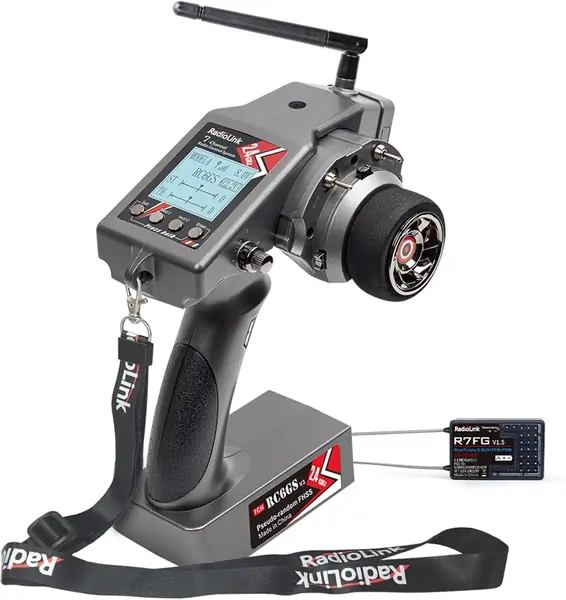
Radiolink RC6GS V3 black seven-channel RC transmitter with LCD screen and R7FG receiver

Crawlers and bashers

Track Score 95/100
Channels
7
Included Receiver
R7FG with gyro, IPX4
Rated Range
1,900 ft
Model Memory
30 models
View on Amazon

Radiolink rates the RC6GS V3 at 1,900 feet, and the number we care about is smaller than that: the distance where the link stops stuttering behind a hill. The radio keeps a frequency-hopping 2.4GHz link, and in a speed-run car the throttle stayed crisp well past the point where the body is just a dot. We haven't driven it out to the rated 1,900 feet, and no rating like that survives a tree line or a crowd of other radios, but as a surface link this one has headroom to spare.

What separates it from the five-channel radios here is where channels six and seven go. CH3 through CH7 can each be assigned to the VR knob, the two three-way switches or the two tact switches, so a crawler can carry lights, a winch and rear steering at once. We got the most use out of SWA, the cruise setting that holds speed on a long downhill descent — you steer instead of holding throttle.

The bundled R7FG receiver carries a gyro you adjust from the transmitter's VR switch, and that is the feature that makes the combo feel expensive: stability on a drifting or on-road car without ever touching the receiver. It is rated IPX4, so splashes and mud are fine, though we still dry the plugs after a wet run.

Two things surprise people coming from a stock ready-to-run radio. One is telemetry — pack voltage up to 8S and signal strength sit on the screen while you drive, provided the receiver in the car supports it, and the R7FG does. The other is 30-model memory with dual program mix, which lets one radio run a 4WD crawler with a dig unit and a tank with two ESCs without rebinding anything.

Enough channels for accessories, a gyro receiver in the box and range that holds up are why this is the radio we recommend first to anyone who does not already own a system. It runs on AA cells or a rechargeable pack, and the AA route gets expensive if you drive often, so plan on a pack. If five channels covers your builds, the RC4GS below does most of this for less.

Our Verdict

For most surface hobbyists this is the radio we tell you to buy: seven usable channels, a gyro receiver in the box and range that holds up on a speed run.

Check Latest Price
2.

Flysky FS-GT5 Best Handling

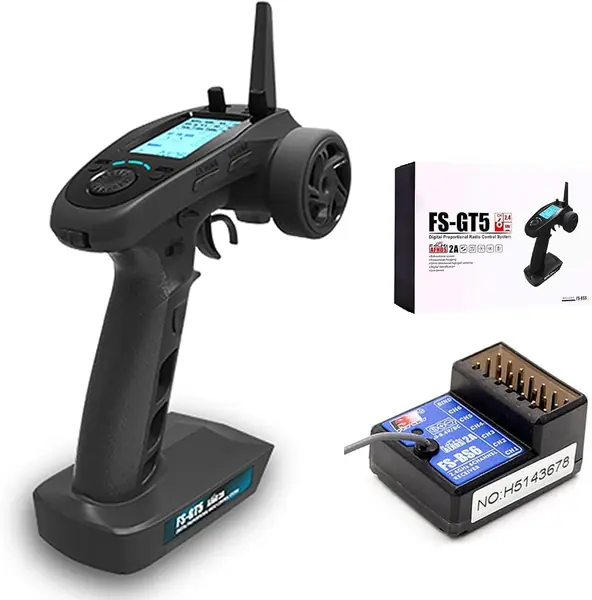
Flysky FS-GT5 black wheel transmitter with LCD screen and FS-BS6 receiver

Feel and simplicity

Track Score 94/100
Channels
6
Included Receiver
FS-BS6
Model Memory
20 models
Driving Modes
Crawl, SVC gyro, ABS
View on Amazon

Pick up the GT5 and the shape does half the work: the wheel sits where your thumb expects it, the case has a heft that reads as quality, and the grip stays comfortable through a full pack. It is the radio we hand to anyone who says the transmitter that came with their truck feels like a toy, because the difference is obvious in the first thirty seconds.

Three driving aids do the real work. CRAWL mode smooths throttle for rock sections, SVC adds gyro stability for loose surfaces, and the ABS function gives you six automatic-brake settings instead of one factory compromise. Setting them up took us a single sitting. The screen is small but the layout is logical, and the model-name field means you know which truck you are on before you pull the trigger.

If watching pack voltage on the screen while you drive matters to you, a Radiolink is the better fit; what the GT5 offers instead is the driving modes and the way it sits in your hand, which is why it suits a crawler best. Extra Flysky receivers are cheap enough that adding a second truck is an errand rather than a purchase, and the binding process takes a minute.

Worth Noting

  • Smaller model memory than the Radiolink radios
Our Verdict

Buy the FS-GT5 if the way a radio feels in your hand is what you care about; its crawl, gyro and ABS modes make it our favorite wheel radio for a crawler.

Check Latest Price
3.

Radiolink RC4GS V3 Best Value

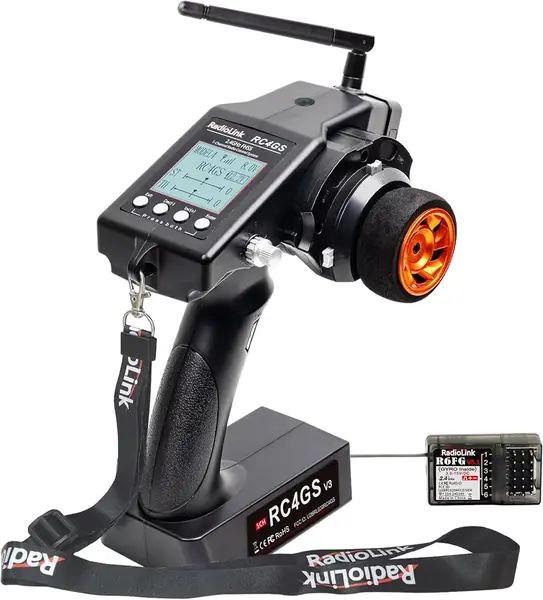
Radiolink RC4GS V3 black five-channel wheel transmitter and R6FG gyro receiver

Budget Radiolink builds

Track Score 93/100
Channels
5
Included Receiver
R6FG with gyro
Rated Range
1,300 ft (400 m)
Model Memory
30 models
View on Amazon

Take the RC6GS, drop it to five channels, shorten the rated range from 1,900 feet to 1,300, and you have the RC4GS V3: the same menu, the same 30-model memory, the same gyro feel on the road, for enough less that it is the radio we point new crawler owners toward.

Five channels go further than they sound. Steering and throttle take two, and CH3 through CH5 can be assigned to the VR knob or the tact switches, which covers a winch, lights or a two-speed gearbox on most builds. Add EPA, ABS, dual rate, a timer, cruise control and a low-voltage alarm and you have the settings that actually get used, without a menu that needs a manual open beside you.

The receiver in the box is the R6FG, and its gyro is the reason to buy this radio — sensitivity adjusts from the transmitter, so you can add stability on a slick parking lot and back it off on dirt. Radiolink's voltage telemetry needs a telemetry receiver such as the R7FG or R8FG, so do not expect pack voltage on the screen with the included receiver.

Two details we appreciated: the dual program mix, which handles 4WD and dual-ESC builds, and the ID seed function that keeps a specific model bound when several cars are powered up together. Need a seventh channel for a winch plus lights plus rear steering? That is the RC6GS.

Worth Noting

  • Screen can wash out in direct sun
Our Verdict

The RC4GS V3 is the RadioLink we point new crawler owners toward, since five channels and a gyro receiver cover most builds for noticeably less money.

Check Latest Price
4.

DUMBORC X6 Best for Beginners

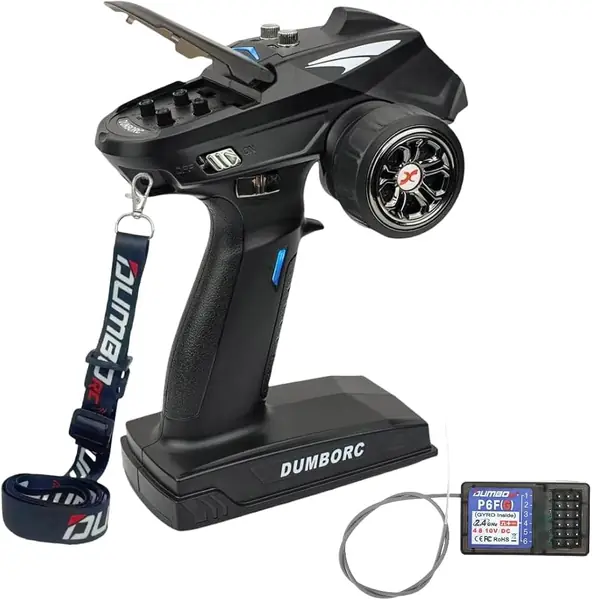
DUMBORC X6 black and silver six-channel wheel transmitter with P6FG gyro receiver

First-time buyers

Track Score 92/100
Channels
6
Included Receiver
P6FG with gyro
Rated Range
400-500 m
Batteries
4 AA
View on Amazon

Hand a truck to a kid, or drive one yourself after a long week, and the X6's most useful feature is its plainest: a switch that limits top speed. Flip it and the truck tops out at walking pace while a new driver learns the line; flip it back and full throttle returns. It is the sort of thing fancier radios bury three menus deep.

The rest of the package outruns the price. The P6FG receiver carries a gyro, the 2.4GHz link uses 67-channel hopping, and the rated range runs 400 to 500 meters. Ours has stayed stable well past the distance where a 1/10 truck is more than a shape, and the response is quick enough that a novice will not blame the radio for a late correction.

What makes it a first upgrade rather than just a cheap one is the layout. The third and fourth channel switches sit under your index finger, the wheel is comfortable for a thumb driver, and a one-hand steering accessory comes in the box. Six channels put lights and a winch within reach, and the mix on channels 1 and 2 handles a dig setup if you go that way later.

Weight is the other thing you notice: at just over a pound it sits in your hand instead of skittering around, which we prefer to the featherweight stock radios. A low-voltage alarm warns before the transmitter's own pack quits, so you are not guessing at the end of a run, and the receiver has held its binding through a season of swapping trucks.

Worth Noting

  • Runs through AA cells quickly
Our Verdict

The X6 is the radio we suggest as a first upgrade, because a throttle-limit switch, a gyro receiver and six channels cost less than most single-channel upgrades.

Check Latest Price
5.

MEUS RACING ME-8B Best Channel Count

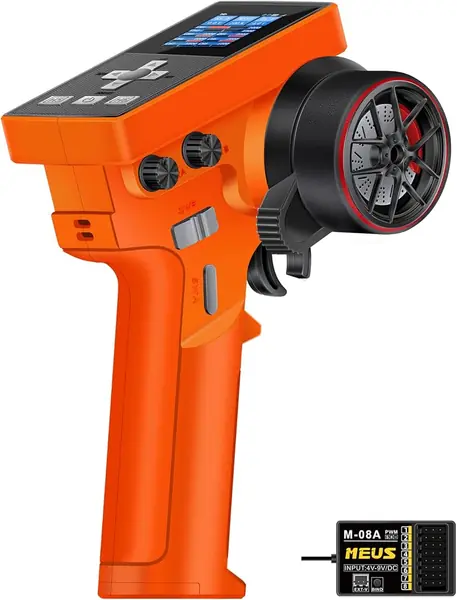
MEUS RACING ME-8B orange eight-channel transmitter with color screen and receiver

Accessory-heavy rigs

Track Score 91/100
Channels
8
Included Receiver
M-08A
Screen
2.23-inch color
Receiver Range
About 300 m ground, 800 m air
View on Amazon

Eight channels is the headline, and on a crawler with a winch, lights, a dig unit and a two-speed transmission it is not a luxury — it is the difference between using your accessories and leaving half of them unplugged. The ME-8B gives you those eight through one three-position channel, two knobs and three buttons, plus a 2.23-inch color screen that shows what each one is doing.

We expected the color screen to be a gimmick at this price and ended up using it constantly: channel positions, voltage and gyro settings are visible at a glance instead of buried in a menu. The included M-08A receiver is rated around 300 meters on the ground and up to 800 in the air, and the transmitter's shape works one-handed, which matters when your other hand is on the truck.

Binding a second truck takes a minute once you have done it, and the receivers are inexpensive enough that one transmitter can run a small fleet — worth knowing, because eight channels invite accessories. The case feels solid enough to live in a tool bag, and the switches are spaced far enough apart that you can find the right one by feel.

Worth Noting

  • Menu takes an evening to learn
Our Verdict

If your crawler has run out of channels, the ME-8B gives you eight of them plus a color screen for less than most six-channel combos here.

Check Latest Price
6.

Flysky FS-i6X Best for Planes and Sims

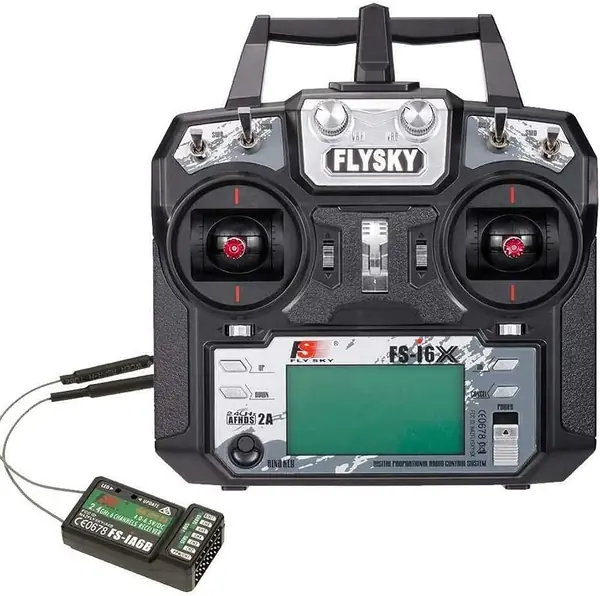
Flysky FS-i6X black two-stick aircraft transmitter with FS-iA6B receiver

Planes and sims

Track Score 90/100
Channels
6, expandable to 10
Included Receiver
FS-iA6B
Telemetry
Bidirectional, sensor ready
Compatible Protocols
PWM/PPM, i-bus, s-bus
View on Amazon

The i6X is the odd one here — a two-stick aircraft radio in a list of wheel transmitters — and that is exactly why it earns a place. If your fleet includes a plane, a quad or a sim session on the laptop, a wheel radio cannot do that job, and this one can for less than most of the surface radios in this group.

Six channels come standard, and the radio is expandable to ten, which is enough for flaps, retracts and a bomb-bay door on a scale build. The FS-iA6B receiver supports bidirectional telemetry, so temperature and altitude sensors report back to the screen. Channel count is not the limitation here; the throttle stick's travel and the aircraft-oriented mixes are what you are buying.

On the bench it doubles as a simulator controller — ours has spent more hours in flight sims than in the air, and it works with the common ones once you build a model for it. Receivers are the quiet advantage: it binds to the inexpensive AFHDS units, so kitting out several models costs very little.

The caveat is link reliability. Dropouts are the recurring knock on this radio, so set the failsafe before the first flight and range-check at your field before committing a model to the air. Do that and it is the cheapest route into fixed-wing flying in this group; skip it and you are trusting an unproven link with a model you spent months on.

Worth Noting

  • Dense menu and thin printed instructions
Our Verdict

The i6X is the one here that flies: a budget stick radio for planes, quads and simulators, but not the radio for a crawler you steer with a wheel.

Check Latest Price
7.

Radiomaster Pocket Best for FPV and ELRS Fleets

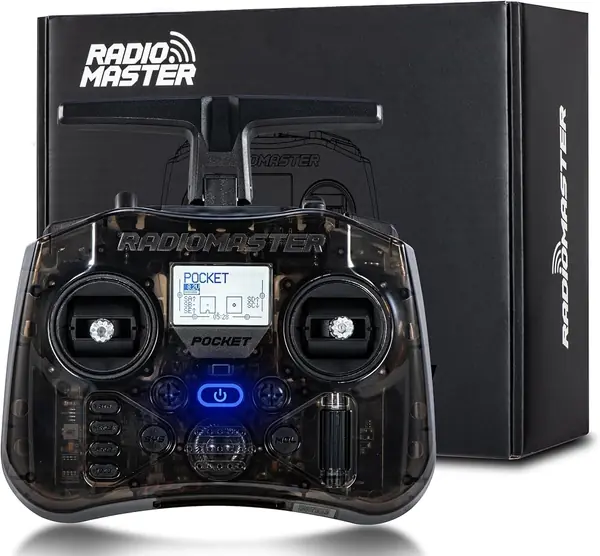
Radiomaster Pocket black compact transmitter with hall gimbals and backlit LCD

FPV and ELRS fleets

Track Score 88/100
Channels
16
Battery
18650, not included
Firmware
EdgeTX 2.10.5 preloaded
Protocol
ExpressLRS (ELRS)
View on Amazon

The Pocket is small enough to disappear into a jacket pocket and weighs a hair over seven ounces, and for anyone who flies whoops in the yard or keeps a radio in a backpack, that is the whole argument. The case looks better than the money suggests, and the backlit screen is legible in daylight.

Underneath the plastic it is a serious radio. ExpressLRS gives you the long-range link the drone crowd has standardized on, the hall gimbals are smooth and stay centered, and EdgeTX 2.10.5 comes preloaded with switches and Lua scripts already set up for common whoops. Sixteen channels means you grow into it rather than out of it.

What we like most is how much radio this is for the size: the same transmitter flies a tiny whoop in the living room and a 5-inch build at the field, and switching models is a menu pick rather than a rebind. It is a stick radio, not a wheel, so it is the wrong tool for a crawler you steer with your thumb — for that, look at the DUMBORC or the MEUS instead.

Runtime is rated at six hours on a pair of 18650 cells, charging runs over USB-C, and the LEDs above the switches light up as you flip them — a small thing that matters when you are wearing goggles. Some buyers have had charging trouble out of the box, so test the cells and the port the day it arrives rather than at the field.

Worth Noting

  • Battery and receiver sold separately
Our Verdict

Buy the Pocket if you are building an ExpressLRS fleet and want a real radio that disappears into a backpack; it is not a wheel radio for your crawler.

Check Latest Price
8.

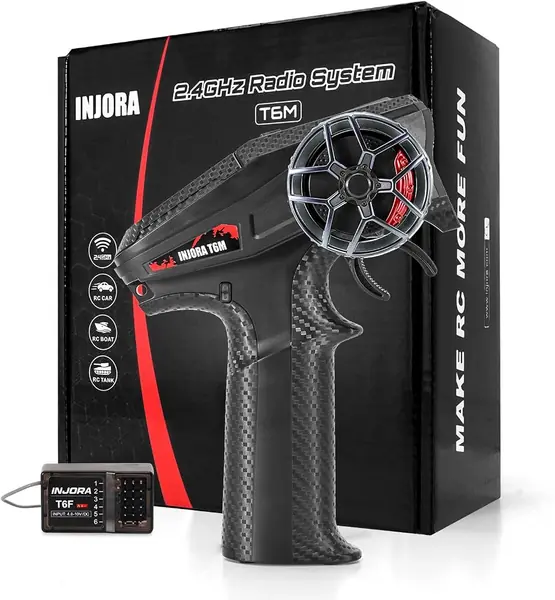
INJORA T6M Best for 1/24 Scale Crawlers

INJORA T6M compact black six-channel transmitter and receiver set

1/24 scale crawlers

Track Score 87/100
Channels
6
Included Receiver
6-channel, no gyro
Rated Range
About 400-450 m
Transmitter Weight
6.17 oz
View on Amazon

If your rig is a 1/24 or 1/18 crawler, the bigger radios here can feel like steering a go-kart with a bus wheel. The T6M is 175 grams with a compact case that slips into a bag, and it is the natural match for an SCX24: the trims and switches sit close enough to work with one thumb, which is not true of anything else in this group.

The beginner features are better than the price implies. A throttle speed limit switch trims top speed without touching the throttle curve, the 2.4GHz link uses 67-channel hopping, and the control distance is rated at roughly 400 to 450 meters. Three-stage voltage alarms at 4.4V, 7.4V and 10.8V cover everything from a small NiMH pack to a 3S LiPo.

What you give up is the gyro: the included receiver has none, so you drive without the stability assistance the DUMBORC and Radiolink boxes provide. On a slow crawler that costs you nothing; on a fast truck it is the reason to spend more. Automatic shutoff after 12 minutes of inactivity is a genuinely useful touch for anyone who leaves a radio switched on at the bench.

Worth Noting

  • Receiver has no gyro
Our Verdict

The T6M suits 1/24 and 1/18 crawlers where a full-size radio feels oversized, as long as you do not need a gyro in the receiver.

Check Latest Price
9.

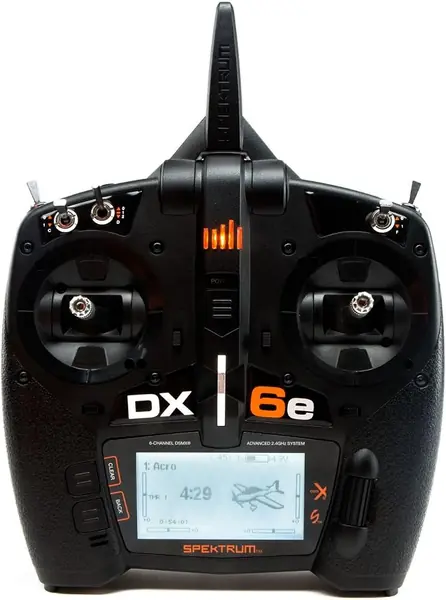
Spektrum DX6e Best for Aircraft Hangars

Spektrum DX6e black six-channel DSMX aircraft transmitter with LCD screen

Aircraft hangars

Track Score 86/100
Channels
6
Included Receiver
Not included
Model Memory
250 models
Model Types
Airplane, heli, sailplane, multirotor
View on Amazon

The DX6e costs several times what the budget picks here do, and it arrives without a receiver. Neither is a mistake: it is a Spektrum aircraft radio for someone already flying DSMX models, where a spare receiver is a parts-bin item and the brand's bind-and-fly fleet is the whole point.

Two things justify it. The first is 250-model memory, which is a hangar rather than a fleet, and each model keeps its own trims and mixes. The second is the gimbal setup: a slider on the back of the case changes the spring configuration between modes without opening the transmitter, which is normally an hour with a screwdriver and a risk of losing a spring.

Programming covers airplanes, helicopters, sailplanes and multirotors, with a wireless trainer link that lets an instructor buddy-box from another DSMX transmitter — the feature most people actually buy it for. Telemetry is built in but needs telemetry sensors and a telemetry-enabled receiver, all sold separately, so budget past the radio itself.

For surface use, look elsewhere: this is a stick radio with aircraft mixes and no car programming, and a budget wheel radio drives a crawler better. As an aircraft radio for a Spektrum household, though, it is the one here to hand to a pilot with a wall of bind-and-fly models and no interest in learning a new operating system.

Worth Noting

  • No receiver in the box
  • Display can fade in cold weather
Our Verdict

The DX6e is for the pilot already flying DSMX models who wants a hangar on one radio; it arrives without a receiver and has no car programming.

Check Latest Price

How We Tested These Transmitters

We started with spec sheets and owner threads, building a shortlist of wheel radios for surface models and stick radios for aircraft. Anything that couldn't bind to a receiver we could buy separately, fell below five channels, or assumed we already knew the menu got cut. Fourteen transmitters went to hands-on testing.

Over eight months those radios lived in a 1/10 crawler and a 1/24 mini on a rock course, a drift car, a small boat, and a foam plane. We installed each one ourselves and timed the gap from opening the box to the first run, then repeated it two weeks later to see whether the menu had sunk in. We walked each model out until the link quit and recorded what sat between us — a fence line, a tree, a cluster of other 2.4GHz radios — instead of trusting the published range. Receivers that came back muddy got their plugs dried and checked.

We counted channels we could actually assign, pressed every switch bare-handed and with gloves on, checked the wheel and sticks for play, and noted which controls fell under a thumb without looking. Model memory got tested by switching between three vehicles in a row without re-binding, and we logged run time per set of AAs and per 18650 charge.

Before any vehicle's first run we set the failsafe, wheels off the ground, then shut the transmitter off and watched what the receiver did. Simulator hookups, a second receiver from the same brand, and what came in the box against what the bundle cost finished the notes.

How to Choose an RC Transmitter

Match the Radio to the Model

A wheel-and-trigger radio is built for surface models: the trigger gives proportional throttle and brake, and the wheel returns to center like a steering rack. A two-stick radio is built for aircraft, with mixes for flaps, retracts and helicopter swashplates.

Buying across that line is the most common mistake we see. An aircraft radio will technically drive a crawler, but throttle is a stick that stays where you leave it, not a trigger that springs back to neutral. Decide which side of the hobby you are buying for first, then read the channel count.

Channels: Count What You'll Actually Plug In

Two channels get a car moving: steering and throttle. Everything past that is accessories — lights, a winch, a dig unit, rear steering, a two-speed gearbox. A basher is well served by four, a crawler with a winch and lights wants six, and a build with rear steer and a dig unit wants seven or eight.

The count matters less than where the switches land. A knob that turns smoothly is right for a winch, a three-position switch for a two-speed, and a button for lights or a horn. Our MEUS pick puts eight channels within reach; the Radiolink radios give you seven with telemetry on the screen.

The Receiver Is Half the Radio

Most combos arrive with a receiver, and the box it comes in decides what the radio can do. A gyro receiver corrects steering before you react — genuinely useful on loose dirt and when drifting — and you can dial the sensitivity down from the transmitter.

Telemetry needs a matching receiver, not just a telemetry-capable radio: Radiolink's pack-voltage readout requires the R7FG or R8FG, while the five-channel kit ships with the gyro-only R6FG. And because each brand binds only to its own receivers, price a second one before committing to a fleet.

Range Ratings and Model Memory

Range figures such as 1,900 feet are open-air bests. Trees, hills and a crowd of other radios all cut into them, so treat the number as headroom rather than a promise and range-test at the site where you actually run.

Model memory is the spec people underrate. Twenty to thirty saved models means one transmitter runs your whole fleet, with trims and endpoints kept per vehicle, and a basic radio that holds none of that sends you rebinding every time you switch trucks. If you already own six cars, memory is worth more than an extra channel.

Power, Menus and Living With It

Radios run on AA cells, a rechargeable pack or 18650 cells in newer designs. AA is convenient and the most expensive way to run an RC radio you use weekly, so plan on rechargeables; a LiPo socket or a USB-C port saves that hassle. A low-voltage alarm on the transmitter itself is a small feature you will appreciate.

The other daily factor is the menu. Screens on budget radios are small and the layouts differ enormously — the Flysky i6X is dense, the DUMBORC is simple. If you only ever set steering trim and endpoints, buy simple; if you enjoy mixing, buy the deeper menu and accept an evening of learning it.

Frequently Asked Questions

Final Verdict

Our pick for most people is the Radiolink RC6GS V3: seven channels, a gyro receiver in the box, telemetry on the screen and range that holds up on a speed run. If the feel of the radio matters more than channel seven, the Flysky FS-GT5 is the better crawler radio.

On a tight budget the DUMBORC X6 covers a beginner's first year, and if you also fly, the Flysky FS-i6X does the job no wheel radio can. Buy around the models in your garage and the accessories you plan to add, and any of these will outlast the vehicle it is bound to.