Best Brushless RC Motors of 2026

A brushless motor has no brushes to wear out; the speed controller does the switching, which is why the pairing matters as much as the motor. A high-KV motor in a heavy trail truck runs hot and cooks itself, while a low-KV crawler motor in a basher feels stuck in first gear. KV is rpm per volt, and it only means something next to the vehicle's weight, gearing and battery.

Treat each maker's cell count as a hard limit; an ESC run past its voltage rating doesn't survive the lesson. Over nine months on gravel lots, a crawler course, a carpet track and a bench stand, peak speed rarely decided anything. Smooth startup and a motor that finished a pack warm rather than hot did. After that comes fit: mount spacing, shaft diameter and sealing for wet grass, across picks for bashers, crawlers, mini trucks, whoop drones and a larger plane.

Our Top Picks

The Best Brushless RC Motors

1.

Hobbywing Quicrun 10BL120 G2 Combo Best Overall
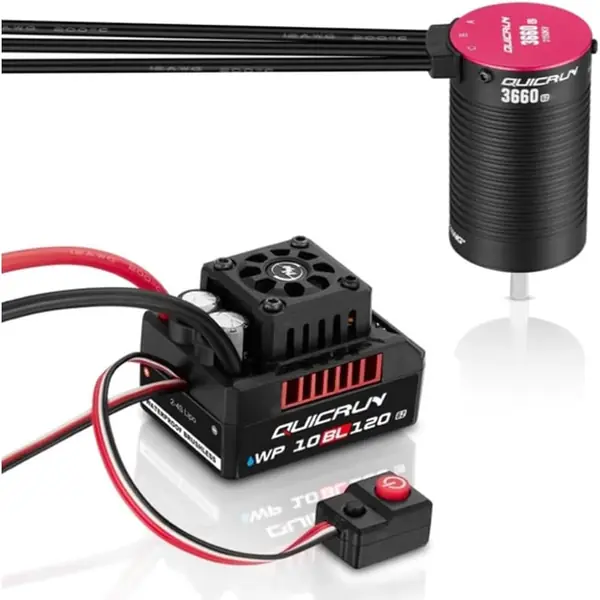
Hobbywing Quicrun 10BL120 G2 ESC and 3660SL G2 motor combo

1/10 car bashers

Track Score 92/100
Motor
3660SL G2 3700KV
ESC
Quicrun WP 10BL120 G2
Sealing
Waterproof and dustproof
BEC
5A continuous
View on Amazon

The 10BL120 G2 ESC and 3660SL G2 motor are the matched pair we reach for first in a 1/10 truck. We like that Hobbywing did not pair a mild ESC with a hot motor: the 120A speed control has headroom, the 3700KV can has a sensible middle-of-the-road wind, and the set is sealed against water and dust. That balance is why it earns our top spot.

On the road, the 3700KV wind is flexible rather than frantic. It pulls cleanly from low speed, has enough top end for a short-course truck, and does not demand the smallest pinion just to feel alive. The 5A continuous BEC is another practical detail: it can feed a strong steering servo without adding a separate pack, which keeps a basher's wiring simple.

Cooling is where our experience got specific. With moderate gearing the motor and ESC ran composed; when we geared taller for a speed run, the motor wanted a fan. That is not a dealbreaker. It is a reminder to gear for the surface and check temperatures after changes, especially in a heavy truck with a sealed body.

The programming port is the quiet advantage. It lets you adjust throttle and braking behavior without replacing the ESC when the combo moves to another truck, and the waterproof housing means a wet parking lot does not end the session. That flexibility is the part we appreciate after the first install.

Our Verdict

Our top pick for 1/10 cars and trucks is this Hobbywing combo: its 120A ESC and 3700KV motor are balanced, sealed, and easy to tune.

Check Latest Price
2.

Hobbywing Quicrun Fusion SE 1800KV Best for Crawlers

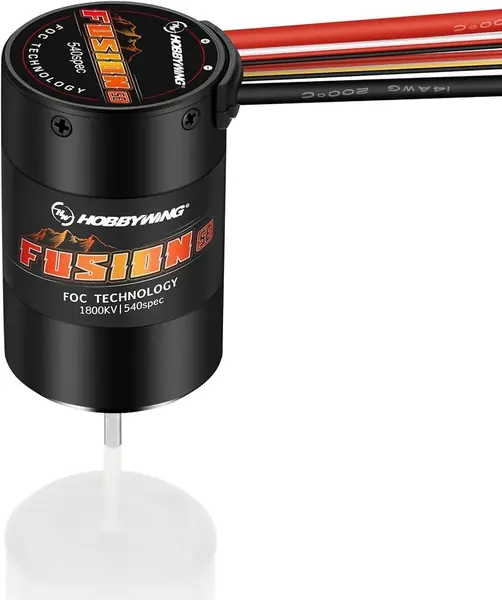
Hobbywing Quicrun Fusion SE 1800KV integrated crawler motor and ESC

RC crawlers

Track Score 91/100
Motor
1800KV
Sealing
IP67
Length
58mm
System
2-in-1 FOC
View on Amazon

A crawler asks for the opposite of a basher motor: not peak power, but control at a creep. The Fusion SE is built around that job, with 1800KV, an integrated ESC, and FOC drive that smooths the low end. We like that it behaves more like a good brushed setup than a switch, with enough torque to pull through a ledge without a lurch.

The 2-in-1 layout is the practical win. There is no separate ESC to find space for, wiring is shorter, and the whole unit is sealed to IP67. We also appreciate the electronic switch, which avoids the fragile mechanical switch that collects dirt on a trail truck. The drag-brake adjustment is deep enough to tune how the truck holds on a slope.

It is not the motor for a short-course basher; 1800KV and crawler gearing give up the top end a truck needs. The separate program box is the other thing to plan for, because the in-box cable alone does not let you change every setting. If you already own the programmer, the setup is easy to live with; if you do not, budget for one before you start tuning. For a trail truck, though, the low-speed manners are worth the specialization.

Our Verdict

For crawler builds, we pick the Fusion SE: FOC drive and an 1800KV motor deliver smooth low-speed control in one sealed unit.

Check Latest Price
3.

Spektrum Firma 85A/3300KV Combo Best for 1/10 3S Bashers

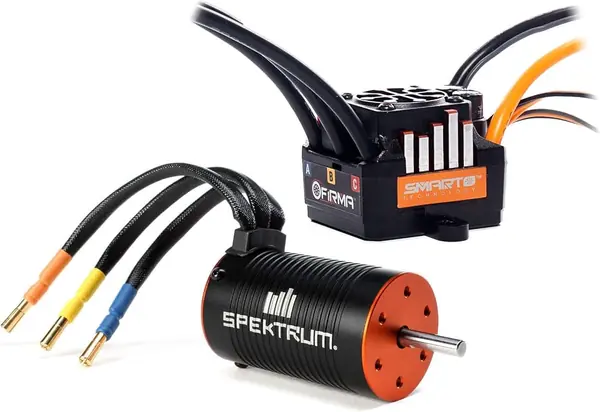
Spektrum Firma 85A Smart ESC and 3300KV sensorless motor combo

1/10 3S bashers

Track Score 90/100
Motor
3300KV sensorless
ESC
Firma 85A Smart
Combo
Motor and ESC
Scale
1/10
View on Amazon

Spektrum's 85A Firma ESC has more current capacity than a lot of 1/10 trucks will ever ask for, and that is the point. The 3300KV sensorless motor is a sensible 3S wind, with enough torque for a short-course truck and enough top end to feel like a real upgrade over a stock brushed system. It is a common drop-in for Traxxas and ARRMA 3S trucks, and the sensorless design keeps the wiring simple.

What we like most is how little drama the install brings. On a 2WD Slash, we spent more time setting steering endpoints than mounting the motor, and the Smart ESC is straightforward to program. The motor uses the common 540 mounting pattern, so most 1/10 chassis accept it without an adapter. You do give up a little smoothness off the line because the motor is sensorless; in tight spaces it can feel less refined than the Fusion SE.

We also appreciate the headroom when temperatures climb. An 85A ESC is not working flat-out in a typical 3S basher, which leaves margin for a hot day or taller gearing. The 85A rating is the margin we want in a 3S truck, especially when the body traps heat. It is a premium choice rather than a budget route, but the ease of setup and the Smart ecosystem are the reasons to choose it.

Our Verdict

We like this Spektrum pair for brand-name 3S bashers: the 85A ESC has useful headroom, and the 3300KV motor is an easy 1/10 drop-in.

Check Latest Price
4.

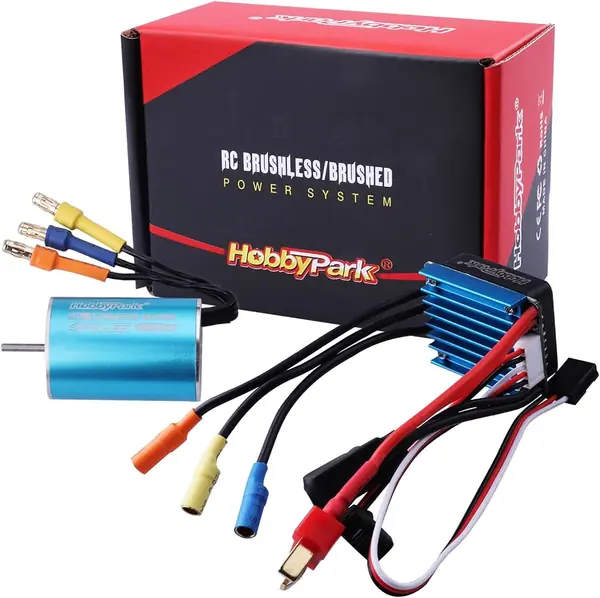
HobbyPark 2435 4800KV Combo Best for Mini and Micro Cars

HobbyPark 2435 4800KV brushless motor and 25A ESC combo

Mini RC trucks

Track Score 83/100
Motor
2435 4800KV
ESC
25A
Battery
2S LiPo only
Mounting
M2.5 screws
View on Amazon

Small-scale brushless upgrades live or die on mounting holes, and the HobbyPark set is aimed squarely at the small trucks this scale was built for: Traxxas LaTrax Teton, Desert Prerunner, Rally, and ARRMA Grom. The 2435 4800KV motor and 25A ESC are a matched pair, and the M2.5 screw pattern is the detail to check before ordering. The set is compact enough for a 1/16 chassis and simple enough for a first brushless swap.

We like that the install is genuinely simple. On a LaTrax, the motor drops into the stock mount without drilling, and the ESC is small enough to tuck into the chassis. No drilling or adapter plate means the swap is a bench job rather than a project. The speed gain over a healthy brushed motor is real but not enormous; the bigger improvement is that the brushless system does not heat-soak the way the stock motor does.

The catch is the drivetrain. A 4800KV motor on 2S gives a mini truck a sharp jab of torque, and that extra power can find the weakest gear or slipper setting. We check gear mesh before the first run and treat the slipper as a wear item. This is a small-truck system, and it feels best on a tight yard course rather than a wide-open speed run. For a small truck, that is a fair trade for the consistency.

Worth Noting

  • 2S LiPo only; not for 3S packs
Our Verdict

For 1/16 and 1/18 trucks, this HobbyPark set is the simple 2S brushless upgrade we recommend when you do not want a wiring project.

Check Latest Price
5.

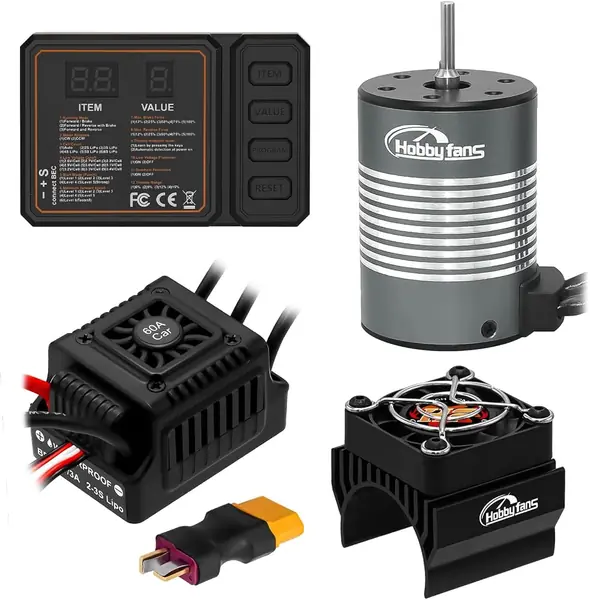
Hobby Fans S3650 4300KV Combo Best Budget 1/10 Combo

Hobby Fans S3650 4300KV motor with 60A ESC heatsink and program card

Budget 1/10 builds

Track Score 82/100
Motor
3650 4300KV
ESC
60A
Shaft
3.175mm
Includes
Heatsink and programming card
View on Amazon

A programming card in the box is a small thing that saves a lot of beeping and guesswork. The Hobby Fans S3650 set includes the 4300KV motor, 60A ESC, heatsink, and that card, so you can set punch and braking without buying another tool. That completeness is what made us look twice.

The 3650 can and 3.175mm shaft are the common 1/10 sizes, so fit is straightforward in most touring cars and short-course trucks. The 4300KV wind is lively on 2S, and the aluminum heatsink helps the 60A ESC manage heat in a heavy chassis. We like the sealed, waterproof construction for parking-lot duty. The sensorless motor has the usual small hesitation off the line, but it is not a big deal in a basher.

The fine print is the voltage guidance. Hobby Fans rates the 60A ESC for a 3650 motor under 4000KV on 3S on-road, so this 4300KV version is a 2S-first combo; running 3S pushes outside the maker's own KV window. We still think it earns a place as a budget 1/10 setup, because the card and heatsink are useful extras and the 2S performance is strong. Just do not buy it expecting a happy 3S basher. For a first brushless swap, that simplicity matters more than a big KV number.

Our Verdict

We think this combo earns its keep in budget 2S 1/10 builds, with a 60A ESC, heatsink, and programming card covering the essentials.

Check Latest Price
6.

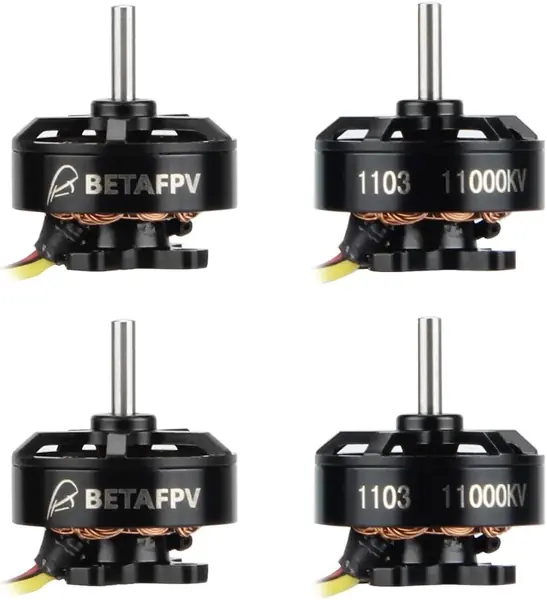
BETAFPV 1103 11000KV Motor Set Best for 2S Whoop Drones

BETAFPV 1103 11000KV brushless motors four-piece set for 2S drones

2S whoop drones

Track Score 81/100
Motor
1103 11000KV
Battery
2S LiPo
Weight
3.25g each
Mounting
8.5mm bolt pattern
View on Amazon

The 8.5mm bolt circle is the first number to check. BETAFPV's 1103 motors are made for the company's 2S frames, not the wider range of 80mm to 110mm whoops, so a set can be right for one build and useless for the next. Each motor weighs 3.25 grams, and the 11000KV wind is meant for 7.4V, 2S packs.

On a light 2S whoop, the high KV gives the instant response that makes a small quad feel bigger than it is. The set of four is the practical part: you have matched motors for the build and a spare if one takes a hard hit. We like the short 16mm can for tight frames, but the small wires and connectors demand care when you solder. The 1.5mm shaft and 16mm can are sized for micro frames, so do not expect them to fit a 2.5-inch cinewhoop.

We treat these as consumables for crash-heavy whoop flying rather than as long-term investments. The four-pack softens the cost of a damaged motor, and the light weight keeps the quad responsive. What we do not like is the narrow frame compatibility: if your frame is not drilled for 8.5mm, this set simply is not the one. A four-pack is the sensible way to buy them. For the right 2S build, though, it is a neat, light solution.

Our Verdict

Light 2S whoop builds are the target here, and we recommend this four-pack as long as the frame uses the 8.5mm bolt pattern.

Check Latest Price
7.

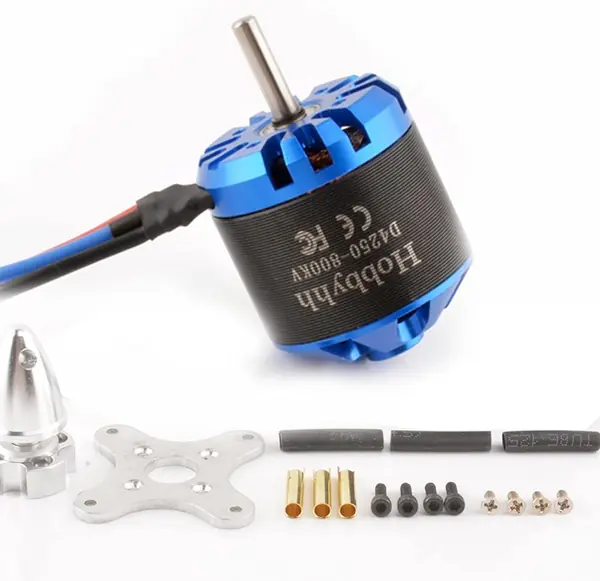
Diamond Dynamics 4250 800KV Motor Best for Larger Planes

Diamond Dynamics 4250 800KV outrunner motor with 4.0mm banana plugs

Larger fixed-wing planes

Track Score 80/100
Motor
4250 800KV
Voltage
7.4V to 14.8V
Connector
4.0mm banana
Max Power
1250W
View on Amazon

The 13x10 and 14x7 props this motor is intended to swing tell you what kind of flying it is for. The 4250 800KV is a large, slow-turning outrunner for fixed-wing aircraft, not a park-flyer motor, and its 1250W rating puts it in the range of bigger sport planes and gliders. The 4.0mm output is a clue that this is a bigger-airplane part.

The 7.4V to 14.8V range covers 2S through 4S, and the 4.0mm banana plugs are already fitted to the motor leads. We like that the connector choice is explicit: you know what mating plugs to order before the motor arrives. The 42mm by 50mm can needs firewall space and a mount that can handle the torque.

A motor this size is only as good as the setup around it. It wants a prop in the recommended range, a battery that can supply the current without sagging, and a firewall that does not flex. We check the mount and the spinner balance before the first flight, because a big prop amplifies any vibration.

What we like is the value in a straightforward, big-prop motor. It is not a polished, sensor-equipped system, and it is not the right choice for a small foamy, but it gives a larger airframe the thrust it needs without a glow engine. The 216-gram weight is the figure we check against the nose moment before committing. For a 60- to 70-size glow replacement, it is a sensible electric swap.

Worth Noting

  • Needs a separate 80A ESC
Our Verdict

This 4250 is our pick for larger fixed-wing planes that need big-prop thrust on 3S or 4S, provided you already have an 80A ESC.

Check Latest Price
8.

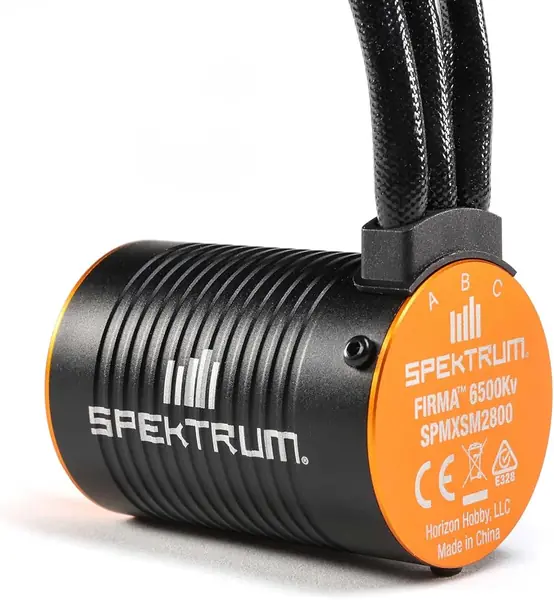
Spektrum Firma 6500KV Motor Best for Speed-Run Builds

Spektrum Firma 6500KV brushless motor with black can and 3.18mm shaft

Speed-run builds

Track Score 79/100
Motor
6500KV
Combo
Motor only
Shaft
3.18mm
Weight
9.12 oz
View on Amazon

A 6500KV motor is a specialist part, not the sensible first brushless upgrade for a basher. It is built to spin hard for short bursts, and the standard 540 can and 3.18mm shaft let it drop into many 1/10 touring cars and drag builds. We like it for exactly that narrow job.

The top end is the point. Spektrum's Firma motor has the kind of high-RPM pull that makes a light on-road car feel absurd, and it stays smooth while doing it. You need a capable ESC and a small pinion to keep the RPM and heat in check; this is not a motor to gear tall and hold wide open.

We also appreciate the standard dimensions. The 9.12-ounce motor fits where a normal 540 fits, so a speed build does not need a custom mount. The motor alone leaves the ESC choice to you, and the wrong choice will either limit the motor or turn runs into heat management exercises.

In our testing, the motor ran clean with a lower pinion and got hot when we leaned on tall gearing for too long. That matches the way we use a high-KV motor: short passes, cool-downs, and a temperature check after each change. It is the pick for a speed-run project, not for a truck that spends an afternoon in the dirt.

Our Verdict

A dedicated speed-run build is the only place this motor makes sense, and we like its 6500KV wind and standard 540 fit for that narrow job.

Check Latest Price

How We Tested the Brushless Motors

We started with spec sheets, the way a shopper should: KV against the vehicle's weight and gearing, ESC current rating against the motor's draw, and the cell-count limit before anything else. From there we filtered by scale and mount, from 1/10 truck patterns down to the smaller bolt spacing on mini chassis and whoop quads, and by what came in the box, since a combo with a programming card and heatsink is a different value proposition than a bare can. That left 14 setups, from budget combos to a high-power plane motor.

Testing ran nine months. Car and truck combos went into gravel lots, a driveway, and a crawler course built from pavers, log rounds, and a steep dirt bank, run pack after pack from a dead stop on the climb. Mini setups ran on a garage carpet track marked out with cones. Drone motors went onto a whoop frame and flew in a garage and a backyard at dusk. The plane motor went on a test stand with the propeller off for current pulls, then into a fixed-wing airframe at a club field, with hands and loose gear clear of the prop whenever anything was armed.

After every run we read motor and ESC temperatures with an infrared gun and noted how fast they climbed, and we geared down and re-checked whenever we changed voltage. We watched startup on the crawl course and the carpet track to see whether a motor cogged or pulled away cleanly, logged top speed with a GPS unit, and test-fit shafts and mounts with calipers. After each session came the tear-down: shaft play, rough bearings, loose magnets, worn connectors. We ran every combo only at its maker's stated cell count, and charged and stored packs the way the battery maker instructs.

How to Choose a Brushless RC Motor

Start With the Vehicle, Then the KV

KV is a motor's RPM per volt, not a quality grade. A 6500KV motor in a trail truck is the wrong tool, and an 1800KV crawler motor in a short-course truck is just as mismatched. We start with the can size and KV range the chassis was designed around, then choose a motor inside that window. A 3300KV to 4300KV motor on 2S or 3S is a familiar middle for 1/10 bashers, while crawlers live much lower and planes trade KV for prop size.

Choose a Combo or a Bare Motor

First brushless upgrade? A motor/ESC combo is usually the cleaner buy: the ESC is matched to the motor, the wiring is shorter, and the current rating is known. A bare motor makes sense when you already have a suitable ESC and want to choose the can separately. We like the Hobbywing 10BL120 G2 for the first route and the Spektrum 6500KV for the second. The real decision is whether you want to shop for an ESC. If you do not, buy the combo.

Treat Voltage and Current as Limits

More cells can mean more speed, but only if the motor, ESC, and gearing can take it. The Hobby Fans S3650 combo's own guidance is a good example: its 4300KV motor sits above the maker's 3S KV window, so it is a 2S-first part. Check the ESC's current rating against the motor's demand, then gear down when you add voltage. We prefer a combo with headroom and a smaller pinion over a maxed-out ESC and a tall gear.

Low-Speed Control Is a Separate Skill

Sensored and FOC systems read the motor's position and deliver smoother starts; sensorless systems are simpler and usually less expensive, with a small hesitation off the line. For a crawler, that difference is the whole experience, which is why the Fusion SE's 2-in-1 FOC design earns its place. For a basher, sensorless is usually fine, and the money is better spent on ESC headroom and sealing. Match the control style to how much time you spend at a crawl.

Check the Mount, Shaft, and Sealing

Before ordering, confirm the can size, shaft diameter, screw pattern, and whether the motor has connectors. A 2435 mini motor will not fit a 1/10 mount, an 8.5mm drone pattern limits frames, and a 4.0mm banana plug needs the right mating connector. Sealing matters if you run in wet conditions: IP67 and waterproof ratings are worth having, but they do not make a motor submersible. We check fit first because the best motor is useless if it will not bolt in.

Frequently Asked Questions

Final Verdict

For most 1/10 car and truck owners, the Hobbywing Quicrun 10BL120 G2 combo is the one we recommend. Its 120A ESC, 3700KV motor, and sealed construction give you headroom and weather resistance without turning the install into a project.

If your driving is mostly technical trail work, the Fusion SE is the better buy: its FOC drive and 1800KV wind put control ahead of top speed. The deciding question is how the vehicle is actually driven, not which motor has the biggest KV number.