Best Airbrush Cleaning Pots of 2026

Flushing an airbrush is the least glamorous part of the hobby and the easiest to get wrong. Dump a cup of thinner, hit the trigger, and a fine mist settles across the bench and into whatever you are breathing. A cleaning pot gives that flush somewhere to go: spray hits the wall of a glass jar, air leaves through a filter in the lid, and the brush hangs in a holder instead of rolling off the edge.

The weak points show up quickly on a working bench: lids that weep thinner down the threads, holders that leave a brush hanging at an angle, jars light enough to skate when the hose tugs. Replacement filters are a running cost worth checking before you buy. And a filtered pot cuts mist without cleaning the air, so open a window either way.

Our Top Picks

The Best Airbrush Cleaning Pots

1.

Iwata-Medea Universal Spray Out Pot Best Overall
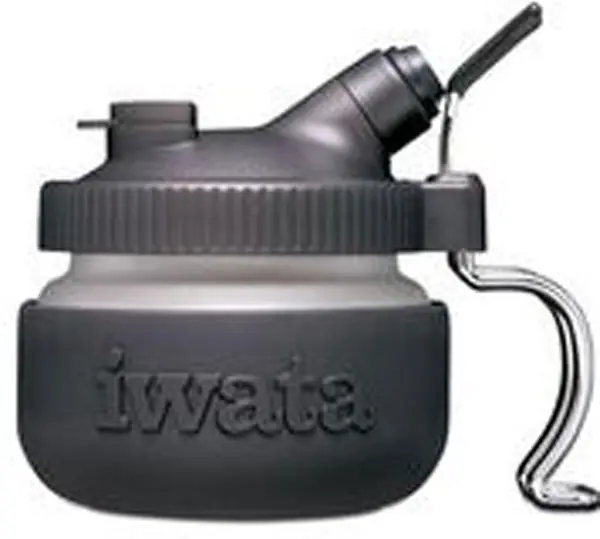
Iwata-Medea Universal Spray Out Pot, black rubber-sleeved glass jar with a filtered lid

Everyday brush cleaning

Track Score 94/100
Jar Material
Glass with rubber sleeve
Filter
Easy-change, one included
Weight
16 oz
Dishwasher Safe
Yes, top rack
View on Amazon

Sixteen ounces of glass in a satin rubber jacket is what the Iwata pot amounts to, and that weight is the reason we recommend it first. With a brush and hose locked into the top holder it takes a knocked elbow without going over, and the rubber sleeve keeps it from skating across a smooth bench. The holder is generous enough for the fat siphon-feed bodies that wobble in smaller pots.

Flushing works the way it does with any of these: a little water or cleaner in the jar, the nozzle into the port, spray until it runs clear. The difference is in the finish. Overspray stays inside, the easy-change filter keeps the mist from pumping back out into the room, and the filter lifts out for a replacement without tools. Nothing about it asks for attention, which is the highest praise we can give a cleaning accessory.

When the jar needs more than a rinse, it goes on the top rack of the dishwasher, and that small permission turned out to matter: a pot that comes properly clean is a pot you keep using instead of setting aside. The rubber sleeve earns its keep the same way, cushioning the glass on the bench and in the hand.

Worth Noting

  • Premium price and only one filter included
Our Verdict

If you clean a brush several times a week, we think the Iwata earns its premium: weighted glass that stays put, an easy filter change, and a holder that fits most brushes.

Check Latest Price
2.

Master Airbrush Deluxe 3-in-1 Cleaning Pot Best Multi-Function Lid

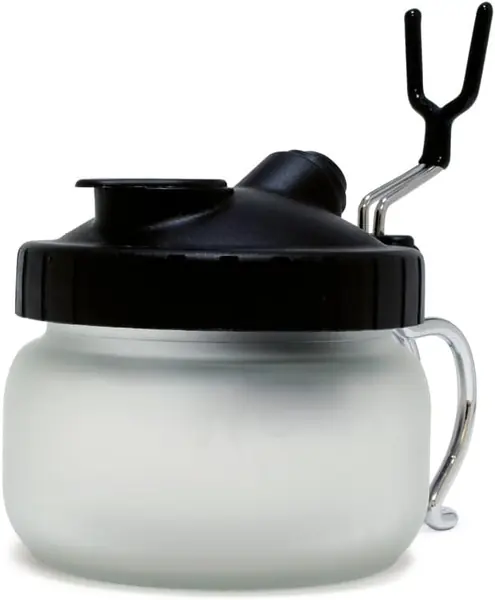
Master Airbrush 3-in-1 cleaning pot, glass jar with black lid and white palette cap

Palette plus cleaning

Track Score 93/100
Filters Included
4 replacement filters
Capacity
9 oz
Footprint
4.2"L x 4.2"W
Lid Function
Color palette and water cap
View on Amazon

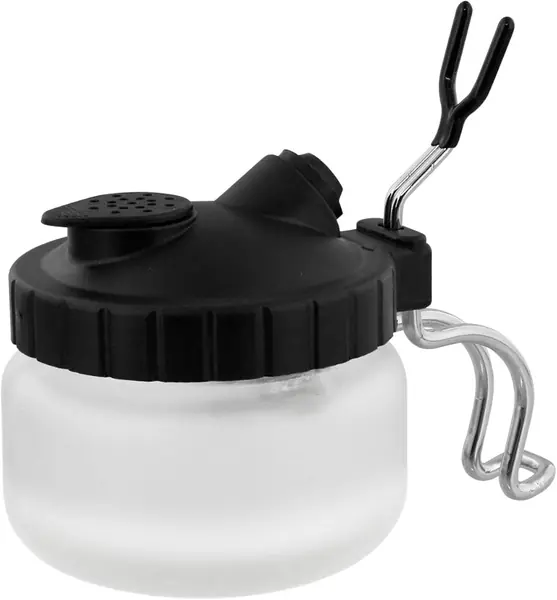
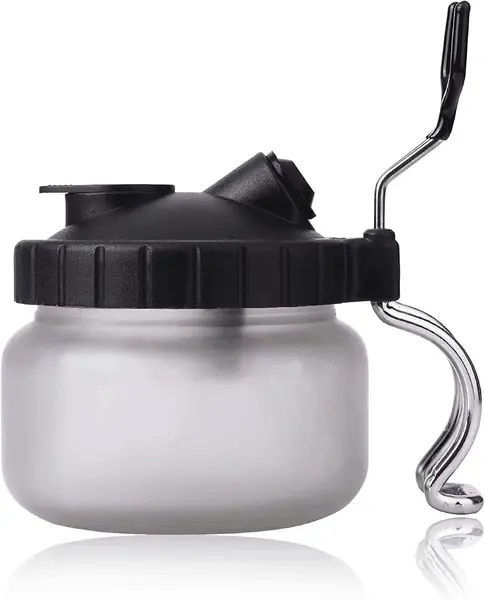
Most of these pots give you a jar, a lid, and a hole. Master's adds a second job to the lid: the small dished area on the cap works as a mixing palette for a few drops of color, and the cap itself serves as a water cup when you're thinning. We used that palette more than we expected during a run of small parts, and having it built into the pot rather than loose on the bench is the whole appeal.

Underneath is a 9-ounce glass jar about 4.2 inches square, with four replacement filters in the box. The glass is thick and the base is heavy for its size, so a hose tug doesn't walk it across the table, and the holder keeps a brush upright between colors.

The lid seal can let solvent fumes past, which matters if you're spraying lacquers in a closed room. That's the one thing we weigh against it, because the rest of the package is strong: four filters, a palette, and a jar that behaves like a much more expensive pot. If solvent smell is your main worry, look for a tighter lid; if you want one piece of gear doing three jobs, this is the one.

Worth Noting

  • Holder clip can work loose under a heavy brush
Our Verdict

We recommend the Master pot to painters who want one piece of gear doing three jobs: a palette, a water cup, and a jar that holds the brush.

Check Latest Price
3.

JIAKAI Multifunctional Airbrush Cleaning Pot Best Budget

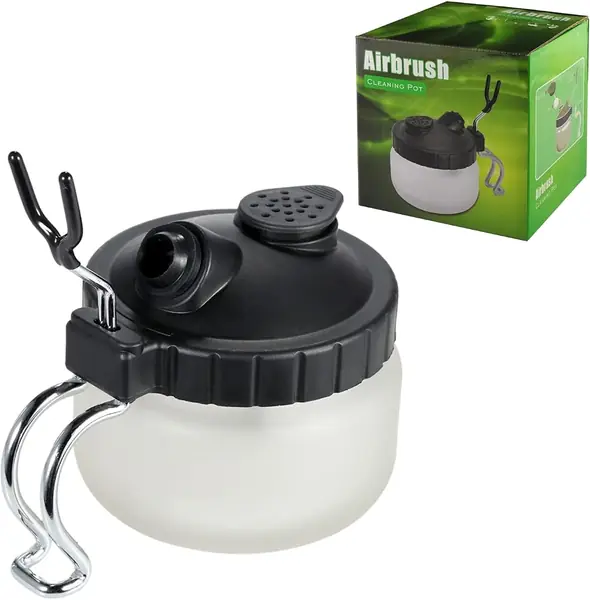
JIAKAI multifunctional airbrush cleaning pot, glass jar with cover and carrying handle

Long painting sessions

Track Score 92/100
Jar Material
Glass
Filter
Easy-change filter with spare
Capacity
399.99 ml
Anti-tip
Handle doubles as anti-tip bar
View on Amazon

The cheapest pot in this group doesn't feel like one. The JIAKAI is a heavy glass jar with a filter you can swap without tools, a spare in the box, and a cover with a curved shield built in to keep backsplash off your hands — the same essentials the pricier pots cover.

What we appreciate most is the handle. It arches over the lid for carrying, then sits wide enough on the bench to work as an outrigger, so a brush leaning in the holder doesn't take the jar with it. The jar is the largest of these at just under 400 ml, which means fewer trips to empty it in a long session.

Pull the plug out of the intake port before the first flush, or nothing goes in — that's the one setup step people miss. Past that, the core job, catching overspray and holding a brush upright, is handled as well here as on pots that cost several times as much, and the spare filter means the first change is already covered.

Worth Noting

  • No palette lid or second function
Our Verdict

The JIAKAI gives you the largest jar here, a handle that stops it tipping, and a spare filter, and it costs about as little as these get.

Check Latest Price
4.

Vallejo Airbrush Cleaning Station Best for Acrylic Painters

Vallejo Airbrush Cleaning Station, glass jar with plastic lid and airbrush holder

Acrylic model painting

Track Score 91/100
Jar Material
Glass jar, plastic lid
Weight
12.3 oz
Filters Included
3 filters
Dimensions
4"L x 5"W
View on Amazon

Vallejo's cleaning station is the one that looks like it belongs beside a paint rack: an airtight lid on a glass jar, built around the brand's own cleaner, with water or cleaner poured in and the nozzle seated in the lid opening until the spray runs clear. What won us over is how little space it asks for. At 4 by 5 inches it's squarer than the round pots, so it tucks against the back of a bench instead of claiming a circle of its own, and at 12.3 ounces it stays planted when the hose pulls. Three filters come in the box, a clear jar shows at a glance when it's due for a dump, and an airbrush holder in the lid keeps the brush off the bench between colors.

The restraint is the point. Nothing here is trying to be a palette or a water cup, and on a dedicated acrylic bench, where the station never leaves the table, we think that's the right trade: you're paying premium money for a sealed jar and a good filter, and that's exactly what arrives.

Worth Noting

  • Premium price for a pot with no extra functions
Our Verdict

Buy the Vallejo station if you want a sealed, tidy pot for an acrylic bench and have no use for a palette lid.

Check Latest Price
5.

SAGUD SD-61 Cleaning Pot Best for Tight Bench Spaces

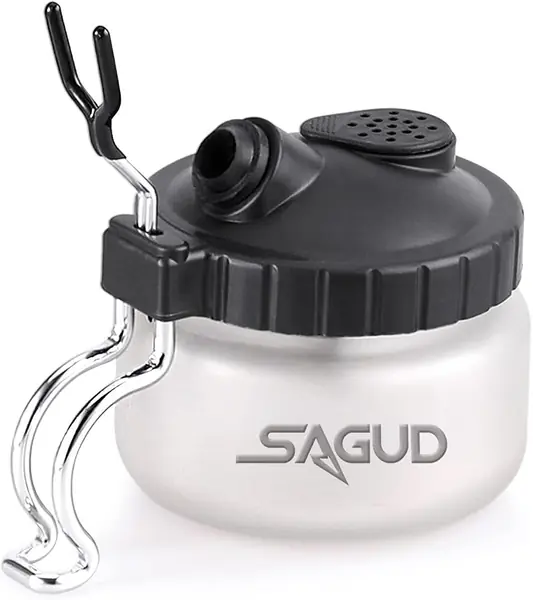
SAGUD SD-61 airbrush cleaning pot, glass jar with plastic lid and brush holder

Tight bench spaces

Track Score 90/100
Filter
Easy-change filter included
Footprint
4"W x 4"H
Included
Cleaning pot and airbrush holder
Materials
Glass jar, plastic lid
View on Amazon

Four inches square and four tall, the SAGUD takes up about as little bench as these pots get. On a table already crowded with a compressor, a spray booth, and a rack of paint, that matters more than capacity.

The jar is glass and the lid is plastic, the usual split at this size. The holder keeps a brush balanced upright between colors, and the lid does the quieter half of the job, cutting down on paint spreading and taking the edge off the thinner smell while you flush. Nothing on it needs a manual: cover off, water in, spray, cover on.

We rate it as a good small-bench pot rather than a do-everything one. Seat the plastic cap flat on the thread before you turn it and it seals; start it crooked and you'll chase a weep along the rim, which is the price of a light, inexpensive lid. For the two jobs that matter, catching the flush and holding the brush, it earns its corner.

Worth Noting

  • No palette lid or spare filter in the box
Our Verdict

For a bench with no spare room, we like the SAGUD's four-inch footprint and glass jar, as long as you seat the plastic lid squarely.

Check Latest Price
6.

JOYABEST Airbrush Cleaning Pot Best for Model Painting Benches

JOYABEST airbrush cleaning pot, weighted glass jar with metal stabilizer lid and hanger

Model painting benches

Track Score 87/100
Jar Material
Thick glass
Weight
15.2 oz
Filters Included
1 fitted plus 3 spares
Dimensions
4.13 x 4.13 x 4.13 inches
View on Amazon

Four filters — one fitted, three spare — plus a metal stabilizer lid and a V-shaped rest that takes gravity-feed and siphon-feed bodies: the JOYABEST box is the best-stocked of the budget pots, and that's most of why we keep it on the list.

The jar is thick glass and heavy at 15.2 ounces, with the low center of gravity that makes these things work, and it comes apart into jar, lid, and hanger so a rinse reaches everywhere. At 4.13 inches on a side it holds a small square of bench without wandering when the hose drags on it.

The lid is what to check when it arrives: seat it flat before you turn it and it holds; start it at an angle and you'll have a puddle under the jar. With three spares in the box, the filter side of the upkeep is settled for a long time, and that's the real argument for this one over a plainer budget pot.

Worth Noting

  • Lid can be fussy to seat without cross-threading
Our Verdict

We see the JOYABEST as the best-stocked cheap pot here: weighted glass, four filters, a metal rest, and a lid worth seating carefully.

Check Latest Price

How We Picked and Tested Airbrush Cleaning Pots

We started with the pots modelers and miniature painters recommend to each other, then filtered by jar material, lid and filter design, holder style, footprint, and whether replacement filters were easy to find. Twelve came back to a working bench in a spare room and stayed in rotation for four months — long enough to push acrylics, urethanes, and lacquer thinner through each one and see which lids stiffened and which filters clogged first.

Each pot was used the way it gets used at home: flushing between colors mid-session, a full cup of thinner at the end of the night, and a brush left hanging in the holder with the hose still attached. We sprayed at working pressure and watched the lid seam and filter cap for drips and beading, then capped each jar and let it sit overnight to see whether solvent smell escaped. Gravity-feed, siphon-feed, and trigger-style brushes all went into the holders, and we tugged the hose to see whether the whole pot skated across the bench.

The pots sat next to a cutting mat so we could judge footprint at real bench scale, and we counted color changes before a jar needed emptying. Lids came apart for washing, with top-rack dishwasher runs noted where the maker allowed it, and we tracked how quickly lid threads gummed up. Filter supply — how many came in the box, how they seated, what spares cost over a year — weighed as much as the pot's own price. Every test ran with a window open and an exhaust fan pulling air; spent solvent went into a labeled container for household hazardous waste drop-off, never the sink.

How to Choose an Airbrush Cleaning Pot

Start With the Lid and Filter

Every pot here works the same way: water or cleaner in the jar, the brush nozzle in the port, spray until it runs clear. So the differences live in the lid. Look for a filter that's held down rather than resting loose, since air pushed out of the jar can lift a poorly seated filter and send mist back at you, and for a curved shield or a deep port around the intake that keeps backsplash off your hands.

The cap thread is the other half of this. A plastic lid started crooked will weep, and once solvent seeps around the rim you've lost the point of the pot. Filters are consumables, so check what comes in the box: the Master pot ships with four, the Vallejo station with three, and the JOYABEST with three spares.

Match the Holder to Your Brush

A holder is only useful if your brush balances in it. Gravity-feed brushes with a color cup on top sit differently from siphon-feed bodies with a jar underneath, and trigger-style airbrushes run wider through the body than a standard slot accepts. V-shaped metal rests, like the one on the JOYABEST pot, grip a broader range than a drilled hole, and the Iwata's holder takes the chunky siphon-feed bodies that wobble elsewhere.

Think about the hose, too. A holder holds the brush only until the hose pulls it, and a pot that's light for its size will follow the brush across the bench.

Weight, Footprint, and Where It Lives

These are glass jars with a hose attached, and that shapes everything. Weight is your friend: the Iwata at 16 ounces and the JOYABEST at 15.2 ounces sit still with a loaded brush in the holder, and a rubber sleeve or a heavy base helps more than a wide one. Footprints run from roughly 4 inches square on the SAGUD to 4 by 5 on the Vallejo, which is the difference between a corner of the bench and a permanent address.

One trap: a pot marketed as portable is easy to carry from shelf to bench, not something to pack for a class. A glass jar with solvent in it doesn't travel, and the filter isn't built to be sloshed.

Capacity, Cleaning, and Running Costs

Jar volume decides how often you stop. The JIAKAI's 400 ml goes noticeably longer between empties than a 9-ounce jar like the Master's, which matters on a long session and hardly at all on a ten-minute touch-up.

Cleaning is quick in glass: a rinse handles a color change, and a lid you can get off with wet hands matters more than capacity once you're emptying the thing every session. Keep two spare filters in the drawer; a loaded filter is what pushes mist back into the room.

Frequently Asked Questions

Final Verdict

The Iwata-Medea is the pot we point most people to. Sixteen ounces of rubber-sleeved glass holds a loaded brush without wandering, the filter lifts out for a swap, and the jar survives the dishwasher, so the routine stays short. You pay premium money for that and get no palette lid — a trade we make happily on a tool that never leaves the bench.

If you mostly spray solvent-based paint in a small room, the sealed lid on the Vallejo station is the better default, even at a similar price. On a tight budget, the JIAKAI's bigger jar and outrigger handle cover the core job without the extras.