Best Airbrushes for Fine Detail of 2026

Fine detail is where a cheap airbrush gives itself away. Everything looks fine on scrap paper, then paint dries at the tip halfway through a cockpit panel and the line you coaxed out ends in a spatter. The usual culprits are a trigger that jumps from nothing to a flood, acrylics that clog the moment you open up the flow, and a needle one drop away from bent.

The nozzle decides how a gun behaves, not the part count in the box. A self-centering nozzle that drops in without eyeballing, a trigger with real feel and air control you can dial down for tight work matter more than an extra needle. The four here, the best of twelve we sprayed, suit different hands and paints, and all of them hold a line when it counts.

Our Top Picks

The Best Airbrushes for Fine Detail

1.

Gaahleri Mobius 0.2mm Best Overall
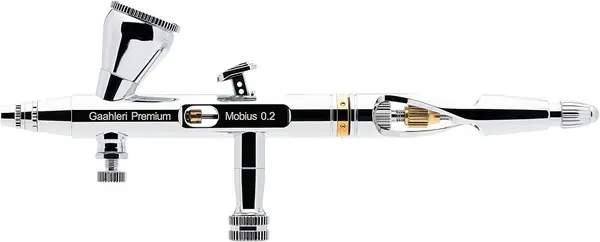
Gaahleri Premium Series Mobius 0.2 mm gravity-feed airbrush in silver with gold accents

Hairline detail work

Track Score 93/100
Cup Finish
Ultra mirror-level polish
Main Lever
Ergonomic square lever with adjustable spring tension
Air Control
Precision air control knob
Nozzle Size
0.2 mm spiral MAC nozzle
View on Amazon

The 0.2 mm spiral nozzle is the reason this one sits at the top of our list. It's the smallest nozzle in this group, matched only by the finest of the SJ83's three, and Gaahleri forms the air channel as a spiral rather than a straight bore so airflow stays even at the low pressures hairline work calls for. That is what buys you a line you can hold rather than a thin spray that sputters the moment you ease off the trigger.

What we kept coming back to, though, is the air knob. On most guns at this level it's a coarse afterthought; the 0.2 mm Mobius gets a longer, finer thread, so a small turn actually changes something and stays changed. Add the square main lever, shaped to stop the stutter that leaves a blob at the end of a stroke, and the whole thing feels like a tool built by people who spray. We were also struck by the cutaway body, which lets you watch the paint path when something starts misbehaving.

Two boundaries come with that precision. The fine nozzle wants properly thinned paint — craft acrylics straight from the bottle will bridge it, so a bottle of airbrush thinner belongs in the same order. And it is a detail gun first: a few inches of coverage is its ceiling, which is exactly the trade you accept for a line no bigger head can draw. If the lever ever hangs in the down position, check packing tension and dried paint before blaming the gun.

Worth Noting

  • Fine nozzle demands well-thinned paint
Our Verdict

We recommend the Mobius to anyone whose work lives at hairline scale: the 0.2 mm nozzle and fine air knob deliver control the bigger guns here can't match.

Check Latest Price
2.

Iwata Eclipse HP-CS Best for Versatility

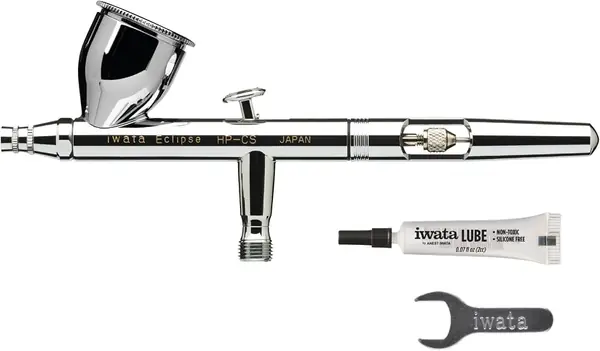
Iwata Eclipse HP-CS gravity-feed airbrush in chrome with a 0.24 oz fluid cup

Detail to coverage

Track Score 92/100
Handle
Quick-flush cutaway handle
Needle
Spring-steel needle
Nozzle
E3 compression-fit, thread-free
Cup Capacity
0.24 oz (7 ml)
View on Amazon

The E3 nozzle compresses into the body instead of threading on, and if you have ever cross-threaded a nozzle at the end of a long session, that detail is the one we value most about this gun. There is no fine thread to strip, the needle comes free through the cutaway handle without draining the cup, and a quick flush clears the passages. We think that is why the Eclipse has the following it does: it is a gun you keep reaching for because maintenance never becomes a project.

Coverage is the other half of its case. The E3 head is built for high-flow atomization, so it pushes thicker acrylics, enamels and pearlized paints with less thinning than a small-bore gun demands, and it runs from a fine line out to a broad fan without a head change. Solvent-resistant needle packings and a spring-steel needle are the unglamorous parts that make the behavior hold up.

What it gives up is the last increment of hairline finesse — the Mobius draws a thinner line — and the 0.24 oz cup runs dry fast when you are covering a large surface. We accept both for what the Eclipse does in return. Our favorite small thing: the cutaway handle exposes the needle for a mid-session wipe, so a dried tip doesn't cost you a full teardown.

Worth Noting

  • Cedes the finest hairlines to the 0.2 mm pick
  • Small cup empties quickly on big jobs
Our Verdict

We point most people here when they want one airbrush for fine lines and broad coverage, with cleanup that never turns into a project.

Check Latest Price
3.

Gaahleri GHAD-39 Best Budget

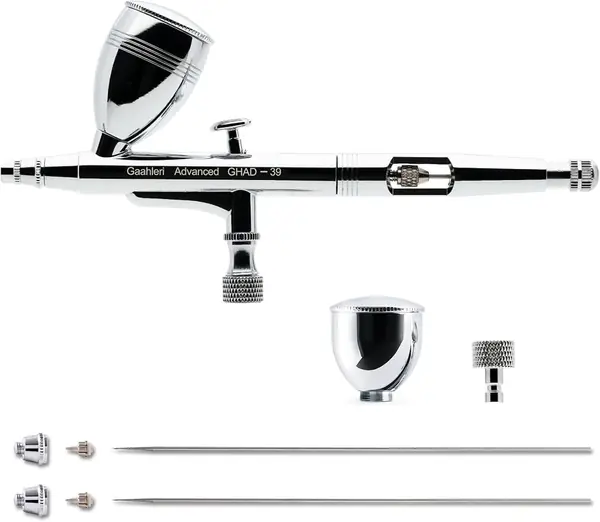
Gaahleri GHAD-39 silver airbrush with 0.35 and 0.5 mm nozzle sets and two cups

Budget fine detail

Track Score 91/100
Nozzle Type
Self-centering drop-in
Nozzle Sizes
0.35 mm and 0.5 mm
Warranty
1 year
Cup Sizes
1/2 oz and 1/4 oz
View on Amazon

The second nozzle in the box is what makes this kit worth more than its tier suggests. With the 0.5 mm head fitted, the GHAD-39 lays primer and basecoat across a whole squad of figures; swap in the 0.35 mm and you have a head that shades and picks out panel lines. Two needle and nozzle sets, two cups, spare O-rings — a beginner doesn't have to buy anything else to find out which kind of spraying they like.

What we appreciate most is the nozzle design. It drops in and centers itself with no thread to cross, so a five-second change between colors is realistic and a cleaning session doesn't end with a stripped nozzle and a reorder. The smooth inner cup helps there too: a rinse and a wipe gets most paints out before they set, and the cutaway handle lets you flush the air passages without a full strip-down.

Atomization is where it gives ground. Thinned paint sprays cleanly and evenly, but heavier acrylics come out uneven until you dilute them further, and that is what a head at this tier costs you. There are also more small parts to keep track of than on a bare-bones gun, so a shallow tray for nozzle pieces is worth the habit. For a first airbrush gun that gets handed primer duty and detail duty in the same week, we haven't found a better balance in this group.

Worth Noting

  • Thicker paints spray unevenly until heavily thinned
  • Several small parts to track during cleaning
Our Verdict

We think it's the smart first airbrush for detail work: a usable 0.35 mm head, a primer-ready 0.5 mm head, and a nozzle that forgives a beginner's cleanup.

Check Latest Price
4.

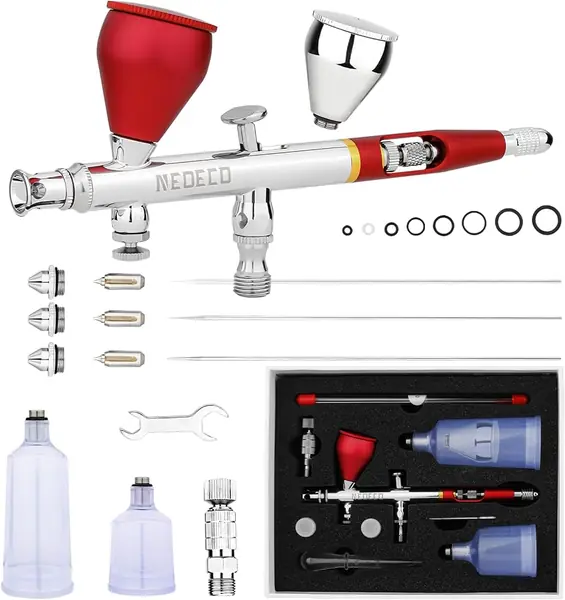
NEOECO SJ83

NEOECO SJ83 airbrush in red with three nozzle sizes and three paint cups

Multi-size starter kit

Track Score 85/100
Nozzle Type
Self-centering plug-in
Nozzle Sizes
0.2 mm, 0.3 mm and 0.5 mm
Cups
9cc, 20cc and 40cc
View on Amazon

Three nozzle sizes in one box is unusual for a gun in this tier, and it is the whole reason the SJ83 stays on our list. The 0.2, 0.3 and 0.5 mm heads share a plug-in, self-centering nozzle with no thread anywhere, so changing sizes is a five-second job with your fingers rather than a wrench and a risk. One gun can prime with the 0.5, basecoat with the 0.3 and finish with the 0.2.

The three cups — 9, 20 and 40 cc — follow the same logic: a splash for a few figures, a full cup for a priming run. The body is heavier than the others here, and that weight with a large cup full of paint is noticeable by the end of a long session. The trigger is the other thing we noticed: it can return slowly on release, which shows up as extra paint at the end of a stroke until you learn to lift early.

Fine needles are the weak point. The 0.2 and 0.3 bend more easily than the sizes above them, and a bent needle spits, so keep the cap on and never overtighten the nozzle. What we like anyway is how much range the money buys and how forgiving the nozzle design is for someone still learning: pull the nozzle, wipe the cup, drop it back, and the gun runs again. That habit is what decides whether an airbrush gets used or sits in a drawer.

Worth Noting

  • Trigger returns slowly on release
  • Thin needles bend if overtightened
Our Verdict

For the widest nozzle range at the lowest tier, this is the one we hand to a beginner who wants room to grow.

Check Latest Price

How We Tested Airbrushes for Fine Detail

We started with spec sheets and owner discussions, then narrowed the field to twelve guns covering the nozzle sizes, cup options and price bands shoppers actually compare. The complaints that kept surfacing — sputtering, tip dry, a nozzle that never seats right again after one cleaning — became the things we watched for. Testing ran eight months, mostly at a garage bench on weekends, with midweek sessions at the kitchen table on model kits, cosplay panels and nail tips.

On primed styrene we pulled hairline strokes until a gun either held the line or broke into spatter, and we measured the finest line each one would hold. Every airbrush got 20-minute sessions with thinned acrylic while we timed how long before tip dry set in and whether a backflush cleared it, then a run with unthinned primer to see which ones coughed. Triggers were tested the same way every time — air rolled on, then paint metered back — and we checked whether air control let us drop pressure for tight work without losing atomization.

After each color change we stripped the gun down: counted the parts, timed the teardown, and noted whether the nozzle dropped in and centered itself or needed a wrench and a careful eye. Needles and nozzles got the clumsy treatment, a knock off the bench onto a rubber mat and a deliberate over-tighten, because that's what a drop really costs. We weighed each one and ran two-hour sessions to find where hand fatigue set in, swapped cups mid-mix, and compared what came in each box against the price.

Lacquers and solvent-based paints were sprayed only with the shop door open and a respirator rated for the coating — never a dust mask — and every gun stayed at or under its stated maximum pressure.

How to Choose an Airbrush for Fine Detail

Start With the Nozzle, Not the Kit Count

Fine detail comes from the head. A 0.2 mm nozzle draws the thinnest line; 0.3 to 0.35 mm is the practical middle for models and miniatures, where you want a hairline without fighting clogs all afternoon; 0.5 mm is primer and basecoat territory. The trap is the multi-nozzle kit whose smallest head is 0.5 mm — that is a basecoat gun with spares, not a detail gun.

Check the smallest number in the box before anything else. Then accept the cost: a small nozzle wants thinner paint and lower pressure, so you pay for that hairline in prep time and in patience.

Trigger and Air Control Make the Line

Fine lines are made at the trigger. Dual action means you press for air and pull for paint independently, and the extras that matter are a needle stop so the trigger cannot travel too far, an air-control knob fine enough to hold a setting, and a lever that returns cleanly.

We care more about a smooth trigger on a 0.35 mm head than a fussy 0.2 mm one, because a jumpy trigger turns a hairline into a blob. If your hands tire, a pistol-style grip helps; weight matters more once a cup is full, so judge the gun loaded rather than dry.

Nozzle Design Decides How Often You Clean It

How the nozzle attaches decides whether you clean properly or put it off. Threaded nozzles are cheap to make and easy to cross-thread; self-centering drop-in and compression-fit designs cost more but swap in seconds and survive an over-tightened hand. The Eclipse's compression-fit E3 head is the design to study if cleaning is your least favorite part of the hobby.

The trap: a nozzle you are afraid to remove is a nozzle that stays clogged. If you tend to clean in a hurry, buy the design that forgives it, and keep nozzle parts in one tray so reassembly is never a search.

Paint, Thinning and Cup Size

Airbrush-ready paints go straight in. Craft acrylics need thinning to roughly skim-milk consistency plus a drop of flow improver, and a 0.2 mm head will reject anything thicker no matter how you adjust the air. If you plan to prime and detail with one gun, either buy one with a coarse head available or accept a lot of stirring.

Cups of around 7 ml suit a few figures and let you switch colors often; bigger cups are for priming runs and get heavy when full. Match the cup to the job and the gun stays pleasant to hold.

Frequently Asked Questions

Final Verdict

Our pick for fine detail is the Gaahleri Mobius 0.2 mm. Nothing else in this group meters air and paint as precisely at hairline scale, and the polished cup and drop-in nozzle mean upkeep doesn't eat your painting time. It asks for properly thinned paint in return, which is the honest price of a 0.2 mm head.

If your work also includes broad coverage and thicker media, the Iwata Eclipse does both with less thinning and a much longer track record. If budget is the binding constraint, the GHAD-39 still gets a beginner to a real 0.35 mm hairline and a primer head without stretching.