Best Airbrush Compressors with Tanks of 2026

A tank stores a reserve of air so the piston isn't the only thing feeding your brush. Without one, every stroke carries the motor's throb and fine detail turns into a fight; with one, lines get cleaner without your hand changing at all.

Noise matters more than spec sheets admit, since these sit an arm's length from your ear for hours, and so does heat: a small pump behaves differently once a long session has warmed it up. Over eight months on desks, garage benches and a kitchen table, we also tracked what came in each box and whether the fittings held up to constant connecting and disconnecting.

Our Top Picks

The Best Airbrush Compressors with Tanks

1.

Cool Tooty Airbrush Compressor Best Overall
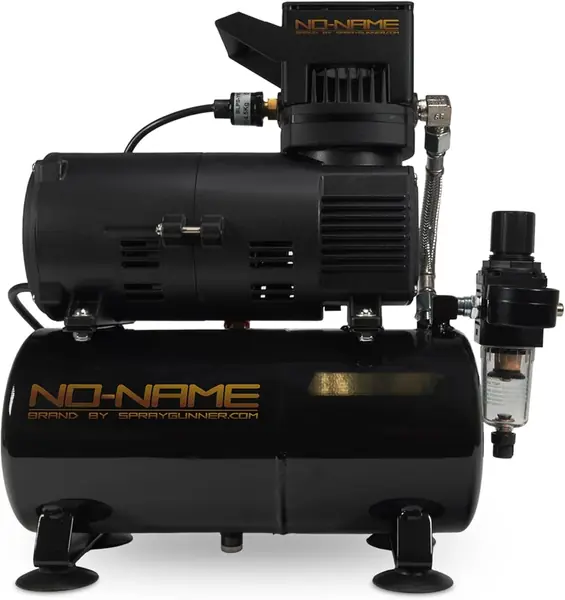
Cool Tooty airbrush compressor with 3-liter metal tank and dual cooling fans in black

Desk model painting

Track Score 93/100
Airflow
23 liters per minute
Tank Volume
3 liters
Noise Level
50 dB
Dimensions
13.5"L x 5.5"W x 14"H
View on Amazon

Two cooling fans are what put this compressor at the top of our list. One sits inside the motor housing and a second is mounted on the piston radiator, and together they go after the thing that actually ends a small oil-free pump: heat built up over an evening of spraying. Pair that with a 3-liter metal tank and a 50 dB rating and you have the combination we want on a workbench — stored air for the brush, and a motor that isn't working flat out to supply it.

The regulator is the other half of the case. It dials down into the low-pressure range where miniature and fine-detail work lives, and because the air comes off the tank, the setting holds between motor cycles instead of surging with each piston stroke. It also ships with a 1/8-inch to 1/4-inch adapter, so the hose you already own is far more likely to fit on day one.

On a bench it's a tidy thing: 13.5 inches long, 5.5 wide and 14 tall, narrow enough to sit at the end of a desk, and the suction-cup feet keep it there rather than letting it shuffle across the surface every time the motor kicks in. We also like that the moisture filter rides up on the regulator where you can see it, which makes emptying it part of the routine instead of a discovery.

Worth Noting

  • Costs more than the budget picks here
  • Ships without hose or airbrush
Our Verdict

We recommend the Cool Tooty as the default tank compressor for model and miniature work: dual cooling fans, steady tank-fed pressure, and quiet enough to share a room with.

Check Latest Price
2.

Timbertech ABPST08 Airbrush Compressor Best Value

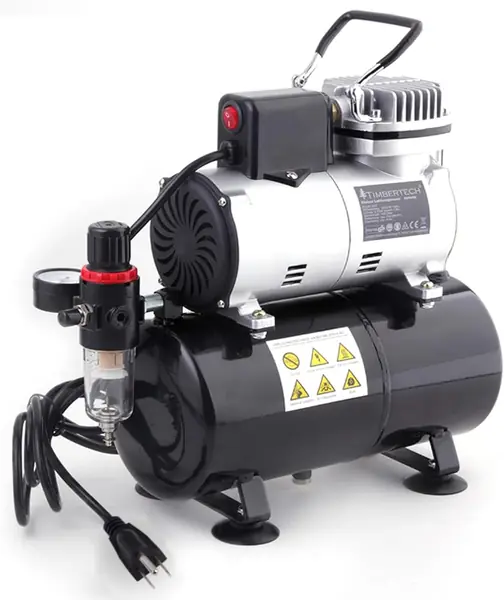
Timbertech ABPST08 black airbrush compressor with 3-liter tank and cooling fan

Budget hobby work

Track Score 92/100
Airflow
23 liters per minute
Tank Volume
3 liters
Noise Level
50 dB
Weight
11.5 lb
View on Amazon

At the bottom of this group's price range sits a compressor that gives up remarkably little: a 3-liter receiver, the same 20 to 23 liters per minute as models costing far more, an oil-free piston, and a regulator with gauge, water trap and filter already on board. It weighs 11.5 pounds and stands about a foot tall, so it moves between a desk and a shelf without a second trip.

What we like most is how little attention it asks for once it's running. Auto start and auto stop let the pump fill the tank, cut out and stay quiet while you work, and the cool-down fan on the piston buys time before the thermal protector steps in. Holding a steady pressure through a long session is the whole job at this price, and this one does it without the fuss of a bigger machine.

Fittings are the one place to slow down before your first session. The outlet is 1/8 inch, and a hose that threads partway and then seeps is usually a thread-standard mismatch rather than a faulty compressor, so match the fitting on your hose or throw an adapter into the same order. Everything after that is plug-in-and-spray.

Worth Noting

  • No hose or airbrush in the box
  • Motor failures are the long-term risk
Our Verdict

We send budget-minded painters to the Timbertech: a 3-liter tank, steady pressure, and quiet running for a fraction of what our top pick costs.

Check Latest Price
3.

Master Airbrush Cool Runner Kit Best All-In-One Kit

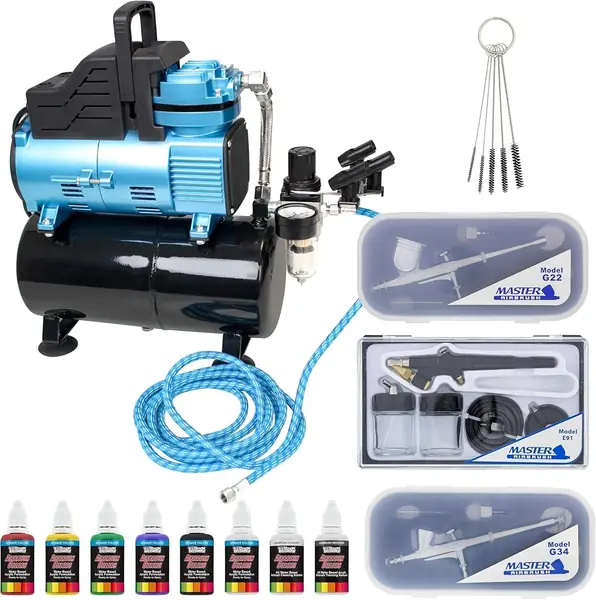
Blue Master Airbrush Cool Runner compressor kit with three airbrushes and six paint bottles

First-time airbrushers

Track Score 91/100
Airflow
25 liters per minute
Tank Volume
3 liters
Noise Level
47 dB
Kit Contents
Three airbrushes, six paint colors, hose
View on Amazon

Twenty-one pieces arrive in one box: the Cool Runner compressor, three airbrushes (two gravity-feed, one siphon-feed), six opaque acrylic colors, a double-sided color mixing wheel, a cleaning brush set, a 10-foot braided hose and holders for two brushes. For someone who has never airbrushed, it turns reading about the hobby into starting it, which is exactly why we keep a kit in a guide about compressors.

The compressor half is the stronger half. Two cooling fans, a 3-liter tank, 25 liters per minute and a 47 dB rating, with a 65 psi ceiling that gives the regulator room to work. The tank does what a tank should: fills, cuts out, and feeds the brush from stored air so the spray stays even instead of pulsing with the piston.

What we tell a first-timer is that the brushes, not the compressor, are the part you outgrow. Three of them means one can stay loaded with primer while another holds color, and the siphon-feed brush handles the broader passes. Six colors won't carry a project far, but they will teach you thinning and trigger control on scrap plastic before you spend real money on a paint set.

Worth Noting

  • Heaviest unit here at 16.2 pounds
Our Verdict

For anyone starting from zero, the Cool Runner kit has it all: three airbrushes, paint, a hose, and a quiet dual-fan 3-liter compressor in a single box.

Check Latest Price
4.

Iwata Power Jet Pro Compressor Best for Two Airbrushes

Iwata Power Jet Pro white dual-outlet airbrush compressor with two regulators and gauges

Two-airbrush studios

Track Score 90/100
Airflow
1.2 cfm
Tank Volume
2 liters
Outlets
Dual outlets and regulators
Pressure Range
1 to 50 psi
View on Amazon

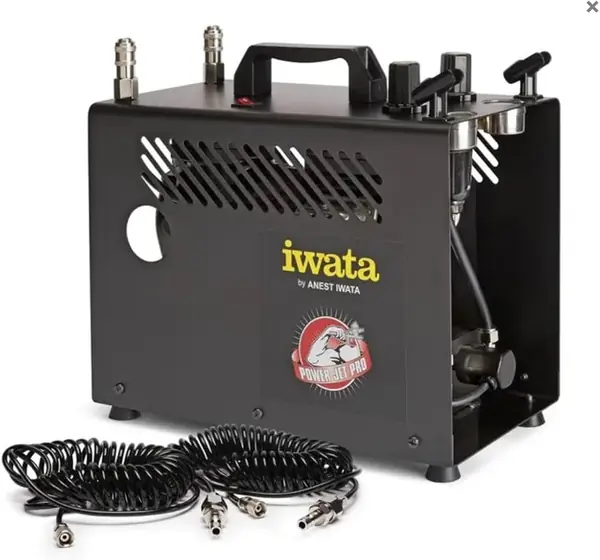
Two outlets, two regulators, two gauges. The Power Jet Pro is built around the idea that one airbrush is not always enough: load a detail brush and a wider one, set each regulator where you want it, and switch between them without touching a dial. Each channel adjusts from 1 to 50 psi, fed by a 2-liter tank and a motor moving 1.2 cfm.

We like it most for what it does at the bottom of that range. Low-pressure detail work is where cheap regulators give themselves away, creeping or jumping from nothing to too much, and the Iwata's dials stay where you put them while the tank absorbs the pump's pulse. The twin moisture filters matter here too: dry air is what keeps a fine-detail pass from blooming halfway across a wing.

The 2-liter tank is the smallest in this group, and it matters less than the number suggests, because at 1.2 cfm the receiver refills quickly and auto shut-off keeps the motor idle whenever a brush is down. At 22 pounds it stays exactly where you put it, which suits a bench with two hoses hanging off it.

Worth Noting

  • Costs several times the other compressors here
Our Verdict

Made for running two airbrushes at once: separate regulators and gauges, rock-steady low-pressure air, and quiet operation.

Check Latest Price

How We Chose and Tested These Airbrush Compressors

We started with every tank-equipped airbrush compressor we could find, then cut the list on what decides whether a unit is livable: a tank big enough to smooth out the piston, a regulator that reaches low pressure, auto start-stop that doesn't short-cycle, and the fittings most brushes need in the box. We bought 11 units and ran them for eight months against the tankless compressor several of us already owned.

Testing happened where these actually live: a spare-bedroom desk, a garage workbench, a kitchen table during a makeup session. We timed each one from unboxing to first spray, then sat beside it with a decibel meter at ear height, noting pitch as well as volume — a low hum you can talk over beats a sharper tone at the same reading. Every hour we shot the housing with an infrared thermometer and logged when the pump kicked on and off; a unit running longer between pauses is telling you it's hot.

At the brush, we sprayed water onto paper towels and paint onto plastic spoons, watching for spitting, surging, and lines that widened whenever the compressor cycled. We turned each regulator down to its lowest usable setting to see how fine a line it would hold, and checked a dry paper towel after long runs for damp spots. Every included hose and adapter got fitted to both common brush thread sizes, and each unit ran on a hard bench to see whether its feet walked.

Durability ran the length of the test: reconnecting fittings dozens of times, checking threads for wear and slow leaks with soapy water, and setting each unit's footprint against how much bench it ate. We released tank pressure before draining condensate, and sprayed only in ventilated rooms with the respiratory protection each paint called for.

How to Choose an Airbrush Compressor with a Tank

What the Tank Actually Buys You

Every compressor here is a small oil-free piston pump, and a piston delivers air in pulses. The tank turns those pulses into a continuous stream: the pump fills the receiver, shuts off, and you spray from stored air while it rests. That is the difference between laying down a smooth coat and chasing a pattern that chatters in time with the motor.

Size matters less than it looks. A 3-liter receiver is the norm in this class, and the 2-liter tank on our Iwata pick refills quickly enough that the motor barely runs during detail work. Treat a bigger tank as longer stretches between cycles rather than a magic improvement in finish.

Match the Pressure Range to the Work

Fine detail lives at low pressure. Miniature and model work often runs between 10 and 25 psi, where a coarse regulator makes small work impossible because you cannot find the setting between too much air and none. Look for a gauge you can actually read and a knob with enough travel to land on 15 psi deliberately.

Ceilings in this group run from 50 to 65 psi, well past what an airbrush needs, so do not buy the highest number on the box. What separates these machines is behavior at the bottom of the dial, and the only way to know yours is to spray a test card before you commit a model to it.

Noise, Heat, and Duty Cycle

Ratings cluster between 47 and 55 dB, and a few decibels make less difference in a room than the spec sheet implies. Cooling design tells you more about living with one: a second fan on the piston radiator, as on our top pick, buys working time before the thermal cutout steps in, and a metal receiver holds up better than a warm plastic housing.

These are intermittent-duty machines. Running in short bursts off a tank keeps the head cooler than continuous spraying, and an overheat protector that shuts the motor down is a feature doing its job, not a fault. If a session is long enough to trip it, give the compressor the break rather than restarting into the same heat.

Fittings, Hoses, and Dry Air

Two things derail first sessions: thread mismatch and water. Outlets are usually 1/8 inch, but 1/8 BSP and 1/8 NPT are different threads, and a hose that threads halfway and then leaks is a fitting problem rather than a broken compressor. Order the adapter with the machine instead of diagnosing a leak on the day your paint arrives.

Water is the other one. The regulator-mounted trap catches most of it, so empty it after each session and drain the receiver through its plug, because condensate sitting inside a steel tank is what rusts it from the inside out. A dry, clean air supply is the quiet advantage of maintaining a cheap compressor properly.

Compressor Alone or a Complete Kit?

If you already own an airbrush and a hose, buy a compressor and put the savings into paint. If you own nothing, a kit costs less than assembling the parts, and our Master pick bundles three brushes, six colors and a hose with a 3-liter, dual-fan compressor that would be a reasonable buy on its own.

The trade is that quality gets spread across more items. Kit brushes are for learning, while the compressor in a kit is often the same mini compressor sold alone. Decide which half of the purchase you care about most and spend there; nobody regrets buying the better pump first.

Frequently Asked Questions

Final Verdict

For most people painting models, miniatures or canvas at a desk, the Cool Tooty is the compressor we point to: two cooling fans, a 3-liter tank and a regulator that behaves at low pressure, all quiet enough to share a room with. It costs more than the budget options, and it earns that in working time before heat becomes a problem.

Spend less and the Timbertech does the same job with one fan and a plainer body. Run two brushes at once, or airbrush for a living, and the Iwata's independent regulators and dry, steady air justify the leap. If you own nothing at all, start with the Master kit and treat the brushes as the part you will replace first.