Best Quiet Airbrush Compressors of 2026

A quiet compressor makes a promise about five minutes from now, when the tank runs low, the motor kicks on and the whole house knows you're painting. The decibel figure on the box says little about that moment, since it's measured at a fixed distance rather than through the way a compressor cycles while you work.

Restarts per hour mattered more than ratings. A bigger tank on a slightly louder unit can be easier to live with than a small tank with a better number, because the motor runs less, and late-night painters notice motor pitch as much as volume. We sprayed thinned acrylics and fine detail with 12 compressors at a spare-bedroom bench, a decibel meter parked where the brush hand sits, and the six picks cover indoor modelers, long sessions, starter kits and tight corners.

Our Top Picks

The Best Quiet Airbrush Compressors

1.

Timbertech ABPST08 Airbrush Compressor Best Overall
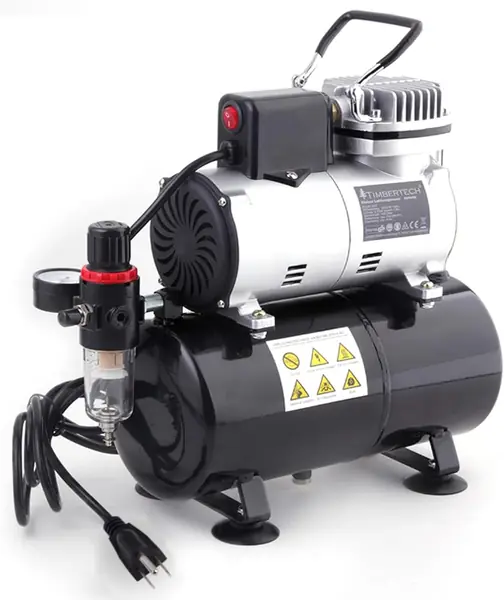
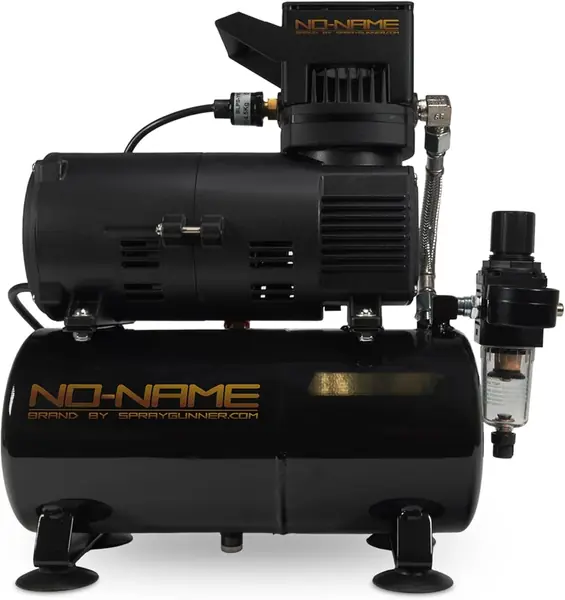
Timbertech ABPST08 black airbrush compressor with 3-liter tank and cooling fan

Indoor model painting

Track Score 93/100
Noise Level
50 dB
Airflow
23 liters per minute
Tank Volume
3 liters
Weight
11.5 lb
View on Amazon

A three-liter tank and a cooling fan are the two features that make an airbrush compressor livable indoors, and the Timbertech ABPST08 has both without turning into a heavy shop tool. The tank gives you a reserve of air so the motor is not running every time you pull the trigger, and the fan helps keep the piston cooler through the longer sessions that model painting tends to turn into. At 11.5 pounds, it is easy to shift from a shelf to the desk and back.

We used it as the quiet default for acrylics and primer on minis, and what we appreciated most was the steadiness. The regulator and water trap let us dial down to the low pressures fine detail wants, while the 23 liters per minute of airflow kept a broader coat moving when we opened up. The 50 dB rating is not silent, but it is the kind of background hum you can live with in a spare room. The cooling fan matters here; it is the difference between a compressor that feels like it can keep going and one you are nursing through a long build.

The trade-off is mostly about expectations. It is a compact compressor, not a piece of shop equipment, and the 3-liter tank is sized for airbrush work rather than sustained high-volume spraying. Longevity is the one caveat we keep coming back to: some units can stop early, so run yours through a real session during the return window. For most model painters, though, it is the best balance here of quiet, steady air and a price that does not feel like a commitment to a new hobby.

Worth Noting

  • Hose fitting can be fussy to start
Our Verdict

The ABPST08 is our quiet default for model painters: a 3-liter tank, cooling fan, and roughly 50 dB rating keep indoor sessions steady without a premium price.

Check Latest Price
2.

Cool Tooty Airbrush Compressor Best for Long Sessions

Cool Tooty black airbrush compressor with dual cooling fans and metal tank

Long quiet sessions

Track Score 92/100
Noise Level
50 dB
Airflow
23 liters per minute
Tank Volume
3 liters
Cooling
Dual fans
View on Amazon

The Cool Tooty is the quiet compressor we reach for when a painting session is going to run long, and its dual cooling fans are the reason. One sits inside the motor housing and a second is mounted on the piston radiator, so the machine has more help shedding heat than the single-fan designs here. The 3-liter metal tank keeps air in reserve, and the suction-cup feet hold the whole thing steady on a smooth desk. That combination is what makes the premium price easier to understand.

At 50 dB, it is not invisible, but it stays in the background while you work. We liked the regulator's range for dialing down to the low pressures model paints want, and the 23 liters per minute of airflow gives you enough headroom for broader coverage without feeling like the tank is emptying instantly. The noise does change as the tank fills, rising a little near the end of a cycle; it is noticeable mostly when you are not actively spraying.

The controls reward a little patience: the regulator is capable, but you may need a few sessions to settle on your settings. That is a small friction, not a reason to skip it. If you want the extra cooling margin and a tank that stays planted, this is the premium pick we point to.

Worth Noting

  • Pressure adjustment instructions are minimal
Our Verdict

For long indoor sessions, we pick the Cool Tooty: dual cooling fans, a 3-liter tank, and steady pressure make it the premium choice when quiet matters.

Check Latest Price
3.

Master Airbrush Cool Runner Kit Best All-In-One Kit

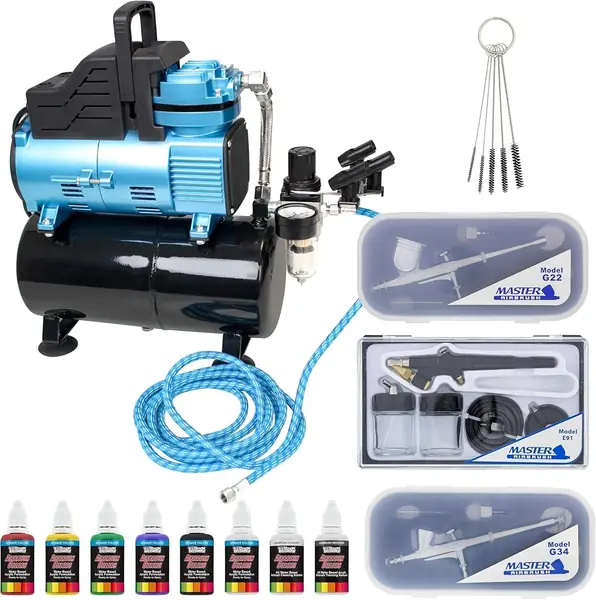
Master Airbrush Cool Runner blue compressor kit with three airbrushes and paint

First airbrush kit

Track Score 91/100
Noise Level
47 dB
Airflow
25 liters per minute
Tank Volume
3 liters
Included
Three airbrushes and six acrylic paints
View on Amazon

The Master Airbrush Cool Runner kit is less about one compressor than about the whole box you open on day one. Inside are three airbrushes, a 10-foot braided hose, six acrylic colors, a mixing wheel, and cleaning brushes, all paired with a dual-fan compressor and a 3-liter tank. For someone who has been buying cans of spray primer and wondering where to start, that completeness is the appeal.

The compressor itself is rated at 47 dB, which puts it among the quieter machines here, and its 25 liters per minute of airflow and 65 psi ceiling give it more headroom than the small tankless units. We appreciated the tank because it keeps the motor from cycling every few seconds while you work. The trade-off is weight: at 16.2 pounds it is the heaviest pick in this group, so it wants a permanent spot rather than a shelf you move every session.

The compressor's long-term reliability is the caveat; some units can stop early, so test the whole kit thoroughly while returns are easy. As a first setup that removes the guesswork, it earns its place for a new painter who wants one order to cover the basics.

Worth Noting

  • Included airbrushes are beginner-level
Our Verdict

First-time airbrushers should look at the Cool Runner kit: we like that a quiet dual-fan compressor arrives with three brushes and paint.

Check Latest Price
4.

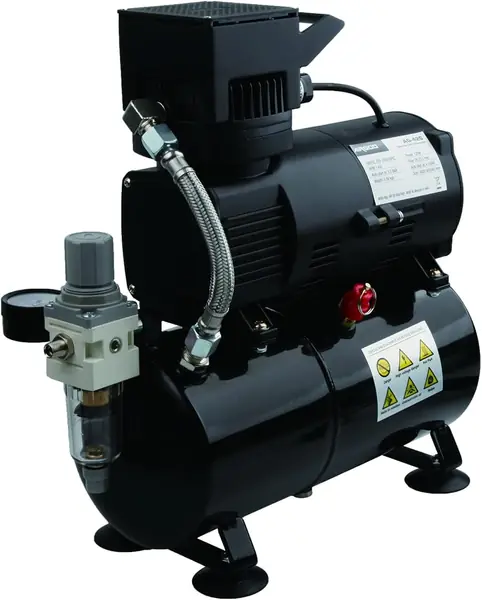
Airgoo AG-426 Airbrush Compressor Best Value Dual-Fan

Airgoo AG-426 black airbrush compressor with dual fans and 3-liter tank

Value dual-fan setup

Track Score 86/100
Noise Level
47 dB
Tank Volume
3 liters
Maximum Pressure
4.5 bar
Cooling
Dual fans
View on Amazon

Dual cooling fans and a 3-liter tank usually push an airbrush compressor into premium territory, and the Airgoo AG-426 is the one here that makes that combination feel like a value. It is rated at 47 dB and runs on a single-piston oil-free motor with a 4.5-bar ceiling, so it has enough headroom for model work without asking you to manage a shop-sized machine.

We liked the pressure control most. The regulator and gauge let us set a low working pressure and hold it closely; the tank keeps the output steady when the motor cycles, and the dual fans mean the compressor is not working alone to shed heat. It sits securely on a bench and does not wander.

The value is the point. The AG-426 gives you the tank-and-fan formula, and it does it with steady pressure that makes fine detail work less fiddly. If you want a dual-fan tanked compressor and do not need the top-priced model, this is the one we point to.

Worth Noting

  • Bulkier than compact tankless units
Our Verdict

Buyers who want dual fans and a tank without the top premium are the ones we send to the AG-426; it holds pressure closely and runs at 47 dB.

Check Latest Price
5.

Timbertech AS18-2 Airbrush Compressor Best for Small Detail Spaces

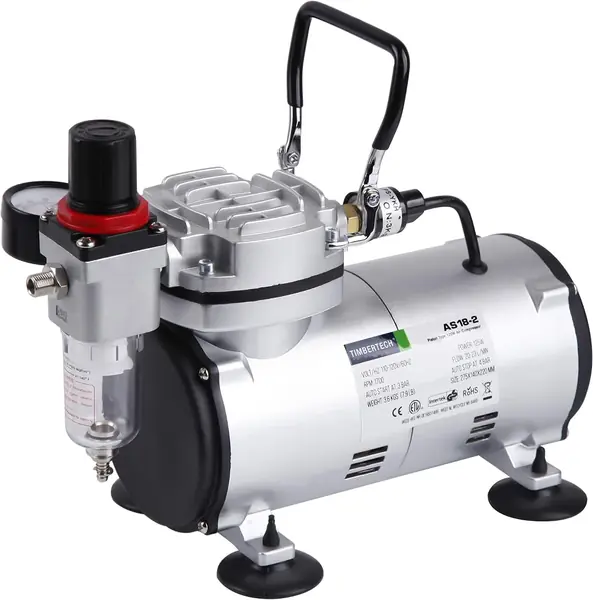
Timbertech AS18-2 black portable airbrush compressor with built-in carry handle

Small detail spaces

Track Score 85/100
Noise Level
50 dB
Airflow
23 liters per minute
Weight
8.25 lb
Maximum Pressure
4 bar
View on Amazon

The Timbertech AS18-2 is the compressor we keep for a small desk or a backup station. At 8.25 pounds and 12 inches long, it tucks under a shelf or beside a cutting mat without dominating the space. It is the one we hand to someone who paints at a kitchen table and puts the compressor away afterward.

We found it quiet enough for indoor detail work, with a 50 dB rating and 23 liters per minute of airflow. The regulator gives you 4 bar of ceiling and enough adjustment for light acrylics and thin paint. The 4 bar ceiling is not the highest here, but it is enough for the light acrylics and thin paints we use for detail. It is best in short sessions and small projects, where its compact body and simple regulator make it easy to live with.

Long-term reliability is the other thing to keep in mind. Some units can stop working, so buy from a seller with easy returns and put it through a real session early. That caveat aside, the AS18-2 earns a place as a compact, quiet second compressor for detail work, not as the main unit in a serious model-painting setup.

Worth Noting

  • No tank means more motor cycling
Our Verdict

The AS18-2 is our compact backup pick for light detail work, not the main compressor for long model-painting sessions.

Check Latest Price
6.

Master Airbrush C16-B Mini Compressor

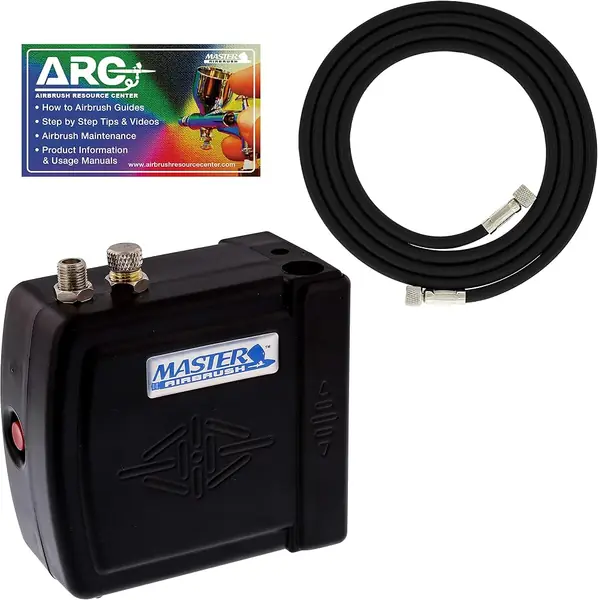
Master Airbrush C16-B compact black mini compressor with braided air hose

Ultra-quiet fine detail

Track Score 83/100
Noise Level
30 dB
Airflow
10.5 liters per minute
Weight
2 lb
Maximum Pressure
25 psi
View on Amazon

The Master Airbrush C16-B has the lowest noise rating here by a wide margin: 30 dB. That number is the whole reason to look at it. It is a tiny 12-volt mini compressor with a 2-pound body, a 6-foot braided hose, and a plug-in adapter, and it can sit on a corner of the desk without taking over. It is the kind of compressor you leave out because it does not look or sound like machinery.

We liked it for thin paint and fine detail, where the low noise lets you work late without thinking about the room next door. The 10.5 liters per minute of airflow is enough for small touch-ups and travel, and the plug-in adapter means you do not need a shop-sized outlet. The regulator is simple, and the included hose gets you spraying without a parts hunt. It is a detail tool, and it is happiest when you keep the work small and the paint thin.

Use it for fine line work, small touch-ups, and travel, where its 2-pound body and 30 dB rating are genuinely useful. It earns a spot as a specialist, not as the one compressor for every model-painting job. That is a narrow role, but it is one the bigger units here cannot fill as quietly.

Worth Noting

  • 25 psi ceiling limits thicker paint
  • Tankless design gives no air reserve
Our Verdict

We keep the C16-B for one job—ultra-quiet fine detail—because its 30 dB rating is remarkable but its 25 psi ceiling leaves no room for priming.

Check Latest Price

How We Tested Quiet Airbrush Compressors

We started with more than 30 compressors sold as quiet hobby units and filtered down by the things that separate them: an actual tank, a cooling fan, a regulator and moisture trap on board, and fittings that mate with a standard 1/8-inch brush without a trip to the hardware store.

Twelve units came in and stayed on the bench for eight months. Each one ran the same sessions: a two-hour model-painting block with thinned acrylics, fine line work at low pressure, and a wide coverage pass to see how fast the tank drained. We metered sound at the hand position, then walked into the next room and listened with the door shut. Counting restarts during a 20-minute continuous spray told us more about living with a compressor than any rating.

We put a hand on the cylinder head after every long session to note whether the fan kept it warm or genuinely hot, and judged airflow at the brush tip — whether paint atomized cleanly or sputtered, and whether the gauge held steady while the motor ran. Durability and reliability showed up on their own: moisture traps that leaked, regulators that drifted, fittings that stripped after a few swaps. We kept every pressure-relief valve installed and stayed under the rated pressure throughout, using these only for airbrush work.

Completeness counted for anyone starting from zero, so we logged what came in each box and priced out what was missing. We weighed each unit and marked its footprint on a shelf, since it has to share bench space. Ease of use came down to small things: turning the regulator with paint on your fingers, reaching the drain valve, threading the same adapter for the tenth time. The six that made the list kept doing all of it eight months in.

How to Choose a Quiet Airbrush Compressor

Noise Ratings and What They Miss

A 30 dB mini compressor can be quieter than a 47 dB tanked unit and still be a worse model-painting compressor if it cannot hold pressure. Decibels tell you how loud the motor is, not how often you will hear it. A tank lets the compressor fill, shut off, and stay silent while you spray; a tankless unit runs more often and turns a lower rating into more interruptions. We prioritize a rating near 50 dB or lower plus a tank for desk work.

Tank Size and Cycling

Three liters is the useful middle ground here: enough reserve for steady airbrush work, small enough to keep the unit portable. The tank does two jobs—it smooths output so you do not feel the piston pulse, and it lets the motor rest between fills. If you paint in short bursts at a small desk, a tankless model can be acceptable, but it will cycle more and may be harder to live with over a long session. For a primary indoor compressor, we choose the tank.

Cooling Fans and Heat

Airbrush compressors are often run for an hour or more while you work through a squad of models, and heat is the quiet enemy of that kind of session. A cooling fan, especially a dual-fan setup, gives the motor and piston more help shedding heat. It also lets the compressor run longer before the overheat protection steps in. If your sessions are short, a single fan or a smaller unit can be enough; if you paint for hours, make the fan a priority.

Pressure and the Airbrush You Own

Most of these compressors deliver around 20 to 23 liters per minute and top out near 4 bar, which is plenty for model paints when you use the regulator to dial down. The exception is the tiny 25 psi class: fine for thin detail work, frustrating for primer or broad coverage. Check the regulator's useful range and the hose fitting before you buy, especially if you already own an airbrush with a nonstandard thread.

Kit or Compressor Only

A kit can be a good first purchase because it removes the mismatch between compressor, hose, and brush. The catch is that bundled airbrushes are usually beginner-level, and you pay for parts you may replace. If you already own a brush you trust, buy the compressor alone and put the savings into a better hose or regulator. If you are starting from nothing, a complete kit is the lower-friction way in.

Frequently Asked Questions

Final Verdict

We recommend the Timbertech ABPST08 as the quiet default for most model painters. Its 3-liter tank, cooling fan, and 50 dB rating keep indoor sessions steady, and it does that at a midrange price rather than a premium one. If you paint for hours and want dual fans, the Cool Tooty is the step up; if you are starting from nothing, the Master Airbrush Cool Runner kit bundles the compressor with brushes and paint. The C16-B is the specialist for ultra-quiet fine detail, not for priming.