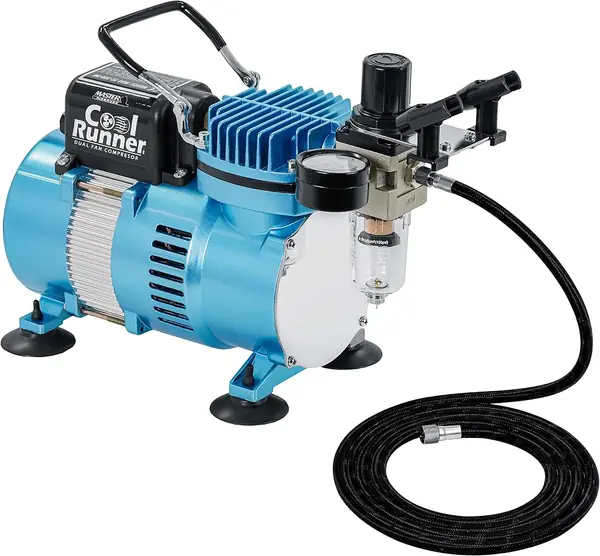
Best Airbrush Compressors for Miniatures of 2026

A pulsing air supply stripes a basecoat, a tank without a moisture trap spits water onto a finished layer, and a motor you can hear through a wall rules out painting after the household goes to bed. For miniatures, the compressor that avoids all three gives steady, dry air at the bottom of the dial, where glazes and edge highlights live, at a noise level you can sit next to for an evening.

Horsepower is what sellers push. What matters is a tank, a readable gauge and a trap that holds steady at low pressure, and footprint counts too if the bench is a folding table near the couch. We ran 11 compressors through primed squads and long sessions of detail work, and the four here split between a crowded desk and a garage bench.

Our Top Picks

The Best Airbrush Compressors for Miniatures

1.

Timbertech ABPST08 Airbrush Compressor Best Overall
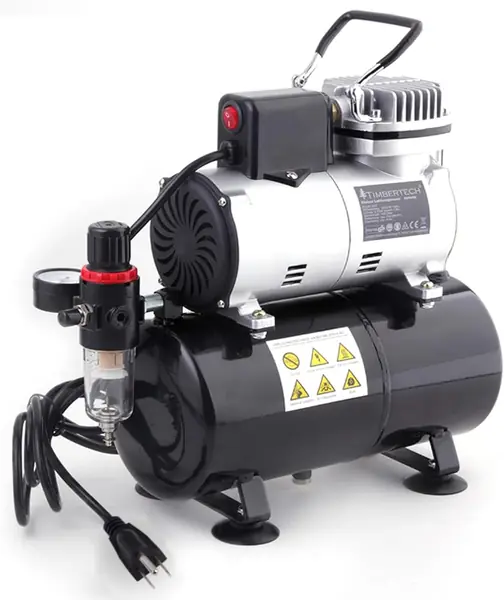
Timbertech ABPST08 airbrush compressor with 3-liter tank, regulator, and cooling fan

Indoor miniature painting

Track Score 92/100
Airflow
20-23 liters per minute
Noise Level
47 dB
Tank Capacity
3 liters
Pressure Control
Regulator with gauge and moisture trap
View on Amazon

The combination of a 3-liter tank and a cooling fan is what makes this Timbertech our default for miniature painting. The tank acts as a buffer, so the compressor is not constantly kicking on while we work, and the fan is aimed at the heat that builds during longer sessions. At 47 dB, it is quiet enough that we can keep painting without feeling like we need to leave the room.

The regulator, gauge, water trap, and air filter are all part of the package, which matters more for acrylics than the spec sheet suggests. A moisture trap keeps condensation out of the airstream, and the regulator lets us drop the pressure for fine edge work instead of blasting a model with too much air. We like that the trap is part of the unit rather than another accessory to find space for.

For a first compressor, we point to this one because it covers detail work and primer coats without asking you to manage a tankless unit's cycling. If you paint in long marathon sessions, the Master TC-326T adds dual fans and a higher pressure ceiling; if your bench is tiny, the AS18-2 is smaller. The built-in carry handle is a small detail we appreciate when moving it from a shelf to the painting desk.

Our Verdict

We recommend the Timbertech ABPST08 as the best all-around choice for miniatures because it pairs a steady 3-liter tank with a cooling fan, moisture trap, and quiet operation.

Check Latest Price
2.

Master Airbrush TC-326T Best for Long Sessions

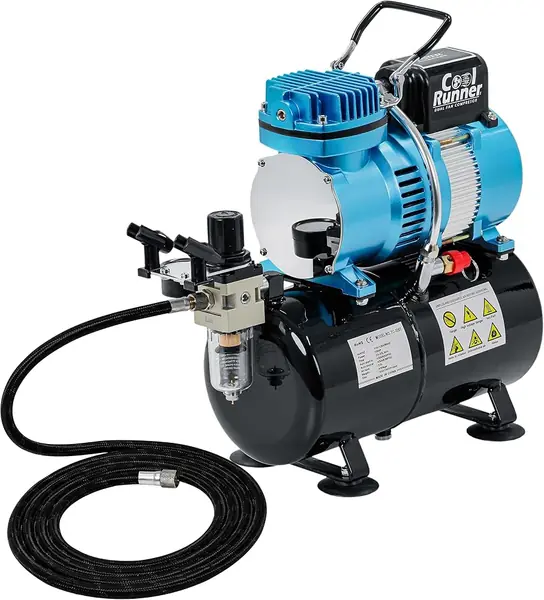
Master Airbrush TC-326T compressor with metal 3-liter tank and dual cooling fans

Long painting sessions

Track Score 91/100
Airflow
25 liters per minute
Noise Level
47 dB
Maximum Pressure
57 psi
Tank Capacity
3 liters
View on Amazon

The TC-326T is the Master model we choose when a batch of miniatures turns into a long weekend. Two cooling fans sit alongside a 3-liter tank, and the combination is built for longer continuous running than the tankless units here. The compressor is rated at 47 dB and 25 liters per minute, with a 57 psi ceiling.

What we like most is how the tank and fans work together: the tank steadies the output, and the fans let us keep spraying without the unit feeling like it is working flat out. The regulator and water trap are easy to reach, and the built-in holder gives the airbrush somewhere to sit between colors. At the low end, dialing in a very fine pressure takes a little patience; we set it by the gauge and test on scrap before committing to a model.

It weighs 12.3 pounds, so it stays on the bench rather than moving around, and the higher airflow makes it a better fit for priming and base coats than the compact tankless models. If you mostly paint small details for short stretches, the top pick is easier to live with; if you regularly spray for an hour or more, the TC-326T is the better match.

Our Verdict

The Master TC-326T suits a long batch; its dual fans and 3-liter tank keep the air steady without making the room loud.

Check Latest Price
3.

Timbertech AS18-2 Airbrush Compressor Best Budget

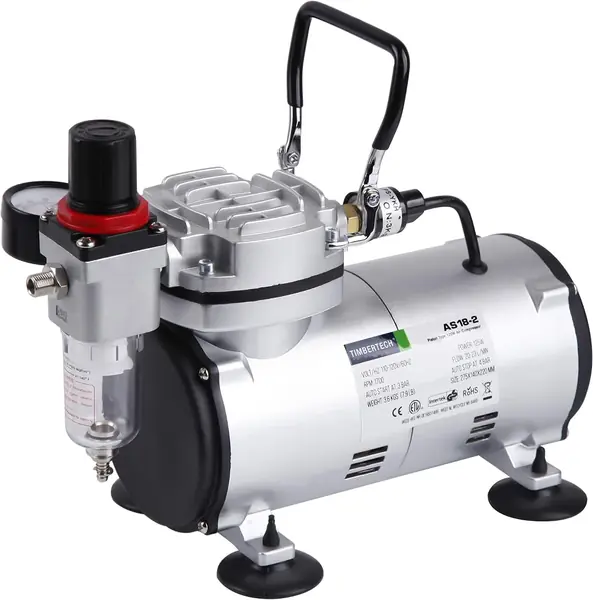
Timbertech AS18-2 compact airbrush compressor with carry handle and pressure gauge

Small budget benches

Track Score 90/100
Airflow
20-23 liters per minute
Noise Level
50 dB
Maximum Pressure
4 bar
Weight
8.25 lb
View on Amazon

At 8.25 pounds, the Timbertech AS18-2 is the compressor we move around without thinking about it. It has no storage tank, so the motor cycles more often than the tank models, but the trade-off is a smaller, lighter unit that fits on a narrow shelf. The 50 dB rating is a touch higher than the 47 dB models here, though it is still easy to live with in a spare room.

The 1/6-horsepower motor delivers 20-23 liters per minute, and the auto start/stop range of 3 to 4 bar keeps pressure in a usable band for miniature work. We like the regulator and gauge for dialing down to detail pressures, and the water trap and air filter are there to keep the airstream clean. The overheat protector is a sensible safeguard for a unit that runs more often.

This is not the compressor for someone who primes large batches or wants the steadiest possible airflow; the top pick's 3-liter tank does that better. We recommend the AS18-2 for a small bench, a light detail schedule, or a second compressor that can be tucked away. The built-in carry handle is a small detail we appreciate when moving it from desk to shelf.

Worth Noting

  • No storage tank means more frequent cycling
Our Verdict

We keep the Timbertech AS18-2 in mind for a cramped bench, where its light, quiet, tankless build matters more than a steady reservoir.

Check Latest Price
4.

Master Airbrush TC-320 Best for Tight Detail Benches

Master Airbrush TC-320 compressor with airbrush holder and dual cooling fans

Tight detail benches

Track Score 89/100
Airflow
0.8 cfm
Noise Level
47 dB
Maximum Pressure
57 psi
Weight
9.5 lb
View on Amazon

The built-in airbrush holder is the first thing we notice on the Master TC-320, and it says a lot about the kind of compressor this is: a bench-side unit for detail work rather than a big tank system. It uses two cooling fans and a 1/5-horsepower motor to deliver up to 57 psi and 0.8 cfm, with a 47 dB rating.

We like the compact 9.5-pound body and the true diaphragm regulator, which gives us a usable range for fine lines and small coverage work. The water trap and filter are welcome, and the holder keeps the airbrush off the bench between passes. The catch is that there is no tank, so the compressor cycles more, and the pressure can feel less steady at the very low end; for short detail sessions we can work with that, but for priming a whole unit we prefer a tank.

That makes the TC-320 a niche pick for us: it earns a place when the bench is tight and the work is mostly detail, not when you need a steady reservoir for broad coats. The top pick costs about the same and includes a tank, so we choose the Master only if you want the built-in holder and a slightly higher pressure ceiling in a tankless body. The 6-foot hose gives us enough reach to move around a model without dragging the compressor closer.

Worth Noting

  • No tank means more cycling and pulses
Our Verdict

We choose the Master TC-320 for a tight bench and short detail sessions, where its holder and dual fans matter more than a tank.

Check Latest Price

How We Tested Airbrush Compressors for Miniatures

We started with every airbrush compressor we could find that was genuinely sized for a hobby bench, then cut the list with spec sheets and owner reviews for the failures that matter: regulators that creep, tanks that spit, motors that overheat twenty minutes in. That left 11 compressors, which we tested over eight months.

Most of that testing happened where these machines actually live — a corner desk in a shared apartment, a garage workbench, a folding table that doubles as a dining table. We batch-primed whole squads on Saturday afternoons, then came back after dinner for thin glazes and edge highlights that need an hour of uninterrupted air.

Every session started with the regulator dialed to the low end, where miniature work happens. We sprayed a primed figure and a sheet of white card, watching for banding and for a gauge needle that drifted while we painted. A sound meter at arm's length and a second reading from the next room told us how far the noise carried, and we noted whether a unit kicked back on mid-pass. We checked the moisture trap after every long session and looked for spatter on the model. For cooling, each ran a full afternoon while we felt the housing and noted when the fans spun up.

Between sessions we drained tanks, checked fittings with soapy water, and packed each unit back into its box and out again, since a compressor that's a hassle to move stops getting used. We measured footprint and weight for tight benches, timed assembly, and confirmed hose fit. Every unit ran only on airbrush work within its stated pressure limits — no spray guns, no air tools — and we left the pressure relief valves as they shipped. Then we set what came in the box against the price.

How to Choose an Airbrush Compressor for Miniatures

Start With the Tank, Not the Horsepower

A receiver tank is the feature that makes the biggest difference at the bench. It stores air so the motor runs less often, and it smooths the output so fine layers do not pulse. A mini compressor with a 3-liter tank is the useful middle ground in this set: enough buffer for a session, not so much that the unit becomes a shop compressor. A tankless model can still work for detail, but expect more cycling and a little more noise.

We prioritize a tank for anyone who primes or base-coats, because that is when the compressor works hardest. If your space is genuinely tight, the Timbertech AS18-2 shows where the compromise lands: lighter and smaller, with the motor filling in for the missing reservoir.

Pressure Control and Dry Air Matter More Than Maximum PSI

Miniature paints want low, adjustable pressure, not the highest number on the box. Look for a regulator with a gauge you can read, and a moisture trap that keeps condensation out of the line. Water in the airstream can spit onto a model and ruin a thin coat, especially in a humid room. A filter and trap are not glamorous, but they are the difference between clean color and a spluttered finish.

We also check that the regulator can hold a setting rather than drifting. The Master TC-326T is a good example of a tank compressor with the regulator, gauge, and water trap in one place; the tank gives you a stable base, and the regulator lets you bring the pressure down for detail.

Match the Noise Rating to Where You Paint

A compressor rated around 47 to 50 dB is quiet enough for a spare room or a basement bench, but the number is only part of the story. Vibration through a hard table can be more annoying than the motor itself, so put the unit on a rubber mat or a folded towel and keep it off the same surface as a drying model. A tank helps here too, because the motor runs less often.

If you paint late at night or share the room, a tanked model with a lower noise rating is worth the extra footprint. The top pick's 47 dB rating and 3-liter tank are why it stays on our desk rather than in a closet.

Cooling, Duty Cycle, and the Long Session

Airbrush compressors are not built for continuous running the way a shop compressor is. A cooling fan and an overheat protector are the features that let you keep working through a batch of figures. If you paint in short detail sessions, a tankless unit can be fine; if you prime and base-coat several models in one sitting, choose a fan-cooled model with a tank and give it room to breathe.

We pay attention to whether the fan is there for a reason or just listed as a feature. On the Master TC-326T, the dual fans and 3-liter tank are a coherent package for longer sessions. On a small tankless unit, the same motor has to work harder, so we plan shorter sessions and let it cool between batches.

Frequently Asked Questions

Final Verdict

For most miniature painters, the Timbertech ABPST08 is the compressor we recommend. The 3-liter tank steadies the airflow, the cooling fan makes longer sessions more comfortable, and the moisture trap keeps the airstream clean. It covers detail work and priming without the bulk of a bigger unit.

If you regularly paint in long batches, the Master TC-326T's dual fans and higher airflow are the better match. If your bench is small and your sessions are short, the Timbertech AS18-2 is the lighter, cheaper way in. Start with the tanked Timbertech unless one of those specific needs points you elsewhere.