Best Airbrush Paints for Miniatures of 2026

The first airbrush pass is where a miniature project moves or stalls. Paint that is too thick spatters and clogs mid-coat; paint that is too thin pools in the recesses and turns a basecoat into a wash. Airbrush-ready acrylics promise to end that, but the label only gets you so far.

What you want is paint that lands where you aim it, covers in two passes and doesn't bury the detail on a face, along with a thinner that works, dropper bottles that don't drip and enough colors to finish a figure without mixing. We sprayed 14 sets on infantry squads, a tank and a shelf of 3D prints, counting passes and timing how long each held a clean line before tip-dry set in.

Our Top Picks

The Best Airbrush Paints for Miniatures

1.

Vallejo Model Air Basic Colors Best Overall
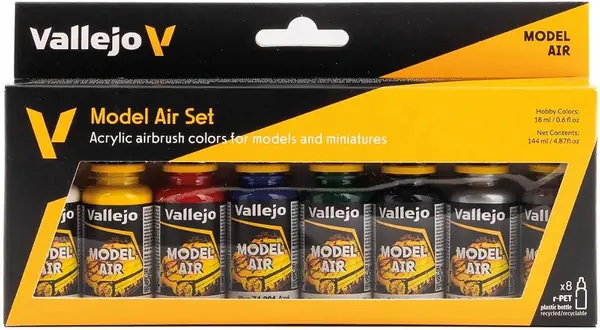
Vallejo Model Air Basic Colors set with eight 17 ml dropper bottles of acrylic paint

Base coating armies

Track Score 96/100
Bottles
8 x 17 ml (0.57 fl oz)
Formula
Pre-thinned water-based acrylic
Colors
White, yellow, red, blue, olive green, black, silver, gold
Dry Time
1.5 hours
View on Amazon

Airbrush-ready gets stamped on a lot of bottles, but with Model Air it means something you can check in the first few seconds: shake, tip into the cup, spray. There is no ratio to work out on a palette and no drop of thinner to guess at. We have sprayed sets that needed per-color adjustment before they behaved, and the difference on a primed figure is a smooth pass versus a speckled one.

The eight shades are a deliberate palette rather than a rainbow — white, medium yellow, red, blue, olive green, black, silver, and gold. That leans military and historical, which suits anyone painting armor or a khaki infantry unit, and the two metallics save you buying a separate bottle for buckles, buckles, and gun barrels.

What we appreciate most is how the paint behaves at the needle. It passes a fine nozzle at low pressure without tip dry turning into spatter, and it settles thin enough that the edge of a shoulder pad and a belt buckle still read after two passes. If a color does start to skin over at the tip, a drop of water on the needle usually gets you moving again.

Eight 17 ml bottles will not base-coat a huge army, but as a first airbrush palette for figures you intend to mix and layer, it is the one we hand people who ask what to buy first.

Worth Noting

  • Only eight colors; fantasy palettes need mixing
  • Pricier per bottle than the budget sets
Our Verdict

The set we reach for first: true airbrush-ready acrylic that sprays straight from the bottle onto primed figures, no thinning or ratio guessing required.

Check Latest Price
2.

X ARTY HUB 42-Color Airbrush Paint Set Best Color Range

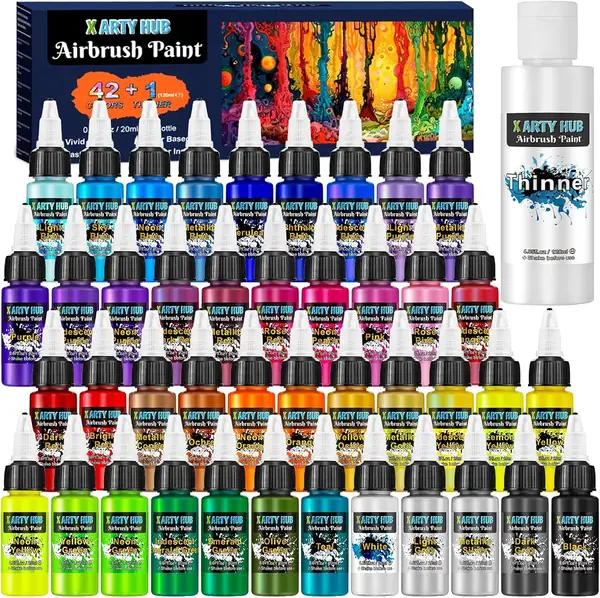
X ARTY HUB airbrush paint set with 42 color bottles and a thinner bottle

Varied collections

Track Score 93/100
Formula
Water-based acrylic
Colors
42 (24 standard, 6 neon, 6 metallic, 6 iridescent)
Included Thinner
4.05 fl oz
Bottle Size
0.75 fl oz
View on Amazon

Forty-two bottles sounds excessive until you are painting a second squad and want it to match the first. The 24 standard shades cover the usual uniform colors, and the six metallics, six neons, and six iridescents let you push a character or a vehicle without opening another product line.

We treated the whole box as a working palette, and the spray quality is what keeps it within reach. The pigment is fine enough to pass a detail needle without spitting, and the viscosity out of the bottle is close to right for miniature work; where a color wanted thinner, it was a drop or two from the included bottle, not a measured ratio.

Coverage rewards patience. The lighter and neon shades read as solid after two or three thin passes, which is the right way to paint a figure anyway — thin layers leave detail that one wet coat would fill in. Expect to build a yellow; expect the darker colors to be nearly one-pass.

The 0.75 fl oz bottles are bigger than the hobby-standard 17 ml, and the 4.05 fl oz thinner bottle is generous enough that you will not be shopping for more mid-project. For a collection that ranges across figures, vehicles, and terrain, it is the range that saves the most mixing.

Our Verdict

When one squad has to match the next, this 42-bottle palette has the range: broad color, fine pigment, and a thinner bottle big enough to last.

Check Latest Price
3.

HOMY ARTY 30-Color Airbrush Paint Set Best Starter Set

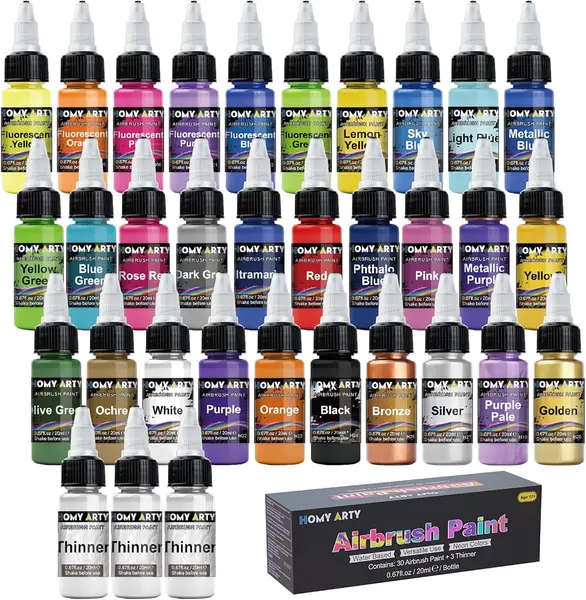
HOMY ARTY airbrush paint set with 30 color bottles and three thinner bottles

First airbrushes

Track Score 92/100
Colors
30 (19 standard, 6 fluorescent, 5 metallic)
Finish
Gloss
Included Thinner
3 bottles
Bottle Size
0.67 fl oz
View on Amazon

A 33-bottle box that costs less than some eight-bottle model sets is the pitch, and it mostly holds up. You get 19 standard shades, six fluorescents, and five metallics, plus three bottles of thinner — enough that a new airbrush owner can learn what a clog feels like and how to clear one without rationing paint.

Where it earns its place is range for the money. We thinned some colors and sprayed others straight from the bottle, and the set tolerated both without spitting. The fluorescents are the fun part — a hot pink or lime that is genuinely hard to mix from a basic palette, and useful on sci-fi armor and terrain.

Two things to know before you buy. The finish is gloss, which looks toy-like on a historical figure until a matte varnish goes over it. And several colors are thicker than a true airbrush-ready paint, which is exactly why the thinners are in the box: add a drop or two per cup and they settle down. Both are steps most painters take anyway.

This is a general-purpose acrylic rather than a miniature-specific formulation, so the palette skews craft-bright instead of uniform-accurate. For learning, for scenery, and for a first army where matching exact historical shades is not the point, that is a fair trade.

Worth Noting

  • Colors sold only as a set, never singly
Our Verdict

Our pick for a first airbrush — thirty colors and three thinners in one inexpensive box, with a gloss finish to varnish down.

Check Latest Price
4.

Micro-Mark Basic Color Acrylic Paint Set Best for Fine Detail

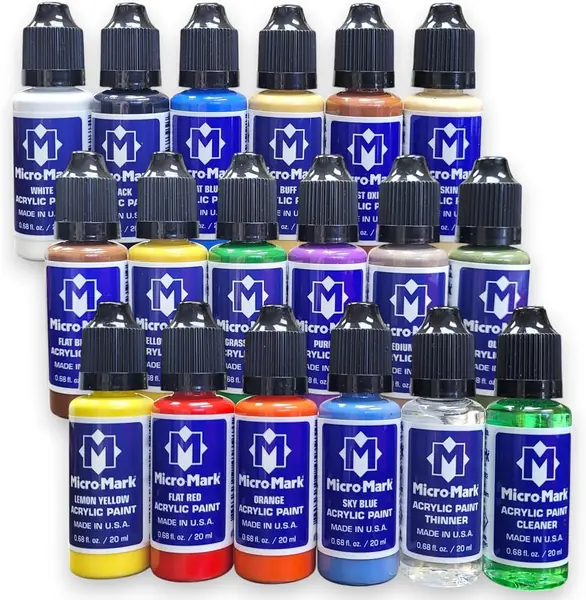
Micro-Mark acrylic paint set with 18 labeled dropper bottles of model colors

Fine detail work

Track Score 91/100
Bottles
18 x 20 ml (0.68 fl oz)
Formula
Water-based acrylic, pre-thinned
Made In
USA
Contents
16 colors plus thinner and cleaner
View on Amazon

The first thing you notice is how thin these are. Tipped into a cup, the acrylic runs like skim milk, which sounds like a warning and is actually the point: thin paint passes a small needle without spitting and settles into recesses instead of burying them.

We sprayed the set on primed 28 mm figures and on a larger resin bust, and the flat, eggshell finish is what brought us back. There is no gloss sheen to fight before the wash stage, and the flat planes of a cloak stayed flat instead of picking up a texture.

Between the 16 colors, the thinner, and the cleaner, it is a complete first airbrush kit for someone who already owns brushes. Refills of every color are sold separately, and that is the detail that tips it for us — running out of a base color mid-project does not mean rebuying the whole set.

Coverage is the compromise on the lightest colors, which want a second pass, and the thin consistency means color goes on gradually — a virtue on a face and a slower process on a vehicle hull.

Worth Noting

  • Only 16 colors in the set
Our Verdict

Thin, high-pigment acrylic that airbrushes beautifully, sold with thinner, cleaner, and refills — our choice when detail matters more than color count.

Check Latest Price
5.

Vallejo The Shifters Galaxy Dust Best Color-Shift Effects

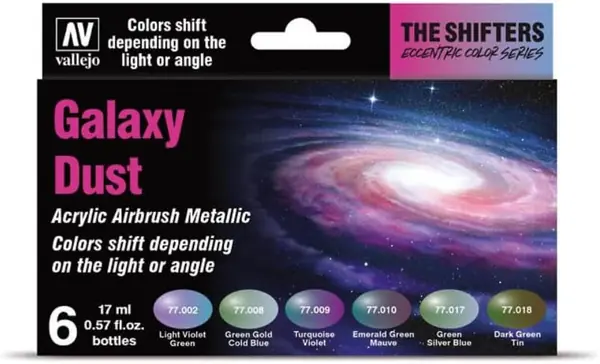
Vallejo The Shifters Galaxy Dust set of six 17 ml color-shift paint bottles

Character accents

Track Score 90/100
Bottles
6 x 17 ml (0.57 fl oz)
Formula
Water-based, solvent-free
Effect
Color-shifting metallic
Base Coat
Gloss black recommended
View on Amazon

Two angles, two colors. That is the trick with The Shifters, and it is genuinely hard to stop turning a finished figure under a lamp. The six bottles are all duotones — violet into green, green-gold into cold blue, turquoise into violet, emerald into mauve — and the change is strongest on curved surfaces like a shoulder pad or a dragon's flank.

Application matters more here than with anything else on this list. Over gloss black the shift is at its most obvious; over a light or matte base it goes soft and pearlescent. We spray it over gloss black in several thin coats, letting each one flash off, and the effect builds rather than appearing all at once.

A bottle goes further than the size suggests, because these are accents rather than base coats; a couple of drops covers a cape. Cleanup is the same soap-and-water routine as the rest of Vallejo's water-based line, which makes a quick effect job painless.

This is a six-bottle specialty set at a premium price, and we keep it for characters and centerpiece models rather than rank and file. If you want a workhorse metallic for a whole unit, this is not it — the effect is wasted at table distance.

Worth Noting

  • Six specialty bottles, no core colors
Our Verdict

Not a workhorse set, and we do not treat it as one: six multichromatic metallics for the cloak, the wings, or the model you want people to pick up.

Check Latest Price
6.

ERCorArt 33-Color Airbrush Paint Set Best for Priming and Practice

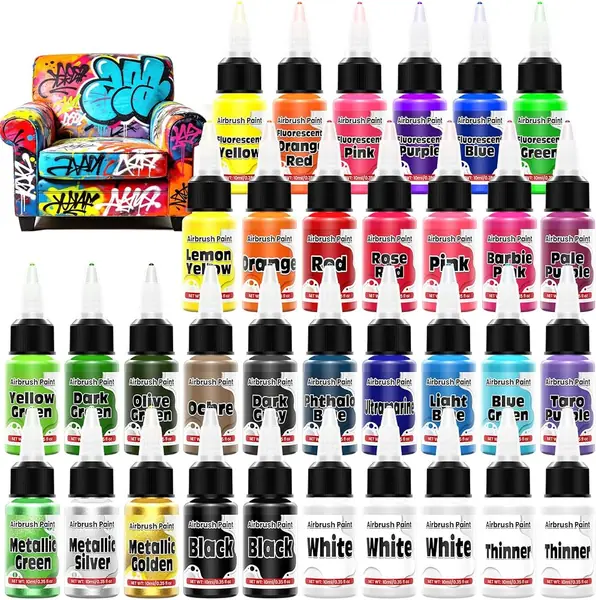
ERCorArt airbrush paint set with 33 small bottles, six primers, and thinners

Priming and practice

Track Score 89/100
Bottles
33 x 0.35 fl oz
Finish
High-gloss
Included Thinner
2 bottles
Primers Included
6
View on Amazon

Six primers in a paint set is unusual, and it is the reason to look at this one: black, white, and gray undercoats in the same box as the colors means you can prime a figure and start spraying without a separate rattle can.

The standard shades plus metallics and fluorescents give you plenty of choice, and the water-based formula flushes out with soap and water. We found control is where it slips: some colors spray thin enough to run if you are not careful, a few want the included thinner, and on a smooth unprimed surface the paint can bead instead of gripping.

Where it fits best is scenery, test pieces, and a first attempt at airbrushing, where a run or a rough patch costs you little. On a competition figure, the compromises show.

Worth Noting

  • Small 0.35 fl oz bottles
  • High-gloss finish needs a varnish
Our Verdict

The cheapest way here to get primers and colors in one box; we keep it for scenery and practice rather than fine detail.

Check Latest Price
7.

Smallbudi 20-Color Model Paint Set Best for Trying Both Methods

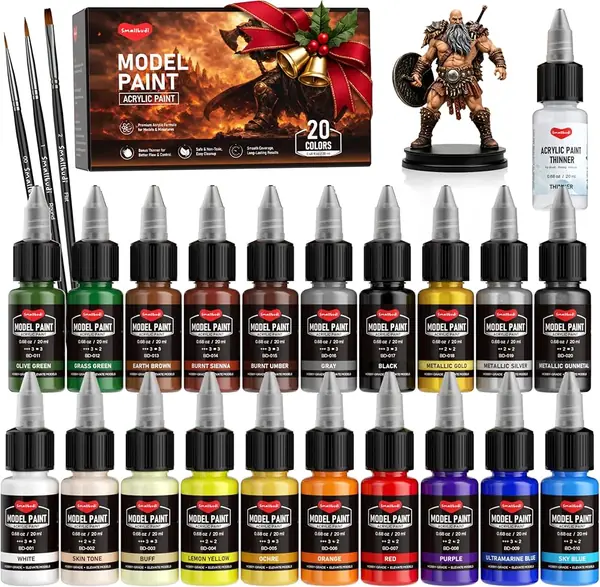
Smallbudi model paint set with 20 bottles, three brushes, and a thinner

Trying both methods

Track Score 88/100
Bottles
20 x 20 ml (0.68 fl oz)
Formula
Water-based acrylic
Finish
Matte
Included
3 brushes and 1 thinner
View on Amazon

Twenty bottles, three brushes, a thinner, a color wheel, and an instruction sheet: this is a beginner box in the truest sense, and the extras are not filler. The dropper tips make it easy to dispense a few drops into a cup without wasting paint, which matters more than it sounds when you are learning how little a cup actually needs.

It is formulated for brushing, with the airbrush as the second job. Thinned, it sprays cleanly, and the matte finish is the reward: a figure that does not glare under a lamp while you decide on a varnish.

The palette has the usual beginner gaps and you will mix for anything specific. But the whole box fits in a drawer, and for someone deciding whether they even enjoy miniature painting, that is the right scale to start at.

Worth Noting

  • Brush-first formula needs extra thinning to spray
  • Twenty colors leaves gaps you will mix
Our Verdict

A brush-first set we recommend for the airbrush-curious: colors, three brushes, and thinner in one box for trying both methods.

Check Latest Price
8.

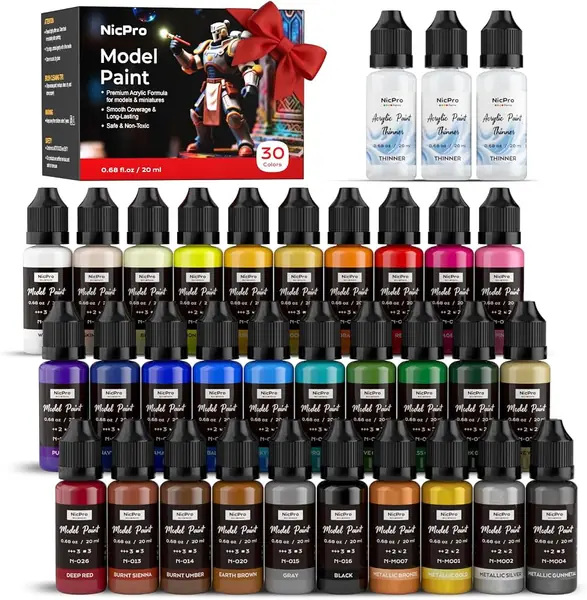
Nicpro 30-Color Model Paint Set Best for Brush-First Painters

Nicpro model paint set with 30 dropper bottles and three thinner bottles

Brush-first painters

Track Score 87/100
Colors
30 (26 standard, 4 metallic)
Finish
Matte and metallic
Included Thinner
3 bottles
Bottle Size
20 ml (0.68 fl oz)
View on Amazon

Nicpro's label says brush and airbrush compatible, and the order matters. These are pre-thinned for brushing; spraying is something you do with the included thinner, not straight from the bottle.

As a brush paint, the set is easy to like. Twenty-six standard shades and four metallics, matte and lightfast, with dropper tips that put a precise amount on a wet palette. Coverage builds rather than covering in one pass, which is what you want on a figure with detail to protect.

For spraying, we thin it further than the bottle suggests and test on a primed spare first; the set rewards a patient ratio more than a fast one.

Either way, buy it for the bottle format as much as the color: 20 ml with a dropper tip is a better working size than the 17 ml hobby standard, and the last of a bottle pours as cleanly as the first.

Our Verdict

Buy it as a brush set that can airbrush — thirty matte colors and metallics, with thinner included for the times you want to spray.

Check Latest Price

How We Tested Airbrush Paints for Miniatures

Before anything touched a needle, we built a shortlist from sets that ship pre-thinned or include their own thinner, then compared price per fluid ounce, bottle format, and whether a palette covered a whole subject instead of six shades of one color. That narrowed the field to 14 sets, which we sprayed over seven months.

Testing happened at the kitchen table, spray booth venting out an open window, respirator on — the same setup most people actually paint in. Each set got at least two 45-minute sessions: batch base-coating a ten-model infantry squad, blocking in a tank, priming a row of 3D prints, then slowing down for faces and edge highlights on a single character.

We sprayed every color straight from the bottle at 20 psi and counted the drops of thinner it took before the paint flowed instead of spitting, then counted passes over black primer before a coat went opaque. A stopwatch tracked the first sputter of each session and whether a quick needle wipe got us back to a clean line. Fine work at low pressure showed whether pigment was fine enough to keep an eye or a rivet from disappearing, and every finish cured before we judged it under a desk lamp — the color-shift pigments over gloss black, as directed.

Weighing bottles before and after a squad gave a rough sense of how far each one goes, and we watched dropper tips for drips and clogs between sessions. Every included thinner, primer, and cleaner got used per its label, and we flushed the brush afterward to see what residue stayed behind; finished models were then handled for a week to catch flaking. Price per fluid ounce came last, since a cheap set that drinks thinner isn't cheap.

How to Choose Airbrush Paints for Miniatures

Test Viscosity Before You Trust the Label

A paint that sprays straight from the bottle removes a decision from every session; a paint that needs reduction adds a variable to every mix. Dedicated lines such as Model Air and The Shifters pour thin and stay thin, while general-purpose boxes often land somewhere between brushable and sprayable and expect the included thinner to close the gap.

The trap is reading pre-thinned as thin enough for a fine needle. Load a few drops, spray a scrap of primed plastic, and watch for spitting or a dry, grainy edge — both mean the paint wants a drop of thinner or a little more pressure. Note the ratio once a color sprays clean; you will need it again on the next bottle.

Pigment Fineness Decides How Much Detail Survives

For miniatures, pigment size matters more than one-coat opacity. Coarse pigment needs a heavier layer to read as solid, and a heavy layer is what softens an edge or fills a face. Fine pigment lets you build color in passes so the detail stays.

Test with a light color over a dark primed figure and see whether it settles into recesses or bridges them. If a shade goes on translucent, lower the pressure and add a pass rather than reaching for more paint.

Palette Size: Tuned Sets Versus Big Boxes

A set of eight shades chosen for a subject will base-coat an army faster than forty generic colors, because you are not mixing every green from scratch. A big box wins when you paint across genres — fantasy, sci-fi, terrain — and want something close at hand for each project.

We start people on a tuned model paint set and add a large budget box for scenery and test pieces, rather than spending everything on one enormous palette with bottles that never get opened.

Finishes and Effects Change What Happens After the Base Coat

Gloss paint, metallics, and color-shift pigments behave differently from flat acrylics and demand a different next step. Gloss needs a matte varnish before a wash will sit evenly; color-shift needs a gloss black undercoat and a curved surface to show its range.

Buy effects after your core palette, and buy fewer bottles than you think — a couple of drops covers an accent area.

Frequently Asked Questions

Final Verdict

Start with Vallejo Model Air Basic Colors. It takes the variable that ruins more miniature paint jobs than anything else — inconsistent thinning — off the table, and its eight shades are the ones a military or historical force actually needs. If your collection ranges across fantasy, sci-fi, and terrain instead, X ARTY HUB's 42-color set covers far more ground for a similar outlay.

And if you are buying a first airbrush and want to learn without rationing paint, HOMY ARTY's thirty-color box is where we point people.