Best Airbrushes for Gunpla of 2026

Paint is what takes a Gunpla build from bare gray plastic to something that looks finished, and the airbrush is the tool most likely to fight you on the way: sputtering mid-panel, drying at the tip, throwing a bubble into the cup just as a coat was going down clean. More often than not the brush is the problem, not the painter.

The finest nozzle is not the best choice for most Gunpla work. A slightly wider needle handles base coats with far less clogging, and a 0.2 mm detail brush pays off in shading. We ran primers, acrylics and lacquers through 12 brushes on inner frames, weapons and full repaints, judging trigger control at the start and end of a pass, how the cup cleans and whether replacement needles will still be on sale next year.

Our Top Picks

The Best Airbrushes for Gunpla

1.

Gaahleri GHAD-39 Airbrush Kit Best Overall
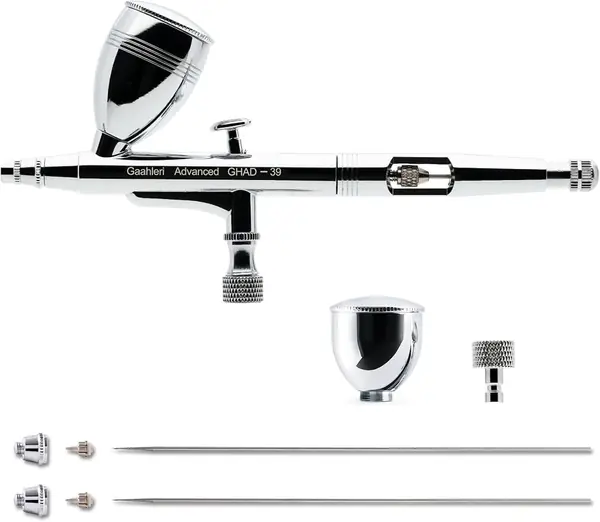
Gaahleri GHAD-39 silver airbrush kit with two gravity-feed cups and two nozzle sets

All-around Gunpla painting

Track Score 92/100
Fluid Cups
1/2 oz and 1/4 oz
Nozzle Sizes
0.35 mm and 0.5 mm
Feed And Action
Gravity feed, dual-action
Included Components
Two needle/nozzle sets, two cups, spare O-rings
View on Amazon

Two cups and two nozzle sets in one box are why the GHAD-39 is our default for Gunpla. The 0.35 mm setup handles most builds, covering basecoats, color separation, and soft shading around panel lines, while the 0.5 mm head has the appetite for primer and clear topcoat. It is a dual-action gravity feed, so air and paint volume stay separate, which is exactly what you want when you are feathering a thin layer instead of flooding a part.

What sold us on the design is the self-centering nozzle. It drops into place without the usual alignment fuss, and that makes cleaning between colors less of a chore. The two cups are a practical touch, too: the small one suits a few drops of shading color, while the larger one lets you load enough primer for several parts without refilling. The smooth inner cup wipes down easily, and the whole head comes apart in a few pieces rather than a puzzle.

The caveat is paint discipline. The 0.35 mm setup can clog when you push thick primer or poorly thinned acrylic through it; keep the mix at the consistency of skim milk and flush the nozzle before it dries. We also treat the 0.5 mm needle as the workhorse and save the smaller setup for controlled layers. For most Gunpla builds, start here.

Worth Noting

  • No 0.2 mm fine-detail nozzle included
Our Verdict

We recommend the GHAD-39 to Gunpla painters who want one dependable all-rounder for primer, basecoat, and general shading without paying for a premium name.

Check Latest Price
2.

Harder & Steenbeck Ultra 2024 Best Premium Upgrade

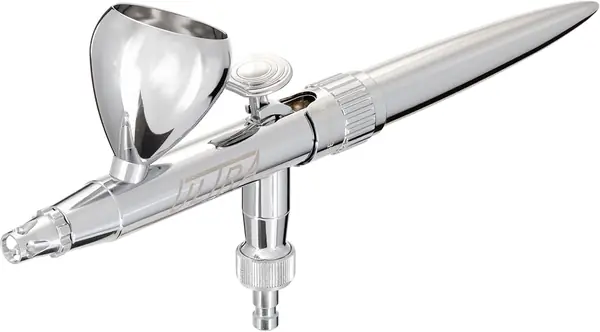
Harder & Steenbeck Ultra 2024 dual-action airbrush with 5 ml cup and 0.45 mm nozzle

Premium all-round painting

Track Score 91/100
Action
Dual-action gravity feed
Fluid Cup
5 ml
Nozzle Size
0.45 mm self-centering
Upgrade Path
Infinity FineLine head system
View on Amazon

The Ultra 2024 feels like a serious tool rather than a starter kit. Its 0.45 mm self-centering nozzle sits in the middle of the range, so it handles primer, basecoat, and general color work without changing heads, and the 5 ml cup is enough for a long session on a master grade. The body has a reassuring heft, and the trigger gives you the separate air-and-paint control that makes thin layers possible.

We appreciate the tool-free breakdown more than any spec-sheet number. The headset comes apart by hand for cleaning, and the self-centering nozzle removes the alignment guesswork that makes beginners avoid deep cleans. It is also modular: the body accepts the FineLine head system from the Infinity line if you later want a finer detail setup. That upgrade path is why we think it earns its premium for someone who plans to stay in the hobby.

The 0.45 mm size is the compromise: it is a wonderful all-rounder, and it keeps the trigger feel consistent because you are not swapping heads. Thick acrylics can still make the nozzle fussy, so thin them and flush often. For a single brush that does most of a Gunpla build, it is the one we choose.

Worth Noting

  • One 0.45 mm head limits hairline detail
  • Premium price for a single-nozzle brush
Our Verdict

The Ultra 2024 is for Gunpla painters who want one beautifully made all-rounder and are ready to pay for its fit, finish, and tool-free maintenance.

Check Latest Price
3.

Gaahleri Mobius 0.2mm Best for Fine Detail

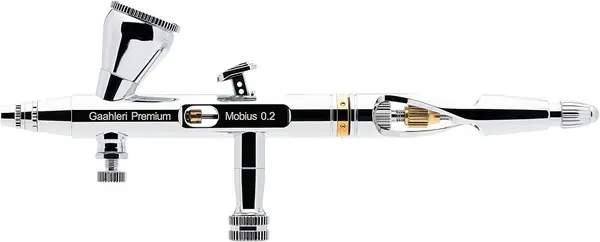
Gaahleri Mobius 0.2mm premium airbrush with gold highlights and mirror-finish cup

Fine detail work

Track Score 90/100
Cup
Ultra mirror-level finish
Nozzle
0.2 mm spiral MAC
Trigger
Ergonomic square main lever
Air Control
Precision air control knob
View on Amazon

A 0.2 mm head is not what we grab for primer, and that is the point. The Mobius 0.2mm is built for the small stuff: preshading 1/144 parts, tinting panel lines, and building subtle color transitions. It gives you a finer line than the 0.35 and 0.45 picks here, and the precision air-control knob is the detail we like most because it lets you trim airflow without changing compressor settings when you are working close to the plastic.

The trigger action is another point in its favor. The square main lever has a firm, even feel that makes it easier to hold a consistent paint flow, and the mirror-polished cup wipes down with a quick flush. The break-down is simple enough that we do not dread a color change, even with a nozzle this small.

The reward is a line that stays where you put it, without the spatter a larger head can leave around a tight panel line. We treat it as a dedicated detail brush rather than a do-everything tool, and that is how it makes the most sense. The fine line is the reward, and it is worth keeping a dedicated brush for.

Worth Noting

  • 0.2 mm head demands well-thinned paint
  • No larger nozzle for primer or topcoat
Our Verdict

The Mobius is for builds that depend on fine shading; it makes a 0.2 mm nozzle feel useful rather than fussy.

Check Latest Price
4.

Timbertech ABPST01 Airbrush Kit

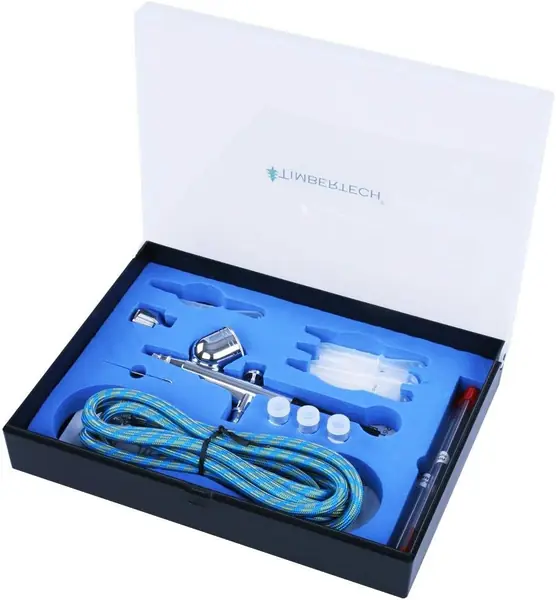
Timbertech ABPST01 airbrush kit with three nozzles and plastic storage case

Budget starter kit

Track Score 89/100
Included
Four pipettes, nozzle wrench, storage case
Paint Cup
5 ml
Air Connection
8 mm (1/8") external thread
Nozzle And Needle Sizes
0.2 / 0.3 / 0.5 mm
View on Amazon

Three needle sizes and a molded case put the Timbertech ABPST01 at the budget end of this group, and that is the role it fills: a low-risk way to find out whether airbrushing fits your Gunpla routine. The 0.2, 0.3, and 0.5 mm sets cover everything from panel-line shading to primer, and the 5 ml cup is a sensible size for small parts.

We like that the kit includes a wrench, four pipettes, and a foam-lined case; those are the small extras that keep a first session from turning into a scavenger hunt. The 1/8-inch threaded inlet is the common size for hobby compressors, and the kit includes an adapter and hose, but confirm they match your compressor before you order. You will still need a compressor and paint, as with every pick here.

The trade-off is capacity: the 5 ml cup is fine for a few parts, but a full primer run means refilling more often than with the larger cups on the Gaahleri. That is acceptable for a starter kit, and it keeps the brush light in the hand. It is a learning tool, not a do-everything brush.

Worth Noting

  • Nozzle changes require a small wrench
Our Verdict

The Timbertech is a low-cost first airbrush for learning Gunpla paint control, provided you accept slower wrench-based nozzle changes.

Check Latest Price

How We Picked and Tested Gunpla Airbrushes

We started with what Gunpla painters actually say about their brushes — the clogging complaints, the praise for a trigger that doesn't fight back — then built a shortlist of 12 brushes spanning the range of nozzle sizes and price points, skipping anything we couldn't find replacement needles, nozzles, or O-rings for. Testing ran eight months of weekend bench sessions and a few long nights before a build deadline.

Every brush got the same workout: base coats on inner frames and large armor panels, shading on smaller pieces, and color tests on plastic spoons so finishes could be compared side by side. We thinned paints in steps to find where each one started spitting or laying down a grainy coat, and watched the cup for bubbles, which usually means air is escaping at the nozzle seal instead of atomizing paint. For trigger control, we sprayed freehand lines and dots and noted how much travel there was before paint appeared, whether the trigger returned cleanly, and whether the air control knob drifted mid-session. Two-hour sessions showed where hand fatigue set in.

Cleaning was timed, not eyeballed: a full teardown after every color, noting whether the nozzle needed a wrench, whether the needle came out the back, and how much paint hid in the threads. Each brush was threaded onto our compressors' hoses to check the connection without an extra adapter. All spraying happened in a ventilated booth with respirators on, and we stayed inside each maker's stated pressure range — lacquers got more caution than acrylics, in handling and in cleanup.

At the end, we priced replacement needles and nozzles for every brush that made the cut, because a brush you can't maintain has a short life no matter how well it sprays.

How to Choose an Airbrush for Gunpla

Start With Nozzle Size

A 0.2 mm or 0.3 mm head is for preshading, tinting panel lines, and the close-in work that gives a kit depth. A 0.35 mm to 0.45 mm head is the all-rounder for basecoats, color separation, and general shading. The 0.5 mm head is the one for primer and clear topcoat, where you want coverage rather than a hairline. If you want one brush to do everything, a 0.35 or 0.45 mm head is the better compromise than a 0.2 mm head that makes primer feel like a marathon.

The Gaahleri GHAD-39's 0.35/0.5 mm pairing is a practical expression of that split, while the Mobius 0.2 mm is the specialist companion.

Gravity Feed and Dual Action

A gravity-feed airbrush gun puts the cup on top, so paint flows down into the nozzle and you can work with small amounts without a siphon tube. Dual action means the trigger does two jobs: press down for air, pull back for paint. That separation is what lets you feather a thin layer instead of dumping paint.

The catch is that you need a regulated air supply and the right hose or adapter. Check the inlet thread and whether the kit includes a hose before you order; the airbrush alone will not get you spraying.

Cleaning Is a Design Feature

Self-centering drop-in nozzles are easier to remove and reinstall than conventional threaded heads, and that matters because Gunpla painting involves frequent color changes. A smooth cup that wipes clean and a nozzle you can flush without a full teardown will do more for your routine than an extra accessory.

We look for a head that comes apart without fuss and a cup that empties completely; the Gaahleri's self-centering design and the H&S tool-free breakdown are the examples here.

Trigger, Comfort, and Control

Conventional dual-action triggers suit fine control and are what most detail painters learn on. Pistol-grip designs can be more comfortable for long sessions or for hands that tire, but they change the way you hold the brush and are not automatically better for hairline work.

An air-control knob is useful if you like to trim flow at the brush; otherwise, a good regulator on the compressor does the same job. Pick the handle you can hold steady for a whole paint session, not the one with the longest feature list.

Paint, Air, and Safety

Gunpla paints range from water-based acrylics to lacquers, and each needs its own thinner and cleaning routine. Thin to a skim-milk consistency for general work, strain older paint, and test on a plastic spoon before committing to a kit.

Use a compressor with a regulator and moisture trap, and spray in a ventilated area with respiratory protection; solvent-based paints and cleaners need more care than acrylics. If you are new, start with acrylics and one nozzle size until the routine feels automatic.

Frequently Asked Questions

Final Verdict

We start most Gunpla painters with the Gaahleri GHAD-39. It covers the bulk of a build with 0.35 and 0.5 mm setups, and its self-centering nozzle makes the cleaning routine shorter. If fine preshading is the part you care about most, the Gaahleri Mobius 0.2mm is the better companion. If you want the most refined single brush here, the Harder & Steenbeck Ultra 2024 earns its premium.