Best Airbrushes for Model Cars of 2026

A rattle can paints a model car body in ninety seconds, then you spend two evenings sanding out orange peel and rescribing the door lines it buried. An airbrush puts you back in charge: thin passes built up slowly, color that stops where you aim it, and a coat thin enough that the panel gaps survive.

The nozzle does the work, not the feature list. A 0.35 mm head handles most body color and detail, a 0.5 mm pushes primer and clear without spitting, and a gun that fights you at cleanup ends up in a drawer. Over eight months of primers, acrylics and clears on the same 1/24 bodies, we compared bare guns with full compressor kits; the picks run from quiet desk setups for a spare room to a siphon-feed gun for volume work.

Our Top Picks

The Best Airbrushes for Model Cars

1.

Gaahleri GHAD-39 Airbrush Best Overall
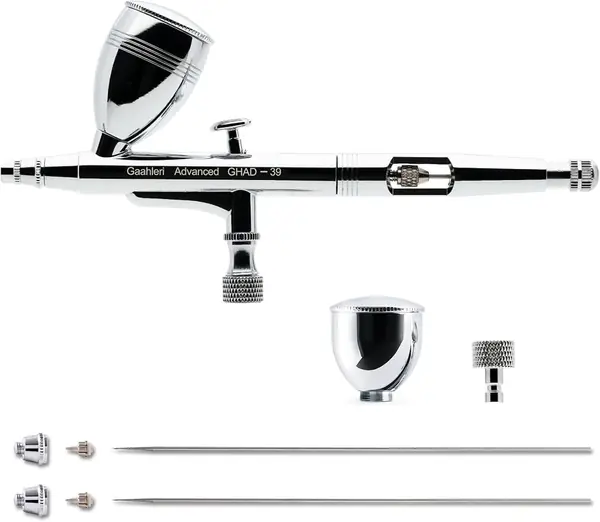
Gaahleri Advanced Series GHAD-39 silver dual-action gravity airbrush with two fluid cups

Model car detail

Track Score 93/100
Fluid Cups
1/2 oz and 1/4 oz, replaceable
Nozzle Sizes
0.35 mm and 0.5 mm
Feed And Action
Gravity feed, dual-action
Nozzle Design
Quick self-centering drop-in
View on Amazon

The nozzle on this gun drops in and centers itself, and that is the detail that won us over. When you are switching from color to clear on a body you have already masked, cleaning takes minutes and reassembly is hard to get wrong. None of that is decorative: a misaligned 0.35 mm tip is the usual reason a fine line turns into a spray of dots.

Two needle and nozzle sets come in the box, 0.35 mm for detail and color and 0.5 mm for primer and heavier coats, along with a 1/2 oz and a 1/4 oz cup that swap for the size of the job. For scale cars the 0.35 mm is the sweet spot, fine enough for panel-line shading and a two-tone break, big enough to lay a wet basecoat across a 1/24 shell without chasing the surface.

The smooth interior of the cups matters more than a spec sheet suggests. Pigment that dries in a seam or a rough corner eventually spits into your clear, and both cups wipe clean with a swab and a shot of cleaner. Where it can stumble is thick paint: unthinned craft acrylic will clog a 0.35 mm nozzle, so strain your color and thin it to a milky consistency before it goes in.

What keeps it at the top of this list is the ratio of finish quality to fuss. If a compressor already sits under your bench, there is nothing here to upgrade around; if you are starting from zero, the Master kit below is the shorter path to a first sprayed body.

Worth Noting

  • No compressor or hose in the box
Our Verdict

We think most model-car painters should start here: a 0.35/0.5 mm gravity gun that cleans quickly, sprays smooth basecoats, and costs less than the kits.

Check Latest Price
2.

Master Airbrush Cool Runner II Kit Best Complete Kit

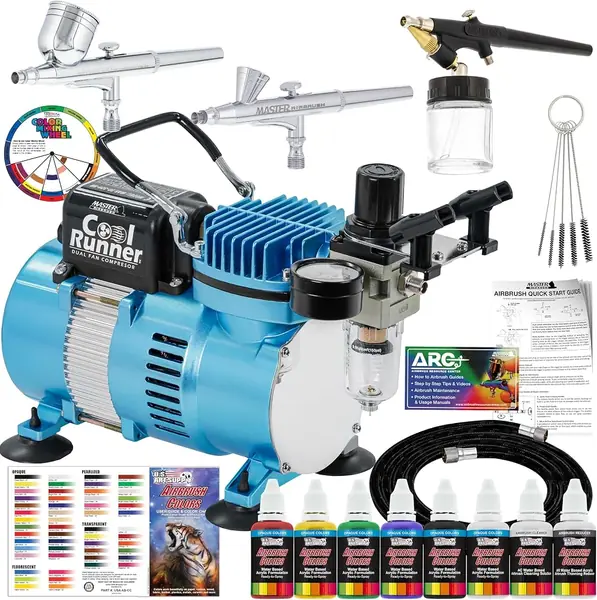
Master Airbrush Cool Runner II blue airbrush kit with three airbrushes and compressor

First full setup

Track Score 92/100
Compressor
1/5 hp single piston with two cooling fans
Airbrushes Included
Three, including 0.2 mm and 0.3 mm gravity models
Hose
Included
Paint Included
Six 1 oz acrylic colors plus reducer and cleaner
View on Amazon

A bench with nothing on it is the situation this kit is built for: a 1/5 hp single-piston compressor with two cooling fans, a hose, three Master airbrushes, a six-color acrylic set with reducer and cleaner, brushes, and a quick-start guide, all arriving in one order.

What we like is the lineup. The G25's 0.2 mm tip and 1/16 oz cup suit panel lines and tight freehand, while the 0.3 mm G22 and its 1/3 oz cup will carry a basecoat across a 1/24 body. Having both means no needle swaps mid-project and no cleaning detail paint out of the cup you need for color. Those two fans earn their place during a body-plus-clear session, when a single-piston unit runs almost continuously.

The paint is where the box disappoints. Six opaque water-based acrylics plus reducer and cleaner are craft colors for practice spoons and spoilers, not factory-matched model-car color, and there is no clear in the set. Plan on buying model-grade color and clear for the body you care about, and use the included bottles to learn the trigger before you pour anything expensive.

The three guns come from Master's value-priced line rather than its precision line, so treat them as a starting point and not the last airbrush you will own. What you are really buying is momentum: everything arrives matched, and the first spray happens the day the box lands instead of after three more orders.

Our Verdict

We recommend it to anyone starting from zero: three airbrushes, a cooled compressor, hose, and paint arrive matched, so you can spray a body the day it lands.

Check Latest Price
3.

VEVOR Airbrush Kit with Compressor Best Do-It-All Kit

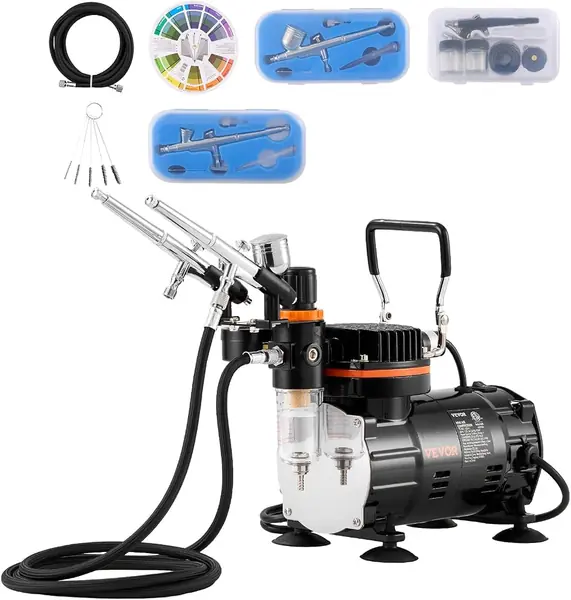
VEVOR airbrush kit with three dual-action gravity airbrushes and a dual-fan compressor

Primer to clear

Track Score 91/100
Compressor
1/6 hp dual-fan, 18–23 L/min airflow
Airbrushes Included
Three, with 0.2 mm, 0.3 mm and 0.8 mm nozzles
Power
120 V, 120 W
Hose Length
70.8 inches
View on Amazon

Three nozzles, 0.2, 0.3, and 0.8 mm, each on its own gun, is the spread this kit offers, and for model cars that is close to the whole map. The 0.2 mm draws panel-line shading, the 0.3 mm lays color and basecoat, and the 0.8 mm moves enough material for primer and a full clear coat.

Air comes from a 1/6 hp dual-fan compressor rated at 18 to 23 liters per minute, with a gauge and regulator on the machine so pressure can be matched to whichever gun you picked up. Nozzles unscrew by hand for cleaning, and a holder keeps the idle guns upright instead of rolling across the bench.

We were struck by how much of this kit is about avoiding teardown. Instead of pulling a 0.2 mm needle to spray primer and reinstalling it for color, you move the hose, and on a multi-stage car build the finish work is the part you least want to interrupt.

Its size is the trade. It weighs 9.4 pounds and stands about 15 inches tall, so it lives on a shelf rather than in a drawer; clear a permanent spot before it arrives. Do that and the three-gun arrangement earns its keep the first time primer goes on in the morning and clear goes on in the afternoon without a detail gun coming apart in between.

Worth Noting

  • Benchtop unit needs permanent shelf space
Our Verdict

We like it for builds that move through primer, color, and clear in one session, since three guns and a cool-running compressor spare you constant needle swaps.

Check Latest Price
4.

Timbertech AG-183K Airbrush Set Best for Clear Coats

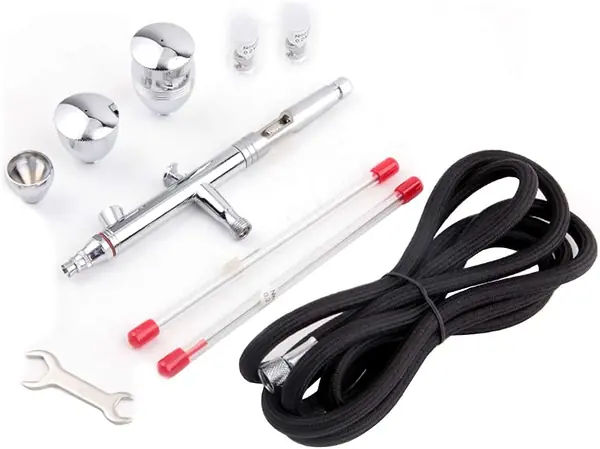
Timbertech AG-183K black dual-action gravity airbrush with three nozzles and screw-on cups

Clear coats

Track Score 89/100
Fluid Cups
2 ml, 5 ml, 13 ml screw-on
Nozzle Sizes
0.3 mm, 0.5 mm (mounted), 0.8 mm
Feed And Action
Gravity feed, dual-action
Body Material
Stainless steel
View on Amazon

Clear coat is where small airbrushes embarrass themselves: a 5 ml cup runs dry halfway around a roof, and a 0.3 mm nozzle turns a wet coat into a misting exercise. This set answers that with a 13 ml screw-on cup and a 0.8 mm nozzle, and we reach for it whenever the job is a whole body rather than a door handle.

The rest of the set is the standard trio done properly: 0.3 mm for detail, 0.5 mm installed for general color, 0.8 mm for primer and clear, plus three cups at 2, 5, and 13 ml that screw on by hand. The body is stainless steel, disassembly is simple enough to do between colors, and the hand-tightened nozzles mean no tiny wrench to lose.

The 0.8 mm setup is the reason to own it. A larger nozzle puts more paint past the tip on every pass, so a wet coat goes down before the acrylic skins over, and the 13 ml cup goes much further around a shell than the 2 ml cups on the detail guns here. For primer, single-stage color, and clear on a 1/24 body, that is the difference between building a coat and misting at it.

It gives ground at the fine end. At 0.3 mm its smallest nozzle is still coarser in feel than the Gaahleri's self-centering 0.35 mm, which is the smoother tool for panel lines and tight masking. Spray whole bodies in primer, color, and clear, and the comparison stops mattering.

Worth Noting

  • No compressor or air line included
Our Verdict

The gun for priming or clearing a whole body: the 0.8 mm nozzle and 13 ml cup keep a wet coat moving where fine guns fade.

Check Latest Price
5.

Timbertech Airbrush Kit with Compressor Best Budget Kit

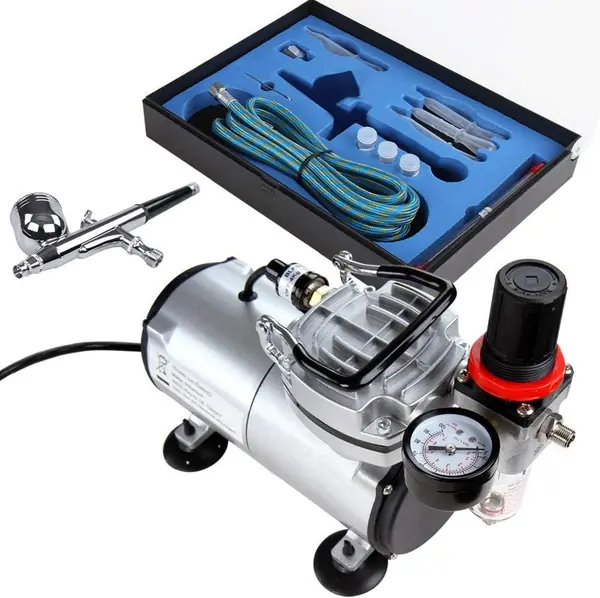
Timbertech airbrush kit with silver gravity-feed gun and oil-free piston compressor

Budget starter kit

Track Score 88/100
Compressor
Oil-free piston, auto start/stop at 3–4 bar
Airflow
20–23 L/min
Fluid Cup
7 ml
Nozzle Sets
0.2 mm, 0.3 mm, 0.5 mm
View on Amazon

This is the kit we point to when the Master bundle is more than the project needs: one airbrush instead of three, no paint in the box, but the same idea of a compressor, hose, and gun arriving together and already matched.

What you get is a 0.3 mm gun with additional 0.2 mm and 0.5 mm nozzle and needle sets, a 7 ml gravity cup, and an oil-free piston compressor that starts at 3 bar and stops at 4, moving 20 to 23 liters per minute. The regulator, gauge, and air filter are built into the machine rather than sold as an extra, and the hose runs about 6 feet.

Having pressure control at the unit is worth more than it sounds: we trimmed the air down for a tinted coat and opened it up for primer without walking to a separate regulator. The 0.2 mm set is the one for panel lines and small parts, and the 0.5 mm handles primer and single-stage color when you want coverage.

Where it stops is at the clear coat. At 0.5 mm the largest nozzle in the box is smaller than the AG-183K's, so a heavy wet build is that gun's job rather than this one's. Up through primer and single-stage color it keeps pace with kits that cost more, and it does it with one gun and one cup to clean.

Worth Noting

  • Single 7 ml cup needs refills on full bodies
Our Verdict

Air and a gun without paint you would replace anyway: a quiet piston compressor with three nozzle sizes.

Check Latest Price
6.

Gaahleri TurboX Mini Kit Best for Small Spaces

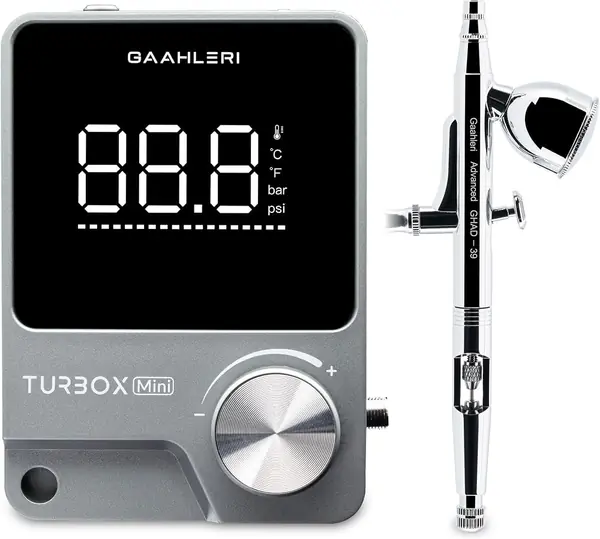
Gaahleri TurboX Mini black desktop airbrush kit with GHAD-39 gun and digital display

Small workspaces

Track Score 84/100
Noise
Under 48 dB at 1 m
Airbrush
GHAD-39, 0.35 mm dual-action
Pressure Range
8–30 PSI adjustable
Pressure Control
18-gear dial with digital display
View on Amazon

Half a desk, a closet shelf, or a kitchen table is where most model cars actually get painted, and this kit is built for that footprint. The compressor measures 5.5 by 3.9 by 2.3 inches and is rated under 48 dB at one meter, which takes noise off the list of reasons not to spray.

The gun is the same GHAD-39 we recommend on its own, so the self-centering nozzle and 0.35 mm tip come with it, along with a hose and a compressor that watches its own temperature and warns before it overheats. Air delivery is tankless by design, which is what keeps the whole thing the size of a book.

We are pleasantly surprised by how much the pressure control adds. A dial with low, medium, and high presets and a digital readout showing what the gun is actually getting turns the question of whether this is too much air for primer into a number you can watch and adjust while spraying.

The honest limit is pressure while spraying. Without a tank, working pressure sits around 10 to 20 PSI, plenty for primer, color, and detail on a 1/24 body and thin for a heavy wet clear. If clear coats are the point of the build, the bigger compressors here earn their keep; if it is primer, color, and decals, this is enough machine.

Worth Noting

  • No moisture trap in the kit
Our Verdict

We recommend it for small-space modelers: a genuinely quiet desktop compressor and the same 0.35 mm gun we rate highest, in one box.

Check Latest Price
7.

Master Airbrush S68 Siphon Feed Best for Volume Body Work

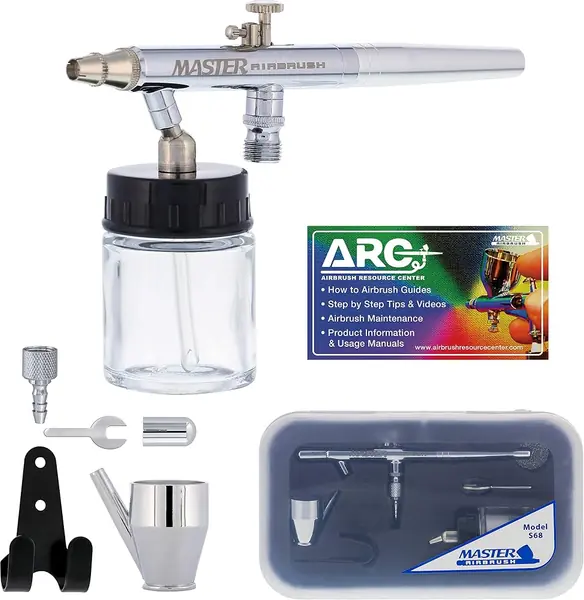
Master Airbrush S68 black siphon-feed airbrush with 3/4 oz bottle and color cup

Volume body work

Track Score 83/100
Included
Nozzle wrench and molded storage case
Tip Size
0.35 mm
Feed Type
Siphon feed
Fluid Capacity
3/4 oz bottle plus color cup
View on Amazon

Three quarters of an ounce in a bottle you can cap and set down is the reason to look at a siphon feed at all: load several bottles with the colors a body needs and the paintwork happens without a cup rinse between coats.

The S68 pairs a 0.35 mm tip with a 3/4 oz fluid bottle and a color cup, plus a nozzle wrench and a molded case. That tip size is a sensible middle, fine enough for a two-tone break and coarse enough to move primer and single-stage color across a shell when the bottle is doing the feeding.

It is not the panel-line brush. Siphon feed lifts paint with air moving past the bottle, so it wants more pressure than a gravity gun, and the trigger here feels coarser than the Gaahleri's when you are chasing a thin line. Buy it as the volume tool and it makes sense; buy it as your only airbrush and you will fight it on detail.

Its place in this list is the bottle. We keep three loaded with primer, surfacer, and color, and swap instead of rinsing, which on a run of bodies is worth more than a smoother trigger would be.

Worth Noting

  • Siphon feed needs more pressure than gravity
Our Verdict

Use it when the job is volume, primer and single-stage color on a full body, where a bottle beats a small gravity cup.

Check Latest Price

How We Tested Airbrushes for Model Cars

We started with spec sheets rather than marketing copy, pulling every dual-action gravity and siphon gun in the model-car size range and comparing nozzle and needle options, cup capacity, compressor output, and what actually ships in the box. We also weighed how much extra each one still needed — hose, fittings, moisture trap, paint — before it could spray a single body. Twelve units made the cut, from bare guns to complete kits, and they've been in rotation for eight months.

Every gun got the same work on a desk in a spare room and a bench in the garage: 1/24 and 1/25 bodies, plastic spoons, and flat card, sprayed with primer, acrylic color, and a solvent-based clear, the last only with cross-ventilation and a respirator rated for that finish. We watched how the coat landed — smooth and even into the panel edge, or speckled and half-dry before it reached the plastic — and noted tip dry and clogging across a fifteen-minute session. Then we swapped needles between sizes to see how much fine detail each setup actually gave up.

Pressure was read at the gun with a gauge during continuous spray, not just at the compressor, and every setup stayed inside its stated working range with the hose fittings checked before we pressurized anything. A meter at desk distance told us which compressors you could sit beside in a small room. For cleanup, we timed a full color change: how long the cup took to flush, whether pigment hid in the throat, and whether the nozzle dropped in and seated without fiddling. Over the eight months we tracked needle straightness, air-valve feel, and trigger slop, and judged build quality by the threads, the chrome, and how the gun balanced in hand mid-panel.

How to Choose an Airbrush for Model Cars

Start with the nozzle, not the feature list

A 0.2 or 0.3 mm nozzle draws the thin lines for panel shading and two-tone breaks. A 0.35 mm is the most useful single size, fine enough for detail and big enough to lay color on a 1/24 shell, while 0.5 mm and up is primer, clear, and large panels. The trap is buying a five-nozzle set and never changing it: each swap means a matching needle, tip, and cap, so most of us settle on two sizes and work around them.

If you want one gun to do everything, get a 0.35 mm and add a 0.5 mm set later. If clear coats are a regular part of your builds, a 0.8 mm nozzle like the one on the Timbertech AG-183K is worth owning rather than borrowing.

Gravity or siphon, and how big a cup

A gravity cup sits on top and lets paint fall into the nozzle, so it sprays at lower pressure and rinses out quickly, which is why most picks here are gravity feed. A siphon bottle pulls paint up from below: it wants more air but holds more color and lets you keep several bottles loaded, as with the Master S68.

Cup size is a working decision. Two to five milliliters is a detail session; seven to thirteen is a body panel or two. Two cups beat one, because a color change stops costing a full rinse.

What the compressor has to deliver

Rated pressure and working pressure are different numbers. A tankless mini compressor is quiet and small, but pressure at the gun drops while you spray; Gaahleri puts its own mini at roughly 10 to 20 PSI in use, which is fine for primer and color and thin for a heavy clear. A tank or a larger piston unit holds steadier through long wet coats.

Whatever you choose, a regulator and gauge at the machine are what let you tune pressure to the nozzle, and the filter matters just as much. Water in the air is what puts fisheyes in a clear coat, so if your kit has no trap, add an inline one at the gun.

Cleanup decides how often you use it

An airbrush you dread cleaning is an airbrush that stays in the case. Quick self-centering nozzles, cutaway handles, and screw-off cups are not marketing details; they are the difference between a two-minute rinse and an evening of soaking, and with model acrylics you are cleaning between every color.

Look for a nozzle that drops in and seats itself, cups with smooth interiors, and a design you can strip by hand. That is also why two nozzle sizes you trust will serve a model-car builder better than five you avoid.

Kit or gun alone

If a compressor and hose are already on your bench, spend the budget on the gun. If they are not, a kit usually costs less than the parts bought separately, but read what is inside: kits often pair a decent compressor with the brand's value-line airbrushes, and a third gun you never use is not a feature.

Check for a hose, a regulator, and a filter before comparing two kits on airbrush count alone. Adding those to a bare kit is easy; un-buying a gun you did not need is not.

Frequently Asked Questions

Final Verdict

We start with the Gaahleri GHAD-39. Its self-centering nozzle and two sizes make it the easiest gun here to live with, and it lays model-car color and clear without the fuss that sends beginners back to spray cans. If you own no compressor, the Master Cool Runner II puts air, hose, three guns, and paint on your bench in one order.

And if a wet clear coat is the whole point of your builds, the Timbertech AG-183K's 0.8 mm nozzle and 13 ml cup are worth adding as a second gun.