Best Trigger Airbrushes for Models and Priming of 2026

A trigger airbrush swaps the press-down-and-pull-back motion of a dual-action brush for a single pull, and that change fixes most of what frustrates people about airbrushing: flooded panels, sputtering starts and an index finger that aches after an hour at the bench. Air and paint arrive together, in the direction the hand already moves, so volume and the start and stop of each stroke come under control.

Don't buy the smallest nozzle by default. A fine needle is a joy on a miniature and slow misery on a broad primer coat, which is why most of these eight come with swappable needle and nozzle sets or a fan cap that widens the pattern without changing tips. We sprayed primers and thinned acrylics through 12 trigger brushes onto model parts and RC shells in a ventilated booth over nine months, then tore each one down to see how long cleanup took.

Our Top Picks

The Best Trigger Airbrushes for Models and Priming

1.

GSI Creos Mr. Procon Boy LWA 0.5mm Best Overall
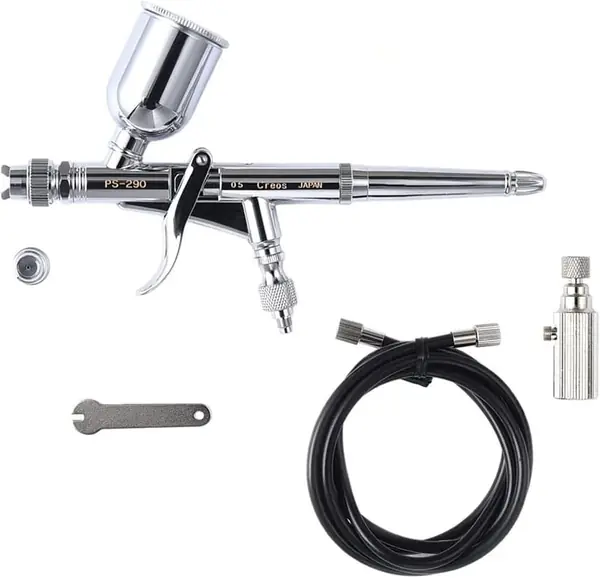
GSI Creos Mr. Procon Boy LWA chrome trigger airbrush with 0.5 mm nozzle

Priming and models

Track Score 91/100
Nozzle Size
0.5 mm
Cup Capacity
15 ml
Air Caps
Two included
Trigger Action
Double-action trigger
View on Amazon

A 0.5 mm nozzle and two air caps make the GSI Creos Mr. Procon Boy LWA the most broadly useful trigger airbrush in this group. The hand-operated pull trigger is built to spare your fingers during long coats, and the normal and wide caps let one brush move from general model work to broader priming. That combination is why it is our top pick.

The 15 ml cup is a sensible middle size for primer, color, and clear on a model or a small body. We paid close attention to the trigger and cap changes because those are the parts that decide whether a long session feels smooth or fiddly. The chrome and stainless construction gives it a more substantial feel than the budget kits here, and the airflow adjustment lets you dial back for smaller work without changing nozzles.

Against the Iwata NEO TRN 2, the GSI is the simpler choice: one cup, two caps, and fewer parts to handle. The Iwata's side-feed cups and bottle hold more paint for a full RC shell, but that is a different kind of session. We keep the GSI for the days when we want one dependable broad-work brush, a quick cap change, and no second cup to manage.

Worth Noting

  • Single 0.5 mm nozzle limits fine detail
Our Verdict

We recommend the Mr. Procon Boy LWA as the default trigger airbrush for broad model and primer work because its 0.5 mm setup and two air caps cover large surfaces comfortably.

Check Latest Price
2.

Iwata-Medea NEO TRN 2 Trigger Airbrush Best for Large Coverage

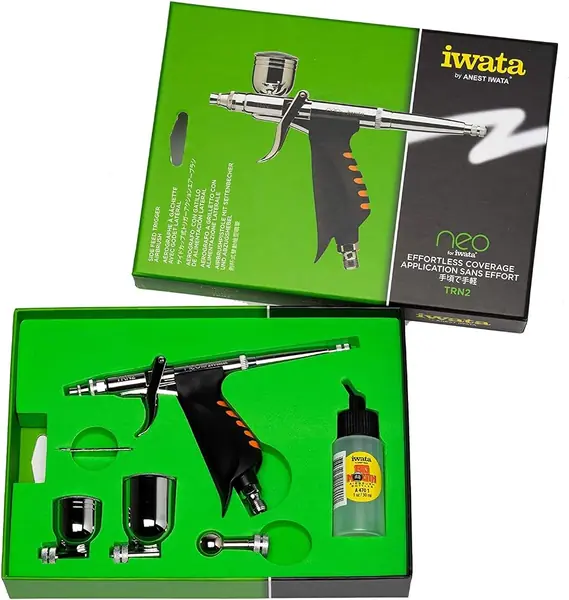
Iwata-Medea NEO TRN 2 silver side-feed trigger airbrush with two cups

Large RC bodies

Track Score 90/100
Nozzle Size
0.5 mm
Warranty
5-year
Maximum Pressure
20 psi
Cup Setup
1/4 oz and 1/2 oz side-feed cups with 1 oz bottle
View on Amazon

A full RC body or a primer session is where the Iwata-Medea NEO TRN 2 earns its keep. The 0.5 mm nozzle is built for high paint flow, and the side-feed cups sit out to the side so you can see the surface while you work. The kit includes a 1/4 oz cup, a 1/2 oz cup, and a 1 oz bottle, which means fewer refills on large jobs.

We favor it over our top pick when the work is bigger than a typical model. Its pull trigger gives precise control across the range, and the five-year warranty is the kind of backing we want on a premium brush. The ergonomic feel and unobstructed view are practical advantages once you are spraying for an hour. It is also the one we hand someone who already knows they will be spraying a lot of paint in one sitting.

This is not the brush we choose for tiny detail; its 0.5 mm tip is happiest laying down color, primer, and clear. For detail, the NEO TRN 1 is the better fit. The NEO TRN 2 is the large-job specialist we keep in mind for RC bodies, automotive panels, and any session where the cup should outlast the masking tape.

Worth Noting

  • Cleaning takes more effort than simpler brushes
Our Verdict

For large RC bodies and primer sessions, choose the NEO TRN 2, whose side-feed cups and high-flow 0.5 mm setup keep refills and finger fatigue down.

Check Latest Price
3.

Iwata-Medea NEO TRN 1 Trigger Airbrush Best for Fine Detail

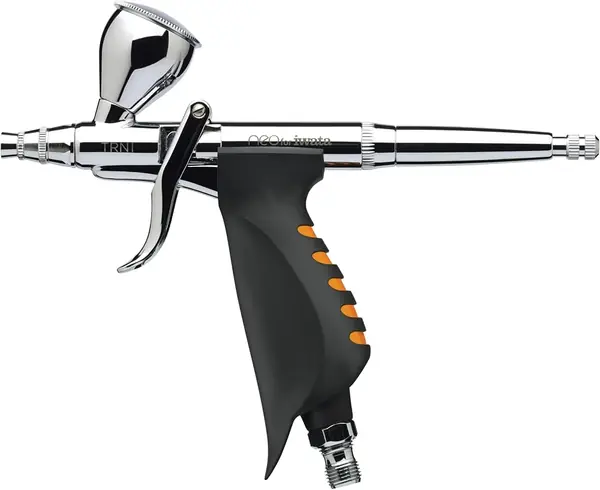
Iwata-Medea NEO TRN 1 black gravity-feed trigger airbrush with two cups

Fine miniature detail

Track Score 89/100
Nozzle Size
0.35 mm
Warranty
5-year
Cup Capacity
1/3 oz and 1/16 oz cups
Maximum Pressure
20 psi
View on Amazon

The 0.35 mm Iwata-Medea NEO TRN 1 is the detail-first trigger airbrush in this group. Its smaller nozzle is meant for finer spray patterns, and the two funnel-shaped cups, 1/3 oz and 1/16 oz, let you switch between a small detail load and a larger color session. The hand-operated trigger carries over the comfort advantage.

We like the way it works at lower air pressures; the gravity-feed design is intended to keep control when you dial the compressor down. The trigger feels intuitive and the pistol grip keeps the hand relaxed for miniature work. The 0.35 mm tip is a better match for small parts than the 0.5 mm brushes here, and the 1/3 oz cup is the larger of the two for a short priming run.

The TRN1 suits edges, panels and small parts that need controlled passes. It will not replace a 0.5 mm brush for a full body, but that is not the job we give it. The trigger is the reason it stays comfortable, even when the work is fussy.

Worth Noting

  • Small 1/16 oz cup suits detail only
Our Verdict

We favor the NEO TRN 1 when fine detail matters more than coverage, because its 0.35 mm nozzle and easy trigger make close work comfortable.

Check Latest Price
4.

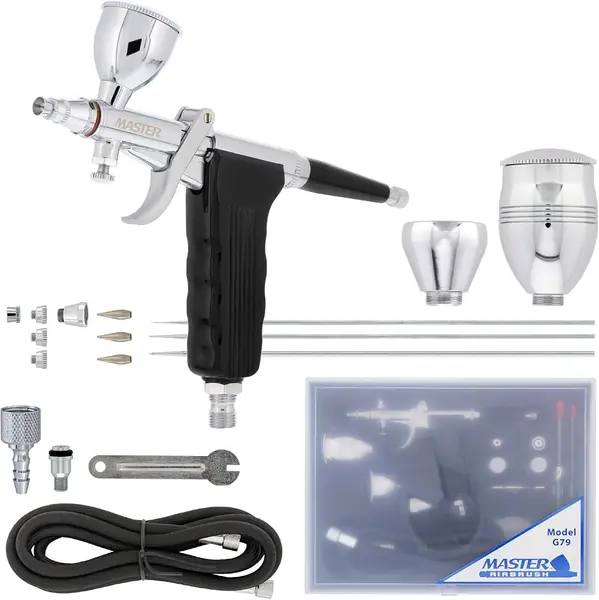
Master Airbrush G79 Best Starter Kit

Master Airbrush G79 black and silver trigger airbrush with three cups

Starter trigger kits

Track Score 88/100
Needle Sizes
0.3, 0.5, 0.8 mm
Cup Capacities
1/16, 1/6, 1/2 oz
Feed Type
Gravity
Included Hose
6 ft braided
View on Amazon

The Master Airbrush G79 arrives as a kit rather than a single brush: three needle sizes, three screw-on cups, a six-foot braided hose, a wrench, and a storage case. That is a lot of trigger airbrush for a starter, and it lets you try 0.3 mm detail, 0.5 mm general work, and 0.8 mm broad priming with one purchase.

We like the pistol grip for longer priming sessions because the pull trigger keeps the hand in a more natural position. The three cups, 1/16, 1/6, and 1/2 oz, are sized for everything from a small detail load to a larger panel, and the hose means you can connect and spray without hunting for another part.

The 0.8 mm setup is a broad-coat tool, not a detail nozzle; that is expected at this end of the kit. The 0.3 mm setup is the one for finer work, and the 0.5 mm sits in the middle for general model painting. The gravity feed is simple to fill and the cups unscrew for cleaning.

We recommend the G79 as a starter kit when you want to explore trigger spraying without paying premium money. It is not as refined as the GSI or Iwata picks, but it covers more needle sizes and includes the hose, which makes it an easy first setup.

Worth Noting

  • More cups and tips to keep track of
Our Verdict

We think the G79 is the starter kit to choose when you want three needle sizes, three cups, and a hose without moving into premium territory.

Check Latest Price
5.

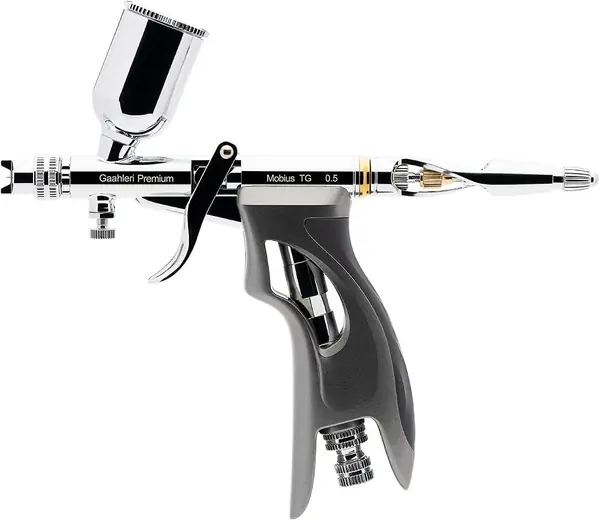
Gaahleri Mobius-Trigger Best for Wide Fan Coverage

Gaahleri Mobius-Trigger starry gray metal airbrush with fan and round caps

Wide fan coverage

Track Score 87/100
Trigger
Optimized pull trigger
Cup Finish
Mirror-polished
Spray Caps
Fan and round
Body Finish
Starry gray PVD
View on Amazon

The fan air cap is the first thing we notice on the Gaahleri Mobius-Trigger: it lays down twice the spray width of the round cap, which turns a large panel into a few quick passes. The optimized pull trigger and all-metal body make it feel like a premium tool in the hand, and that combination is why it is our pick for wide fan coverage.

We appreciate the dual-cap setup because it keeps the brush from being a one-trick sprayer. Swap to the round cap for edges and smaller areas, and use the fan cap for broad color and primer. The mirror-polished cup is easier to wipe between colors, and the PVD-coated starry gray finish gives it a distinctive look.

Against the GSI LWA, the Mobius is the more specialized broad-coverage brush; the GSI's two caps are simpler to live with as an only brush. The Mobius makes sense when speed on large surfaces is the priority. The round cap is useful, but it does not turn this into a detail brush.

Worth Noting

  • Fan cap consumes more paint
Our Verdict

We like the Mobius-Trigger for broad work where the fan cap's extra width and the polished cup make fast coverage easier to manage.

Check Latest Price
6.

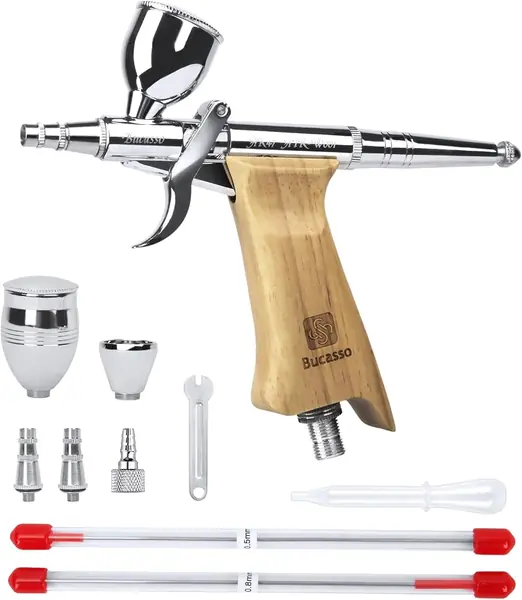
Bucasso AIRAK47 Best Budget Kit

Bucasso AIRAK47 trigger airbrush with burlywood wood handle and three cups

Budget model painting

Track Score 86/100
Cup Capacities
3, 7, 11 cc
Body
Metal with wood handle
Air Inlet
1/8 adapter
Needle Sets
0.3, 0.5, 0.8 mm
View on Amazon

The Bucasso AIRAK47 pairs a metal body with a burlywood wood handle, which gives it a warmer look than the all-metal brushes here. More important, the kit includes three nozzle and needle sets, 0.3, 0.5, and 0.8 mm, and three cups at 3, 7, and 11 cc, so you can size the setup to the job.

We recommend it as the budget kit for modelers who want range without paying premium money. The pistol grip is comfortable, the 1/8 adapter fits common hoses, and the one-year warranty adds a little peace of mind. Changing nozzle sets is straightforward, and the three cups reduce the need to mix a big batch for a small job.

The wood handle is the part we notice first, but the three-cup system is what makes it practical. We also like that the 0.3 mm setup is included rather than sold as an extra, so the brush can move from a fine line to a broad base coat without a second purchase. The metal body gives it enough substance to feel stable in the hand.

Worth Noting

  • Three cups mean more pieces to clean
Our Verdict

We pick the Bucasso for budget-minded modelers who want three needle sizes, three cups, and a comfortable wood handle in one kit.

Check Latest Price
7.

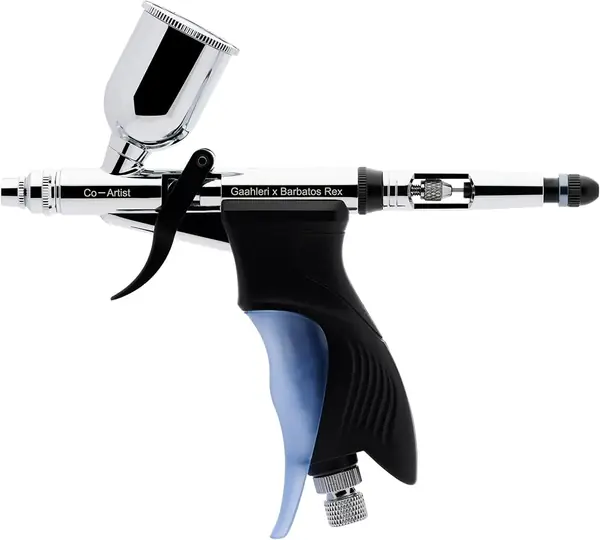
Gaahleri Ace Swallowtail & Barbatos Rex

Gaahleri Ace Swallowtail and Barbatos Rex airbrush with three needle sizes

Multi-needle versatility

Track Score 83/100
Trigger
Redesigned extended pull
Cup Finish
Mirror-polished
Needle Sizes
0.28, 0.5, 0.7 mm
Handle
Extended tail
View on Amazon

Three needle sizes, 0.28, 0.5, and 0.7 mm, make the Gaahleri Ace Series a different proposition from the fan-cap Mobius. The redesigned trigger is longer and more curved, and the extended tail gives your pinky a place to rest during long sessions. The kit is built to cover fine detail, general work, and broad base coats with one handle.

We like the range because it lets you keep the same grip and trigger feel while changing the needle set. The 0.28 mm setup is for precision, the 0.5 mm is the everyday middle, and the 0.7 mm moves heavier paint for base coats. The mirror-polished cups also make color changes easier to wipe clean.

We see the Ace Series as the versatile alternative to the Mobius: choose it when three needle sizes matter more than the fan cap's wide spray. The longer trigger suits a range of hand sizes, and the extended handle is a real comfort detail, not just styling. It is a strong choice for a modeler who wants one handle to do several jobs.

Worth Noting

  • Multiple needle sets add storage and cleaning
Our Verdict

The Ace Series is our choice when three needle sizes and a longer trigger matter more than the Mobius fan cap's wide coverage.

Check Latest Price
8.

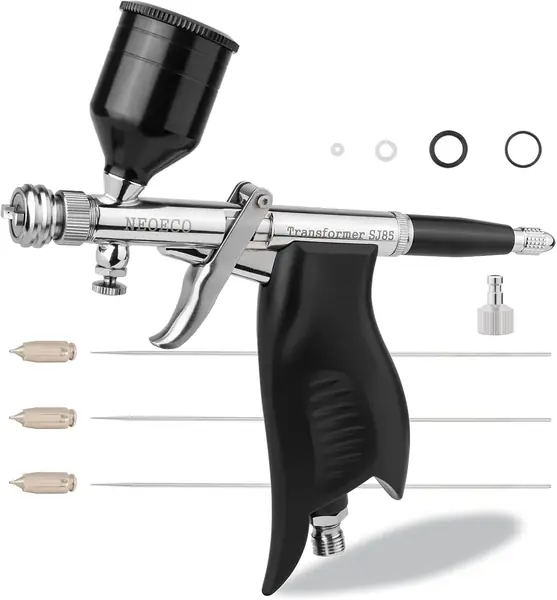
NEOECO Transformer SJ85 Best for Switchable Spray Patterns

NEOECO Transformer SJ85 gray pistol-grip airbrush with three nozzle sets

Switchable spray patterns

Track Score 76/100
Weight
6.88 oz
Nozzle Sets
0.3, 0.5, 0.8 mm
Spray Modes
Round and fan
Working Pressure
12-30 psi round, 38-50 psi fan
View on Amazon

The NEOECO Transformer SJ85 has a trick the other trigger airbrushes here do not: a patented Quick-Shift that changes from a round spray to a fan in about a second. That makes it the most pattern-flexible brush in this group, and the three included nozzle sets, 0.3, 0.5, and 0.8 mm, add to the range.

We like the enlarged grip and the 195 g body for longer sessions; the mass feels purposeful rather than clumsy. The self-centering drop-in nozzle is a smart maintenance choice because it avoids threaded nozzle alignment. We appreciate that the nozzle drops in and centers itself, which makes cleaning less fiddly.

The Quick-Shift is the feature that separates it from the Mobius: both give you fan coverage, but the NEOECO changes modes without swapping a cap. If you switch between broad and round work constantly, that convenience is easy to understand.

We suggest the SJ85 for a sprayer who switches patterns often and wants an ergonomic grip; for a first trigger brush, our top pick is the simpler default. It is a distinctive design with a useful trick, and the three nozzle sets give you room to grow.

Worth Noting

  • Fan mode requires up to 50 psi
Our Verdict

We suggest the SJ85 for sprayers who want to switch between round and fan patterns quickly and do not mind a higher-pressure fan setting.

Check Latest Price

How We Tested Trigger Airbrushes

We started by gathering every trigger-style airbrush we could reasonably put in a booth — gravity and side-feed bodies, single-nozzle detail guns, and kits with swappable needle and nozzle sets. From there we filtered by nozzle range, cup setup, air inlet and compressor compatibility, and whether replacement needles, nozzles, and seals were easy to source, which cut the field to 12 units.

Testing ran nine months, mostly at a hobby bench and a garage worktable: primers and thinned acrylics on model kit parts, color coats on RC body shells, fine shading on miniatures, and a few craft projects. Every session happened in a ventilated spray booth with respirators rated for the paint and solvent in use, and solvent-based finishes and cleaners stayed well away from any ignition source.

We sprayed 20-minute continuous sessions with each airbrush and noted where the trigger started to stack up and where our hands began to cramp, since long-session comfort separates a good pull from a great one. Every needle and nozzle set that shipped in a kit got swapped in, with fine lines and broad primer passes sprayed on the same scrap panel to find where each size stopped being useful. We filled and refilled cups, running one dry to see when sputtering started, compared side-feed against gravity setups on the same job, and ran each airbrush on a shop compressor across the 12 to 30 psi range to check low-pressure behavior and how the inlet handled an inline filter.

Cleaning got timed: a full flush, then a teardown down to the needle and nozzle to look for pigment packed into threads or dried at the tip. We also sprayed a full ounce straight through each one, watching for tip dry, spatter, and an uneven pattern, and inspected trigger play, finish, and thread quality after the final session before asking makers about warranty coverage and parts support.

How to Choose a Trigger Airbrush

Match the Nozzle to the Work

A 0.3 to 0.35 mm nozzle is the detail end: it lays down a narrow pattern for miniatures, trim, and small parts. A 0.5 mm setup is the all-around choice for general model painting, primer, and clear, while 0.8 mm is for broad priming and heavier materials. The 0.35 mm Iwata NEO TRN 1 suits edge work and the 0.5 mm GSI LWA suits coverage. If you want one brush for both, a multi-needle kit such as the Master G79 or Gaahleri Ace gives you the range, but you will spend time changing and storing parts.

Do not assume a bigger number is an upgrade. A 0.8 mm tip is wrong for fine lines, and a 0.3 mm tip will make a full-body base coat feel slow. Buy the nozzle range that matches the work you do most, then add a second needle set only if you keep running into its limit.

Choose the Cup Around the Job

Cup size and feed style determine how often you stop to refill and how much paint you waste. A 3 to 7 cc cup is enough for detail and small color loads; larger cups, such as the 15 ml on the GSI LWA, make more sense for a full body or a primer session. The Iwata NEO TRN 2's side-feed cups and bottle are the large-job setup here, while the Bucasso's three cups let you match capacity to the batch.

More capacity is useful, but it also means more paint to mix and clean. If you mostly spray small parts, a large cup is extra surface area to rinse. Buy for the work you do most, not for the biggest job you might attempt once.

Put Trigger Comfort First

The point of a pistol-grip airbrush is to move the control from a small top lever to a pull your index finger can repeat. Look at the trigger's shape, the handle's support, and the balance in your hand. The Gaahleri Ace's longer trigger and extended tail, and the NEOECO's enlarged grip, are aimed at longer sessions. We prioritize a trigger that returns cleanly and a handle that lets your hand relax; extra needle sizes do not help if your hand is cramped after ten minutes.

A trigger does not automatically mean comfortable. A sharp edge or a short pull can be worse than a good top lever. If you spray for hours, treat comfort as a primary specification rather than a bonus.

Check Air and Maintenance Before You Buy

Most trigger airbrushes use a standard 1/8-inch hose fitting, but the kit contents vary: the Master G79 includes a braided hose, while many others include only an adapter. Check your compressor's fitting and its pressure range. Fan caps and higher-flow setups need more air; the NEOECO SJ85 is rated for 38-50 psi in fan mode, for example. Also plan for cleaning: removable cups and drop-in nozzles make the routine easier, and a brush with fragile threads or hard-to-find parts will cost you time later.

An adapter is not a hose. If the box lists only a fitting, budget for the hose before you plan your first spray session.

Frequently Asked Questions

Final Verdict

Start with the GSI Creos Mr. Procon Boy LWA 0.5mm if you want one trigger airbrush for broad model work, primer, and clear. It has the most useful balance of coverage, build, and trigger comfort in this group. For a full RC body, the Iwata NEO TRN 2's side-feed cups and bottle are the better match; for fine miniatures, choose the 0.35 mm NEO TRN 1.