Best Glues for Model Rockets of 2026

Rockets that wobble off the pad get blamed on the engine, but plenty of flights end because a fin let go at 200 feet. The glue has to hold through launch vibration, engine heat and a hard landing, and the right bottle depends on the materials: balsa and cardboard soak up wood glue, styrene fin cans need a solvent cement that fuses the plastic, and 3D-printed parts are their own problem.

Strength turned out to be the least interesting difference. Thin CA wicks into a tight joint and sets in a couple of seconds, which gives you one shot at a straight fin; a gel buys time to nudge it into place. No glue rescues a bad fin alignment or a warped body tube, but these eight held every joint from nose cone to launch lug over six months of builds and repairs.

Our Top Picks

The Best Glues for Model Rockets

1.

Titebond Original Wood Glue Best Overall
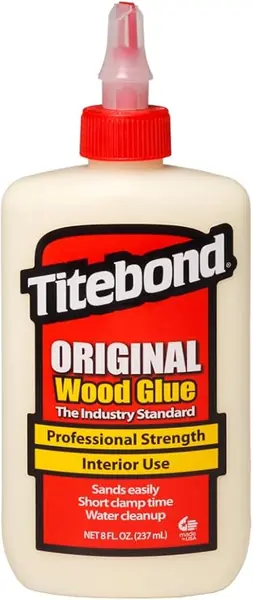
Titebond Original Wood Glue yellow bottle with 8-ounce label

Balsa and cardboard

Track Score 97/100
Adhesive Type
Aliphatic resin (PVA)
Volume
8 fl oz
Full Cure Time
24 hours
Listed Tensile Strength
3600 psi
View on Amazon

A balsa fin root joint gives you one chance to line up the fin before the glue grabs, and that is exactly where Titebond Original earns its place. The aliphatic resin formula stays workable long enough to slide the fin into alignment, then holds it without clamp drama. We kept reaching for it on cardboard body tubes because a damp cloth takes away squeeze-out before it cures.

What we appreciate most is the working time. The 8-ounce bottle is easy to meter with a toothpick or glue syringe, and the joint stays adjustable long enough to check fin alignment against a straightedge. The listed tensile strength is 3600 psi, but the practical advantage on a model rocket is that the glue line is stronger than the balsa around it; a hard landing usually dents the wood before the joint lets go.

It dries to a translucent film that sands without softening, which matters when you are shaping a fillet or cleaning up a fin root before paint. The trade-off is speed: this is not the adhesive for a quick field repair. For a first build or a competition model where alignment matters, the slower set is a feature, not a delay.

Worth Noting

  • Not water resistant
  • Will not bond plastic parts
Our Verdict

We recommend Titebond Original for balsa fins and cardboard tubes because it gives working time to align parts, cleans up with water, and sands smooth.

Check Latest Price
2.

Starbond Super Fast Thin CA Glue Best for Tight Joints

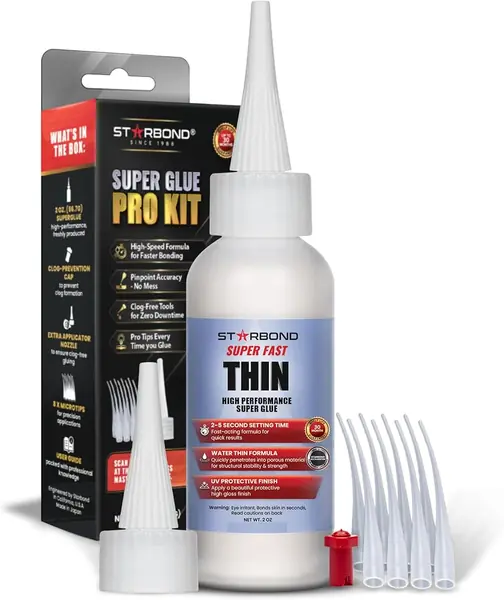
Starbond Super Fast Thin CA glue bottle with microtips and nozzles

Tight CA joints

Track Score 96/100
Adhesive Type
Thin cyanoacrylate (CA)
Volume
2 fl oz
Set Time
2-3 seconds
Included Tips
8 microtips
View on Amazon

Thin CA is the one that surprises first-time builders: it does not sit on the surface so much as disappear into the joint. We were struck by how quickly the Starbond thin formula pulled into a fitted balsa fin root, leaving a hard, clear line without a raised bead. The 2-3 second set is fast enough that you need the part aligned before the bottle touches it.

The kit matters as much as the glue. Starbond includes eight precision microtips, two applicator nozzles, and a pin cap, which turns a notoriously messy adhesive into something you can place on a small joint. We used a microtip to run a thin line along a hardened balsa edge and appreciated that we could place a small drop without flooding the whole edge.

This is the adhesive we use after the parts already fit, either to lock a tight joint or to soak and harden balsa that might otherwise dent. Dry-fit first, because the fast set leaves little time to reposition. The result is a hard, lightweight reinforcement that disappears under paint.

Worth Noting

  • No gap-filling ability
  • Thin formula can run into unwanted areas
Our Verdict

This thin CA is for when a tight fin joint needs wicking and reinforcement.

Check Latest Price
3.

Starbond Medium CA Glue Best All-Around CA

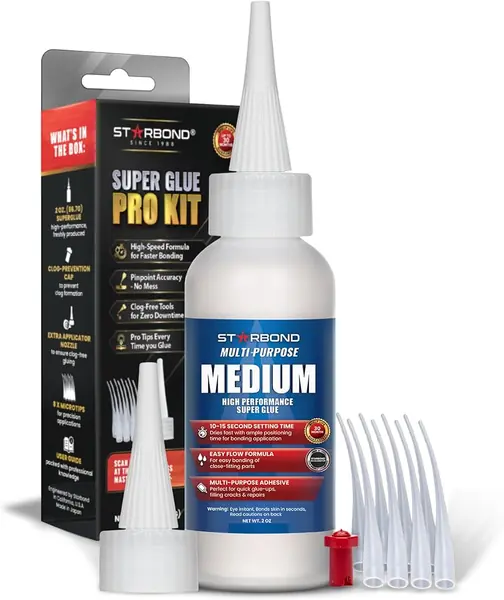
Starbond Medium CA glue bottle with precision microtips and pin cap

General CA assembly

Track Score 95/100
Adhesive Type
Medium cyanoacrylate (CA)
Volume
2 fl oz
Set Time
10-15 seconds
Included Tips
8 microtips
View on Amazon

A CA kit can look like a bottle with a few extras until you are trying to place a drop on a fin tab without gluing your fingers together. Starbond's medium formula comes with eight microtips, two nozzles, and a pin cap, so the applicator is part of the purchase rather than an afterthought.

The 10-15 second set gives you a little more rope than thin CA. We used it on a small cardboard-to-balsa tab and found enough time to slide the part into place before the glue grabbed, though not enough to dawdle. The medium body also stays closer to where you put it, which makes it easier to control on a vertical surface than a watery CA.

What sells us on this kit is the control: the microtips let us put a small amount on a tight joint, and the pin cap keeps the bottle usable between sessions. It is the CA for when you want a little more working time than thin and a placement that is easier to predict.

Worth Noting

  • Not a gap filler for loose joints
  • Glossy plastics may need scuffing
Our Verdict

The microtips put medium CA exactly where a joint needs it, which makes this kit good for general model assembly.

Check Latest Price
4.

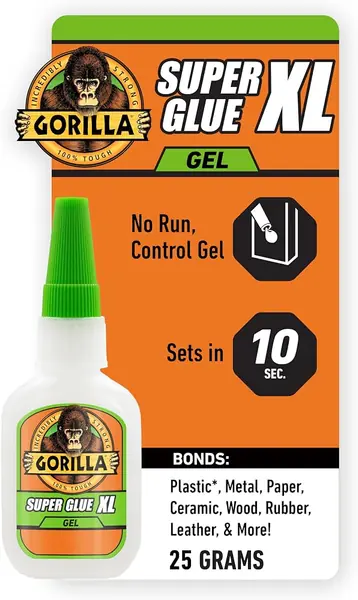
Gorilla Super Glue Gel XL Best No-Run Gel

Gorilla Super Glue Gel XL clear 25-gram bottle with anti-clog cap

No-run gel repairs

Track Score 94/100
Adhesive Type
Cyanoacrylate (CA) gel
Set Time
10-45 seconds
Finish
Clear
Bottle Size
0.88 oz
View on Amazon

Vertical repairs are where a runny CA shows its bad side: the glue heads downhill before it cures and leaves a shiny streak on the body tube. Gorilla Super Glue Gel XL is thick enough to sit where you place it, which is the behavior you want when a launch lug or a small plastic fitting needs to be tacked in place.

We choose this gel when glue has to stay put on a vertical body tube or a mixed-material repair. The 10-45 second set is fast, but the gel body gives you a few seconds to nudge a part before it locks. The 25-gram bottle is also large enough to keep on the bench for more than one build, which is not true of every CA in this group.

It dries clear and the impact-tough formula is aimed at bumps and drops, so it is a sensible choice for a repair where a fin or lug has already taken a hit. Use a small dot and press the parts together rather than spreading it like wood glue. The gel needs contact, not a thick cushion.

Worth Noting

  • Thick gel will not wick into tight seams
  • Can add bulk if applied heavily
Our Verdict

We choose this gel when glue has to stay put on a vertical body tube or a mixed-material repair.

Check Latest Price
5.

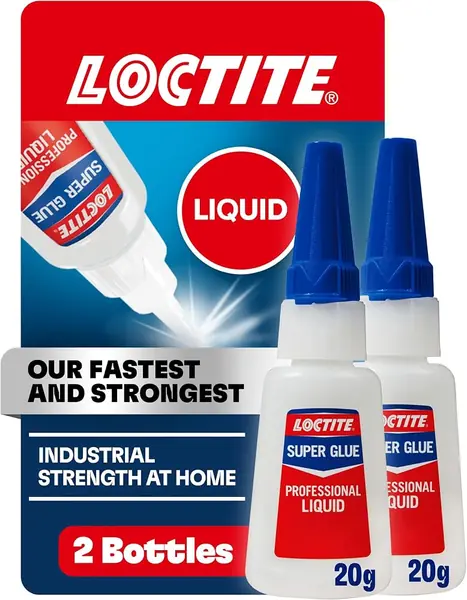
Loctite Professional Liquid Super Glue Best Liquid CA

Loctite Professional liquid super glue two clear 0.7-ounce bottles

Precision liquid CA

Track Score 93/100
Adhesive Type
Cyanoacrylate (CA) liquid
Set Time
15-30 seconds
Pack Size
2 bottles
Bottle Volume
0.7 fl oz each
View on Amazon

A long metal nozzle is a small thing until you are trying to lay a bead along a fin root without flooding the surrounding balsa. Loctite Professional Liquid puts the glue exactly where the tip touches, and the bottle's quick-open and lock-closed cap is easy to work one-handed.

The formula sets in 15-30 seconds, which is slower than the thin specialty CAs but still fast enough for tacking. We used it to run a narrow line along a cardboard tube seam and found the low-to-medium viscosity stayed in the seam instead of running away. The listed tensile strength is 3000 psi, and the bond is water resistant, which gives it a little more margin than a plain craft CA.

The two-bottle pack is the practical part for us. A 0.7-ounce bottle lasts through several small assemblies, and the long nozzle reaches into a fin root without a separate applicator. It is the bottle we leave on the bench for detail work rather than a one-and-done tube.

What settles it for us is the combination of a precise nozzle and enough volume to keep using it. This is the liquid CA we recommend for builders who have moved past one-off repairs and want a bottle that stays on the bench. For flat fin roots and detail tacking, it is easier to place than a standard squeeze tube.

Worth Noting

  • Liquid can run on vertical surfaces
  • Not a gap filler for loose joints
Our Verdict

We recommend this liquid CA for builders who want a long precision nozzle and a larger bottle for repeated fin and detail work.

Check Latest Price
6.

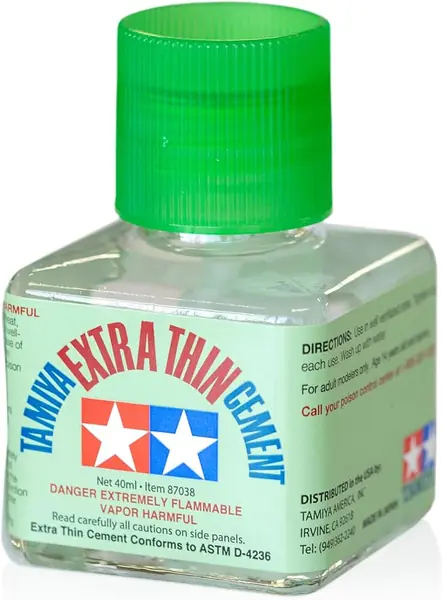
Tamiya Extra Thin Cement Best for Plastic Fin Cans

Tamiya Extra Thin Cement 40-milliliter bottle with fine brush applicator

Plastic fin cans

Track Score 92/100
Adhesive Type
Polystyrene cement
Volume
40 ml
Full Cure Time
24 hours
Applicator
Fine-point brush
View on Amazon

Styrene is not a material you glue so much as a material you weld, and Tamiya Extra Thin Cement is built for that distinction. The thin solvent flows between fitted parts by capillary action and softens the plastic so the seam becomes one piece. We use it on plastic fin cans and detail parts where a film of CA would show a shiny glue line.

The fine brush tip is the reason the bottle works. You hold the parts together, touch the brush to the seam, and let the cement wick in; there is no need to coat both faces. The 40-milliliter bottle is small enough to control and the brush reaches into tight joints, though the cement sets by evaporation rather than by a quick chemical grab.

The joint is cleaner and stronger than a surface adhesive, but the cement rewards a dry fit. Hold the parts together, touch the brush to the seam, and let capillary action do the work. The fumes are strong, so work with ventilation and keep the cap on between seams.

Worth Noting

  • Only welds compatible styrene plastics
  • Will not fill loose joints
Our Verdict

On styrene fin cans and plastic details, this cement welds the parts instead of sitting on top.

Check Latest Price
7.

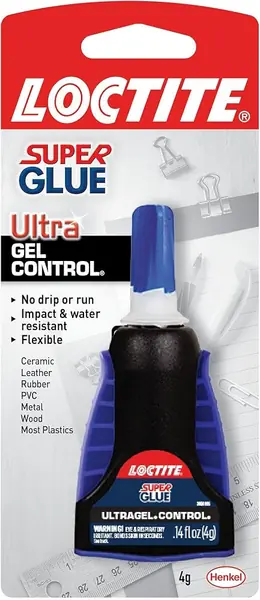
Loctite Ultra Gel Control Best for Impact-Resistant Gel Bonds

Loctite Ultra Gel Control clear super glue in side-squeeze bottle

Impact-resistant gel bonds

Track Score 91/100
Adhesive Type
Rubber-toughened CA gel
Volume
0.14 fl oz
Listed Tensile Strength
3625 psi
Water Resistance
Water resistant
View on Amazon

Impact and vibration are the enemy of a brittle CA joint, especially on a rocket that has already landed hard once. Loctite Ultra Gel Control uses a rubber-toughened formula that is meant to absorb some of that shock, and the gel stays where you put it on a vertical repair.

The side-squeeze bottle is the best part of the design. You squeeze the flat sides to meter a drop instead of relying on gravity, and the gel does not run down the body tube while you position a part. We found it easier to control than a standard squeeze tube on a small plastic tab.

The listed tensile strength is 3625 psi, and the formula is water resistant, so it has a little more margin than a plain craft CA for outdoor recovery or a damp field. It sets clear and does not need clamping, which makes it a useful repair bottle to keep in a range box.

What keeps it in our kit is the toughness. This is the repair gel for when a small, impact-prone joint needs a bond that can take a knock without a complicated clamp-up. It is the one we trust for a quick fix that has to hold until the next build session.

Worth Noting

  • Tiny bottle runs out quickly
  • Thick gel resists wicking
Our Verdict

We keep this gel for small impact-prone repairs where a tougher, water-resistant bond matters.

Check Latest Price
8.

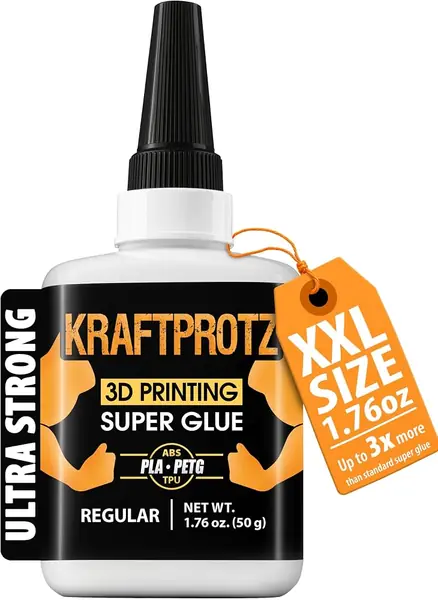
KRAFTPROTZ 3D Printing Super Glue Best for 3D-Printed Rocket Parts

KRAFTPROTZ 3D Printing Super Glue clear 1.76-ounce bottle with needle tip

3D-printed rocket parts

Track Score 90/100
Adhesive Type
Thin cyanoacrylate (CA)
Volume
1.76 fl oz
Heat Resistance
Up to 110 °C
Compatible Filaments
PLA, ABS, PETG, TPU, ASA, Nylon
View on Amazon

Layer lines leave narrow seams that a thick glue cannot reach, which is why a thin CA designed for 3D prints has a place on a model rocket bench. KRAFTPROTZ 3D Printing Super Glue is a watery cyanoacrylate that flows into the gaps between printed layers and sets clear.

The needle tip is the useful part. We used it on a small PLA bracket and found the glue reached a tight seam without a separate applicator. The formula is aimed at PLA, ABS, PETG, and TPU, and the listed heat resistance up to 110 °C gives it some margin near a motor mount or electronics bay.

For 3D-printed fin cans, nose cones, and camera mounts, we suggest this as a dedicated plastic bond rather than a general wood glue. Where the printed pieces already fit, the thin formula does what a model builder wants: it gets into the seam and disappears. It is a specialist bottle, and that narrow focus is the point.

Worth Noting

  • No gap-filling ability
  • Thin liquid can run on vertical parts
Our Verdict

For 3D-printed rocket parts, its thin formula reaches tight layer seams and bonds PLA and PETG.

Check Latest Price

How We Tested Model Rocket Glue, From Balsa Fins to Styrene Cans

We started with more than 30 bottles from hobby shops and hardware stores — CA in thin, medium, and gel formulas, rubber-toughened gel, aliphatic resin wood glue, and polystyrene cement — and narrowed to 14 that covered every chemistry a rocket builder runs into.

For six months we built and repaired rockets on a garage workbench: balsa fins onto cardboard body tubes, launch lugs, shock cord mounts, styrene fin cans, and a few 3D-printed parts. Every glue got a joint on a real build, not a scrap of pine.

We timed how long each one stayed workable by pressing a fin into place at five-second intervals until it grabbed, and noted how much clamping it took. We ran beads along fin roots to see which formulas stayed where they were put and which sagged away, and touched a drop of thin CA to a tight seam to watch whether it wicked the length of the joint on its own. After a full cure we flexed every joint by hand and dropped finished rockets fins-first onto pavement from waist height to see which held.

Between builds the bottles sat capped and upright on a shelf, and we checked each tip before the next session to see which had clogged and which still flowed — a bottle that gives out halfway through a kit is bad value at any price. We counted fin sets per bottle, left cured joints in a hot car, and spritzed others with water to see how they held. CA went on with clamps and tweezers rather than fingers, always with the garage door open, and the polystyrene cement was used outdoors on styrene parts only.

How to Choose Glue for Model Rockets

Start With the Material

Wood glue is the default for balsa fins, cardboard body tubes, and paper-to-wood joints because it needs porous surfaces and gives you time to align the parts. CA glue handles mixed materials and quick tacking, but it is brittle under shock and not a substitute for a proper wood-glue fillet. Plastic cement is different again: it softens and welds styrene, so it only works on compatible plastic. The trap is assuming any plastic part takes plastic cement; test a hidden spot on a fin can first, because polyethylene and polypropylene need a CA or mechanical fastening instead.

Choose the CA Consistency

Thin CA is watery and wicks into already-fitted joints, which makes it useful for hardening balsa edges and locking a tight fin root. Medium CA stays put a little longer and gives you seconds to position a part; gel CA is the no-run choice for vertical surfaces and repairs where a drip would migrate. None of them fills a loose joint well. If the parts rock or show a gap, fix the fit before gluing rather than counting on a thick bead to bridge it.

Plan Working Time and Clamping

Wood glue and plastic cement reward a dry fit. Tape or pin the fin in place, check the alignment, then apply glue and clamp or tape until the joint holds. CA grabs in seconds, so it is better for tacking a part you have already positioned than for sliding a fin into final alignment. Plastic cement is the opposite: capillary action pulls it into a fitted seam after the parts are together, so apply it to the joint line rather than coating both faces.

Store Glue So It Stays Fresh

CA glue starts to thicken and clog once moisture reaches the tip, so wipe the nozzle, replace the pin cap, and stand the bottle upright. A clogged tip is not a reason to squeeze harder; clear it with the pin or a fresh nozzle. Wood glue is more forgiving but can skin over in the bottle. Keep both out of direct sun and extreme heat, and test a drop of older CA on scrap before trusting it on a fin.

Know When to Step Up to Epoxy

For low- and mid-power rockets, wood glue and CA cover most balsa, cardboard, and plastic assemblies. High-power motor mounts, reloadable casings, and heavy nose weights put more heat and shock into the joint than these adhesives are meant to take. That is the point to choose a two-part epoxy rated for the materials and cure time you need. Do not use a flexible craft glue or a thin CA as the only adhesive on a motor mount.

Frequently Asked Questions

Final Verdict

For most model rocket builds, Titebond Original is the one to buy first: it gives you time to line up balsa fins and cardboard tubes, cleans up with water, and sands smooth.

Add a CA only for the jobs wood glue cannot do: Starbond Super Fast Thin for wicking into tight joints, or Gorilla Super Glue Gel XL when the repair is vertical and you need no-run control. If your kit uses styrene fin cans, Tamiya Extra Thin Cement is the correct adhesive, not a general-purpose glue.