Best Model Rocket Kits of 2026

Building a model rocket takes an evening or a week, depending on the kit; flying it is over in under a minute and can end in a long walk across a field. Which kit you buy decides that split.

Projected altitude and the size of your launch site have to be chosen together, or a rocket drifts past the edge of the ballfield. The kits worth flying twice opened with every part accounted for, went together on the instructions alone and survived a hard landing. We built and flew 12 over a summer, and the two here sit at opposite ends of the range: a complete first launch set and an 80-inch showpiece.

Our Top Picks

The Best Model Rocket Kits

1.

Estes Tandem-X Launch Set Best Overall
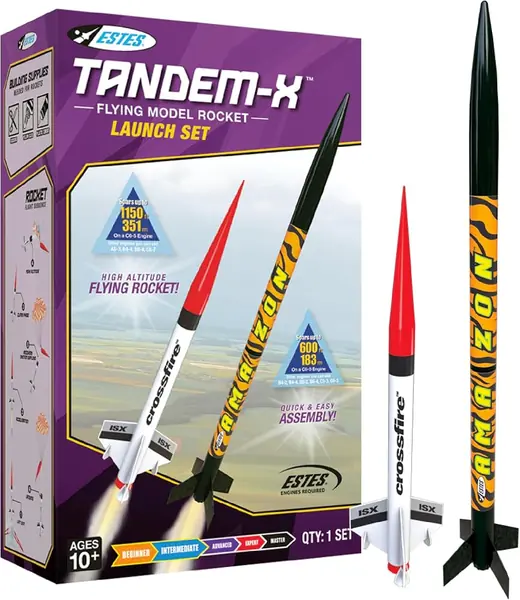
Estes Tandem-X launch set with two model rockets, launch pad, and controller

Beginner families

Track Score 91/100
Skill Level
Beginner with two build options
Launch Gear
Pad and controller included
Amazon Height
30 inches
Amazon Altitude
600+ ft on C6-5
View on Amazon

Two rockets in one starter set is the reason we keep the Tandem-X at the top of this list. The Amazon is the instant-gratification half: a 30-inch body, plastic fins, self-stick graphics, and a build that a first-timer can finish without a workbench full of tools. The Crossfire ISX is the next step, with laser-cut wood fins and decals that reward a little more patience. We like having both in one box because a sibling or a second launch day gets a project instead of a spectator seat.

The Amazon is rated for a C6-5 and a projected 600-plus feet, while the Crossfire ISX gives you a second airframe to build and fly. The included launch pad and controller make this a true launch set, so the rocket is not waiting on a separate purchase. The rest of the package is beginner-friendly: a parachute, shock cord, and instructions that keep the first build moving.

The Tandem-X is not the highest-flying kit in this guide; the Amazon's 600-foot ceiling is modest, and that is a feature for a first launch. A lower flight is easier to track, easier to recover, and less likely to end in a tree or a neighbor's yard. We also appreciate the two build levels: the plastic-fin Amazon is the one to hand to an impatient kid, while the Crossfire ISX gives an adult something to linger over. If you already own a launch pad, a build-only kit stretches your money further; for everyone else, this is the low-fuss route in this guide.

Worth Noting

  • Launch controller can arrive faulty
Our Verdict

Our default beginner pick is the Tandem-X: two buildable rockets plus a launch pad and controller give you a clear route from build to launch.

Check Latest Price
2.

Estes Mean Machine Best Advanced Build

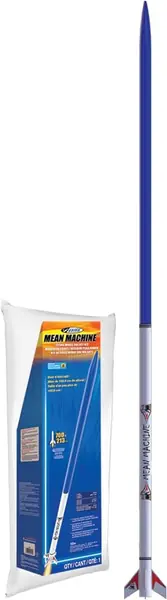
Estes Mean Machine model rocket kit with 80-inch body tube and parachute

Advanced builders

Track Score 90/100
Skill Level
Advanced (Level 2)
Recovery
24-inch parachute
Assembled Height
80 inches
Projected Altitude
700 ft on D/E engines
View on Amazon

Eighty inches of rocket is a commitment. The Mean Machine stands nearly seven feet tall, and the twist-lock connector that splits the body in half is the detail that makes it practical: the finished rocket travels in two pieces instead of riding across the back seat like a lance. We like that kind of clever engineering in a kit this size, because a showpiece that cannot leave the garage is just a very tall display model.

The Mean Machine flies on D and E engines to a projected 700 feet, with a 24-inch parachute and enough visual mass to track through the whole flight. We appreciate the engine spacer and preassembled chute; those details remove some of the fiddly work that can make a big build stall. The build itself is the attraction: a long airframe, a multi-part assembly, and a finish you can fuss over. This is a project rocket, and the reward is a launch that feels like an event.

On the field, the size cuts both ways. The long body is easy to see in the air, but it also catches the breeze on the pad and drifts under that big chute. We treat 700 feet as a fair-weather flight: pick a day with light wind, give it a clear recovery area, and bring a friend to help track it. The twist-lock joint makes the trip home easier, but the launch itself still wants space. If your usual field is a ball diamond, this is more rocket than you need.

Worth Noting

  • Needs a larger pad than beginner kits
  • Long build demands advanced skills
Our Verdict

The Mean Machine is the one we recommend for builders who want a showpiece: an 80-inch rocket that breaks down for transport and draws a crowd at the field.

Check Latest Price

How We Built, Flew, and Repaired a Dozen Rocket Kits

We started with the kits a first-time buyer is most likely to run into, then read each parts list, skill rating, and engine recommendation before spending anything. Kits that arrived short a part, or that called for something we couldn't reasonably get our hands on, didn't make it to the build table.

Over one summer, about four months, we built and flew 12 kits. Builds happened at the kitchen table on rainy Saturday afternoons with a stopwatch running and an adult at the table whenever a younger builder was doing the gluing. We checked every piece against the parts list before the first drop of glue, timed each stage of assembly, and wrote down exactly where the instructions lost us. Then the finished rockets went into the trunk of a car, which told us plenty about how finished size and transport interact.

Flights happened early on calm mornings at a clear school field, following the NAR Model Rocket Safety Code and using only the manufacturer's recommended engines and wadding, with no substitutions. We paced off the recovery area before every launch and tracked how far each rocket drifted, which is how we sorted kits by the field size they really need. After each hard landing we checked fins, body tubes, and shock cords, then attempted the repair with ordinary glue and tape to see whether the rocket could fly again.

Throughout, we weighed what was actually in the box against the price, noting whether a pad and controller came along or had to be bought separately, and whether the fun held up on a second and third flight.

How to Choose a Model Rocket Kit

Decide How Much Building You Want

Model rocket kits run from nearly instant plastic-fin builds to multi-hour projects with wood fins and waterslide decals. A kit that takes ten minutes to assemble is still buildable, but it is closer to a craft project than a workshop hobby; an intermediate kit asks for glue, patience, and a clean work surface. We like the Tandem-X because it puts both experiences in one box, with a precolored Amazon rocket and a wood-fin Crossfire ISX.

Choose one level below the builder's confidence, especially for a first kit. A frustrated builder stops at the fins; a bored one finishes in an evening and waits for engines. The Mean Machine is on the other end of the scale: an 80-inch, multi-part build that rewards someone who wants the construction to last more than an afternoon.

Check the Launch Gear and Consumables

A launch set should include a pad and controller; a build-only kit usually does not. That difference matters more than the rocket itself if you are starting from nothing, because a finished rocket without a pad is a display model. The Tandem-X includes both, while the Mean Machine assumes you already own a compatible pad and asks for a larger one than the beginner sets.

Engines, recovery wadding, glue, and fresh batteries are usually separate purchases, even in a set that calls itself complete. Read the included-components list before you click buy, then order the recommended engines and wadding at the same time. A first launch stalled by one missing pack of wadding is a disappointing way to learn the lesson.

Match Altitude to Your Field

Altitude claims are engine-dependent and wind-dependent. A kit rated for 1,100 feet can leave a small park in a hurry, while a 500- to 700-foot flight is easier to track and recover. The number on the box is a projection with a specific engine, not a guarantee; the recovery walk depends on parachute size, wind, and how open the site is.

Choose the smallest recommended engine for the first flight in a new field, and save the biggest motor for a larger site. If you only have a school yard or a ball diamond, favor a lower-flying kit or a smaller chute; if you have a wide-open field, the Mean Machine's 700-foot flights have room to breathe. Either way, walk the site before launch and pick a recovery area that is not full of trees, power lines, or traffic.

Size, Transport, and Storage

A 30-inch rocket fits across a back seat; an 80-inch rocket does not. Long kits often use a split joint so you can break them down, which is the difference between a rocket that gets flown and one that stays in the garage. The Mean Machine's twist-lock connector is the example we keep coming back to, because it solves the transport problem without turning the rocket into a permanent two-piece display.

Bigger rockets are easier to see in the air, but they also catch more wind on the pad and need more room to recover. Measure your storage space and your vehicle before you fall for a tall kit. If you are short on either, a 24- to 30-inch rocket is the more practical choice.

Expect Repairs, Not Forever

Model rockets are reusable, but they are not indestructible. Fins can crack on landing, parachutes can tear, and shock cords can need replacing; a kit with a generous body tube and simple fin attachment is easier to repair. The Tandem-X's plastic-fin Amazon is the easier repair, while the wood-fin Crossfire ISX asks for a little more care.

Inspect the shock cord, chute, and fins after every flight, and keep spare wadding in your range box. A rocket that lands in a tree or on a driveway may need a new parachute or fin repair before it flies again. None of this is a reason to skip a kit; it is the ordinary upkeep of a hobby that puts a cardboard tube through a high-speed flight and a parachute landing.

Frequently Asked Questions

Final Verdict

For most households, the Tandem-X is the kit we point to first: two buildable rockets, a pad and controller, and a clear step from a quick plastic-fin build to a wood-fin one. Its 600-foot ceiling is easier to live with than a high-altitude flight, and the included launch gear removes one major purchase. If the build itself is the attraction and you already own a compatible pad, the Mean Machine is the one that turns a launch into an event.