Best Model Rocket Kits for Adults of 2026

A model rocket kit is two hobbies in one box. There's the build, sanding fins, gluing a motor mount and coaxing waterslide decals onto a body tube, and there's the flight, over in seconds and sometimes over in a treeline. A good kit balances them: enough building to feel like yours, and not so much altitude that launch day becomes a search.

Fins matter more than box art. So does build level, what's in the box (a few kits ship with a pad and controller, most don't) and whether the projected altitude fits the field you have. We built and flew 14 kits over six months, from evening builds to an advanced project that took weeks, and the eight picks range from complete launch sets to kits that assume you already own a pad, a controller and a drawer of motors.

Our Top Picks

The Best Model Rocket Kits for Adults

1.

Estes Der Red Max Best Overall
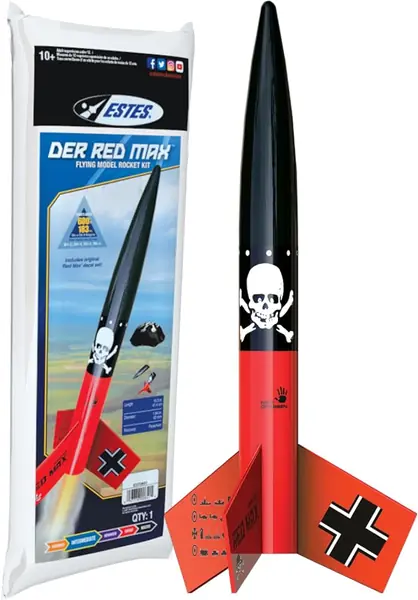
Estes Der Red Max flying model rocket kit with laser-cut wood fins and decal sheet

Intermediate builders

Track Score 93/100
Projected Altitude
600 ft
Length
16 inches
Skill Level
Intermediate, about 2 hours
Fins
Laser-cut wood
View on Amazon

Two things separate this rocket-building kit from the snap-together models on the same shelf: four laser-cut wood fins you align and glue yourself, and a sheet of waterslide decals. The build is listed at about two hours, which is realistic if you count construction alone. Add paint and decal work and it fills a couple of evenings, which is exactly what an adult who wants a project is shopping for.

Of everything here, this is the kit we point an adult at first. It's 16 inches tall, it has been in the Estes catalog for decades, and the airframe is sturdy enough to survive the landings that come with learning. Waterslide decals are the step that turns a decent build into a good-looking one, and they are also the step people rush; a shallow dish of water with a drop of dish soap and a soft cloth to chase the bubbles out makes the difference between a clean graphic and a wrinkled one.

In the air it's a 600-foot rocket on a C6-5 — high enough to feel like something, low enough that a 16-inch airframe usually comes back to you. Nothing to launch it with is in the box, though: no pad, no controller, no engines and no wadding. The Tandem X set below solves that in one order if you want everything to arrive together.

Worth Noting

  • No launch pad, controller, engines or wadding included
Our Verdict

For the adult who wants a real build, this is the one we hand over first: wood fins, waterslide decals and 600 feet on a C6-5.

Check Latest Price
2.

Estes Mean Machine Best Advanced Build

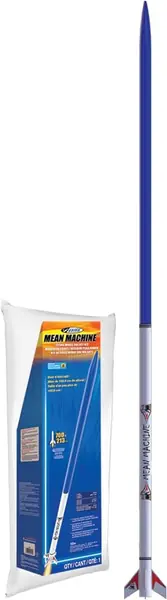
Estes Mean Machine model rocket kit with 80-inch airframe and twist-lock connector

Advanced builders

Track Score 92/100
Projected Altitude
Up to 700 ft
Length
80 inches
Skill Level
Advanced, 3+ hours
Engines
D and E
View on Amazon

Eighty inches of rocket changes the logistics before it changes anything else. Estes answers the obvious problem with a twist-lock connector that splits the airframe at the middle, so a rocket taller than most people travels in two pieces and goes back together at the field in seconds. What it can't shrink is the motor, the field or the pad.

Assembly is listed at three-plus hours at skill level 2, and the payoff is a 24-inch parachute, flights on D and E motors to about 700 feet, and a silhouette on the pad that no 12-inch model can match. A slow, straight boost from something this long is the most impressive launch in this group, and that's a different pleasure from the quick, high flights the small kits deliver.

The catch is everything around the rocket. It wants a Porta-Pad E and a sturdier rod than the starter pads use, and an 80-inch airframe is awkward to stand up in any breeze and hard to recover if it drifts. On a calm morning with the right pad, nothing else here looks like it — which is why this is the kit we name when someone has already finished a build and wants the long one.

Worth Noting

  • Needs a Porta-Pad E and a sturdier rod
  • Wind-sensitive at 80 inches long
Our Verdict

Our pick for builders who have already finished a kit — 80 inches of rocket that wants D or E motors and a calm morning.

Check Latest Price
3.

Estes Big Bertha Best Slow, Visible Flights

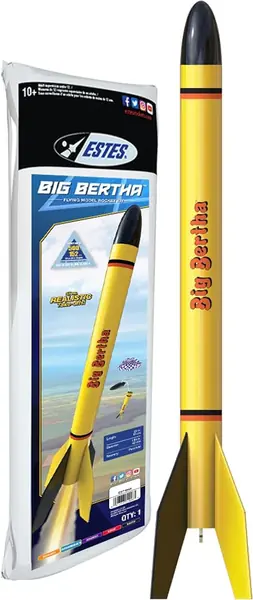
Estes Big Bertha model rocket kit in yellow with wood fins and parachute

Easy tracking

Track Score 91/100
Projected Altitude
Up to 500 ft
Length
24 inches
Skill Level
Intermediate
Recommended Engines
B4-2, B4-4, B6-2, B6-4, C6-5
View on Amazon

Most model rockets leave the pad in a blink. The Big Bertha doesn't: on a B or C motor it climbs to about 500 feet with a slow, heavy liftoff you can actually watch, then comes down under an 18-inch parachute. For a first launch with an audience, that's a better show than a rocket that's a speck before you've found it.

We like this one for the size of the thing. At 24 inches with a wide body tube it is easy to see, easy to track on the way down, and easy to work inside — there's room to reach the shock cord anchor without jamming a finger into a narrow tube. It's an intermediate kit with wood fins and an evening's worth of building, which makes it a satisfying step up from a molded-fin model without demanding advanced skills.

Two things to know before the glue comes out. Inspect the long body tube for shipping damage first, because that's the part that arrives dented if the box has been handled badly. And pack the parachute loosely with a dusting of talc and check the shock cord before each flight, since a hard landing is where the nose cone and chute tend to part company.

Our Verdict

The Big Bertha is what we suggest when you want to watch the whole flight — slow, low and big enough to follow all the way down.

Check Latest Price
4.

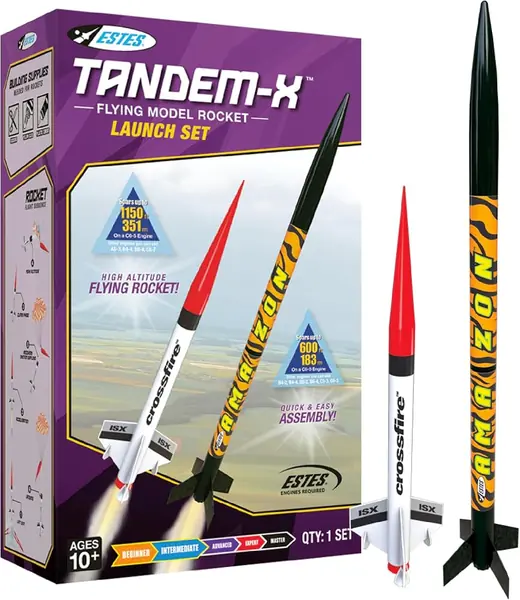
Estes Tandem X Launch Set Best Complete Launch Set

Estes Tandem X launch set with Amazon and Crossfire ISX rockets plus pad and controller

First launch day

Track Score 90/100
Projected Altitude
600+ ft on a C6-5
Fins
Plastic (Amazon), laser-cut wood (Crossfire ISX)
Included
Launch pad, controller, two rockets
Rocket Height
30 inches (Amazon)
View on Amazon

One box gets you a launch pad, an Electron Beam controller and two rockets. The 30-inch Amazon goes together in minutes with plastic fins and self-stick graphics; the Crossfire ISX has laser-cut wood fins and self-stick decals and is a genuine build. That pairing is why this set belongs on an adult's list and not just a family's.

The Amazon is the crowd-pleaser, hitting 600-plus feet on a C6-5 and staying big enough to follow. The Crossfire is the one that teaches you something about fin alignment and glue joints. Neither arrives ready to fly: engines, starters, recovery wadding, glue and four AA batteries for the controller are separate purchases, and that gap is the usual reason a first launch day stalls.

We treat the controller as the weak link in every launch set, this one included — the trouble clusters in the trigger and clips rather than in the rockets. Plug it in and pull the trigger in the yard before you drive anywhere. The two rockets themselves build cleanly and fly well, and having a pad on hand from day one is why this is the set we suggest to someone who wants to be flying the same weekend they order.

Worth Noting

  • Engines, wadding, glue and AA batteries sold separately
  • Launch controller is the weak point
Our Verdict

The Tandem X makes the most sense for a first launch day: pad, controller and two rockets in one order.

Check Latest Price
5.

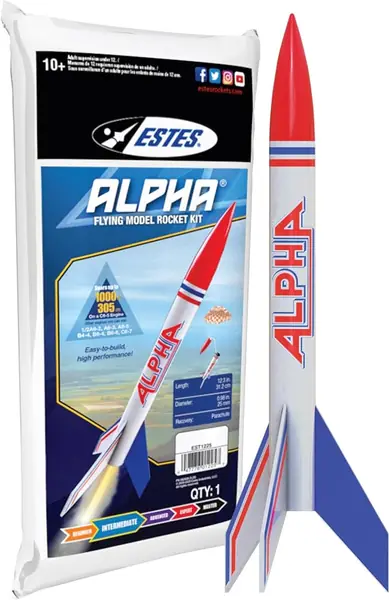
Estes Alpha 1225 Best Budget Build

Estes Alpha model rocket kit with balsa fins and nose cone

First wood-fin build

Track Score 89/100
Projected Altitude
1,000 ft
Length
12.3 inches
Skill Level
Intermediate, about 1 hour
Fins
Laser-cut balsa
View on Amazon

The Alpha is the kit we hand someone who wants to learn wood-fin building without spending much: it's the least expensive real build in this group, and it wastes nothing. A one-piece body tube, laser-cut balsa fins and an aerodynamic nose cone come together in about an hour into a 12.3-inch rocket that will touch 1,000 feet on a C engine.

Balsa is the trade. It's light, easy to shape and forgiving of a beginner's glue fillets, but it's soft, and a fin that lands on a rock is a fin you'll be repairing. Extra glue at the root, a smooth fillet and a calm-day launch go a long way toward a second season out of the same airframe.

At 12.3 inches it also disappears fast. On a C engine it will reach 1,000 feet and drift, so fly it on the smallest motor your field allows and save the C for a still morning with open ground. That's the honest boundary of this kit: it's a learning rocket, and a genuinely good one.

Worth Noting

  • Balsa fins crack on hard landings
  • Small and easy to lose at altitude
Our Verdict

We point new builders at the Alpha when they want to learn wood fins on the cheapest real kit here that still reaches 1,000 feet.

Check Latest Price
6.

Estes Power Patrol Best for Warm-Up Flights

Estes Power Patrol model rocket kit with swirled plastic body and fin unit

Warm-up flights

Track Score 88/100
Projected Altitude
Over 1,000 ft
Length
20 inches
Recommended Engines
A8-3, B4-4, B6-4
Assembly Time
About 10 minutes
View on Amazon

Ten minutes is roughly the whole build — glue the fin can halves, slide the plastic fins into their slots, tie the shock cord to the nose cone — and the swirled pre-colored plastic means no painting either. That's the honest appeal of the Power Patrol: it's a flying rocket you can have ready before the coffee goes cold.

What we value it for is the flight rather than the build. A 20-inch rocket on a B6-4 goes over 1,000 feet, and because there's no build time invested you can fly it first and let it tell you what the wind is doing. If it drifts hard on the way down, the bigger rocket stays in the car.

Two limits are worth naming. The fin unit is molded as one piece, so there's nothing here to learn about alignment, and the kit arrives without an engine, pad, controller or wadding — the altitude figure assumes a motor you buy separately. If a project is the point, the Alpha or the Der Red Max is the better purchase; if a launch is the point, this is the fastest route to one.

Worth Noting

  • Molded plastic fin unit offers no building challenge
  • No engine, pad or controller included
Our Verdict

Ten minutes of assembly and over 1,000 feet on a B6-4 — this is the one for when the build isn't the point.

Check Latest Price
7.

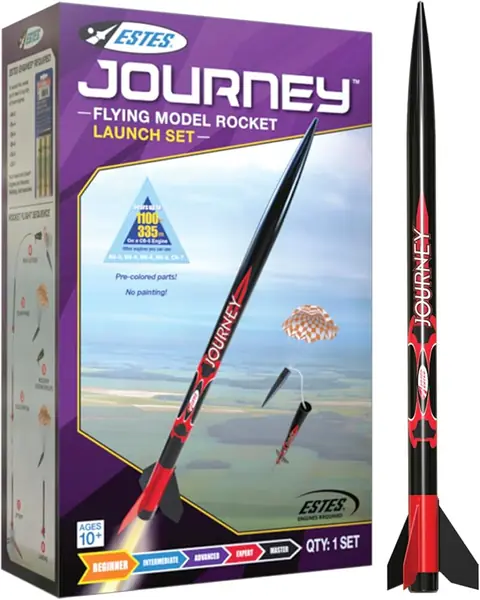
Estes Journey Launch Set

Estes Journey launch set with rocket, Porta-Pad II and Electron Beam controller

Simplest complete set

Track Score 87/100
Projected Altitude
1,100 ft
Included
Porta-Pad II and Electron Beam controller
Build Time
About 1 hour
Recovery
Parachute
View on Amazon

The Journey brings the hardware: a Porta-Pad II with an adjustable launch angle and an Electron Beam controller, paired with a rocket that goes together in about an hour from precolored parts and self-stick decals. On a C engine it's rated to 1,100 feet, which is a lot of altitude from a beginner set.

Where these sets get fussy is the trigger. The Electron Beam needs a firm, deliberate squeeze to send current to the igniter, and a half-hearted push is the usual reason a pad sits there doing nothing. Test the controller with the igniter out of the rocket, and make sure the micro-clips bite bare wire rather than insulation.

The 1,100-foot ceiling is the other thing to plan around. In any breeze the Journey will drift, so pick a field with room and watch the descent instead of the liftoff. It's the easiest complete set here to build, and the pad is reusable across everything else you buy later.

We recommend it to someone who wants one order, one evening of building and a working pad at the end of it. The Tandem X gives you two rockets and a harder build in the same kind of package; the Journey is the calmer, simpler version, and for a first season that's often the right call.

Worth Noting

  • Controller trigger needs a firm deliberate push
  • 1,100 feet demands a large open field
Our Verdict

The easiest complete set here to build, and the one we suggest for a first season, provided you test that controller first.

Check Latest Price
8.

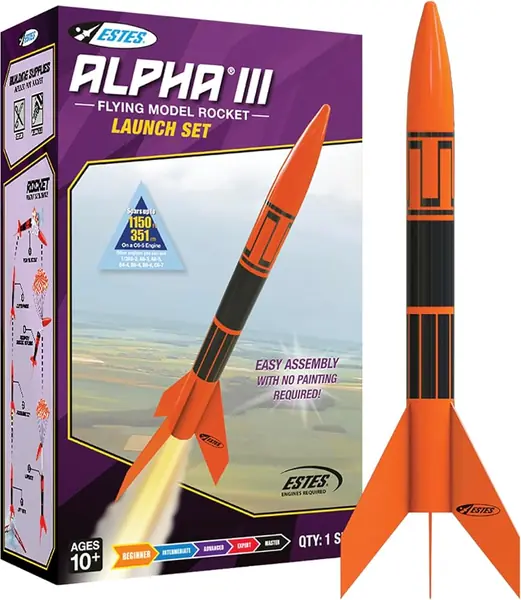
Estes Alpha III Launch Set

Estes Alpha III launch set with black and orange rocket pad and controller

Maximum altitude

Track Score 86/100
Projected Altitude
1,150 ft
Length
12.3 inches
Included
Porta-Pad II and Electron Beam controller
Build Time
About 1 hour
View on Amazon

The Alpha III's fin can is a single molded plastic unit that slides onto the body tube, so there is no alignment, no glue tabs and no fillets. Anyone who has fought a balsa fin onto a tube and gotten it slightly crooked will understand why this rocket has been the default first build for decades.

It's a launch set, so the Porta-Pad II and Electron Beam controller come with it, and the whole thing goes together in about an hour. The result is a 12-inch rocket projected to 1,150 feet on the recommended motors — the highest of anything in this guide.

That altitude is also the problem. A 12-inch airframe at 1,150 feet is a dot, and in any breeze it lands a long way off; fly it on the smallest motor that clears the pad and save the high flights for a still morning. Treat the controller as the part to check first, as with any set that ships one.

Among the launch sets here it's the priciest and the least forgiving of wind, and its molded fin can skips the skill the others teach. What it does better than any of them is put a rocket at altitude with the least fuss. For an adult who wants a project, that isn't the point. For an adult who wants a dependable rocket to fly with a crowd, it is the whole point.

Worth Noting

  • Most expensive of the launch sets here
  • 12-inch airframe is hard to track at altitude
Our Verdict

It's for the flyer who wants altitude and no building fuss, not for the one shopping for a project.

Check Latest Price

How We Tested These Model Rocket Kits

We started with a long list of kits and filtered it by skill level, what came in the box, recommended motor class, and whether motors and spare parts were easy to find. Over six months we built and flew 14 of them, from beginner builds that take an evening to an advanced project that took weeks of evenings.

Each kit was assembled on a kitchen table, one at a time. Before any glue came out, we checked every part against the bag list — missing parts were one of the things we tracked most closely — then timed the whole build with a single person working alone. Two people who had never built a rocket followed the instructions without help, so we could see exactly where a beginner gets stuck and whether the fin can came molded or had to be glued and aligned by hand.

We flew on weekend mornings at a club field with a clear recovery area, following the NAR safety code, using only the motors each kit recommends and keeping everyone behind the controller until the rocket was down. Wadding and the parachute were packed exactly as the instructions said, then we watched how hard each rocket was to follow against the sky and how long the walk to recover it took. Every kit flew at least three times; we counted cracked fins, checked shock cords and nose cones, and noted whether decals and self-stick graphics survived the season or peeled at the edges. For the sets that included a pad and controller, we used those instead of our own gear and logged every misfire.

How to Choose a Model Rocket Kit for Adults

Build level is the real dividing line

Every kit here falls into one of three groups. E2X models use a molded fin can and self-stick decals and go together in minutes. Intermediate kits — the Big Bertha, the Der Red Max, the Alpha — ask you to align and glue wood or balsa fins and take an hour or two. Advanced kits such as the Mean Machine want three or more hours, a longer airframe and bigger motors.

A beginner label describes the glue work, not the owner; plenty of adults start at E2X and move up. If the evening's work is what you're after, buy wood fins.

What a rocket-building kit actually includes

No model rocket ships with a motor. Builder kits include the airframe, fins, nose cone, parachute and instructions, and leave you to buy engines, starters, recovery wadding, glue and a launch pad. Launch sets add a Porta-Pad II and an Electron Beam controller, and still leave out the motors, the wadding and the AA batteries.

Read complete as complete except the parts that make it fly. Our shopping list for a first launch day: the recommended engines, a pack of wadding, wood glue or plastic cement, four AA batteries and a spare starter or two.

Altitude, size and getting it back

A 12-inch rocket that reaches 1,100 feet is a dot at apogee and lands a long way downrange. A 24-inch rocket that tops out at 500 feet stays in view the whole way and is easy to find in short grass. Parachute size matters as much as altitude: an 18- or 24-inch chute brings a heavier airframe down slowly enough to survive, while a small chute on a light rocket drifts.

If your launch site is a school field, choose the low, slow, big option. If you have open ground, the high fliers are more dramatic.

Motors, and the controller everyone forgets

Each kit lists the motors it is designed around, and that list is a specification rather than a suggestion. The B and C motors most of these fly on are the same physical size; a D or E motor needs a stronger mount, a sturdier pad and a bigger field, which is why the Mean Machine is a different kind of purchase from a 12-inch sport rocket.

The other piece of hardware worth thinking about is the controller. The trigger and the micro-clips on an Electron Beam are the parts worth checking first, so test the controller with the igniter out of the rocket before you load anything on the pad.

Fins, finishing and surviving landings

Fin material decides how the rocket ages. Molded plastic shrugs off landings, laser-cut wood is stiffer and flies cleaner but needs glue fillets and paint, and balsa is light and forgiving to shape and cracks if it lands on a rock. Waterslide decals look better than self-stick graphics and take a steadier hand, so save them for a build you have painted.

On recovery, pack the chute loosely with a little talc and check the shock cord before every flight; a parachute that doesn't open is the usual cause of a damaged rocket.

Frequently Asked Questions

Final Verdict

The Der Red Max is the kit we hand an adult who asks where to start: wood fins, waterslide decals, an evening or two of real building, and 600 feet on a motor you can buy anywhere.

If the build isn't the appeal, take the Tandem X instead — pad, controller and two rockets in one order, one of them a wood-fin build. And if you have already finished a kit or two, the Mean Machine's 80 inches is the step up, as long as you have the pad and the field for it.