Best LiPo Battery Chargers of 2026

A LiPo pack holds a startling amount of energy in a small brick, and the charger decides whether that energy goes in cleanly or cooks a cell. Anyone who has raced a few seasons has a puffed-pack story. A good charger takes out the guesswork: it shows what it is doing, stops when it should and brings a pack back to storage voltage instead of leaving it full for a month.

Balancing comes first, because a charger that never flags a drifting cell is how packs swell. After that, the good ones stood out for a menu that makes sense without the manual, two channels that don't throttle each other and a fan you can live with. Twelve chargers handled everything from a 2S shorty in a pit box to a six-cell drone pack over eight months, and the picks run from a one-channel starter to a dual-channel race box.

Our Top Picks

The Best LiPo Battery Chargers

1.

Gens Ace Imars D300 Best Overall
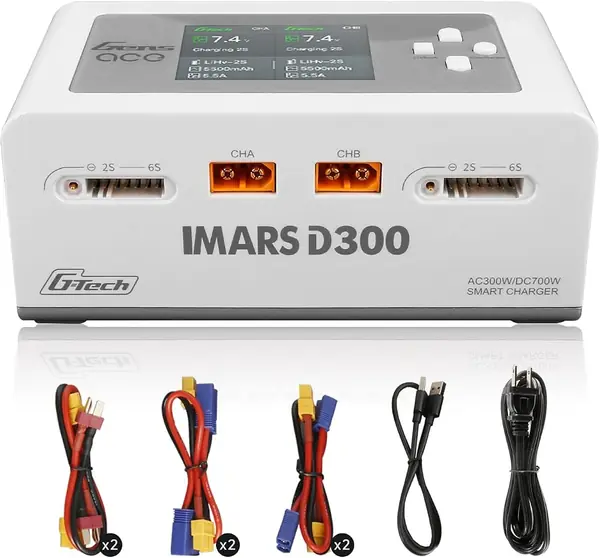
White Gens Ace Imars D300 dual-channel LiPo charger with screen and XT60 outputs

Two-car race weekends

Track Score 92/100
Cell Range
1S–6S lithium packs
Charge Current
Up to 16 A per channel
Max Output
300 W AC across two channels, 700 W DC
Included Adapters
XT60 to T-plug, EC5 and EC3 pairs
View on Amazon

Two channels at up to 16 amps each, 300 watts on AC and 1S through 6S coverage — the Imars D300 is more charger than a single basher needs, and it is the one we kept plugging in once two vehicles were running on the same afternoon. The same box takes a 2S short-course pack, a 4S buggy pack and the 6S brick in a boat without a settings hunt each time.

Programming is where it earns its keep. Gens Ace's G-Tech chip reads their smart packs and sets chemistry, cell count and current on its own, and non-smart packs fall back to the manual menu, so the charger is not locked to one brand's batteries. We also like that the outputs are XT60 with T-plug, EC5 and EC3 adapters in the box — the three plugs most cars and drones arrive with.

We paid close attention to the safety spec, because a LiPo charger sits next to a pack holding a lot of energy. The housing is UL94-V0 flame-retardant and the charger monitors the pack in real time rather than simply pushing current until a timer runs out. Those are not features you can evaluate on day one, but they are the reason this is the charger we leave out on the bench rather than tucked away in a drawer.

At home the AC side does everything; the DC input raises the ceiling to 700 watts for anyone running it off a larger supply at the track. It weighs 1.2 pounds, so it travels without argument. That kind of headroom is what keeps a charger useful after the first car turns into three.

Worth Noting

  • Adapter set skips Deans and XT90 packs
Our Verdict

Our pick for most hobbyists: two 16-amp channels, 1S–6S coverage, and smart or manual programming in a compact white case.

Check Latest Price
2.

HTRC Dual 10A LiPo Charger Best Value

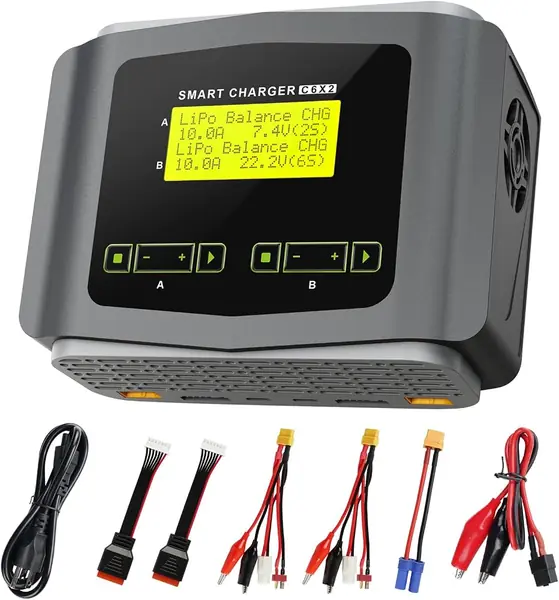
Gray HTRC dual-channel LiPo balance charger with large screen and two charging ports

Budget two-car setups

Track Score 91/100
Cell Range
1S–6S lithium, 1–15 cell NiMH
Charge Current
Up to 10 A per channel
Channels
2, simultaneous
Memory Presets
20 saved profiles
View on Amazon

For a good deal less than our top pick, the HTRC dual gives you the same shape of tool: two channels, 10 amps a side, and the full set of modes — charge, balance charge, discharge and storage — for 1S to 6S lithium packs of nearly every chemistry, plus NiMH, NiCd and lead-acid.

The screen is the part we ended up relying on. It is large enough that you are not squinting mid-charge, and the 20 saved profiles mean a 3S buggy pack and a 4S truck pack each come up with their own settings instead of a walk through the menu every session. That is the sort of small convenience that decides which charger lives on the bench.

Both channels are live at once, one pack each, which is what makes a two-car afternoon workable instead of a queue. Storage mode handles the packs you are not running this week, and it saves you remembering to come back and discharge them later.

Worth Noting

  • Ships with XT60 and EC5 connections only
Our Verdict

We point value shoppers here: two 10-amp channels, storage and discharge modes, and 20 memory presets for a lot less than our top pick.

Check Latest Price
3.

Traxxas EZ-Peak Plus Dual Charger Best for Traxxas Rigs

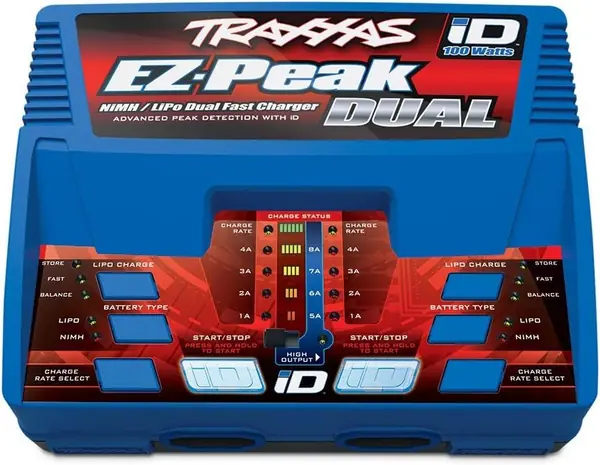
Blue and black Traxxas EZ-Peak Plus dual charger with iD ports and cooling fan

Traxxas iD owners

Track Score 90/100
Cell Range
2S–3S LiPo, 5–8 cell NiMH
Output
100 W on one channel, 50 W per side in dual
Weight
1.27 lb
Channels
2
View on Amazon

If the trucks in your garage all wear a Traxxas badge, battery day here is two plugs and one button. An iD pack tells the EZ-Peak what it is, so chemistry, cell count and current are set before you have the body back on the truck. That is the whole appeal, and it is not an exaggeration: we never had to open Advanced Mode for a Traxxas pack.

The 100 watts is split, not doubled. Run two packs and each channel gets 50 watts at 4 amps; switch to High-Output mode and a single pack takes the full 100 watts at 8 amps. That is the trade to understand before you buy — a pair of 5000 mAh packs charges at a relaxed pace, while one pack is quick.

It also charges a NiMH and a LiPo at the same time, which is handy when a Slash and a TRX-4 go out together. The charger weighs 1.27 pounds and the audible alerts are loud enough to hear from the next room, a detail that matters more than it sounds when the charging happens in a garage.

The failure to keep an eye on is a channel that quits, so charge on both sides in the first month while a swap is still easy. Otherwise this is a charger that gets out of the way, which is exactly what a Traxxas-only household wants from it.

Worth Noting

  • Manual mode required for non-Traxxas packs
  • Stops at 3S LiPo and 8-cell NiMH
Our Verdict

For a fleet of Traxxas trucks, this is the least fiddly charger we tested: iD packs program themselves, and two can charge at once.

Check Latest Price
4.

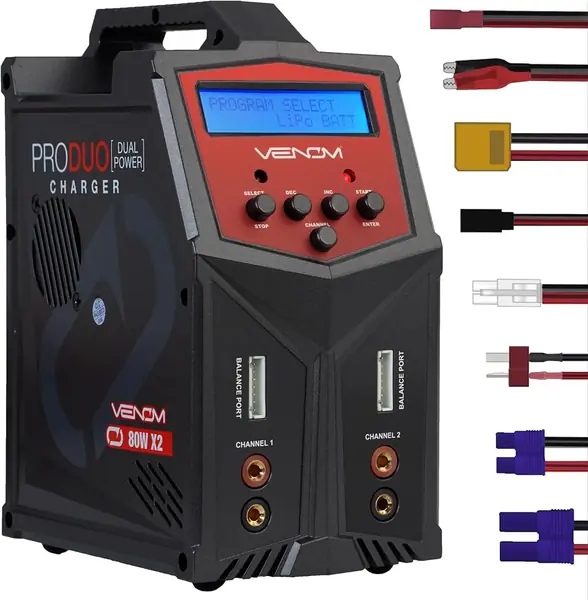
Venom Power Pro Duo Charger Best All-In-One Kit

Black and red Venom Power Pro Duo charger with backlit LCD and two charging ports

Mixed battery collections

Track Score 89/100
Output
80 W per channel
Charge Current
Up to 7 A
Weight
2 lb with handle
Included Leads
8 connector types
View on Amazon

Two independent 80-watt circuits, a handle molded into the top and eight charging leads in the box: the Pro Duo is built to be carried rather than bolted to a bench. At two pounds it rides to the track in the same bag as the cars.

The lead kit is the reason to pick it over the cheaper duals. Alligator clips for a lead-acid pack, Deans, EC3, EC5, JST and receiver plugs mean the charger arrives able to talk to almost anything you own, without a separate adapter order. Beyond the basics it carries balance charge, fast charge, discharge, cycling, storage and a battery meter.

What we appreciate most is the internal temperature monitoring, which cuts the charger off when the case reaches its set limit — the sort of safeguard that matters for a unit that lives in a hot car between rounds. Saved profiles for each pack spare you the menu walk every session, and that is the difference between a charger you tolerate and one you like.

Worth Noting

  • Only one lead per connector type included
  • Some units fail to power on
Our Verdict

The one we take to a club night: two 80-watt channels, eight leads in the box, and a handle for anyone charging several battery types.

Check Latest Price
5.

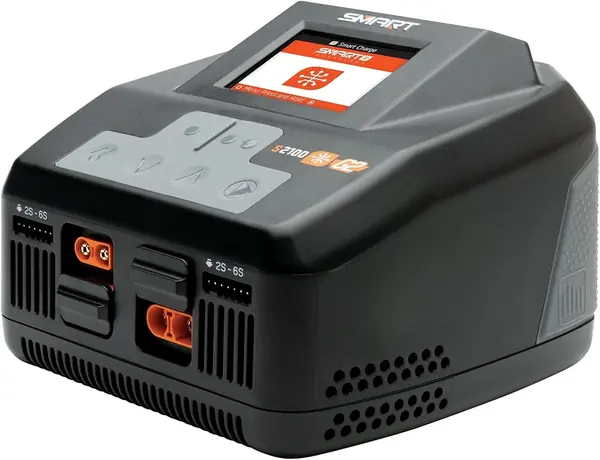
Spektrum S2100 G2 Smart Charger Best for Smart Batteries

Spektrum S2100 G2 dual smart charger with 2.4-inch display and IC3 and IC5 ports

Spektrum Smart packs

Track Score 88/100
Output
100 W per channel, 200 W single
Display
2.4 in screen with charge countdown
Certifications
RoHS, UL, CE, FCC
Smart Connection
Single IC3 or IC5 lead, no balance lead
View on Amazon

There is no balance lead to plug in, no chemistry to select and no rate to type. Connect a Smart G2 pack to the S2100 with a single IC3 or IC5 lead and the charger reads it, sets the current and starts, while the 2.4-inch screen counts down the remaining charge time. It is the least button work of anything here.

We like it best as the center of a Spektrum setup rather than on its own. Two channels at 100 watts each, or 200 watts into one pack when you are in a hurry, is plenty for 2S and 3S car packs and most boat packs, and the software keeps a record of each Smart battery so you can see how it has been treated. The certification list — RoHS, UL, CE and FCC — is longer than most here, and at 2.9 pounds it stays put on a bench instead of sliding around.

Outside the Smart ecosystem the charger still works, but you are back to adapter leads and manual settings. The failure to watch for is a dead port or a unit that will not power on, so run a pack through each channel in the first week.

Worth Noting

  • Smart auto-charging only works with Spektrum packs
  • IC3 and IC5 outputs only
Our Verdict

If your packs are Spektrum Smart G2, this is the cleanest charge going: one plug reads the pack, balances it, and counts down to full.

Check Latest Price
6.

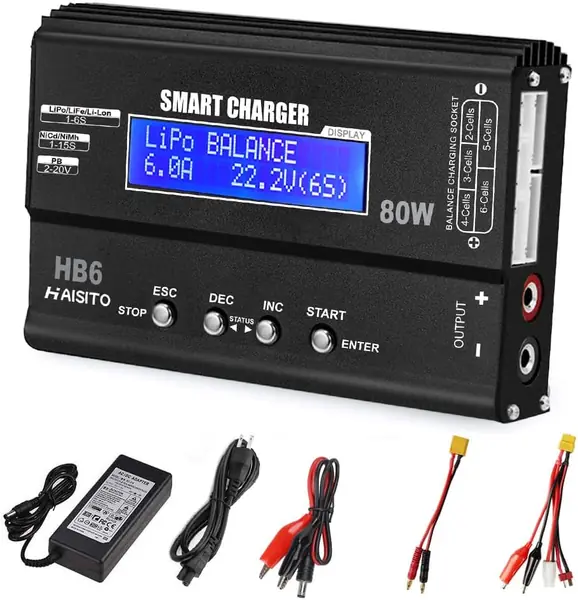
Haisito HB6 Balance Charger Best Budget

Black Haisito HB6 balance charger with LCD screen and multiple adapter plugs

First charger buyers

Track Score 87/100
Cell Range
1S–6S lithium, 1–15 cell NiMH/NiCd
Output
80 W, 6 A
Weight
1.5 lb
Connectors
XT60, Deans, JST, Futaba
View on Amazon

Eighty watts, 6 amps, one channel and a screen: that is the whole of the HB6. It covers 1S through 6S lithium plus NiMH and NiCd, and it puts charge, balance, fast charge and storage behind a readable LCD.

The box is generous at this end of the range — AC cable, AC/DC adapter, a DC cable for field use, a T-crocodile clip, and plugs for XT60, Deans, JST and Futaba servo connectors. The practical upshot is that it usually works with what is already in your battery drawer instead of sending you shopping for a lead.

Protection is the part we check first on a budget balance charger, and reverse polarity, short circuit and over-current are all listed here. The case is small enough for a toolbox, and nothing about the build reads as stripped down.

We recommend it as a first charger, and that is a real recommendation rather than a shrug. What earns it the spot is the combination of a balance tap, storage mode and a screen that tells you where things stand — the three things a new owner actually needs, and the three things cheap chargers usually skip.

Worth Noting

  • Single channel and 80 watts cap bigger packs
Our Verdict

The cheapest way into balance charging that we are comfortable recommending: 80 watts, a readable LCD, and a plug for almost every pack in the drawer.

Check Latest Price
7.

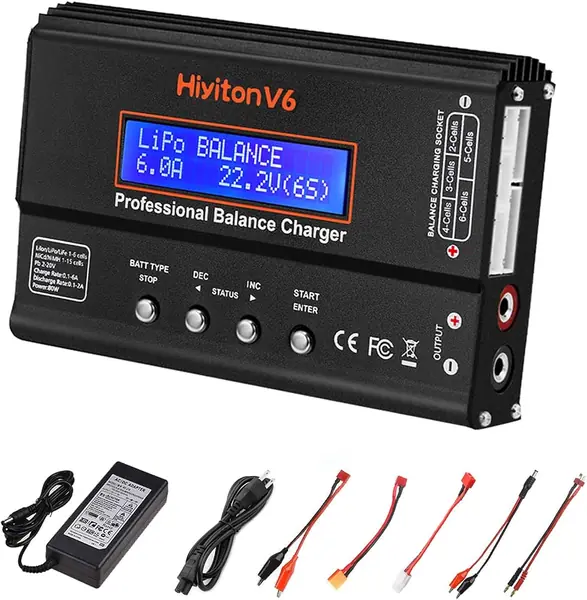
Hiyiton V6 LiPo Charger Best for Older Connector Types

Compact black Hiyiton V6 balance charger with LCD display and XT60 connector

Older connector types

Track Score 86/100
Cell Range
1S–6S lithium, NiMH and NiCd
Charge Current
Up to 6 A
Connectors
Tamiya, XT60, Deans, Futaba
Display
LCD
View on Amazon

Cyclic charge and discharge are the surprise here. Most budget chargers offer charge, balance and storage and stop; the V6 also stores and reloads settings for each pack and will run a full charge-discharge cycle to exercise a pack that has been sitting.

The rest is conventional in a good way: 1S to 6S lithium plus NiMH and NiCd, an LCD that shows the mode and cell information, and connectors for Tamiya, XT60, Deans and Futaba plugs. It is CE and FCC listed and small enough to sit on a shelf without claiming a workbench.

Our view is that the extra modes are worth more than the savings on a cheaper two-mode box, especially if you rotate four or five packs and want each one's settings waiting. It is also one of only two chargers here that takes a Tamiya plug without an adapter, which matters if your shelf predates XT60.

Worth Noting

  • No internal cooling fan so the adapter runs hot
Our Verdict

A compact 6-amp charger that adds cyclic and memory modes, useful if you rotate several packs between charges.

Check Latest Price
8.

HTRC 150W 10A LiPo Charger Best for Field Charging

Compact black HTRC 150-watt charger with LCD screen and T-plug output lead

Field charging

Track Score 85/100
Cell Range
1S–6S lithium, 1–15 cell NiMH/NiCd
Output
150 W, up to 10 A
Connectors
Seven types including TRX and Deans
Input
100–240 V AC or 11–18 V DC
View on Amazon

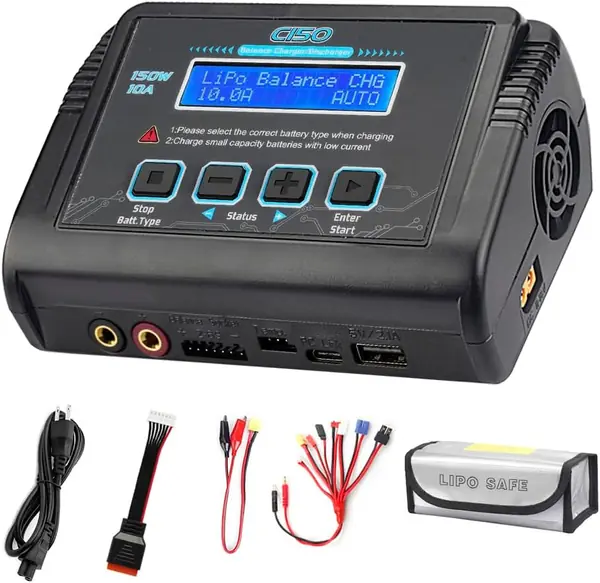
The input panel is why this one stays in the car. It runs from a wall outlet anywhere between 100 and 240 volts, or from an 11 to 18 volt DC source, so a bench at home and a car battery between heats both work.

At 150 watts and 10 amps it has more headroom than the budget single-port chargers. Worth knowing: the 10-amp figure only holds at lower cell counts — at 6S the 150-watt ceiling works out to roughly 7 amps, still quick for a 5000 mAh pack but short of the headline number.

The battery meter is the feature we leaned on most. It reports pack voltage, cell count, each cell's voltage and a capacity percentage before you connect anything, which settles the is-this-pack-charged question faster than digging out a voltmeter. Seven connector types, including standard and mini Tamiya, JST, T-plug, EC3, TRX and Deans, cover a mixed fleet.

Narrow brief, strong fit. If most of your charging happens away from an outlet, the AC/DC flexibility and the pre-charge cell readout make this the single-channel charger to beat in this group.

Worth Noting

  • Charges one battery at a time
  • Cooling fan is loud in a quiet room
Our Verdict

Our pick when the car battery at the track is your power source: 150 watts, 10 amps, and both AC and DC inputs on one compact box.

Check Latest Price

How We Tested LiPo Battery Chargers

We started with spec sheets and manuals for about 30 chargers and filtered on the things that actually change how a pack charges: chemistry and cell count, watts and amps per channel, one channel or two, and whether the unit plugs into the wall or needs a separate supply. Anything that couldn't handle more than one lithium chemistry or set a storage charge came off the list. That left 12 chargers, which we ran for eight months.

Testing happened where charging actually happens: a garage workbench, a trailer at race weekends, and a field where we ran chargers off a car battery between flights. We timed a 2S shorty from storage voltage to full, then read the per-cell voltages at the end to see how tightly the cells sat after a balance charge. We ran a large pack on both channels at once to watch for one side slowing down, used storage mode after every session, and checked case temperature by hand after back-to-back packs.

We handed each charger to someone who had never used it and timed how long it took to start a correct charge without opening the manual. Connector fit got checked against the packs and leads we own, including older plugs, to see which adapters were actually in the box. Fan noise was measured at arm's length during a full-rate charge, and we noted whether a charger with a smart-battery connection set itself up or still made us confirm every field. Over eight months the units lived in pit boxes and tool bags, and we logged the ones that developed loose ports, noisy fans, or menu quirks.

How to Choose a LiPo Battery Charger

Start with cell count and chemistry

Nearly every car, boat and drone pack on a hobby shelf is 1S to 6S lithium, so a charger that stops at 3S will strand anything bigger the moment you move up. Check chemistry as carefully as cell count: LiHV packs need a LiHV setting, and if you still run a NiMH truck or a lead-acid field battery, you want those modes in the same box.

Write your packs down — cell count, chemistry, connector — before you compare anything. The Gens Ace Imars D300 and the HTRC dual both cover 1S to 6S lithium plus NiMH, which is why they suit a mixed collection rather than a single vehicle.

Watts decide how fast a big pack charges

A charge rate of about 1C — 5 amps into a 5000 mAh pack — is the sensible ceiling for most packs and roughly an hour to full. Wattage is what limits you: 80 watts works out to a little over 3 amps at 22.2 volts, so a 6S pack charges at maybe half the rate the amp rating suggests, while the same charger is perfectly matched to a 2S pack.

When a maker quotes power, check whether that figure is per channel or for the whole unit. A charger advertising 100 watts that splits 50 watts a side in dual mode is not the same tool as one with 100 watts on each port.

One channel or two

Two channels mean two packs charging at once and the option of different chemistries side by side; a single port is smaller, cheaper and fine for one car. If you routinely come home with four packs, buy the channel count you actually need rather than the one that matches tonight's session.

Watch how the watts divide across those channels. The Traxxas EZ-Peak Dual delivers its full 100 watts to one pack but 50 watts per side when both are connected, and that pattern is common across dual chargers in this group.

Wall power or a DC supply

Older hobby chargers needed a separate 12-volt power supply; most of the chargers here have the AC supply built in, which is one less box on the bench and one less cable to lose. A DC input between 11 and 18 volts is the feature to look for if you charge at a track from a car battery — the HTRC 150-watt single-port is the obvious example in this group.

Do not connect both inputs at once. That warning appears on more than one of these chargers, and it is the kind of instruction that reads as boilerplate right up until it matters.

Connectors and balance taps

Every LiPo needs its balance tap connected during a balance charge, and that tap has to match the charger's board or lead. XT60 is the default output on most of these chargers, with adapters for T-plugs, EC5, EC3, Deans or Tamiya depending on the model.

Check that list against your packs before ordering rather than after. A pack whose plug you cannot connect is a pack you cannot charge, and hunting for an adapter is the fastest way to leave a new balance charger sitting in its box for a week.

Frequently Asked Questions

Final Verdict

The Gens Ace Imars D300 is the charger we recommend to most people: two 16-amp channels, 1S to 6S coverage, and the choice of letting a smart pack program itself or setting everything by hand. It is the one that still has headroom when your fleet grows past a single truck.

If the budget is tighter, the HTRC dual does the same two-channel job at 10 amps a side for appreciably less, and Traxxas owners are better served by the iD handshake of the EZ-Peak Dual. Different packs, different answers — but the Imars is the default.