Best LiPo Battery Checkers of 2026

LiPo packs rarely fail politely. One cell sags harder than the rest, the model goes soft on the sticks, and by the time it's back you're shopping for a battery. A checker is the cheapest insurance in the hobby, reading each cell and showing how much charge is left. A pack can look fine on total voltage with one cell nearly flat, which is exactly what a per-cell reading catches.

Cheap meters aren't all honest: a tenth of a volt of drift, an alarm you can't hear over a propeller or a plug that barely grips the balance lead. We checked 16 against a reference meter on the bench, in the pit lane and at the flight line, and all seven picks read individual cells and held their numbers. They differ in where they belong, flight box or bench, and what you pay for balancing and discharging.

Our Top Picks

The Best LiPo Battery Checkers

1.

CAMWAY 1–8S LiPo Voltage Tester Best Overall
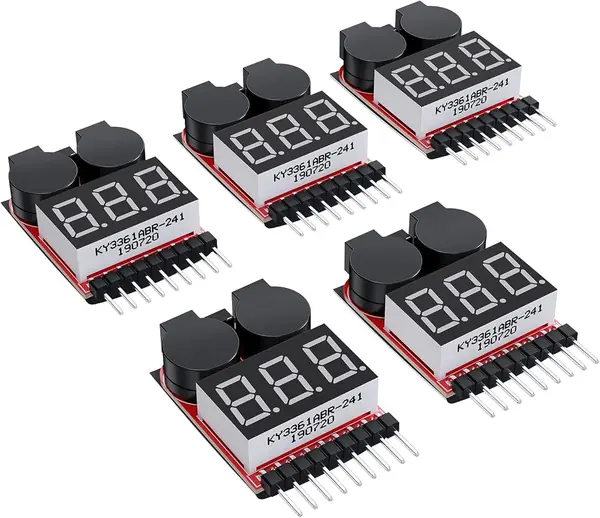
CAMWAY five-pack LiPo voltage tester with black cases and LED displays

Field pack checks

Track Score 94/100
Display
Cell, total, lowest cell, capacity
Battery Types
1–8S LiPo, Li-ion, LiMn, Li-Fe
Pack Count
5 testers
Alarm Mode
2–8S, 3.3V default
View on Amazon

Five tiny alarms in one bag is the reason this CAMWAY set became our default: one can live in the flight box, one in the car, and one on the bench without any planning. Each unit reads a 1–8S LiPo or Li-ion pack through the balance lead and cycles through cell voltage, total voltage, the lowest cell, and a remaining-capacity estimate. We value the alarm most. Set the threshold and the buzzer makes a low pack hard to ignore, which is exactly what a field checker needs to do.

The display is not fancy, but it is legible in daylight and easy to cycle with the single button on top. There is no separate battery to forget: the pack supplies the power, so the checker comes alive as soon as it is plugged in. We also like that the same unit handles LiFe and LiMn packs, which makes it useful when the drawer contains more than one battery chemistry.

What it does not do is diagnose a pack beyond voltage and a capacity estimate; it will not balance, discharge, or test a receiver. That is fine by us because the job here is a quick, loud second opinion before a run. The five-pack is the clincher: one stays with the transmitter, one in the pit box, and the rest are there when a flying buddy needs a check.

Worth Noting

  • Alarm keeps sounding until unplugged
Our Verdict

For most RC flyers and drivers, we recommend this five-pack first: it reads 1–8S packs, gives a loud adjustable alarm, and leaves a spare checker in every bag.

Check Latest Price
2.

QWORK RC Battery Capacity Checker Best for Capacity Readings

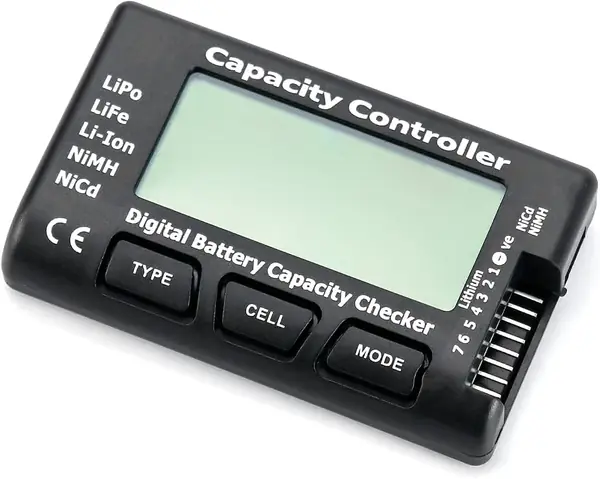
QWORK black RC battery capacity checker with digital screen and balance connector

Capacity percentage

Track Score 93/100
Display
Cell, total, max/min, difference, capacity %
Supported Packs
2–7S LiPo, Li-ion, LiFe; 4–7 cell NiMH/NiCd
Power
No power source
Connector
2–7S balance port only
View on Amazon

QWORK's checker makes its case with numbers rather than noise: total voltage, each cell's voltage, the highest and lowest cells, the gap between them, and a remaining-capacity estimate. The screen cycles through those values in a sensible order, and the max/min gap is the one we look at first when a pack has been sitting or comes back from a run. A pack can show a healthy total and still have one cell dragging the rest down; this is the display that makes that visible.

We like it best as a bench checker. It is small enough to keep in a drawer, needs no separate battery, and gives a fuller picture than a plain voltage alarm. The percentage readout is an estimate, not a fuel gauge, but it is useful for sorting packs before a charge session.

For 2–7S LiPo, Li-ion, or LiFe packs and 4–7 cell NiMH, it covers the common workshop jobs without asking you to learn a menu system. The cell-spread screen answers the question a voltage total cannot, and that is why it stays within reach on our bench.

Worth Noting

  • Needs a balance connector to read
  • Does not test single-cell packs
Our Verdict

For a remaining-capacity percentage and cell spread rather than an alarm, it is the cleanest bench checker here for 2–7S packs.

Check Latest Price
3.

ISDT BG-8S Battery Checker Best for Advanced Diagnostics

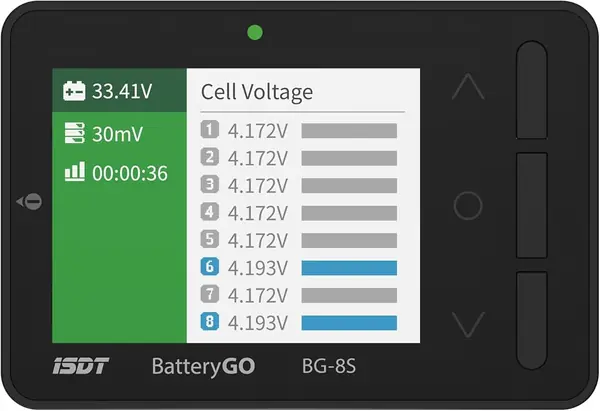
ISDT BG-8S battery checker with LCD display and XT60/XT60i ports

Advanced diagnostics

Track Score 92/100
Battery Types
LiHv, LiPo, Li-ion, LiFe, NiMH/Cd
Ports
XT60, XT60i, balance input
Balance Range
2–8S
Extra Functions
Balancing, USB power bank, receiver test
View on Amazon

The BG-8S starts with ports you do not expect on a checker: XT60, XT60i, and a 2–8S balance input. With a compatible smart battery, the checker pulls pack settings and usage history rather than just cell voltages. The LCD is the other clue that this is a different class of tool: it shows each cell and the pack data in a readable layout instead of cycling a single number.

We appreciate the extras that earn their space at the field. The BG-8S can balance cells, test receiver signal and protocol, and act as a USB power bank from a connected pack. None of those functions replaces a charger, but they turn a checker into a small diagnostic station for an afternoon of flying.

We think it earns its premium for the pilot with smart packs or a bench full of receivers; for a simple pre-flight voltage check, it is more tool than most people need. The USB output is the sleeper: a pack that still has charge can top up a phone or a receiver battery between flights. That practicality is why we keep it in the flight case rather than the drawer.

Worth Noting

  • Balancing results can be inconsistent
  • Smart-battery data requires an XT60i plug
Our Verdict

We think the BG-8S earns its premium when you need XT60i data, balancing, and receiver testing in one field tool rather than a basic voltage readout.

Check Latest Price
4.

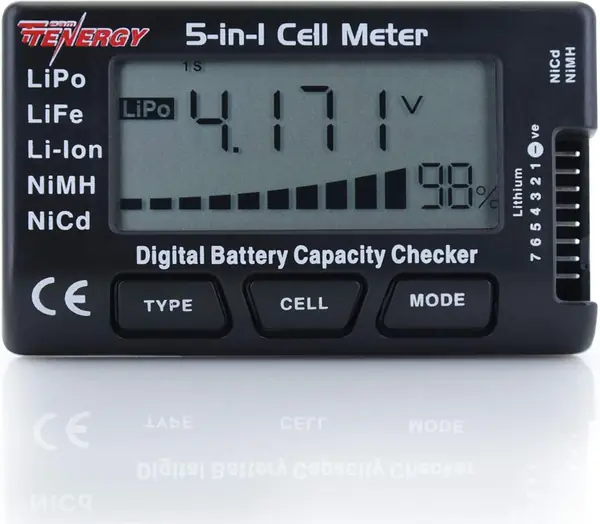
Tenergy 5-in-1 Cell Meter Best Multi-Function Meter

Tenergy 5-in-1 black battery meter with balance and servo-test connections

Bench servo work

Track Score 91/100
Supported Packs
2–7S LiPo, LiFePO4, Li-ion; 4–7 cell NiCd/NiMH
Functions
Voltage, balance, discharge, resistance, servo test
Connectors
Balance; Hitech/Futaba
Discharge Rate
180mA
View on Amazon

The servo-centering function is why the Tenergy 5-in-1 stays on our bench rather than in a drawer. Plug a servo into the meter and you can center it without powering up a receiver, which is the kind of small convenience that saves a whole setup session. The same box reads LiPo, LiFePO4, and Li-ion packs, plus NiCd and NiMH receiver and transmitter packs through Hitech or Futaba connectors.

The display cycles through total voltage, individual cells, and the spread between them, and the internal-resistance check gives a second look at a pack that is getting tired. For storage days, the discharge function bleeds a lithium pack down to an adjustable threshold at 180mA. That is slow work, but it is useful when you want to bring a few packs down without tying up a charger.

We also like the NiMH/NiCd side. A receiver pack with a Hitech or Futaba plug can be checked without a balance lead, and the servo test makes it easy to sort a handful of servos before a build. The controls take a little learning, but the functions are grouped logically enough that the manual does not stay out for long.

We recommend the Tenergy to the pilot who wants one bench battery meter for voltage, balancing, discharge, resistance, and servo work; it is far more tool than a pocket alarm. If your whole routine is a pre-flight cell check, the extra functions are weight without payoff. The discharge feature is the one we use most, because it turns storage maintenance into a background task instead of a charger session.

Worth Noting

  • Readings can be inconsistent
  • Some units fail after light use
Our Verdict

Our bench pick for servo work and storage: it checks, balances, discharges, measures resistance, and centers servos in one meter, with more capability than a pocket checker.

Check Latest Price
5.

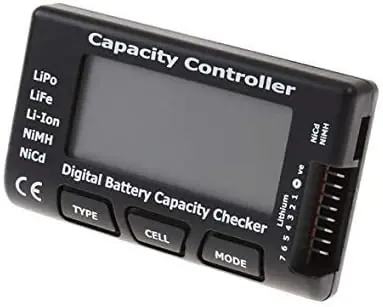
FLY RC Cellmeter 7 Best for Simple Bench Checks

FLY RC Cellmeter 7 black digital battery checker with compact display

Simple bench checks

Track Score 90/100
Display
Cell, total, min/max, voltage gap, capacity %
Supported Packs
2–7S lithium; 4–7 cell NiMH/NiCd
Power
Battery powered
Dimensions
3.35 x 1.97 x 0.67 in
View on Amazon

The Cellmeter 7 is a display-first checker with a plain, readable screen. Plug a lithium pack or a 4–7 cell NiMH pack into the balance lead and the screen cycles through cell voltage, total voltage, the highest and lowest cells, the voltage gap, and a remaining-capacity estimate. It is built for sorting packs at the bench, and the display gives you the numbers without a menu tree.

The control layout is simple: type selects the chemistry, cell steps through the pack, and mode moves between the readouts. After a minute or two it becomes muscle memory. The voltage-gap screen is the one to watch, because a pack with one lazy cell looks fine on total voltage but obvious once the spread is on screen.

The Cellmeter 7 gives a quick bench read without a menu tree or a charging session. It is compact enough to live in a tool tray, and the display is legible without squinting. The lack of an alarm is the dividing line: if you need a warning while the model is running, this is the wrong tool; for pre-flight checks, the clear cell-gap view is the reason to keep it.

Worth Noting

  • Lithium support stops at 7S
Our Verdict

We like the Cellmeter 7 as a straightforward bench checker: it shows cell spread and a capacity estimate clearly, with simple controls we can learn in a minute.

Check Latest Price
6.

AOICRIE LiPo Voltage Checker Alarm (2-Pack) Best for Budget Field Alarms

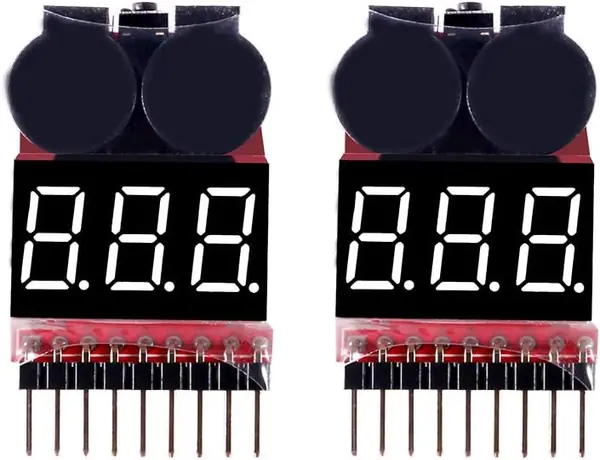
AOICRIE two-pack LiPo voltage checker alarms with red LED indicators

Budget field alarms

Track Score 89/100
Display
Cell, total, lowest cell, capacity
Battery Types
1–8S LiPo, LiFe, LiMn, Li-ion
Pack Count
2 testers
Alarm Range
OFF–2.5–3.8V
View on Amazon

Two small plug-in alarms are the whole idea here. Each AOICRIE unit reads a 1–8S LiPo, LiFe, LiMn, or Li-ion pack through the balance lead and cycles cell voltage, total voltage, the lowest cell, and a remaining-capacity estimate. The alarm threshold is set by pressing the button on top, and the buzzer is loud enough to carry across a field.

We keep this pair for simple low-voltage watch: plug in, set the threshold, and let the alarm do the work. The two-pack is more useful than a single unit because one can live in the transmitter case and one in the car, each set for a different pack. The display is basic, but it shows the cell values that matter before a run.

One unit can stay set for a small park flyer and the other for a faster model, which saves reprogramming at the field. The red LED flashes along with the buzzer, so the warning is visible as well as audible when the model is close. That pairing is the reason to choose this set over a single alarm.

Our Verdict

We keep this pair for simple low-voltage watch: plug in, set the threshold, and let the loud alarm do the work.

Check Latest Price
7.

HOBBYFLY 3-in-1 Battery Balancer Best for Storage Discharging

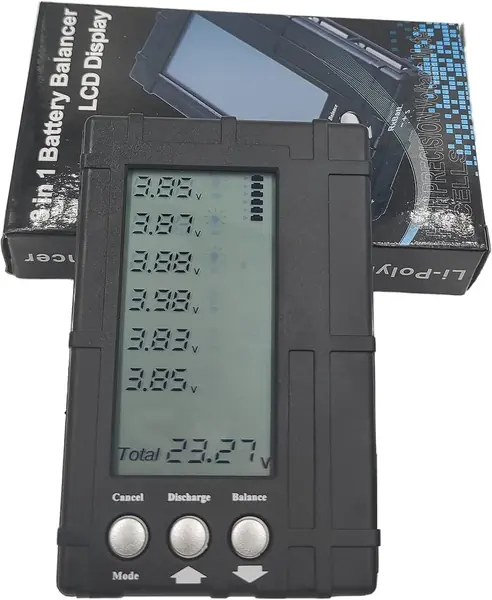
HOBBYFLY black three-in-one LiPo balancer and voltage checker

Storage discharging

Track Score 85/100
Functions
Balance, discharge, voltage check
Dimensions
4.21 x 2.6 x 0.86 in
Balance Current
400mA per cell max
Compatible Cells
2–6S LiPo/LiFe
View on Amazon

The 400mA-per-cell balance and discharge current is what makes the HOBBYFLY more than another voltage reader. It handles LiPo and LiFe packs, shows instant cell voltages, and indicates an abnormal cell while it works. We recommend it as a storage and balancing tool first; the voltage checker is the bonus, not the main event.

The three-button layout is easy to work one-handed, and the back is vented to move heat away during balancing or discharge. That matters because this is a function that can run for a while, and a small tool that gets warm is easier to trust when the case is designed for it. It also reads a receiver pack through its JST connector, which is handy when you are sorting a model's electronics.

We keep it for the jobs a pocket alarm cannot do: bringing a pack down after a session and nudging cells back into line. It is not the checker we grab for a quick pre-flight number, because the menu and the balancing setup take more attention than a plug-in display. The 400mA rate is the reason it earns bench space, and the voltage readout is a useful extra while the pack is connected.

Worth Noting

  • Only fits 2–6S LiPo and LiFe packs
Our Verdict

We recommend this small balancer for storage chores: it discharges and balances 2–6S packs and still gives an instant cell-voltage read.

Check Latest Price

How We Tested These Battery Checkers

We started by gathering every checker we could find, then narrowed the pool to meters that connect through a real balance plug rather than a pair of clips. That left models covering the packs our test pilots actually own, from single-cell receiver packs to full flight packs, along with the nickel chemistries still living in older radios — spread across a wide range of prices. We bought 16 and tested them for four months.

Most of that time was spent where these get used: on a tailgate before a flight, in the pit lane between heats, and on the workbench with packs coming off the charger. For each meter we recorded per-cell voltage, total voltage, the lowest cell, and the spread between cells against a reference meter, then repeated the same pack three times to see whether the numbers held or wandered. We set alarms to the reserve we actually fly to, listened for them with a propeller spinning nearby and from across the pit area, and checked how much adjustment each alarm offered. Every alarm was treated as a call to land, never as permission to keep flying.

Balance plugs got their own scrutiny. We plugged and unplugged each meter dozens of times, tried it on both a snug lead and a worn one, and noted which housings buried the pins or demanded two hands. Capacity percentages went up against what a charger put back into the pack, and each meter rode in a flight box, sat in a hot car once, and had to read the same afterward.

For the meters that balance, discharge, or run a servo, we used those functions the way they'd be used at home — short discharge runs with a cooldown in between and someone at the bench the entire time, because these are not set-and-forget devices. Finally we weighed each one and worked out the cost per unit, since several ship as pairs. The meters that kept their readings honest are the ones that made this list.

How to Choose a LiPo Battery Checker

Field Alarm or Bench Meter?

The first decision is whether you want a device that stays on the model and warns you while you run, or one that gives a fuller reading on the bench. A field alarm plugs into the balance lead, watches each cell, and sounds when voltage falls below the threshold; it is the right choice for a pilot who might not see a screen in flight. A bench meter is for pre-flight and storage checks, with per-cell values, total voltage, and the spread between high and low cells. Use an alarm when a pack is going into a model and a meter when sorting packs at home. Some tools, like the CAMWAY set, do both jobs in one simple unit.

Match the Plug and Cell Count

Most RC LiPo checkers read through the balance lead, so the plug and pin count come before screen features. Standard JST-XH balance plugs are common, but a tight housing can still make a plug hard to seat; check the opening before you force anything. A 1–8S checker covers almost every RC pack, while 2–7S models leave out 8S and single-cell packs. If you use smart batteries, an XT60i input can add data that a balance-only checker cannot see. Bring your pack's connector to the decision, not just its cell count.

Read the Cells, Not Just the Total

A healthy total voltage can hide one weak cell. We want per-cell voltage, the lowest cell, and the gap between the highest and lowest cells, because that spread tells you whether a pack is out of balance or simply discharged. A remaining-capacity percentage is a useful convenience, but it is an estimate built from voltage, not a fuel gauge; use it to sort packs, then confirm with cell values before charging or flying. The QWORK's max/min display is a good example of a bench readout that earns its space by showing the spread, not just a single number.

Set the Alarm for Reserve, Not Target

An alarm is only useful if it sounds before the pack is damaged. Check the adjustment range and set the threshold high enough to leave time to land or pull into the pits; a warning at the last possible moment is not a reserve. Loud is good at the field and annoying on the bench, so decide where the checker will live. If you want one device for both settings, check that the alarm can be silenced or turned off. We treat every alarm as a warning, not as a cutoff that makes over-discharge safe.

Pay for Extras You Will Actually Use

Balancing, discharging, internal-resistance checks, servo testing, and smart-battery data are the reasons to step up from a basic checker. They are real bench tools: a discharger brings packs down to storage voltage, a servo tester saves powering up a receiver, and internal resistance gives a second signal about pack health. They also add size, cost, and operating limits, so we do not pay for them unless the work is routine. For pure field checks, a simple alarm does the job; for a bench that handles several packs and receivers, the ISDT BG-8S or Tenergy 5-in-1 earns its space.

Frequently Asked Questions

Final Verdict

For most RC pilots, the CAMWAY five-pack is the checker we recommend first. It covers 1–8S packs, gives you a loud adjustable alarm, and puts a spare unit in every flight box. If your routine is bench sorting rather than in-flight warning, the QWORK's percentage and cell-spread readout is the better fit. For smart batteries and receiver testing, step up to the ISDT BG-8S; that is the one that turns a voltage check into a full diagnostic session.