Best Paints for Model Cars of 2026

A model car body is an unforgiving surface. There's no grain to hide a run, a dry patch or the bald spot where tape lifted the paint, and the wrong solvent can craze a body into a web of cracks. A paint worth keeping grips styrene, ABS or polycarbonate, behaves in the tool you use, airbrush, brush or can, and dries to a finish that reads right.

Airbrush-ready and brushable are different animals. Paint pre-thinned for a nozzle runs watery off a brush, and brush-thick paint clogs a fine tip. Over three months on body shells, chassis rails, spoilers and window trim with 14 sets, the seven picks stuck to the plastic, dried to something you can tape and handle, and had paint left for the last coat.

Our Top Picks

The Best Paints for Model Cars

1.

Vallejo Model Air Basic Colors Best Overall
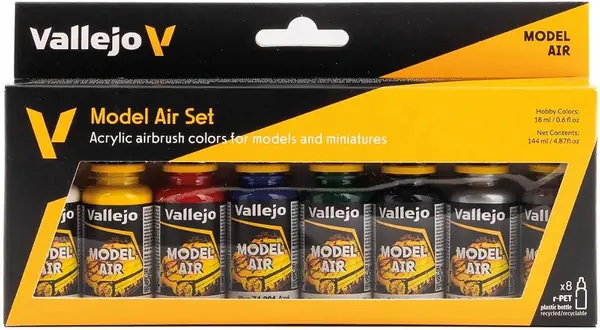
Vallejo Model Air Basic Colors, eight 17 ml dropper bottles of water-based acrylic model paint

Airbrushing body shells

Track Score 96/100
Paint Type
Water-based acrylic
Set Contents
8 bottles, 17 ml (0.57 fl oz) each
Listed Dry Time
1.5 hours
Application
Airbrush-ready, pre-thinned
View on Amazon

An airbrush is unforgiving about thickness. Too thick and it spatters, too thin and it runs off a curve before it covers. The eight 17 ml bottles in this set arrive already thinned for spraying, so the first step is decanting into a cup and checking the pattern, not measuring and straining. On a body shell the color goes down in even passes that follow the panel lines instead of filling them.

We keep reaching for this set because the eight shades do more work than the count suggests. White, medium yellow, red, blue, olive green and black give you mixing stock for most solid factory colors, and the silver and gold cover bumpers, grilles and badges without a second order. It's water-based and labeled non-toxic and non-flammable, which is why it's the set we're comfortable spraying in a spare room with a window open, and a brush rinses clean in water if you get to it before the paint sets.

Pre-thinned paint also flows fast off a brush, so load lightly for interiors and fine detail work. The listed dry time of 1.5 hours is the slowest in this group, and it's the reason a full body is a weekend job rather than an afternoon one.

Worth Noting

  • Only eight shades, so extra colors are likely
  • 17 ml bottles are modest for a full body
Our Verdict

We recommend this as the default model-car paint: eight airbrush-ready acrylics that spray smooth, clean up with water, and stay safe at the kitchen table.

Check Latest Price
2.

Testors Enamel Paint Set 9146XT Best Enamel for a Hard Gloss

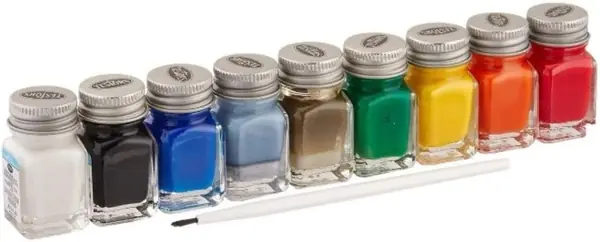
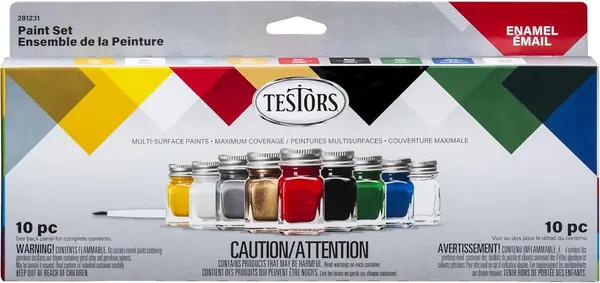
Testors enamel paint set with eight quarter-ounce glass bottles, thinner, brush and tray

Gloss body shells

Track Score 95/100
Paint Type
Solvent-based enamel
Set Contents
8 bottles, thinner, brush and tray
Bottle Size
1/4 fl oz each
Listed Dry Time
About 40 minutes
View on Amazon

Everything for a first enamel job comes in the box: eight 1/4-ounce bottles of gloss color, a bottle of thinner, a brush and a tray. The thinner is the piece that earns the kit. Enamel straight from the bottle is too heavy for an airbrush, and a few drops of the included solvent gets it spraying.

Enamel is the old-school answer to a model car body, and it still works. It flows out flat, dries to a hard gloss that shrugs off handling, and levels over small sanding scratches in a way a watery acrylic won't. The listed dry time is about 40 minutes, quick enough for a second coat the same evening and slow enough to keep a wet edge while you work a panel.

Solvent paint behaves like solvent paint. The smell lingers, brushes clean up in thinner rather than the sink, and the work wants an open garage or a booth. Age is the other thing to watch: a bottle that has sat for years can arrive thick or slow to set, so check that the caps are tight, stir a drop, and test it on scrap plastic before you commit a body to it.

We reach for this kit when the finish we want is a deep, hard gloss and we can ventilate the space to get it. On a body that gets picked up and set down and dusted, that film is worth the fuss. For interiors, chassis and engine bays, the water-based acrylics here are easier to live with and just as good.

Worth Noting

  • Quarter-ounce bottles run out on a full body
Our Verdict

If you want a hard, deep gloss on a body shell and don't mind solvent cleanup, this is the enamel kit we point people to.

Check Latest Price
3.

Tamiya Spray Lacquer TS-29 Semi-Gloss Black Best Spray for Chassis and Trim

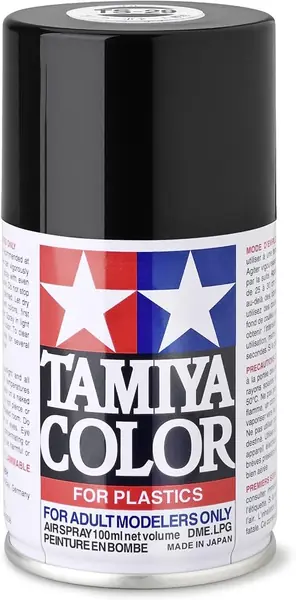
Tamiya TS-29 semi-gloss black spray lacquer in a 100 ml aerosol can

Chassis and trim

Track Score 94/100
Paint Type
Synthetic lacquer spray
Finish
Semi-gloss
Can Size
100 ml (3.3 fl oz)
Listed Surfaces
ABS, styrene and metal parts
View on Amazon

No color works harder on a model car than semi-gloss black. Chassis, interior tub, window trim, grille, exhaust, the shadow line under a rocker panel — it all wants the same sheen. A can belongs on the shelf before any other paint, and this one sprays fine, levels out, and is dry to the touch in about 15 minutes.

The can holds 100 ml and is listed for ABS and styrene as well as metal parts, so it covers engine pieces and photo-etched trim as readily as it does plastic. The sheen lands between gloss and flat: enough shine to read as paint, not so much that a chassis looks like a toy. Lacquer bites into plastic rather than sitting on top of it, so keep each pass light and let it flash. A heavy wet coat is where styrene gets into trouble.

A hundred milliliters covers a lot of small parts and one body shell in light coats, and it's the lowest-priced item in this group. That makes it the cheap way to find out whether a rattle can suits your hands before you commit to a whole palette.

Worth Noting

  • One color per can, so it adds to a set
  • Aerosol spraying needs outdoor or booth ventilation
Our Verdict

Buy a can before anything else: semi-gloss black handles chassis, interior and trim, and this one sprays and flashes fast.

Check Latest Price
4.

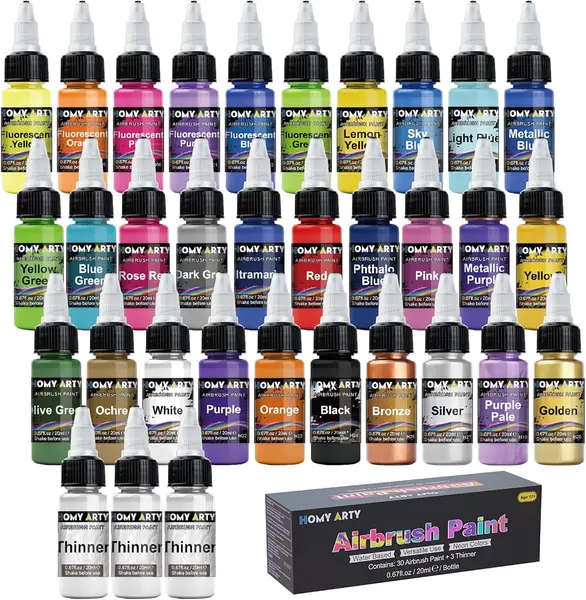
HOMY ARTY Airbrush Paint Set, 30 Colors Best Ready-To-Spray Color Range

HOMY ARTY airbrush paint set with 33 bottles of water-based acrylic and three thinners

Big airbrush palettes

Track Score 92/100
Paint Type
Water-based acrylic
Set Contents
33 bottles: 30 colors plus 3 thinners
Formula
Pre-thinned, ready to spray
Cleanup
Water and soap
View on Amazon

Thirty colors and three bottles of thinner arrive ready to pour: nineteen ordinary shades, six fluorescents and five metallics, all pre-thinned at a spraying ratio. There's no measuring and no straining before the first cup.

The formula is water-based acrylic, so a session ends with soap, water and a paper towel instead of solvent and a headache. The fluorescents and metallics are where the set has fun. A hot orange stripe or a metallic silver bumper is a bottle away rather than a special order, and those are the shades a small palette usually forces you to mix badly.

This is the set we hand to someone who has just bought a compressor and wants options immediately. Thirty shades and three thinners at the low end of this group buys a lot of experimenting, and the extra thinner means a weak compressor doesn't stall the first session. What it won't give you is a shade matched to a specific factory color. The colors are sold by category rather than by name, so you're choosing from what arrives in the box.

Worth Noting

  • Fluorescent shades go unused on most builds
  • One bottle per color, so favorites run out first
Our Verdict

For an airbrush setup that needs a color for every livery, we like thirty pre-thinned acrylics and three thinners with no mixing before you spray.

Check Latest Price
5.

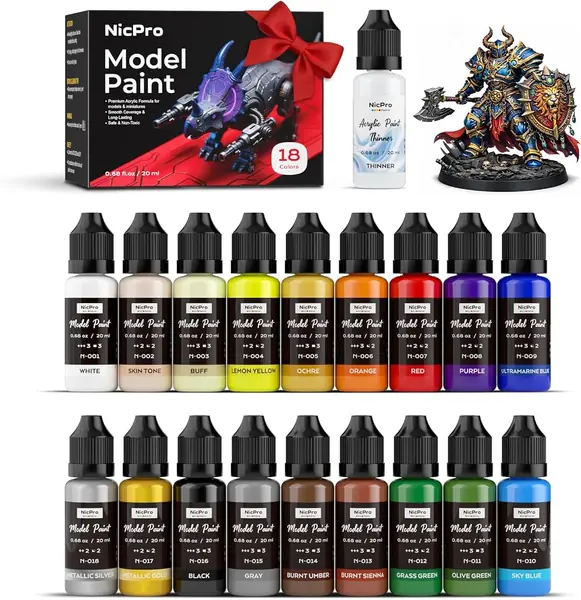
Nicpro 18 Colors Model Paint Set Best Brush-First Starter Set

Nicpro 18-color acrylic model paint set with 20 ml dropper bottles and a thinner

Brush-first beginners

Track Score 91/100
Paint Type
Water-based acrylic
Set Contents
18 colors plus 1 thinner
Bottle Size
20 ml (0.68 fl oz) each
Finish
Matte
View on Amazon

Eighteen colors and a bottle of thinner, in 20 ml dropper bottles, with a printed instruction sheet and a color wheel tucked into the box. The paint is pre-thinned for brushing, so you can open a bottle and start an interior or a set of wheels without buying anything else first.

We like the color wheel more than we expected to. Picking a body color and a contrasting interior off a printed wheel is quicker than holding bottles up to a screen, and the sheet gives a beginner somewhere to start with layering and shading instead of guessing. The paint really is ready for a brush, the dropper tips let you put out two drops rather than a puddle, and the matte surface is a good base for a weathering wash.

Twenty milliliters per bottle is generous for brush work — a set like this lasts through several cars if you're not airbrushing full bodies. The included thinner is what stretches it into fine detail, panel lines and a thin wash, so the box covers more technique than the color count implies.

Worth Noting

  • Matte finish needs a clear coat for gloss bodies
Our Verdict

We steer first-time modelers here: eighteen brush-ready acrylics plus the color wheel and thinner that make a first body job less of a guess.

Check Latest Price
6.

Testors Acrylic Finishing Paint Set 9196T Best for Younger Modelers

Testors acrylic finishing paint set with nine quarter-ounce gloss bottles and a paintbrush

Younger modelers

Track Score 90/100
Paint Type
Water-based acrylic
Set Contents
9 bottles plus a paintbrush
Bottle Size
1/4 fl oz each
Finish
Gloss
View on Amazon

Nine gloss acrylics in 1/4-ounce bottles, plus a brush: water-based, low odor, non-toxic and washable out of a brush with soap and water. This is the set we put in front of a kid or a first-timer who wants to paint a model car this afternoon without a respirator, a booth or a steep learning curve.

The gloss colors suit small parts — bumpers, roll bars, engine pieces, a two-tone roof — and the gold and silver in the box are why it covers trim a plain primary-color set can't. Red, black and the gloss blues go on with a brush and stay where you put them. Yellow and white over gray primer are the two that will test your patience, so prime light and build them in thin coats rather than one heavy one.

The finish is a hard-working gloss rather than a show gloss, and it settles down overnight to something you can handle without leaving fingerprints. Keep it to parts that are small and detailed and the results look deliberate; that's the job it was built for.

Worth Noting

  • Small bottles limit use on a full body shell
Our Verdict

This is what we hand a kid or a beginner — water-based gloss acrylics that wash out of a brush and need no ventilation.

Check Latest Price
7.

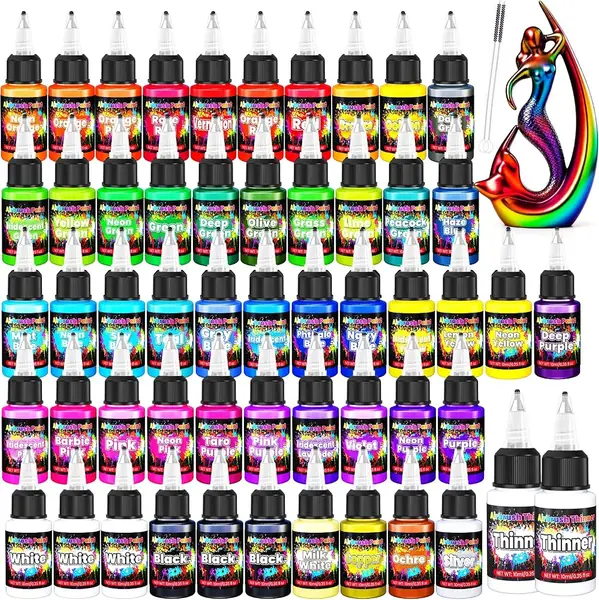
ERCorArt Airbrush Paint Set, 54 Colors Best for Wide Color Ranges

ERCorArt airbrush paint set with 54 water-based acrylic colors and two thinner bottles

Wide color ranges

Track Score 87/100
Paint Type
Water-based acrylic
Bottle Size
10 ml
Formula
Ready to spray
Colors
54 plus 2 thinners
View on Amazon

Fifty-four colors and two bottles of thinner, water-based and pre-thinned. Thirty-seven of the shades are ordinary colors rather than neons, which matters when the job is matching a factory paint or a race livery instead of painting a skateboard.

The palette is the whole argument for this set. With this many shades on the shelf you can pick one close to your reference and skip custom mixing, and a box that isn't mostly fluorescents means fewer bottles that never get opened. Two thinners also mean a low-airflow compressor doesn't end the session early.

Where it earns a place beside the smaller sets is breadth for the money: midrange money for fifty-four shades is the cheapest route here to stop mixing custom colors by hand. Spray a test panel on scrap plastic before you commit a whole shell. That habit separates a good result from a repaint, and it's the first thing we do with an unfamiliar acrylic.

Worth Noting

  • Thin paint needs extra coats for solid color
Our Verdict

Fifty-four shades make this the palette for matching a livery, though the paint is thin and rewards a patient hand.

Check Latest Price

How We Chose and Tested Model Car Paints

We began with research, not a shopping cart: reading what modelers say about these sets, then sorting the market into three families — water-based acrylic, solvent enamel and lacquer aerosol — because that choice drives everything else. From there we narrowed by price per bottle, whether a set was pre-thinned, brushable or a can, and how many shades a car really uses. A 54-color box with four usable reds isn't better value than eight bottles that all earn their place.

Fourteen sets came to the workbench and stayed for three months. Each went onto body shells, spoilers, chassis rails and window trim, applied the way the maker intended — airbrush, brush or straight from the can — and we watched for beading, crazing, or paint pulling away from a door line. We counted coats to cover a sanded patch and noted which formulas sat on top of a polycarbonate shell instead of biting in.

Dry and recoat time we timed with a fingertip, then with tape: once cured, panels were masked, pressed and pulled, and we logged what lifted. Slipped strokes were wiped while wet to see if a mistake came off the plastic cleanly, and finished bodies were handled and turned over for weeks to see how the finish held up. We also checked whether thinned paint stayed workable as the bottle emptied.

Cleanup counted too: acrylics rinsed from the brush with soap and water, while enamel and lacquer work happened outdoors or under a booth with real airflow, away from anything with a pilot light. We noted odor, read the age guidance on solvent sets and kept those out of younger modelers' hands, and tracked whether each included thinner kept its paint spraying to the last bottle.

How to Choose Paint for Model Cars

Start With How You'll Apply It

Spray can, airbrush or brush decides the rest of your list. A rattle can puts a smooth coat on a body in a couple of passes with no equipment, but it's one color per can and it needs open air. Airbrush paint arrives pre-thinned and gives you control over coverage, at the cost of a compressor and a cleaning routine between colors. A brush is slowest across a large panel and best on interiors, engines and trim. Choose the method you'll use on the body first, then buy for it — the other two are supplements, not replacements.

Match the Paint to the Plastic

Most model car bodies are molded in styrene or ABS, and all three paint families will stick to them, just differently. Lacquer bites into the surface and leaves the hardest, thinnest film, but it attacks plastic when it goes on wet and heavy, so spray mist coats and let them flash between passes. Enamel sits on top and levels out glossy. Water-based acrylic wants a clean, primed surface to grip. Before any of them, we wash the body in warm water with a drop of dish soap to strip mold release, which is the step most first-timers skip.

Pick the Sheen Before the Color

A showroom body wants gloss; a race car's chassis, interior tub and underbody want semi-gloss or matte. Many acrylics dry flat, which suits a weathered rally car and looks wrong on a base-model sedan unless you put a clear coat over it. Two or three clear coats over a matte acrylic get you close to a gloss enamel and protect decals at the same time. Semi-gloss black is the one sheen we buy as a spray can no matter what else is on the shelf.

Check Volume, Thinner and Shelf Life

Whether a set is still usable next year matters more than how many colors are printed on the box. Quarter-ounce bottles handle interiors and trim and run short on a full body; 17 to 20 ml dropper bottles go further. Pre-thinned paint saves a step but leaves less room to add your own thinner, which is why we like a set that includes a bottle of it. Solvent enamels and lacquers can thicken or skin over in storage, so tighten the caps, stand the bottles upright and keep them out of the sun. A smaller set with thinner and a brush beats a bigger one without.

Frequently Asked Questions

Final Verdict

For most people building a model car, the Vallejo Model Air set is the one to start with. Pre-thinned acrylics spray and brush well, the eight shades cover a body and its trim, and water cleanup makes a second color ten minutes' work instead of an evening's.

If the finish you're after is a deep, hard gloss and the garage can be opened up, the Testors enamel kit does that better. And if you're spraying a body this weekend with no airbrush at all, spend the least on the Tamiya semi-gloss black and learn what a rattle can does in your hands.