Best Plastic Model Putties of 2026

Putty failures show up a week after the primer, when a seam that looked flawless shrinks back, cracks or flakes at the edge. That failure is usually a mismatch between putty and job: one-part paste from a tube for glue lines and pinholes, two-part epoxy mixed by hand for structural fills and sculpted detail.

A putty that spreads nicely can still creep back out of a wing-root gap after sanding, so spreading isn't the test. Grain fineness decides whether a putty can hold a hairline, and working time starts when you finish mixing, not when you sit down. We pressed 14 putties into hairline seams, pinholes, deep gaps and sculpted detail, then sanded, carved and drilled them after cure, and the six picks were judged 24 hours later with sandpaper in hand.

Our Top Picks

The Best Plastic Model Putties

1.

Tamiya Basic Type Putty Best Overall
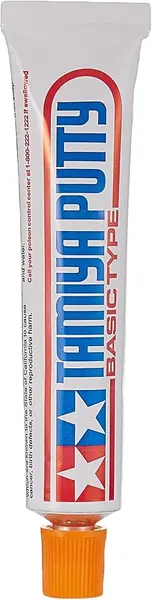
Tamiya Basic Type Putty gray tube of modeling filler for plastic kit seams

Everyday seam filling

Track Score 95/100
Volume
1.13 fl oz
Best For
Seams, glue lines and surface defects
Form
One-part gray putty in a squeeze tube
Works On
Styrene and ABS plastic, resin, metal, vinyl
View on Amazon

A seam line along a fuselage, or a sink mark just behind a cockpit opening, is the first thing that betrays an otherwise finished model, and it never needs much material to fix. That is why the tube is the size it is. Tamiya's gray paste comes out at a medium consistency, so you can drag it along a joint with a flat tool or push a dot into a pinhole with a toothpick. We paid attention to how it sits on the plastic: it stays where it is placed instead of sliding off an edge or sagging down a curve.

What earns it the top spot is the sanding. It skins over quickly, so you are back at the bench with paper the same session, and it powders away at the repair edge instead of tearing or balling up. Once it is level you can paint straight over it, and the gray gives you a reading on the seam before primer ever goes on. The water-cleanup paste below is gentler around fine detail, but for long joints and flat panels we keep coming back to this one.

Squeeze out a short bead rather than a long one, because it starts to skin while you are still working, and cap the tube the moment you are done. It is also the least expensive of our picks, which makes it the easy one to keep in the drawer and reach for without thinking.

Worth Noting

  • Fills seams, not large gaps
Our Verdict

We recommend it as the first putty to buy for plastic kits: it pushes into a seam, dries fast, and sands to a feather edge without chewing up surrounding detail.

Check Latest Price

2.

Milliput Standard Grain Best for Sculpting and Structural Fills

Milliput Standard Grain two-part epoxy putty in yellow-grey packaging for model sculpting

Sculpting and repairs

Track Score 94/100
Type
Two-part epoxy putty, mixed by hand
Volume
4 oz
Cure Time
About 5 hours at room temperature
Grain And Color
Standard grain, yellow-grey
View on Amazon

Milliput is the pick here that stops behaving like filler and starts behaving like material. You cut a ribbon from each bar, knead the yellow and the gray until the color is even, and what you get holds a shape instead of slumping off it. We especially like that it rolls down to 1/64 inch, thin enough for a weld bead on armor or a raised panel line — work that is genuinely awkward with a paste squeezed from a tube.

The five-hour cure is the other half of the case. Once it is hard you can saw, drill, file, sand and paint it, so a rebuilt landing-gear leg or a reshaped fender survives being handled, masked and painted rather than crumbling at the first knock. Before it sets, a wet finger pulls the surface flat and water takes the excess off your tools, which is also the moment to put gloves on.

Mixing is the honest cost: you are kneading until the color is uniform, and on a cold day that takes longer than you want it to, so make a little more than you think you need rather than start a second batch. The two bars keep for a long time as long as they stay sealed and separate, which is why one box outlasts a shelf of half-dried tubes.

Worth Noting

  • Tacky to handle until it cures
Our Verdict

For a fill you plan to carve, drill or sculpt into shape, Milliput is the one we choose: it cures hard enough to be machined, not just sanded flat.

Check Latest Price
3.

Perfect Plastic Putty Best Water-Cleanup Putty

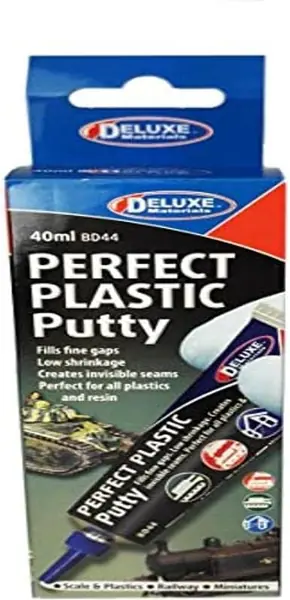
Deluxe Materials Perfect Plastic Putty white 40 ml tube of model filler

Fine seam work

Track Score 90/100
Type
One-part water-cleanup putty
Volume
40 ml
Finish
Superfine, dries without cracking
Best For
Fine gaps, seams and pinholes
View on Amazon

Most fillers force a choice between a neat seam and an intact surface. This one is a superfine white paste that goes on with a small spatula and comes back off with a damp cotton swab, so the excess leaves the surrounding detail alone instead of being ground off later with paper. Around cockpit framing, rivets or a raised panel line, that changes the job from a re-scribing exercise into a two-minute cleanup.

It handles the small stuff well: hairline seams, pinholes and the shallow sink marks that only show up once primer is on. It dries without cracking to a smooth finish that takes acrylic and enamel alike, and the low odor is the reason we do not mind using it at the kitchen table with the windows shut.

It belongs at the fiddly end of a build, where a smear of paste in the wrong place costs an hour. The tube is the weak point — the paste is stiff to squeeze and skins over in the nozzle between sessions, so wipe the tip and cap it every single time. That habit is the difference between a tube that lasts a season and one you cut open in frustration.

Worth Noting

  • Premium price for a small tube
Our Verdict

If a seam runs through detail you cannot replace, this is the putty we hand over: it wipes away with water instead of being sanded back.

Check Latest Price
4.

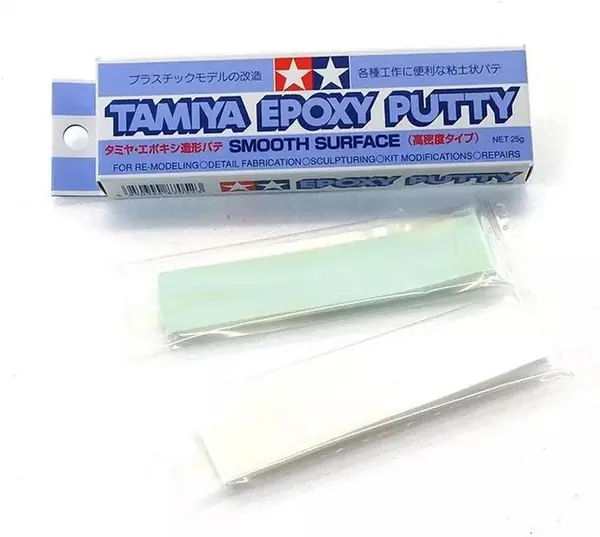
Tamiya Epoxy Sculpting Putty Best for Slow Detail Work

Tamiya Epoxy Sculpting Putty white and blue two-part compound package for models

Slow detail work

Track Score 89/100
Type
Two-part epoxy putty, white and blue
Weight
0.88 oz
Cure Time
About 12 hours
Finish
High density, smooth and fine
View on Amazon

Twelve hours sounds like a strange thing to advertise about a putty until you have tried to blend a shoulder into a torso at the end of an evening. Mix the white base with the light blue hardener and you have most of a day to add a little, step back, and take some of it off again. Nothing is lost if you walk away and come back after dinner.

We think that patience is the whole point. The high-density mix is smooth and fine enough to hold a crisp edge, and it cures to something that carves and sands like the kit plastic around it rather than the glassy hardness of a standard epoxy. On a figure conversion, that means blending a shape instead of fighting one, and it is why we keep this separate from the fast seam fillers.

The colors do more work than you expect: because the base and hardener are so far apart, you can see the instant the mix turns uniform, which removes most of the doubt about a soft batch. A 25-gram package does not go far, so we buy it for detail work and leave bulk filling to a pound of clay.

Worth Noting

  • Only 25 g in the package
Our Verdict

When a conversion needs more than one sitting, this slow epoxy is the choice: it stays workable for most of a day and cures like plastic rather than stone.

Check Latest Price
5.

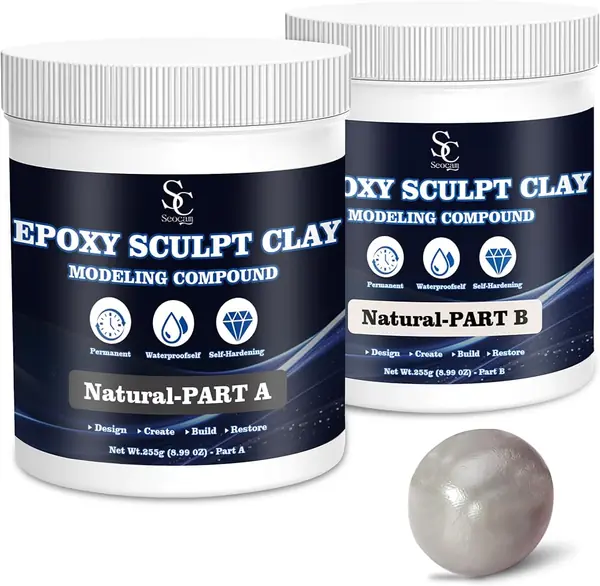
Seocam Epoxy Sculpt Clay Best for Large Sculpting Jobs

Seocam Epoxy Sculpt Clay natural color one-pound tub for modeling and repair

Large sculpting jobs

Track Score 88/100
Type
Two-part epoxy clay, 1:1 mix
Weight
1 lb
Cure
Sets hard in a few hours
Color
Natural (medium grey)
View on Amazon

Buying putty by the pound changes what you are willing to use it for. This is the tub for big jobs, such as armatures, terrain or a printed part with a seam you could park a car in, rather than a hairline joint where a fine paste does better. It mixes one-to-one by eye, sets hard in a few hours, and takes sandpaper and paint without fuss, and a little of it really does cover a lot of surface.

The natural shade is the detail worth knowing: it arrives closer to a medium gray than the name suggests, which matters on a light-colored model that will not get a full primer coat. And it is a clay for building volume rather than for the last clean millimeter of a seam — this is the material you sand back, not the one you wipe to a finished edge. One pound also means you stop rationing, and you mix what the job needs instead of what is left in the tube.

Worth Noting

  • Sticky and grainy to smooth out
Our Verdict

A pound of two-part clay is what we buy for the jobs that eat putty by the ounce: big sculpts, backfilled seams on printed parts and thick repairs.

Check Latest Price
6.

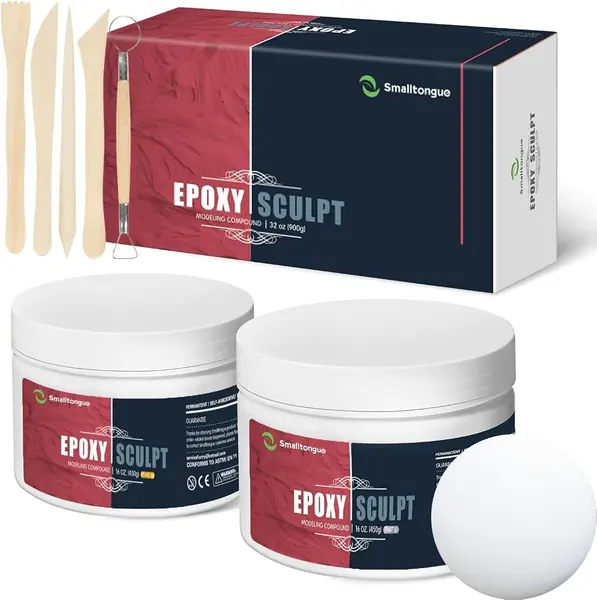
Smalltongue AB Epoxy Sculpt Clay Best for Bulk Fill Work

Smalltongue AB Epoxy Sculpt Clay white two-tub modeling compound in one-pound kit

Bulk fill work

Track Score 87/100
Type
Two-part epoxy clay, 1:1 by volume
Weight
1 lb (two 250 g tubs)
Cure Time
Fully hardens in 24 hours
Shrinkage
Under 1 percent
View on Amazon

Two tubs arrive, half a pound each, and because they mix one-to-one by volume you can eyeball equal scoops without hunting for a scale. The white paste reads clearly against gray kit plastic, which sounds trivial until you are filling a shallow sink mark and need to see exactly where the putty ends and the model begins.

Working time is the reason to pick this over a fast epoxy: you get something close to an hour to move a shape around before it stiffens, and a full cure inside a day. Shrinkage is rated under one percent, and that is the number that matters when you are skimming a wide, shallow area and do not want it dishing out from under the primer.

Where it fits is building thickness. Lay in more than you need, let it cure, then carve and sand back to the line you want — a softer clay would slump off a curved surface, and this one holds where you put it. That is the job we keep the tubs around for, and a pound of it handles a lot of reshaping before you run low.

Worth Noting

  • Too stiff to spread in thin layers
Our Verdict

Two half-pound tubs of white epoxy clay, with about an hour of working time, that we like for thick fills and builds you shape after it sets.

Check Latest Price

How We Tested Plastic Model Putty

We started with a shortlist of about 30 putties pulled from hobby shop shelves, kit-building forums and manufacturer spec sheets, then narrowed it by form (one-part tube versus two-part epoxy), volume, claimed cure time and price. Fourteen made it to the bench. We spent four months on them, mostly in evening sessions after work and one long weekend dedicated to nothing but seam work.

One-part pastes went straight into glue lines and pinholes on polystyrene and ABS scrap; we noted whether they dragged, sagged, or pulled out of the seam when we wiped the edges. Two-part epoxies we mixed by hand in 1:1 and other ratios — nitrile gloves on the whole time, since uncured epoxy sticks to skin — and we ran a clock from the last fold of mixing to the point where the putty stopped taking a fingerprint.

Sandability got its own round: 400 grit, then 800, then a scribed panel line and a drilled hole through the cured fill, watching for putty that balled up, chipped at the edge, or sanded noticeably softer than the surrounding plastic. We re-checked every seam after full cure for shrinkage lines and lifted edges. Water-cleanup putties were wiped with a damp finger and rinsed; solvent types were used by an open window, with a note on how far the smell carried in a small room.

We also resealed the tubes and tubs and came back to them weeks later to see which had skinned over, and compared how much usable putty a container actually delivered against its price.

How to Choose a Plastic Model Putty

Start With One-Part or Two-Part

Nearly everything here is one of two things, and that choice sets how much work surrounds a five-minute fill. A one-part paste comes out of a tube, spreads thin with a flat tool or a fingertip, and skins over in minutes — right for a seam along a fuselage or a sink mark behind a cockpit, where the putty is only ever going to be sanded flat. A two-part epoxy has to be kneaded, and it cures hard enough to be carved, which is what you want when the repair is a shape rather than a line.

If you build straight from the box, buy the paste. If you convert, sculpt or repair broken parts, buy the epoxy and expect to spend a few minutes mixing.

Match the Working Time to How You Work

Putty is on a clock from the moment it leaves the tube, and that clock is a feature you are choosing rather than a compromise. A fast filler keeps a seam job moving but punishes fiddling; a slow epoxy lets you add a bit, look at it from another angle, and take it back down. The practical question is whether a repair finishes in one sitting. If it does, fast is fine; if your bench time comes in short evenings, pay for the working time.

The spread within this group is wide. Tamiya's sculpting epoxy gives you around twelve hours before it is unworkable, Milliput cures in about five and can be hurried with a hair dryer played over the part, and the pastes are sandable the same session.

Sandability Is Where Putties Are Won and Lost

The moment of truth is a piece of wet/dry paper. A putty that cures softer than the surrounding plastic smears and pulls out of the seam; one that cures harder than the plastic sands a dish into the kit before it ever flattens the fill. Both failures look identical under primer, and both cost an afternoon.

Run a test on a scrap of sprue from the same kit before you commit, sand with a block rather than a fingertip so the paper bridges the seam instead of dipping into it, and stop the moment the fill is level with the plastic.

Grain, Cleanup and Where You Work

Fineness matters more than volume for most modelers. A superfine paste pushes into a hairline seam and wipes back with water, which is the difference between tidying a joint and re-scribing the detail around it; a coarse material that needs heavy sanding erases raised lines faster than it fills the gap.

Cleanup decides where you can work, too. Water-based pastes wipe away with a damp swab and smell of very little, while two-part epoxies want gloves and a scrap of card to mix on. Buy a pound of sculpting clay when you are building volume, and a small tube when you are chasing seams — one product will not do both well.

Frequently Asked Questions

Final Verdict

We recommend the Tamiya Basic Type Putty as the default for plastic models, because a seam is the repair most kits actually need and it does that job with the least fuss: thin enough to push into a joint, quick enough to sand the same session, and fine enough to vanish under primer. Keep a tube in the drawer and you will use it on nearly every build.

When the fill has to be carved, drilled or sculpted rather than sanded flat, buy Milliput Standard instead. It cures to something you can machine, and that is a genuinely different job from chasing a seam line.