Best RC Helicopter Brands of 2026
RC helicopters have always carried an intimidating reputation—and for decades, they earned it. Older nitro and gear-driven electric machines were complex assemblies of flybars, fragile tail drives, and dozens of tiny linkages where one nervous thumb twitch meant $150 in bent shafts and an evening of mechanical rebuilding.
Two modern breakthroughs rewrote that script: flybarless electronic gyros with self-leveling rescue modes, and direct-drive dual-brushless micro helicopters that ditch fragile main gears and tail belts altogether. Today, Blade offers the friendliest guided beginner ladder, OMPHobby and Goosky dominate the ultra-durable micro-to-mid-size 3D renaissance, SAB Goblin, Align, and XLPower lead full-size 3D aerobatics, and budget starters like XK (K110S) and Syma cover casual entry budgets. Knowing which rotor architecture fits your goal keeps your first hover exciting instead of expensive.
Quick comparison of the best RC helicopter brands
| Brand | Signature Models | Class Range | Drivetrain Style | Stabilization / Flight Modes | Best Fit For |
|---|---|---|---|---|---|
| Blade (Horizon) | Nano S3, 150 S, 230 S Smart, Fusion 360 | Micro to 360–550 | Brushed/Brushless gear & direct tail | Spektrum SAFE + Panic Recovery | Beginners wanting local parts & guided progression |
| OMPHobby | M1 EVO, M2 EVO / V2, M4, M7 | Micro to 700 | Direct-drive dual-brushless (M1/M2) | Built-in FBL (Attitude + 3D) | Beginners-to-pros wanting tough, zero-gear micro CP helis |
| Goosky | S1, S2, RS4, RS7 | Micro to 700 | Direct-drive dual-brushless (S1/S2) | Built-in GTS FBL (Attitude + 3D) | Pilots wanting razor-sharp 3D value & clean tuning |
| SAB Goblin | Raw 420 / 500 / 580 / 700, Kraken, Piuma | 420 to 700+ | Belt/gear precision high-power | Open FBL (VBar, Spirit, Rotorflight) | Advanced 3D pilots & enthusiasts wanting exotic Italian engineering |
| Align | T-Rex 470L, TB40, TB60, TB70 | 450 to 700 | Belt / torque-tube combos | Open FBL / BeastX | Pilots wanting proven value-packed full-size kits & deep parts |
| XLPower | Protos 380, Specter 700 V2, Nimbus 550 | 380 to 700 | Belt-drive lightweight 3D | Open FBL | Competitive 3D flyers prioritizing power-to-weight agility |
| XK / Syma | XK K110S (CP), Syma S107G (Coaxial) | Sub-micro / Micro | Geared brushless (K110S) / Brushed | 6G stabilized + 3G (K110S) | Lowest-cost taste of indoor coaxial or budget CP learning |
Coaxial, fixed-pitch and collective-pitch explained
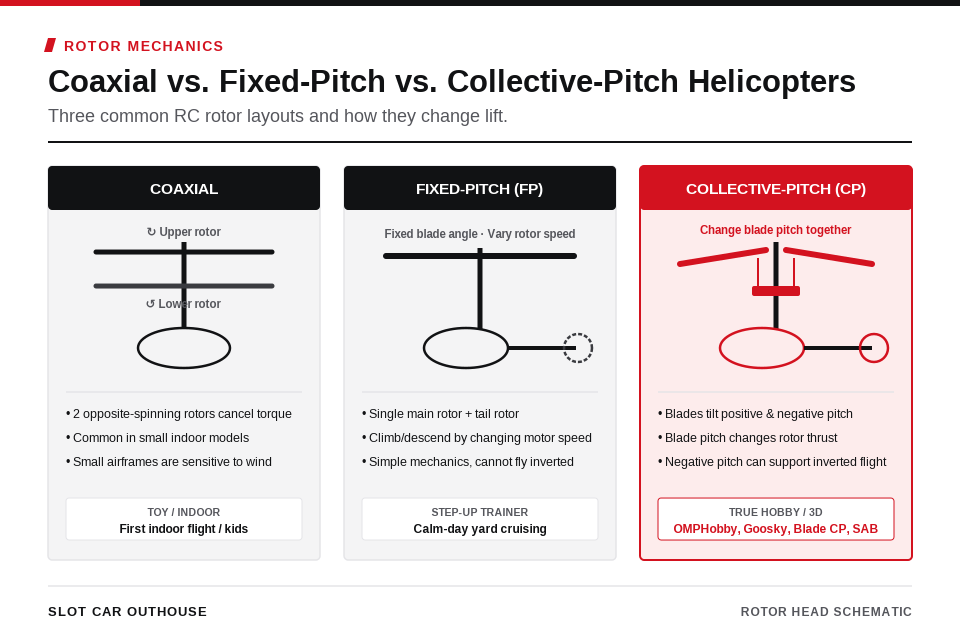
Before picking a brand inside RC planes and helicopters, understand the three mechanical rotor designs. Confusing them is the #1 reason newcomers either outgrow a helicopter in one afternoon or crash a machine they weren't ready for.
- Coaxial (counter-rotating dual blades): Two sets of main blades stacked on one shaft spinning in opposite directions so their rotational torque cancels out naturally. Coaxial helicopters (like the classic $25 Syma S107G) hover steadily in a living room within minutes, yet they lack true side-to-side agility and blow away in the slightest outdoor breeze. Treat them strictly as fun indoor toys—not trainers for real outdoor helicopters.
- Fixed-Pitch (FP): A single main rotor whose blades are locked at one permanent tilt angle, plus a small tail rotor. To climb, the motor spins faster; to descend, the motor slows down. Fixed-pitch helis introduce true four-channel control (throttle, rudder/yaw, forward/back elevator, left/right aileron) and handle crashes gently, but because changing motor RPM takes a split second, they feel sluggish in wind and cannot fly upside down.
- Collective-Pitch (CP): How real full-size helicopters—and all serious hobby machines—work. The main motor spins at a constant, high head speed, and three servos tilt a ring called a swashplate up and down to change the angle ("pitch") of the blades instantaneously. Positive blade angle pushes air down to climb; negative blade angle pushes air up to rocket downward or hover completely inverted (upside down). Every serious modern CP heli is flybarless (FBL), replacing old mechanical stabilizer paddles with a tiny three-axis electronic gyro that holds the rotor disc rock-steady in wind and crisp through aerobatics.
Modern FBL controllers blurred the old learning barrier: a modern collective-pitch helicopter like a Blade 230 S, OMPHobby M1, or Goosky S1 can run in Attitude / SAFE self-leveling mode (limiting tilt angle and leveling itself when you release the sticks) while you learn to hover—then unlock full inverted 3D aerobatics with the flip of a switch once your thumbs catch up.
Brand-by-brand breakdown
Blade (Horizon Hobby): the safest U.S. beginner ladder
Blade built the modern electric micro-heli category and remains the easiest brand to support at local American hobby shops. Its progression is cleanly mapped: start indoors with the featherweight Nano S3 (which bounces off carpet without breaking), step up to the 150 S, or jump straight into outdoor flying on the Blade 230 S Smart—a stable, visible mid-micro CP trainer that handles light wind gracefully.
Blade's ace card is Horizon Hobby's SAFE technology with Panic Recovery: lose orientation mid-hover, tap the panic button, and the helicopter snaps upright automatically. Because Blade models come in RTF and BNF formats paired with Spektrum transmitters, newcomers avoid complex radio programming on day one. The downside compared to newer direct-drive rivals is mechanical layout: several Blade models still use geared drivetrains or brushed/tail-motor setups that feel slightly less locked-in during hard 3D maneuvers and cost more per ounce of CNC hardware.
OMPHobby: the direct-drive micro revolution
When OMPHobby introduced the M2 and smaller M1 (now refined as the M1 EVO and M2 EVO), it fundamentally changed how both beginners and world-class 3D pilots buy small helicopters. Instead of routing motor power through plastic main gears and delicate tail belts that strip whenever a blade clips grass, OMPHobby mounts the main rotor directly onto a high-torque brushless outrunner motor—and puts a second independent brushless motor directly on the tail boom.
The result of this direct-drive dual-brushless architecture is transformative: whisper-quiet operation, zero gear stripping on grass tip-overs, instant throttle response, and astonishing crash survivability. Hit throttle hold (the mandatory kill switch that cuts motor power a split second before impact), and an M1 or M2 frequently lands in tall grass with zero broken parts—pick it up, straighten the blades, and fly again. Both models include a clean built-in FBL controller offering a calm self-leveling Attitude mode for beginners alongside blistering 3D authority. OMPHobby has also scaled upward into serious belt-driven 380–700 class kits (M4, M7) using the same crisp design ethos.
Goosky: crisp 3D precision and standout value
Founded by former OMPHobby design talent, Goosky perfected the same direct-drive micro formula with the Goosky S1 (compact backyard/indoor size) and Goosky S2 (larger outdoor park powerhouse). Pilots often note that the S1 and S2 feel exceptionally crisp and locked-in right out of the box—almost like flying a miniature 700-class machine—with clean CNC aluminum rotor heads, sleek canopies, and a built-in Bluetooth-tunable FBL controller (plus both Attitude stabilization and full 3D modes).
Goosky's mid-size RS4 (380-class belt-driven kit/combo) has similarly become one of the hottest stepping stones into larger helicopters thanks to easy maintenance, low part counts, and affordable crash kits. Both OMPHobby and Goosky offer RTF bundles (with a simple transmitter) or BNF/PNP versions that accept a small Spektrum, Futaba, or ELRS/S.BUS satellite receiver so you can fly them on any modern radio.
SAB Goblin: Italian engineering at the top of 3D flight
Walk down any serious RC helicopter flight line and SAB Goblin machines stand out instantly from fifty yards away. Known for sweeping painted fiberglass booms, quick-release battery trays, belt-driven transmissions that run smoothly and quietly, and jaw-dropping CNC craftsmanship, models like the Goblin Raw 420 / 500 / 580 / 700, Kraken, and ultralight Piuma represent the aspirational peak of modern 3D helicopters.
SAB designs prioritize crash-serviceability and low part counts—especially on the exposed-boom Raw line, which cuts repair costs compared to full-fiberglass boom canopies. Make no mistake, though: a 580- to 700-class helicopter spins 600–700 mm carbon-fiber blades at 2,000+ RPM with lethal kinetic energy. These are serious aircraft built from kits with separate high-end FBL controllers (Mikado VBar, Spirit, Rotorflight) and strict safety discipline—never starter machines.
Align: the T-Rex heritage and full-size combo value
For nearly two decades, Align's T-Rex series (450, 500, 550, 700) was the universal standard of electric RC helicopters—the brand that brought 3D heli flight to everyday club fields. Today, Align's updated TB40, TB60, and TB70 belt-driven platforms modernize that lineage with sleeker frames, strong powerplants, and generous "Super Combo" kits that bundle the airframe, brushless motor, ESC, and high-voltage servos at a total price that routinely undercuts piecing together boutique rivals. Parts remain widely stocked worldwide, keeping Align a dependable workhorse for intermediate and advanced pilots stepping up to large scale.
XLPower: lightweight 3D performance favorite
XLPower (home of the Protos 380, Nimbus 550, and Specter 700 V2) earned fierce loyalty among competition and sport 3D pilots by obsessing over power-to-weight ratio and crisp cyclic feel. A Specter 700 or Nimbus 550 feels light on the sticks, recovers sharply from aggressive pitch pumps, and keeps spare-parts pricing noticeably friendlier than some European boutique rivals. Like SAB and Align, XLPower builds serious kit-based helicopters intended for pilots who already know how to set up pitch curves, swashplate leveling, and FBL gains.
XK K110S and Syma: ultra-budget starters
Not everyone wants to drop $250–$400 before confirming they actually enjoy hovering a helicopter. If you want an ultra-cheap indoor toy for a kid's birthday, a $25–$40 Syma coaxial heli delivers harmless living-room fun—just treat it as a toy. If you want the absolute cheapest real collective-pitch trainer on earth, the XK K110S (~$100–$130 RTF) has been a cult favorite for years: a tiny, featherweight 1S brushless CP heli with 6G self-leveling mode that survives hundreds of bounces on carpet or short grass while teaching genuine four-channel CP stick habits. Its stock radio feels toy-like and tail hold is modest compared to an OMP M1 or Goosky S1, yet nothing beats its cost-per-crash ratio for absolute beginners on a shoestring budget.
Why simulators + direct-drive micros changed how beginners learn
Before spending a dime on replacement feathering shafts, follow the modern two-step heli learning formula:
- Train on a PC simulator first: Programs like AccuRC, RealFlight Evolution, or HELIX let you practice the four essential hover orientations—tail-in (easiest), left side-in, right side-in, and nose-in (where steering reverses)—plus hitting the throttle-hold switch automatically the instant things go sideways. Building that thumb reflex on a monitor saves hundreds of dollars in real-world parts. (If you enjoy sim-first learning across rotorcraft, see our best FPV drone simulators guide too.)
- Start with a direct-drive micro over grass: A 100–300 gram direct-drive heli (OMPHobby M1/M2 or Goosky S1/S2) flown above thick lawn grass is the sweet spot. Larger 500–700 helis actually fly more stably in wind than micros, yet their crash bills ($100–$400+) and serious safety risks make them terrible first trainers. Learn your orientations on a sim and a tough micro; step up to a 380–550 class belt-driven machine once hovering nose-in feels calm and automatic.
And as you expand your fleet, invest in dependable flight packs (see our best LiPo battery brands guide—helicopter 3D flight pulls heavy burst current where cheap packs sag quickly) and basic bench gear like a swashplate leveler, pitch gauge, and clean soldering iron for ESC leads.
Which RC helicopter brand fits your skill level?
- Best true beginner with local hobby-shop support: Blade 230 S Smart (outdoors) or Blade Nano S3 (indoors), leveraging SAFE + Panic Recovery.
- Best overall modern starter-to-3D micro: Goosky S1 / S2 or OMPHobby M1 EVO / M2 EVO—unmatched direct-drive durability and zero gears to strip.
- Best shoestring-budget real CP trainer: XK K110S over soft grass or carpet.
- Best first mid-size "real kit" build (380–420 class): Goosky RS4, OMPHobby M4, or SAB Goblin Raw 420.
- Best large-scale 3D flagships (550–700 class): SAB Goblin (craftsmanship), XLPower (lightweight agility), or Align (combo value).
Sources
- Horizon Hobby — Blade Helicopters & SAFE Technology
- OMPHobby Official — M1, M2, M4 & M7 Helicopters
- Goosky Official — S1, S2 & RS Series
- SAB Heli Division — Goblin Helicopter Lineup
- Align Corporation — T-Rex & TB Series
- XLPower — Protos, Nimbus & Specter
- FAA — Recreational Flyers & TRUST Certification
Frequently Asked Questions
Yes. A camera drone holds its GPS position automatically when you let go of the sticks, and a high-wing RC plane glides gently forward even with the motor off. A collective-pitch helicopter is naturally unstable—like balancing a marble on top of a bowling ball—requiring tiny, continuous corrections on both sticks. Self-leveling modes (SAFE / Attitude) make early hovering much easier, yet mastering true unassisted flight is one of the most rewarding skills in RC.
Throttle hold is a dedicated transmitter switch that instantly cuts power to the main and tail motors while keeping your steering servos active. Flipping throttle hold half a second before an unavoidable crash stops the spinning blades from violently shearing gears, snapping booms, or causing injury—often turning a $50 crash into zero damage on grass.
Both brands are outstanding and share the same direct-drive dual-brushless philosophy. Goosky S1/S2 slightly edges ahead for pilots who want razor-sharp stock 3D tuning and slick Bluetooth app setup out of the box, while OMPHobby M1/M2 EVO enjoys slightly wider long-standing global parts inventory and a slightly calmer stock feel. Choose the smaller M1 / S1 for tight backyards and indoor gyms, or the larger M2 / S2 for breezy parks and better visibility.
A 700-class helicopter weighs 11–13 pounds and spins rigid carbon-fiber blades over 4.5 feet across at tip speeds approaching 250+ mph. Mechanical failure, a loose link, or a momentary orientation mistake carries enough energy to cause severe injury. Always fly large helicopters at wide-open fields or AMA-chartered clubs, keep safe standoff distance, and double-check every bolt with thread-locker before maiden flights.
Yes—under the same U.S. recreational rules as RC airplanes and drones. Outdoor recreational flyers need the free online FAA TRUST certificate, and any RC helicopter weighing 250 grams (0.55 lbs) or more at takeoff (which includes the Blade 230 S, OMPHobby M2, Goosky S2, and all larger machines) requires a $5 recreational FAA registration number displayed on the aircraft. Sub-250 g micros like the Nano S3, M1, S1, and K110S sit below the registration weight threshold.