Best Model Train Brands of 2026
If you want a model train that runs smoothly straight out of the box without electrical headaches, Kato is the closest thing the hobby has to a guaranteed winner. Its N-scale and HO-scale locomotives run quietly at a whisper-slow crawl, and its snap-together Unitrack roadbed holds reliable electrical contact even on a living-room floor. For budget-friendly first sets, Bachmann covers almost every major scale at approachable prices; for classic under-the-tree and family hi-rail nostalgia, Lionel owns O-gauge; and when you want jaw-dropping historical accuracy down to individual grab irons and cab interiors, ScaleTrains and Rapido sit at the pinnacle of modern miniature engineering.
The biggest mistake newcomers make is assuming all model train brands compete on the same playing field. In reality, the hobby is divided by track standard, control system (DC vs. DCC), and product tier—where a single manufacturer often sells both a simplified $120 starter locomotive and a $350 brass-quality replica under different sub-brands. Understanding how each major brand fits into that ladder saves you from buying incompatible track or overpaying for fragile details you don't yet need.
DC vs. DCC: the one technical decision that shapes your brand choice
Before you fall in love with a locomotive, understand how electricity reaches its motor—because two identical-looking models on the shelf can cost $150 apart based solely on electronics.
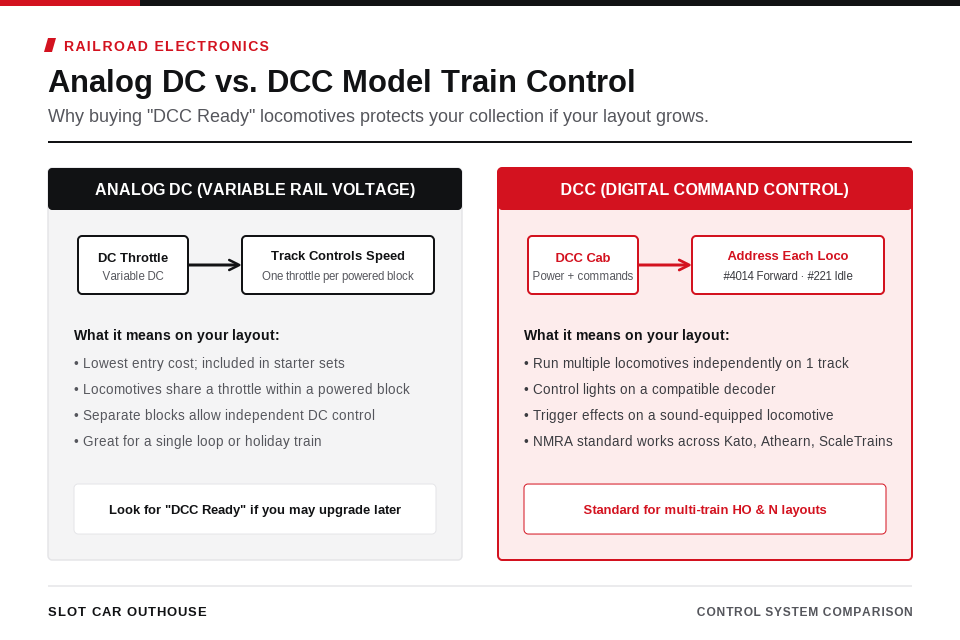
- DC (Direct Current / Analog): The traditional system most people remember from childhood. Turning the dial on a power pack raises or lowers the voltage across the entire track. Locomotives on the same powered block share that throttle. Separate electrical blocks can give different trains independent control. DC is inexpensive, dead simple to wire, and completely fine if you only plan to run one train at a time.
- DCC (Digital Command Control): Constant AC-like digital power stays on the rails at all times, carrying addressed data packets—just like Wi-Fi signals riding on the track. Each locomotive contains a tiny circuit board (decoder) with its own unique address (often its cab number, like 4014). You can run multiple trains on the same track at different speeds and directions simultaneously, turn headlights and ditch lights on independently, and trigger synchronized DCC Sound—realistic diesel prime-mover notches, steam chuffs timed to wheel revolutions, bells, horns, and air-brake hisses from tiny speakers inside the loco.
- DCC-Ready: Means the locomotive runs on standard DC today, but includes an internal socket (like a 21-pin MTC or Next18 plug) so you can snap in a decoder later without soldering.
(One quirk to know: Lionel's modern LionChief O-gauge trains use Bluetooth and dedicated handheld remotes over constant track power, giving families DCC-like sound and independent control without learning DCC programming.)
Best model train brands compared
| Brand | Primary Scales | Signature Strength | Control Systems | Price Tier | Track System | Best Fit |
|---|---|---|---|---|---|---|
| Kato | N, HO | Ultra-smooth drives & bulletproof snap track | DC, DCC-Ready, DCC Sound | Mid | Unitrack (industry benchmark) | Beginners & veterans wanting zero-drama reliability |
| Bachmann | HO, N, O, On30, G | Widest accessible starter sets & licensed sets | DC, DCC, DCC Sound | Entry to Mid | E-Z Track (steel or nickel-silver) | First-time buyers, kids & budget layouts |
| Lionel | O (3-rail), HO, G | Iconic American O-gauge presence, smoke & sound | LionChief Bluetooth, Legacy | Mid to High | FasTrack (3-rail) | Holiday loops, family rooms & nostalgia collectors |
| Athearn | HO, N | Breadth of North American freight & diesels (RTR / Genesis) | DC, DCC-Ready, DCC Sound | Mid to High | None (uses standard 2-rail) | US prototype freight & diesel modelers |
| ScaleTrains | HO, N | Extreme prototype accuracy (Operator to Rivet Counter) | DC, DCC-Ready, DCC Sound | Mid to Premium | None (uses standard 2-rail) | Detail-focused modern & classic US modelers |
| Rapido Trains | HO, N | Museum-grade passenger cars & quirky North American locos | DC, DCC Sound | Premium | None (uses standard 2-rail) | Passenger train fans & serious collectors |
| Walthers | HO, N | Complete ecosystem: locomotives, cars & unmatched buildings | DC, DCC-Ready, DCC Sound | Entry to High | WalthersTrack | Full-layout builders needing scenery & structures |
| Märklin | HO (3-rail AC), Z, 1 | Legendary German engineering & metal construction | MFX / DCC digital (AC 3-rail) | High | C-Track / K-Track | European train enthusiasts & Z-scale fans |
| Hornby | OO (UK), TT:120 | Iconic British steam & modern UK railways | DC, HM7000 Bluetooth DCC | Entry to High | Hornby Track | British railway modelers & TT:120 adopters |
| Peco & Atlas | N, HO, OO, O, G | Precision turnouts, flextrack & permanent layout geometry | N/A (Track & Atlas locos) | Mid | Streamline / Code 55–100 | Permanent benchwork & scenic layouts |
Deep dive into the top model train brands
Kato: the reliability benchmark in N and HO
Ask ten veteran model railroaders which brand to trust with your first layout, and at least eight will say Kato. Based in Japan with a strong US division (Kato USA), the company manufactures locomotives with precision five-pole flywheel motors and all-wheel electrical pickup that glide across switches without stalling or stuttering.
Equally famous is Kato Unitrack. Unlike traditional bare track that has to be nailed onto cork roadbed and soldered carefully, Unitrack snaps together on a realistic molded ballast base with positive-locking nickel-silver rail joiners. You can build an oval on a dining table in five minutes, run trains smoothly all weekend, pack it away in a closet, and later glue that exact same track onto a permanent layout. If you are deciding whether Kato's N or HO ecosystem fits your room better, check our breakdown of model train scales.
Bachmann: the most accessible gateway into the hobby
Bachmann sells more starter sets than perhaps any other two-rail brand on earth—covering HO, N, On30 narrow gauge, and large G-scale garden trains, plus beloved licensed series like Thomas & Friends and the Polar Express.
The smart way to buy Bachmann is to pay attention to two crucial details:
- Choose nickel-silver E-Z Track (gray roadbed) over steel-alloy E-Z Track (black roadbed): Nickel-silver resists oxidation far better than steel, meaning far fewer stalled trains and much less rail cleaning.
- Know the tiers: Entry-level Bachmann train-set locomotives use simpler details and lighter frames designed to survive kids' handling. Step up to Bachmann Spectrum or Sound Value locomotives for heavier diecast frames, sharper detailing, and factory DCC sound at reasonable prices.
Lionel: the king of three-rail O-gauge presence
When most Americans picture a model train steaming around a Christmas tree with puffing smoke, clanging bells, and glowing passenger windows, they are picturing Lionel. Operating primarily in hefty O-gauge (roughly 1:48 scale on three-rail track), Lionel trains have a tactile weight and shelf presence that tiny scales simply cannot replicate.
Modern Lionel LionChief sets solved the old transformer learning curve: plug a wall power supply into snap-together FasTrack, and run the train via an included wireless remote or a smartphone Bluetooth app—complete with whistle, bell, steam announcements, and smoke units. At the high end, Lionel's Legacy locomotives pack heavy diecast bodies, synchronized chuffing smoke, and museum-grade electronics aimed at dedicated basement empires. Because O-gauge is sturdy and easy for small hands to put back on the rails, Lionel also shines for younger operators—a trade-off we explore closely in our guide to the best model train scale for kids.
Athearn: the backbone of North American HO modeling
For decades, Athearn (now part of Horizon Hobby) has been the workhorse of North American HO and N railroading. Rather than locking everything at one price point, Athearn neatly splits its catalog into clear tiers:
- Roundhouse: Classic, simpler rolling stock and locomotives with affordable pricing and durable molded details that withstand frequent handling.
- Athearn Ready-to-Roll (RTR): The middle ground—crisp paint, upgraded metal wheels, and strong mechanical drives.
- Athearn Genesis: High-end, prototype-specific diesels and steam locomotives loaded with etched-metal walkways, separately applied wire handrails, LED lighting, and SoundTraxx Tsunami2 DCC sound.
If you want a specific American freight railroad—whether Union Pacific, BNSF, CSX, or fallen flags like Santa Fe and Southern Pacific—Athearn almost certainly makes multiple accurate eras of it.
ScaleTrains and Rapido Trains: the museum-grade innovators
Over the past decade, two enthusiast-founded companies reset expectations for how detailed a mass-produced plastic locomotive can be:
- ScaleTrains divides every release transparently into three lines: Operator (affordable, durable, fewer fragile add-on parts—ideal for club layouts or running with kids), Kit Classics, and flagship Rivet Counter (roadname-accurate down to the exact antenna array, sunshade shape, and snowplow style of a specific locomotive number in a specific year).
- Rapido Trains (based in Canada) built a devoted following for hyper-detailed North American passenger cars—complete with full multi-color interiors, flickering fluorescent-style LED lighting, and underbody piping you'd normally see only on $1,500 brass imports—alongside iconic Canadian and US diesels and quirky prototypes other makers overlook.
Both brands reward careful handling: their tiny wire grab irons, air hoses, and windshield wipers look breathtaking on a scenic layout, though they are too delicate for casual carpet-floor play.
Walthers: the one-stop layout builder
While every brand above focuses mostly on trains, Walthers builds the world around the trains. Its Cornerstone line of plastic structure kits—steel mills, grain elevators, roundhouses, bridges, and urban factories—forms the backdrop of countless HO and N layouts. On the rolling stock side, Walthers spans three straightforward tiers: Trainline (budget starters), Mainline (solid everyday value), and WalthersProto (detailed flagship locomotives and streamlined passenger fleets). If you want matching locomotives, freight cars, track, and the exact industrial complex they serve, Walthers makes sourcing painless.
Märklin and Hornby: European and British specialists
- Märklin (Germany): One of the oldest toy-train makers in the world, famous for metal-bodied European locomotives, rock-solid engineering, and Z scale (1:220) pioneers. One critical compatibility note: Märklin HO uses a three-rail AC system with subtle center studs embedded in the ties. Märklin HO locomotives will not run on standard North American two-rail DC/DCC track (though its sister brand Trix sells two-rail DC/DCC versions of many Märklin models).
- Hornby (UK): The household name in British railroading, specializing in OO gauge (1:76.2 scale running on standard 16.5 mm HO track) and a rapidly growing TT:120 range. Hornby's recent HM7000 Bluetooth decoders even let you control DCC-equipped trains directly from a phone or tablet without buying a dedicated DCC command station.
Peco and Atlas: the track builders' standards
Once you graduate from snap-together roadbed track to a permanent wooden benchwork layout with cork roadbed, realistic ballast, and custom curve geometry, Peco and Atlas take over. Atlas offers reliable, affordable flextrack and switches across N, HO, and O (and also produces excellent locomotives). Peco (made in the UK) is widely considered the gold standard for turnouts (switches), prized for smooth frog geometry and spring-loaded switch points that snap cleanly into place without derailments. Before buying yards of flextrack and switches, sketching your room footprint in model train layout software saves both money and frustration.
Practical buying rules: starter loop vs. serious railroad
To avoid buying twice, pick your brand lane based on how you actually plan to run trains:
- Tabletop, floor, or apartment running: Buy Kato Unitrack (N or HO) or Lionel FasTrack (O-gauge). Integrated roadbed keeps carpet fibers out of gears and guarantees steady electrical contact.
- Permanent basement or spare-room layout: Invest in Peco or Atlas nickel-silver flextrack and switches, then mix locomotives freely across Kato, Athearn, ScaleTrains, Walthers, and Rapido—because two-rail HO and N brands all follow standardized NMRA track and coupler norms.
- Avoid brass and steel rails: Always buy nickel-silver track. Even when nickel-silver oxidizes slightly, the oxide layer still conducts electricity, whereas steel and brass corrode into dead zones that stall locomotives.
- Match durability to operators: If children or guests will handle trains, choose Kato, Bachmann, Lionel LionChief, or ScaleTrains Operator. Save Rivet Counter, Athearn Genesis, and Rapido for careful hands and display-grade running.
Explore our model trains category for curated locomotive, starter-set, and scenery picks across every scale.
Sources
Frequently Asked Questions
Yes—as long as they share the same scale, track gauge, and electrical system. An Athearn HO locomotive, ScaleTrains freight cars, and a Walthers caboose will run seamlessly together on Kato, Bachmann, Atlas, or Peco two-rail HO track (using standard knuckle couplers). The main exceptions are three-rail systems: Märklin AC HO and Lionel 3-rail O-gauge cannot mix with standard two-rail DC/DCC trains.
Kato is better if your priority is ultra-smooth operation, zero derailments, and long-term reliability—especially in N scale, where small electrical hiccups are more noticeable. Bachmann is better if you want a lower entry price, a wider selection of whimsical or licensed sets, or a complete all-in-one box with buildings and accessories to get running immediately.
You do not need DCC on day one. Starting with a simple DC power pack and DCC-Ready locomotives lets you learn track laying, scenery, and operations affordably. When you want to run multiple trains independently or add realistic engine sound later, you can upgrade to a DCC command station and drop decoders into your existing locomotives.
The price jump pays for three things: factory DCC sound decoders (which alone add $90–$120), prototype-specific tooling (hundreds of tiny separately applied metal handrails, hoses, wiper blades, and cab details rather than molded-on shapes), and drivetrain refinement (heavy diecast frames, precision motors, and multi-function LED lighting).
For snap-together convenience and electrical reliability, Kato Unitrack is the undisputed favorite in both N and HO scale. If you are building in O-gauge, Lionel FasTrack is durable and easy to assemble. When you are ready to build a permanent table layout with custom curves and hand-laid ballast, switch to Peco or Atlas nickel-silver track.