Best Model Train Scales Explained of 2026
If you want the safest all-around answer, HO scale (1:87.1) is the world's most popular model train size for a reason: it offers the biggest catalog of locomotives, buildings, and scenic details at the best balance of size and affordability. If your available space is tight—like a coffee table, apartment desk, or a single 4×8-foot board where you want sweeping mountains and long freight trains—N scale (1:160) doubles what you can pack into the same footprint. And if you want sturdy, heavy trains with dramatic presence for a family room or holiday loop, O gauge (1:48) is tough to beat.
Picking a model train scale is the single most important decision you will make in the hobby, because tracks, locomotives, bridges, and buildings from different scales don't mix. Worse, many beginners fall in love with a locomotive's size in a hobby shop without realizing how wide a circle it needs to turn around at home. Once you understand the difference between scale and gauge, and match each scale to real-world room dimensions, the right choice becomes obvious.
Scale vs. gauge: the five-minute distinction that prevents headaches
Model railroaders use "scale" and "gauge" casually in conversation, which confuses almost every newcomer—until you separate the two concepts cleanly:
- Scale is the ratio between the miniature model and the real full-size train. In HO scale (1:87.1), 1 inch on your layout represents 87.1 inches (about 7.25 feet) in the real world. Think of scale as the size of the people, houses, trees, and train bodies.
- Gauge is the exact distance between the inside edges of the two running rails. Most full-size railroads in North America and Europe use standard gauge (4 feet, 8.5 inches—or 1,435 mm—between rails). Divide 1,435 mm by 87.1, and you get 16.5 mm, which is HO standard track gauge.
Why does that distinction matter? Because of narrow gauge and a few famous historical quirks:
- Narrow gauge (like On30 or HOn3): Real mining and mountain railroads often ran smaller trains on narrower tracks (like 30-inch or 36-inch rail spacing) to squeeze around steep cliffs. In On30, you run big, chunky O-scale (1:48) train bodies on standard HO (16.5 mm) track—giving you large, easy-to-detail trains that turn tight curves in small spaces.
- British OO gauge (1:76.2 on HO track): Early British model train makers couldn't fit 1930s electric motors inside tiny 1:87 British steam locomotive boilers, so they kept standard 16.5 mm HO track and enlarged the train bodies slightly to 1:76.2. Today, OO dominates the UK market—meaning UK Hornby OO trains run on standard HO track, even though the train bodies look noticeably taller next to US HO models.
- O-gauge scale quirks: In the US, traditional O gauge runs on 1.25-inch (32 mm) three-rail track—which is actually slightly wider than true 1:48 scale! Furthermore, classic Lionel "O-27" and traditional trains are sometimes slightly shortened ("semi-scale") so they can swing around tight 27-inch or 31-inch living-room circles, whereas "scale O" models adhere strictly to 1:48 length and need wide curves.
Scale-by-scale comparison
| Scale | Ratio | Track Gauge | Min. Curve Radius (Typical) | 4×8 ft Plywood Feasibility | Detail & Handling | Best For |
|---|---|---|---|---|---|---|
| Z | 1:220 | 6.5 mm | 5.75–8.5 in | Massive empire (even fits a briefcase) | Delicate; tweezers helpful | Ultra-small apartments, coffee-table & suitcase layouts |
| N | 1:160 | 9 mm | 9.75–15 in | Excellent (long trains + rich scenery) | Crisp modern detail; small hands/eyes watch out | Small bedrooms, apartments & sweeping scenic runs |
| TT | 1:120 | 12 mm | 12–15 in | Very Good (sweet spot between N & HO) | Solid detail; growing UK/EU catalog | European & modern UK modelers (limited US supply) |
| HO | 1:87.1 | 16.5 mm | 18–24 in | Classic starter oval + modest switching | Best all-around detail, value & selection | Most hobbyists & permanent spare-room layouts |
| OO | 1:76.2 | 16.5 mm | 17–22 in | Same track footprint as HO | Slightly chunkier bodies than HO | British railway enthusiasts (Hornby / Bachmann UK) |
| S | 1:64 | 22.4 mm | 20–36 in | Tight single oval only | Great visual heft; matches 1:64 diecast cars | American Flyer collectors & niche US prototype fans |
| O | 1:48 | 31.75 mm (1.25 in) | 18–36 in (3-rail) / 36–72 in (2-rail) | Tight 3-rail oval (O-36) with short cars | Heavy, durable, strong sound & smoke | Kids, holiday trees, family rooms & hi-rail basements |
| G | 1:22.5–1:29 | 45 mm | 24–48+ in | Floor/holiday oval only (needs a yard) | Weather-resistant, huge tactile presence | Outdoor garden railroads & backyard landscaping |
(Note on curve radius: radius is half the diameter. An 18-inch radius curve requires a 36-inch-wide turn—plus extra clearance for train overhang and scenery, which is why an 18-inch radius loop barely fits comfortably across a 48-inch-wide plywood sheet!)
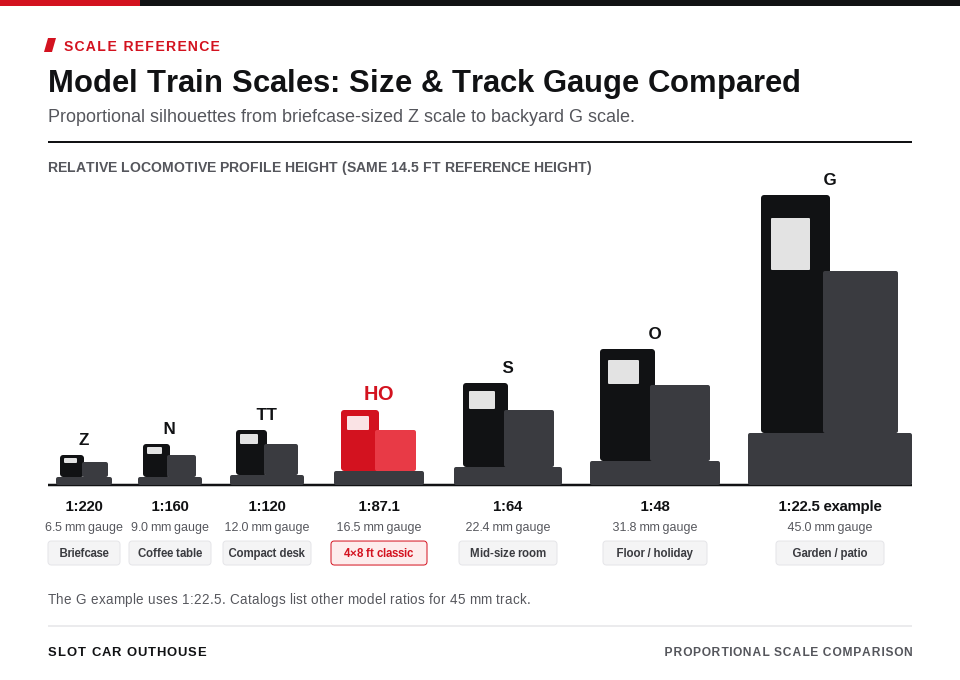
Deep dive into every major model train scale
Z scale (1:220): briefcase-sized engineering
Introduced by Märklin in 1972, Z scale shrinks an entire locomotive down to roughly the length of an adult thumb. You can build a fully scenic mountain railroad inside a guitar case, coffee table, or desk drawer.
The catch is physics: tiny wheels weigh almost nothing, so even a speck of dust on 6.5 mm rails can interrupt electrical pickup, and putting a derailed freight car back on the rails requires steady fingers or a rerailer ramp. Z scale rewards meticulous modelers with tiny footprints—primarily supported by Märklin, Rokuhan, and American Z Line (AZL).
N scale (1:160): maximum scenery per square foot
If you dream of watching a 30-car coal train snake across a canyon trestle—and you don't own a giant basement—N scale is the answer. Because N scale is roughly half the linear size of HO, it requires only one-quarter of the floor area for the same track plan. What feels like a cramped single oval in HO becomes a sweeping double-track mainline with a yard, river bridge, and town in N scale.
Modern N-scale technology has caught up remarkably with HO: brands like Kato, ScaleTrains, and Rapido now pack crisp graphics, LED lighting, and even factory DCC sound into N-scale locomotives. The main trade-off is ergonomics—coupling tiny cars, troubleshooting fine turnouts, and reading small car numbers can be frustrating for young kids or anyone with unsteady hands or tired eyes.
TT scale (1:120): the "tabletop" middle child
Literally named for Table Top, TT sits neatly halfway between N and HO—large enough to handle comfortably and show crisp details, small enough to fit generous loops on smaller boards. TT has long been beloved in Central and Eastern Europe, and Hornby's TT:120 push has sparked a major revival in the United Kingdom. In North America, however, TT remains a tiny niche with very limited US locomotive and building availability, so North American beginners are usually much better served by N or HO.
HO scale (1:87.1): the undisputed hobby standard
Roughly two-thirds of North American model railroaders model in HO ("Half-O")—and that market dominance creates a massive flywheel advantage for buyers. Every major brand (Kato, Bachmann, Athearn, Walthers, ScaleTrains, Rapido, Atlas, Peco) builds its deepest catalog in HO, from tiny brass-grade details to affordable starter sets, bridges, vehicles, and figures.
HO hits the physical sweet spot: locomotives are heavy enough for dependable electrical contact and rich bassier DCC sound speakers, parts are large enough to assemble and repair without magnifying headsets, yet a solid spare bedroom can host a rich multi-town railroad. Its only real limitation is space—modern long 85-foot passenger cars and big six-axle diesels look awkward and can derail on tight 18-inch curves, preferring 22- to 24-inch curves or wider.
OO gauge (1:76.2): the British favorite
If your heart belongs to British steam—the Flying Scotsman, Mallard, or classic Great Western branch lines—OO gauge is effectively the UK's equivalent of HO. Track, bridges, and curve footprints match HO closely (16.5 mm rail spacing), while the slightly larger 1:76.2 bodies give British prototypes satisfying presence. Hornby, Bachmann Branchline, Dapol, and Accurascale keep OO thriving with extraordinary detail.
S scale (1:64): authentic proportions, smaller community
Famously popularized by vintage American Flyer two-rail sets, S scale sits cleanly between HO and O—and happens to share the exact 1:64 ratio of true-scale diecast cars like Mini GT and GreenLight, making realistic roadside vehicles easy to source. Modern S scale looks terrific in person, with realistic two-rail track and commanding size, though its smaller product catalog and higher per-item prices make it a specialist choice rather than a mainstream starter scale.
O gauge (1:48): big, heavy, and built for family presence
O gauge splits into two worlds:
- Three-rail O ("Hi-Rail" / Lionel / MTH): Iconic American fun. Heavy trains, dramatic puffing smoke, loud speakers, easy snap-together FasTrack, and forgiving wheels that handle carpets and eager young engineers cleanly. Traditional 3-rail O can turn surprisingly tight 36-inch diameter circles (O-36) when running shorter rolling stock, making it king of holiday loops and family playrooms.
- Two-rail Scale O: Ultra-realistic museum modeling without the center third rail, demanding generous basement curves (48–72-inch radius) and deep pockets.
If you are specifically buying for younger children, compare O-gauge durability against HO and N in our guide to the best model train scale for kids.
G scale (1:22.5 to 1:29): the backyard garden railroad
G ("Garden") is technically a 45 mm track gauge shared by several large scales—most commonly 1:22.5 (European narrow gauge, pioneered by LGB), 1:24, 1:29 (US standard gauge), and 1:20.3 (US narrow gauge). Built with UV-stabilized plastics, heavy brass or stainless-steel rail, and sealed gearboxes, G-scale trains are designed to run outdoors through real dwarf conifers, stone retaining walls, and backyard water features. Many modern garden railroaders even skip track power altogether, installing onboard lithium batteries and wireless radio control so leaves and rainwater never interrupt a run.
Real-world room examples: what actually fits where
Forget abstract ratios for a moment and picture four real household spaces:
- Coffee table or dorm desk (2×4 feet): Z scale runs an impressive double loop with scenery; N scale fits a compact oval with tight 9.75-inch curves and short locomotives or trolley cars. HO will not turn around cleanly here.
- Classic 4×8-foot sheet of plywood: The legendary American starter board. In HO, you get a comfortable outer oval (18–22-inch radius) plus a passing siding and small town—great for four-axle diesels and 40- to 50-foot freight cars. In N scale, a 4×8 sheet feels gigantic, fitting sweeping broad curves, long passenger trains, mountain grades, and a full freight yard. In O gauge, a 4×8 sheet holds a tight O-36 or O-42 loop with room inside for a station and small town.
- Spare bedroom (10×12 feet, around-the-walls shelf layout): HO truly shines here—giving you 24- to 30-inch broad curves, big steam locomotives, multi-town operations, and natural staging yards while leaving the center of the room open to walk in. N scale in a 10×12 room can replicate an entire multi-state railway corridor.
- Backyard patio or garden bed (15×25+ feet): G scale territory—broad sweeping curves integrated right into landscaping beds and rockeries.
Before committing to lumber and track, test your exact floor plan in free or affordable model train layout software, then compare the top manufacturers in our best model train brands guide and browse starter options in our model trains hub.
Sources
Frequently Asked Questions
HO scale (1:87.1) is by far the most popular scale worldwide (outside the UK, where OO gauge leads). Because HO accounts for the largest share of the hobby, it offers the widest variety of locomotives, rolling stock, buildings, track pieces, and secondhand bargains—making it the easiest scale to grow with over time.
Yes, mechanically—both HO and OO run on 16.5 mm two-rail track using the same 12V DC or DCC electrical standards. However, OO train bodies (1:76.2) are roughly 14% larger than HO bodies (1:87.1), so check platform clearances, tunnel portals, and bridge heights—and note that British OO hook-and-loop tension-lock couplers do not mate directly with US HO knuckle couplers without conversion.
Choose HO if you want larger, easier-to-handle trains with maximum brand selection and are happy running short-to-medium trains on an oval with local switching. Choose N scale if you want long trains, sweeping curves, double-track mainlines, and big realistic scenery on that exact same 4×8 footprint.
HO stands for "Half-O"—literally half the size of traditional O gauge (roughly 1:87 vs. 1:43.5/1:48). N scale gets its name from the number nine, referring to its 9 mm track gauge (which starts with "N" in English, German Neun, French Neuf, and several other European languages).
Not anymore. While larger scales like O and G naturally give you bigger visible parts, modern injection molding and laser scanning allow HO and even N scale flagship models from ScaleTrains, Rapido, and Kato to rival—and sometimes surpass—traditional 3-rail O-gauge trains in fine prototype accuracy. Choose scale for space, handling comfort, and visual presence, not just detail density.