Best Model Train Scale for Kids of 2026
If you want a child to fall in love with model trains instead of walking away in frustration ten minutes after unboxing, buy bigger than your first instinct tells you. For kids ages five through eight, O-gauge or large battery-powered G-scale sets win hands down because chunky wheels drop cleanly onto the rails and survive living-room play. Once a child reaches eight to twelve, HO scale on snap-together roadbed track becomes the smarter long-term investment, opening up the largest catalog of locomotives and scenery in the hobby.
The core trade-off in kids' model railroading is handling forgiveness versus floor space. Larger scales look dramatic, resist breakage, and rerail in two seconds, but they demand a wide turning circle on the living room rug or under a holiday tree. Smaller scales pack elaborate towns and long freight trains onto a bedroom desk, yet their delicate wheels and microscopic couplers quickly test a young operator's patience. This guide breaks down the exact scales, track systems, and safety details that match each stage of childhood.
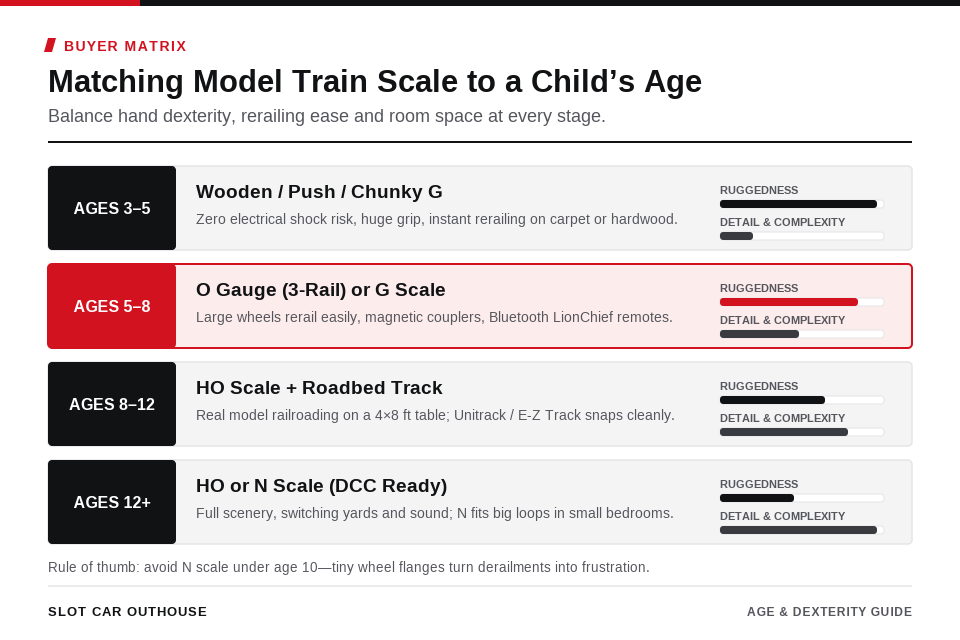
Matching train scale to your child's age
Model train scales describe how many times smaller the train is than the real prototype, while gauge measures the distance between the inside edges of the rails. If you want a complete breakdown of scale ratios and real-world dimensions, see our model train scales guide. When shopping for a child, though, forget prototype accuracy for a moment and focus on three practical factors: finger dexterity, drop durability, and how fast a derailed car goes back on the track.
| Child's Age | Best Scale / System | Typical Track Footprint | Power & Control | Why It Works at This Stage |
|---|---|---|---|---|
| 3–5 years | Wooden rail (Brio, Thomas) or Battery G-scale (Lionel Ready-to-Play) | 3 × 3 ft to 4 × 5 ft | Push-along or AA/C batteries + simple remote | Zero electrical hazards, magnetic or oversized hook couplers, rugged plastic or hardwood bodies |
| 5–8 years | O-gauge (Lionel LionChief) or Large G-scale (LGB, Bachmann Big Haulers) | 40 × 60 in oval (O-gauge) to 4 × 6 ft (G-scale) | Plug-in wall pack + handheld Bluetooth/RF remote | Heavy, sturdy cars rerail effortlessly; three-rail O-gauge simplifies track wiring; no tiny detachable details |
| 8–12 years | HO scale (1:87) with integrated roadbed track | 38 × 47 in oval minimum; 4 × 8 ft table ideal | Low-voltage DC throttle or entry-level DCC | Huge selection of real railroads, affordable rolling stock, teaches careful handling and track planning |
| 12+ years (Teens) | HO scale (1:87) or N scale (1:160) | 4 × 8 ft (HO) or 2 × 4 ft to 3 × 6 ft (N) | DC or Digital Command Control (DCC) with sound | Fine motor skills can handle N-scale couplers and scenery craft; teens appreciate realistic operations |
Ages 3 to 5: Tactile play comes before realism
Preschoolers interact with trains by picking them up, crashing them gently, and rearranging track mid-session. Electric metal rails and wall transformers have no place on a toddler's playroom floor. Wooden track systems like Brio and Thomas Wooden Railway remain undefeated here because magnetic couplers snap together in any orientation and the track pieces lock like puzzle parts without sharp edges.
When a four- or five-year-old is ready for a motorized engine with lights and whistle sounds, step up to an oversized battery-powered plastic set such as Lionel Ready-to-Play (roughly G-scale proportions on wide 50 mm plastic track). Because the engine runs on standard batteries and pairs with a chunky wireless dial remote, there are no exposed wall cords, no live metal rails to short-circuit with a dropped metal toy car, and no tiny handrails to snap off and become choking hazards.
Ages 5 to 8: The O-gauge and G-scale sweet spot
Between five and eight, kids want a "real" electric model train that hauls freight cars, puffs smoke, and blows a horn on command—yet they still bump track joints and lean on tables. This is where O-gauge (1:48) shines. Classic three-rail O-gauge sets, especially modern Lionel LionChief starter ovals, sit on hefty plastic roadbed track (FasTrack) with wide steel rails and deep wheel flanges.
Why does O-gauge rerail so effortlessly for a six-year-old? Physics and proportion. An O-gauge wheel flange is deep enough to catch the rail edge instead of skidding across it, and the car is large enough that a child can hold the body with one hand and feel the axles drop into place without needing surgical precision. Three-rail wiring also eliminates reverse-loop electrical shorts: the outer two rails share one polarity and the center rail carries the other, so kids can snap together figure-eights or turning loops without tripping a circuit breaker.
G-scale (1:22.5 to 1:29)—from brands like LGB or Bachmann Big Haulers—is the main alternative for this age bracket. G-scale locomotives are even bigger and virtually indestructible, built to survive backyard rain and dirt. The catch is size and price: a starter G-scale circle spans roughly four feet across before you add a single straight section, and individual locomotives cost noticeably more than O-gauge starter sets. If you have a patio or a dedicated playroom corner, G-scale is unforgettable; for most family living rooms, O-gauge hits the better balance.
Ages 8 to 12: Graduating to HO scale
By age eight or nine, most kids have the hand-eye coordination to line up metal wheels on 16.5 mm track and want trains that look like the freight or passenger equipment they see in real life. HO scale (1:87) is the global standard for a reason: it is large enough to inspect and rerail comfortably, small enough to build a town with sidings on a 4 × 8-foot sheet of plywood, and backed by every major manufacturer in our best model train brands guide.
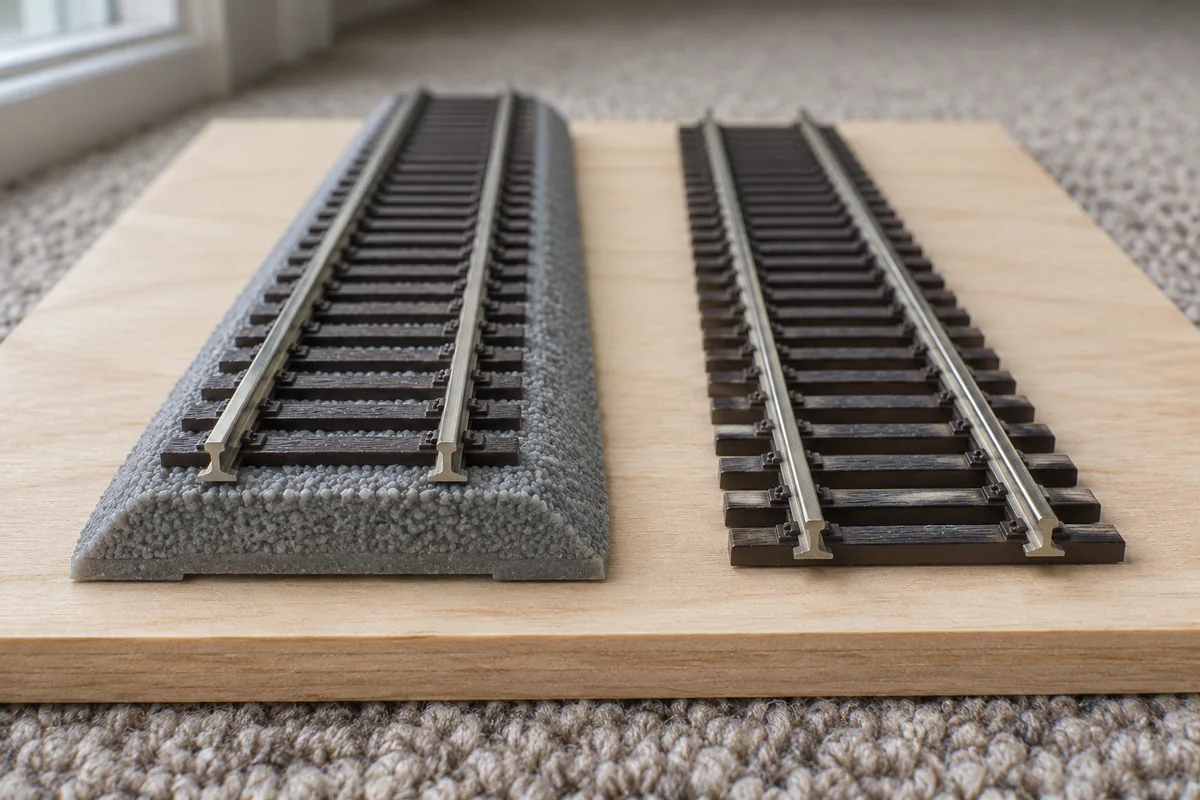
The single biggest upgrade you can make for an eight-to-twelve-year-old starting in HO is integrated roadbed track—specifically Kato Unitrack or Bachmann E-Z Track. Traditional bare rail track flexes when bumped, opens microscopic gaps at rail joiners, and causes maddening stalls. Roadbed track clicks together mechanically like interlocking tiles, keeps rail joints tight, and lifts the rails slightly off the floor or tabletop. Even better, starter sets often include a molded rerailer track section disguised as a grade crossing: roll a misaligned car across it, and angled plastic ramps automatically guide the flanges back onto the rails.
Ages 12 and up: HO scale or N scale for small rooms
Teens bring patience, an eye for realism, and often a tight bedroom footprint where a 4 × 8 table simply will not fit. At twelve and up, both HO and N scale (1:160) open up completely. If your teenager wants to run long double-stack container trains, weave tracks around mountains, and fit an entire switching layout on a 2 × 4-foot tabletop or hollow-core door, N scale delivers twice the railroad in half the linear space.
For teens who prefer heavy locomotives with rich onboard sound speakers, detailed cab interiors, and easier DIY weathering or kitbashing, HO remains the easier canvas to work on. Browse current starter sets and locomotives across scales in our model trains category to compare footprint requirements against your available space.
Why N scale frustrates younger children
Parents frequently eye N scale at hobby shops because a full oval fits neatly on a coffee table. For kids under ten or twelve, however, N scale is the fastest way to kill interest in the hobby.
The problem starts with raw geometry. N-scale rails sit just 9 millimeters apart—barely wider than a standard pencil. Each freight car weighs less than an ounce and rolls on wheel flanges thinner than a fingernail. When a seven-year-old tries to place a four-axle N-scale boxcar on the track, getting all eight tiny wheels seated simultaneously feels like threading a needle on a moving bus. Miss by half a millimeter on one axle, and the car bumps three inches down the track before tipping over and taking the rest of the train with it.
Couplers compound the headache. Tiny knuckle or Rapido couplers require delicate alignment and gentle downward pressure to uncouple; rough handling bends the microscopic trip pins or pops the coupler box clean off the chassis. Add lightweight locomotives that stall at the slightest speck of dust on the rails, and a young child spends eighty percent of playtime asking an adult for help instead of driving the train. Save N scale until your child has the patience and steady hands to enjoy precision modeling.
Carpet lint: the silent killer of kids' model trains
Almost every starter train set gets assembled on a living room rug at least once. On low-pile rugs with battery-powered plastic toys, that is fine. On precision electric HO, N, or even O-gauge locomotives, running directly on medium- or high-pile carpet is mechanical sabotage.
Look underneath a motorized locomotive and you will see exposed drive gears, axle bearings, and spinning worm shafts coated in a light film of plastic-safe grease. As the train rolls a fraction of an inch above carpet fibers, static electricity and airflow pull stray carpet fuzz, pet hair, and dust straight into the gear tower. Within a couple of hours, those fibers wind tightly around the axles like fishing line around a boat propeller. The symptoms show up quickly:
- The engine slows down and requires higher throttle settings just to crawl.
- The motor casing grows noticeably warm to the touch as it fights bound-up axles.
- In worst cases, stripped plastic spur gears or a burned-out motor armature sideline the locomotive permanently.
Carpet also creates an uneven track bed. As a heavy locomotive rolls over soft padding, individual track joints sag and twist, causing uncouplings on straightaways and intermittent electrical contact.
Three easy fixes keep trains healthy without building a permanent bench:
- Use snap-together roadbed track (Lionel FasTrack, Kato Unitrack, or Bachmann E-Z Track) on hardwood, tile, or laminate flooring—never bare sectional rail on carpet.
- Lay down a rigid base if the playroom only has carpet: a 4 × 6 or 4 × 8 sheet of 1-inch extruded foam insulation board (lightweight enough to slide behind a sofa or under a bed) or a folding plastic banquet table creates a dead-flat, lint-free surface.
- Inspect axles periodically: flipping a locomotive over once a month and pulling out stray hairs with fine tweezers prevents ninety percent of premature gear failures.
Electrical safety and kid-friendly controllers
Modern electric model trains are remarkably safe when used with factory-supplied equipment, because the wall transformer steps household 120V AC power down to low-voltage track power—typically 12V DC for HO and N scale, or 14V–18V AC/DC for O-gauge. That voltage will not give a healthy child a dangerous shock, though touching metal tools across both rails can spark and heat up a wire if a power pack lacks quick-trip overload protection.
Still, controller design has evolved dramatically over the past decade, and choosing the right power setup makes a huge difference for young operators:
- Wall-wart DC power packs with plug-in connectors: Modern starter sets from Lionel, Bachmann, and Kato ship with UL-listed sealed power bricks that plug into a lock-on track terminal—no exposed screw terminals carrying line voltage, unlike vintage 1950s–1970s metal transformers. If you inherit grandpa's old steel transformer with frayed cloth cord, display it on a shelf and buy a modern UL-listed power supply for daily running.
- Wireless Bluetooth and RF remotes (like Lionel LionChief): These keep the child away from the wall outlet completely. Track power stays at a constant safe voltage, while the child walks around the room with a battery-powered handheld throttle—or an app on a tablet—controlling speed, reverse, bell, whistle, and announcements.
- Simple rotary dials beat tiny pushbuttons: For ages five to ten, a physical knob that rotates clockwise for faster and clicks back to zero for stop builds instant spatial intuition. Complex DCC cab keypads with thirty numbered function buttons overwhelm beginners; stick to simple DC or handheld wireless sets until the child asks to run multiple locomotives independently on the same loop.
- Thermal circuit breakers: Always confirm the starter power pack includes automatic short-circuit shutdown. When a metal toy truck or derailment bridges both rails, a modern pack cuts power cleanly until the obstruction is cleared and you reset the throttle.
Practical buying rules before you check out
Before clicking buy on a shiny box at the hobby shop or online, run your candidate set through five quick filters:
- Buy a complete starter set first—never piece-meal. A boxed set from Lionel, Kato, Bachmann, or LGB guarantees compatible couplers, matched track radius, a properly rated power supply, and a locomotive that actually pulls the included cars out of the box.
- Match curve radius to your actual floor space. An O-gauge O-36 oval measures roughly 40 × 60 inches; an HO 18-inch radius oval measures about 38 × 47 inches. Measure the exact open patch of floor or table first so the track does not block a bedroom door.
- Avoid ultra-cheap department-store "toy" HO sets with pancake motors. Generic no-name plastic train sets with flimsy snap track derail constantly and cannot be repaired or expanded. Stick to established hobby brands with nickel-silver rails (for HO/N) or steel roadbed track (for O-gauge) that accept standard expansion packs later.
- Prioritize play features kids actually use. Working headlights, whistle/horn buttons, a manual uncoupling track section, and one or two operating accessories (like a grade crossing gate or unloading dump car) hold a child's attention ten times longer than museum-grade rivet detail.
- Plan one expansion step ahead. Check that you can easily buy an extra figure-eight pack, a single turnout (switch) for a passing siding, and two extra freight cars later for birthdays—nothing sparks creativity like adding a spur track to park cars.
Sources
- NMRA — Beginner's Guide to Model Railroading & Scale Standards
- Lionel Trains — Getting Started with O-Gauge and Ready-to-Play Sets
- Kato USA — Unitrack Track Systems and Starter Set Information
- Bachmann Trains — E-Z Track System and Scale Overview
- U.S. Consumer Product Safety Commission — Toy Safety & Small Parts Guidelines
Frequently Asked Questions
O-gauge (1:48), especially a Lionel LionChief starter set with FasTrack, is the best overall fit for a seven-year-old. The locomotive and cars are hefty enough to resist drops, the wide rails and deep wheel flanges make rerailing quick and frustration-free, and the wireless handheld remote lets kids control speed and sound safely away from the wall outlet.
No—age eight is right when most kids develop the finger control needed for HO scale, provided you pair the set with integrated roadbed track like Kato Unitrack or Bachmann E-Z Track and include a rerailer track section. Avoid bare sectional track without roadbed, which shifts easily and causes frequent derailments.
Modern starter sets from major brands use UL-listed wall transformers that step household current down to low-voltage 12V–18V power on the rails, which is safe to touch during normal play. However, corded power supplies, metal rail joiners, and small detachable parts make electric trains best for ages five and up with adult supervision—stick to wooden or battery-powered sets for toddlers ages three to five.
You should avoid running electric trains directly on medium- or high-pile carpet. Carpet fibers and pet hair get pulled into greased axle gears, causing sluggish performance and burned-out motors, while soft padding lets track joints sag. If the room is carpeted, set roadbed track on top of a rigid foam board, plywood sheet, or folding table.
Hold off on full DCC systems until a child is around ten to twelve and specifically wants to run two or more locomotives independently at different speeds on the same track loop. Younger children enjoy simple rotary throttles or single-train wireless remotes much more than juggling locomotive addresses and multi-button function keypads.