Best Model Airplane Brands of 2026
If you want a plastic model airplane kit that goes together cleanly without turning into a battle with gap-filling putty and sanding sticks, Tamiya is the gold standard. Its parts align with precision, its instructions read effortlessly, and its modern releases reward builders at every skill level. For sharper surface rivets and built-in aftermarket upgrades, Eduard delivers unmatched value in 1:48 and 1:72; Airfix and Arma Hobby dominate modern small-scale WWII fighters; and Meng and Great Wall Hobby push modern jet engineering to startling levels of complexity.
Before you buy any brand, though, there is one insider rule that saves beginners more frustration than anything else in scale modeling: mold tooling age matters just as much as the logo on the box. Plastic model companies routinely reuse steel injection molds for thirty, forty, or even fifty years, slapping fresh box art and new decals onto 1970s plastic. That is why two $35 kits from the same brand sitting side by side on a hobby-shop shelf can feel like two different centuries of engineering.
The single most important rule: always check tooling age
Steel injection molds cost tens of thousands of dollars to machine, so manufacturers keep them in circulation for decades. A kit labeled "New Release 2025" might simply be a rebox—new paint schemes and fresh cardboard packaging wrapping sprues originally cut by hand in 1976.
What changed between 1976 and today? Everything:
- Old-tool kits (pre-1990s): Often feature raised panel lines (which vanish the moment you sand a seam), sparse cockpits, thick clear canopies, soft details, and noticeable wing-root gaps that demand modeling putty and patience. They can still build into great models, and nostalgia keeps them alive—just don't confuse them with modern engineering.
- Modern CAD-tooled kits (2010s–present): Designed digitally with laser-scanned museum airframes and slide-molding—a multi-directional mold technique that casts hollow gun barrels, one-piece intakes, and crisp recessed rivets without ugly center seams. Wings click onto fuselages with positive tabs, panel lines stay razor-sharp, and assembly requires far less model glue and putty cleanup.
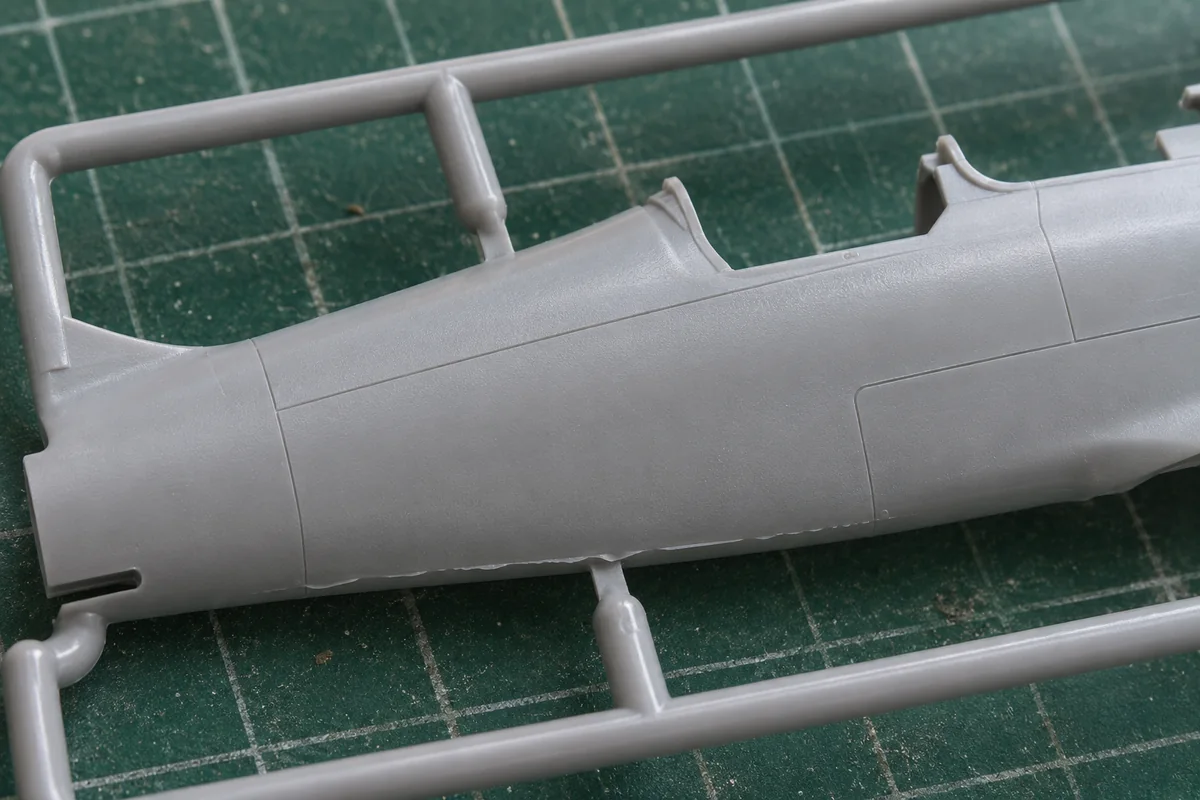
Practical pro habit: Before buying any kit, search its kit number on Scalemates.com (the hobby's free community database). Scroll to the product timeline: it tells you instantly whether you are buying a brand-new mold ("New tool") or a decades-old rebox ("New decals / New box"). That thirty-second check prevents 90% of beginner disappointment.
Picking your scale: 1:72 vs. 1:48 vs. 1:32
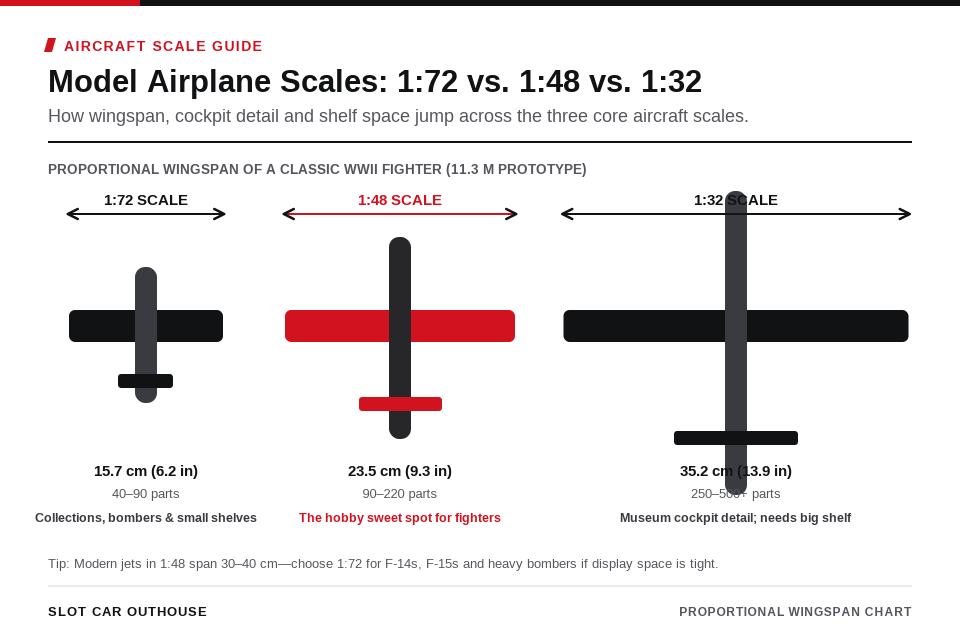
Scale determines how big the finished plane sits on your shelf, how tiny the cockpit parts get, and how much paint you'll burn through:
- 1:72 scale (the collector's scale): A WWII fighter like a P-51 Mustang measures roughly 5.5 inches across; a four-engine B-17 bomber stays displayable at about 17 inches. It is the most affordable scale, offers the widest variety of obscure aircraft, and lets you build an entire squadron without taking over a room.
- 1:48 scale (the all-around sweet spot): A WWII fighter spans 8 to 10 inches—large enough for richly detailed cockpits, visible instrument dials, and realistic weathering without demanding a giant display cabinet. Most modern flagship kits from Tamiya, Eduard, and Great Wall Hobby target 1:48.
- 1:32 scale (the museum centerpiece): A single WWII fighter stretches over a foot wide, and a modern F-14 or F-15 jet dominates a whole coffee table. Expect hundreds of parts, intricate landing-gear bays, higher kit prices ($80–$200+), and weeks of rewarding bench time. (1:144 scale also exists for commercial airliners and massive strategic bombers.)
Best model airplane brands compared
| Brand | Origin | Best Scales | Engineering & Fit | Detail Level | Typical Price | Watch-Outs | Best Fit |
|---|---|---|---|---|---|---|---|
| Tamiya | Japan | 1:48, 1:32, 1:72 | Benchmark (nearly effortless) | Crisp, balanced | Mid to High ($25–$160) | Some 1970s/80s kits remain in catalog | Beginners, returning builders & stress-free builds |
| Eduard | Czechia | 1:48, 1:72 | Excellent (modern tools) | Very High (rivets + PE) | Mid ($20–$70) | Tight tolerances—dry-fit before gluing | Intermediate to advanced WWII enthusiasts |
| Airfix | UK | 1:72, 1:48, 1:24 | Very Good (modern new-tools) | Good to High | Budget to Mid ($12–$100) | Softer plastic; avoid vintage reboxes unless nostalgic | Beginners & RAF/WWII aviation fans |
| Hasegawa | Japan | 1:72, 1:48 | Good to Very Good | Clean, accurate outlines | Mid ($25–$75) | Often sparse ordnance; pricier outside Japan | Classic WWII & Japanese/US jets |
| Revell | Germany / US | 1:72, 1:48, 1:32 | Highly Variable | Mixed | Budget to Mid ($15–$80) | Huge mix of 1960s molds & great modern kits | Budget shoppers who check Scalemates first |
| Meng & Great Wall Hobby | China | 1:48, 1:72 | High (complex modern CAD) | Exceptional | High ($55–$130) | High part counts; slower, meticulous builds | Modern supersonic jets & detail perfectionists |
| Arma Hobby | Poland | 1:72, 1:48 | Very High | Exceptional for 1:72 | Mid ($25–$55) | Small catalog focused on WWII fighters | Dedicated 1:72 builders wanting jewel-like detail |
| Academy / HobbyBoss / Trumpeter | Korea / China | 1:72, 1:48, 1:32 | Good (varies by kit) | Solid to High | Budget to Mid ($15–$120) | Check reviews for occasional shape quirks | Value hunters & unusual aircraft subjects |
Deep dive into the top model airplane brands
Tamiya: the engineering gold standard
If you built plastic models as a kid and remember crooked wings, cloudy glue smears, and parts that refused to line up, building a modern Tamiya kit feels like magic. Tamiya obsesses over buildability: seam lines are hidden along real panel joints, internal wing spars lock dihedral angles automatically, and parts fit with such precision that thin liquid cement pulls joints shut invisibly.
Classic highlights include the 1:48 P-51D Mustang, Spitfire Mk.I (2018 new tool), P-38 Lightning, F-14A Tomcat, and F-35A, plus Tamiya's breathtaking 1:32 Spitfire and Corsair kits. Tamiya sometimes omits hyper-fine surface riveting that rivet-counting builders love, favoring crisp recessed panel lines and bulletproof assembly instead. For most hobbyists, that is a trade worth making every single time.
Eduard: the detail and value powerhouse
Based in the Czech Republic, Eduard started out making photo-etched brass upgrade parts before becoming one of the world's finest kit manufacturers. Its modern 1:48 and 1:72 WWII fighters—Spitfires, Bf 109s, Fw 190s, P-51 Mustangs, and Zeros—feature ultra-fine recessed rivet patterns and crisp cockpit detail.
Eduard's smart packaging tiers make shopping simple:
- Weekend Edition: Just the plastic sprues and decals at a friendly price—no photo-etch or masks. Ideal if you want great modern plastic without tiny brass parts.
- ProfiPACK: The hobby's best all-in-one value. For roughly $10–$15 more, you get pre-painted photo-etched brass (thin metal instrument panels and seatbelts), die-cut kabuki-tape canopy paint masks (saving hours of tedious window masking), and four to six decal schemes printed cleanly.
One practical tip with Eduard: its engineering tolerances are razor-tight. Even a thick coat of primer on a mating flange can throw off fuselage alignment, so scrape paint off glue surfaces and dry-fit every subassembly first.
Airfix: Britain's comeback story
For generations, Airfix was synonymous with pocket-money kits bought at corner shops—charming, cheap, and famously rough around the edges. Over the last fifteen years, however, Airfix invested heavily in 3D laser-scanning full-size museum aircraft and rolling out crisp new-tool kits in 1:72, 1:48, and massive 1:24 scale (like its Spitfire Mk.IXc and Hellcat).
Airfix's modern Starter Sets (red boxes) and newer 1:72 WWII subjects—Spitfires, Hurricanes, Lancasters, and Mosquitoes—offer friendly part counts, sturdy landing gear, and accessible prices. Just note two quirks: Airfix's light-gray plastic is slightly softer than Tamiya's (so cut gently with a sharp hobby blade), and its Vintage Classics line deliberately reissues 1950s–1970s molds for nostalgic collectors.
Hasegawa: clean outlines and classic breadth
Hasegawa dominated the 1990s and early 2000s with an enormous catalog of Japanese, American, and European aircraft in 1:72 and 1:48. Its kits are praised for accurate silhouettes and crisp panel lines, though they often feel more minimalist inside cockpits and wheel wells than newer Eduard or Meng kits—and many Hasegawa jet kits don't include underwing missiles or bombs (sold separately in Hasegawa weapon sets). Still, for subjects nobody else makes well—like Macross sci-fi fighters, classic twin-engine WWII bombers, or specific Phantom and Starfighter variants—Hasegawa remains indispensable.
Revell: ubiquitous, affordable, and wildly mixed
Walk into almost any big-box craft store in the US or Europe and you will see shelves of Revell. Because Revell merged historic US (Revell-Monogram) and German (Revell AG) catalogs, its lineup is the ultimate mixed bag. Some kits—like the Revell Germany 1:32 Spitfire Mk.IIa, 1:48 F-15E Strike Eagle, and 1:72 modern RAF jets—are terrific values. Others are 1960s molds with raised rivets and finicky fit that can discourage a first-time builder. Never judge a Revell box by its glossy cover painting; look up the mold year first.
Meng and Great Wall Hobby (GWH): modern jet engineering marvels
If your passion leans toward modern supersonic fighters—F-14 Tomcats, F-15 Eagles, Su-27/35 Flankers, F/A-18 Super Hornets, or stealth jets—Meng and Great Wall Hobby sit at the bleeding edge. Both brands deploy advanced slide-molding to cast single-piece exhaust nozzles, crisp missile fins, open avionics bays, and jaw-dropping cockpit tubs.
They are not quick weekend builds. Expect dense sprue trees, higher part counts, and premium price tags—best enjoyed once you have a few simpler kits under your belt and a reliable setup from our best model paint brands and best airbrush brands guides.
Arma Hobby: the 1:72 scale perfectionists
Polish boutique maker Arma Hobby has quickly become a cult favorite among 1:72 builders. Focusing on iconic WWII fighters—P-51B/C Mustangs, P-39 Airacobras, Hurricanes, Wildcats, and Ki-84 Franks—Arma squeezes 1:48-level surface detail, delicate cockpit framing, and thoughtful engineering into compact 1:72 airframes. Its kits build cleanly and prove that small scale no longer means toy-like detail.
Academy, Trumpeter, and HobbyBoss: broad catalogs and clever value
- Academy (South Korea): Known for dependable, reasonably priced 1:72 and 1:48 kits (like its crisp 1:48 F-4 Phantom II series) and great Cartograf decals on many modern releases.
- Trumpeter & HobbyBoss (China): Sister companies with a staggering catalog of rare Cold War jets, huge 1:32 aircraft, and unusual prototypes no other maker touches. HobbyBoss also produces Easy Assembly 1:72 WWII kits with one-piece fuselage/wing cores—fantastically fun weekend builds for kids or beginners learning to airbrush and weather.
Practical skill-level matching: what to buy first
Pick your next kit from our model kits hub using three simple rules:
- First kit ever (or first kit in twenty years): Buy a modern Tamiya 1:48 WWII single-engine fighter (like the P-51D, Spitfire Mk.I, or Zero) or a HobbyBoss Easy Assembly 1:72 kit. Avoid complex multi-engine bombers, biplanes with wing rigging, and glossy natural-metal finishes on your first build—matte olive drab or two-tone gray camouflage hides beginner brush or airbrush imperfections forgivingly.
- Stepping up to serious detail: Grab an Eduard ProfiPACK 1:48 or Arma Hobby 1:72 kit to experience canopy masks and photo-etched cockpit accents without hunting down separate aftermarket parts.
- Ready for a long-term showcase project: Tackle a Tamiya 1:32 WWII fighter or a Meng / Great Wall Hobby 1:48 jet, where engineering precision rewards every extra hour spent painting and weathering.
Sources
Frequently Asked Questions
Tamiya is the easiest recommendation for adults and older teens because its parts fit cleanly and its instructions are clear, keeping the focus on learning gluing and painting rather than wrestling warped plastic. For younger builders or tighter budgets, Airfix Starter Sets (modern new-tool releases) and HobbyBoss Easy Assembly kits keep part counts friendly and build fast.
Check the kit's catalog number on Scalemates.com. The site shows a visual family tree for nearly every kit ever produced, marking the original year the plastic molds were cut ("New tool") and every subsequent reissue ("New box" or "New parts"). You can also look at the copyright year molded inside the box—though watch out, as some brands print the year of the box art rather than the mold.
Most hobby-grade kits include only plastic parts, clear canopy pieces, decals, and instructions—no glue, paint, or brushes. Only specific "Starter Sets" (such as Airfix Starter Sets or select Revell Gift Sets) include basic pots of acrylic paint and tube glue, and even then, stepping up to thin liquid plastic cement and dedicated hobby paints makes assembly much cleaner.
Choose 1:72 if you have limited shelf space, want lower kit prices, or dream of building large multi-engine bombers and big collections side by side. Choose 1:48 if you want larger parts that are easier on the eyes and fingers, richer cockpit detail, and the widest range of modern flagship kits from Tamiya and Eduard.
Photo-etch (PE) consists of ultra-thin, chemically etched brass sheets used to represent seatbelts, delicate radar antennas, and crisp instrument panels that injection-molded plastic cannot render thin enough. You never need it—standard plastic kits look great without it—and it requires superglue (cyanoacrylate) rather than plastic cement, so treat it as an optional upgrade once you are comfortable with basic assembly.