Best RC Planes of 2026

A first RC flight goes one of two ways: the plane climbs out smooth and level and you're hooked, or it cartwheels into the grass before you've touched the stick. Price rarely decides which. How much help the plane offers does, through stabilization that fights the wind, a beginner mode that limits bank angle and a throttle you can manage inside a ballfield.

Two things surprise new pilots. Wind matters enormously, and above roughly 10 mph even a stabilized trainer becomes a wrestling match. Charging eats much of the first weekend, so a second battery pack is worth more than a bigger motor. We flew 11 planes, from a palm-sized indoor flyer to a meter-plus trainer, mostly in the calm hour after sunrise on an empty school field, and every pick flies again after a bad landing.

Our Top Picks

The Best RC Planes

1.

Volantexrc P51D Mustang Best Overall
Red Volantexrc P51D Mustang foam RC plane with propeller and transmitter

First-time pilots

Track Score 85/100
Flight Modes
Beginner, intermediate, expert
Radio
4-channel 2.4GHz
Included Batteries
Two LiPo packs
Material
Foam
View on Amazon

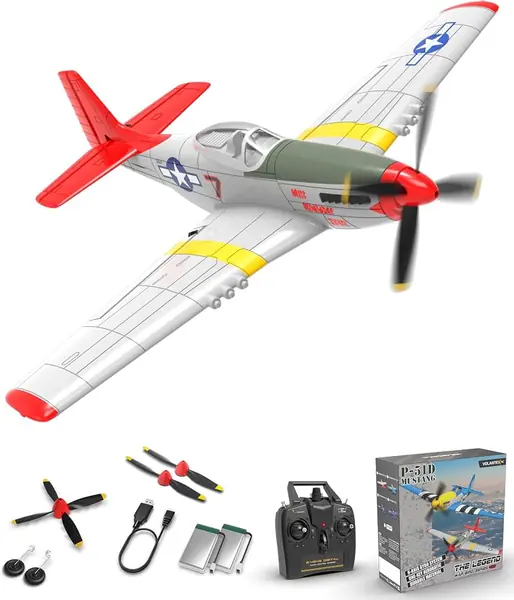
The P51D earns our top spot because it arrives as a complete four-channel package: transmitter, two LiPo packs, charging cable, and a gyro that switches between beginner, intermediate, and expert assist. For a first-time pilot, that means a hand launch in beginner mode, a plane that levels itself, and manual aerobatics saved for later. We spent most of our early flights in beginner mode and found the step to intermediate useful rather than abrupt.

The warbird shape is a crowd-pleaser, but it is not the calm high-wing trainer some beginners need; it carries more speed and stays on the wing rather than floating. In light wind it feels sporty, and the one-button roll is fun once you have altitude. We like that the gearbox and motor give it enough thrust to climb out of a clumsy turn.

Two batteries are a real convenience: you can fly one, swap, and keep the session going without waiting on a charger. The foam airframe is light and repairable, and the four-channel layout leaves room for aileron practice after the assist comes off. If you want the simplest possible trainer, the Carbon Cub below is the calmer teacher; if you want one box that covers learning and sport flying, this is our pick.

Worth Noting

  • Foam nose can crack in hard arrivals
  • Prop mount can break in nose-overs
Our Verdict

We recommend the Volantexrc P51D as the best all-around first RC plane because it includes two batteries, three assist modes, and four-channel control that leaves room to grow.

Check Latest Price
2.

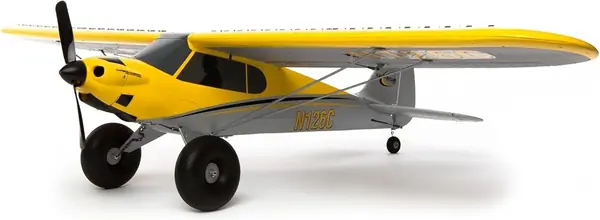
HobbyZone Carbon Cub S 2 Best Hobby-Grade Trainer

White HobbyZone Carbon Cub S 2 trainer plane with long wings and landing gear

Hobby-grade training

Track Score 84/100
Flight Modes
Beginner, intermediate, experienced
Radio
Spektrum DXS 2.4GHz
Wingspan
1.3 meters
Battery And Charger
Sold separately
View on Amazon

A 1.3-meter wingspan and SAFE flight envelope define the Carbon Cub S 2. It arrives with the airframe, Spektrum DXS radio, brushless motor, and servos installed. The three flight modes move from full assist to intermediate to experienced at the flip of a switch.

We like the calm, high-wing manners that make a first solo possible. The Cub is easy to see at distance, and the brushless power climbs without feeling twitchy. The airframe is repairable, and replacement parts are part of the hobby-grade appeal; this is a plane you can keep flying rather than throw away after a hard arrival.

For a committed beginner or a returning pilot, the stability and growth path are worth it. If you want a complete box for less, the Volantex is the easier entry.

Worth Noting

  • Battery and charger sold separately
  • Needs a large open flying area
Our Verdict

We steer committed beginners to the Carbon Cub when they want a calm, repairable trainer, but they must budget for a LiPo battery and charger.

Check Latest Price
3.

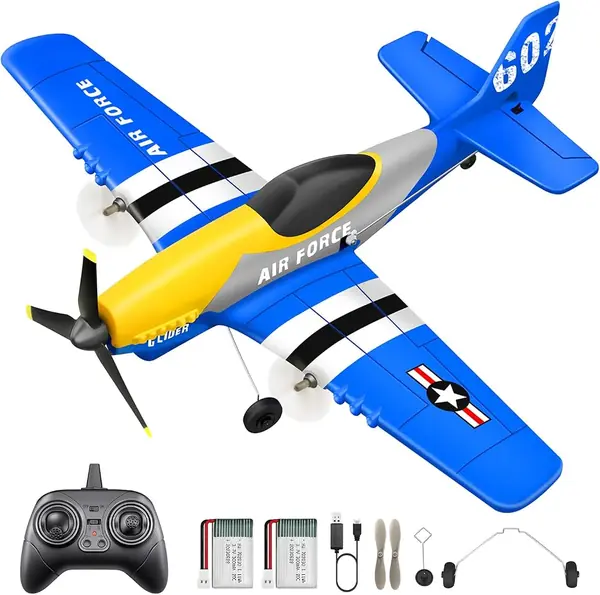
HAWK'S WORK P-51D Mustang 3CH Best for Young Beginners

Blue HAWK'S WORK P-51D Mustang foam RC plane with propeller and wheels

Young beginners

Track Score 83/100
Stabilization
6-axis gyro
Included Batteries
Two rechargeable packs
Channels
3
Takeoff Modes
Hand launch or taxi
View on Amazon

The 3-channel P-51D is aimed at a kid who has outgrown a two-channel toy but is not ready for a full four-channel warbird. It has a 6-axis gyro, high and low speed settings, and two takeoff options: a hand launch or a short taxi run. The two rechargeable packs are a nice touch because a young pilot rarely stops after one battery.

We like the EPP foam airframe for its flex and repairability. The plane is light enough to survive a clumsy landing, and the gyro keeps it from snapping into a spiral when the stick inputs get choppy. The 3-channel layout keeps the controls simple.

The included charger and two batteries make it a complete gift, and the P-51 shape gives it more presence than a plain glider. It is still a small foam plane, so keep the landing area clear. For a young beginner who wants a warbird look without a four-channel workload, this is our pick.

Worth Noting

  • Small foam airframe is wind-sensitive
  • Three channels omit aileron control
Our Verdict

We like the HAWK'S WORK 3CH for kids ready to move beyond a toy glider, thanks to its gyro, two batteries, and simple three-channel control.

Check Latest Price
4.

SYMA X550 Best Toy-Grade Stunt Plane

Green SYMA X550 tiltrotor RC plane with military-style body and propellers

Stunt-loving kids

Track Score 82/100
Control
4-channel
Stunt Moves
Six
Speed Settings
Two
Takeoff And Landing
One-key
View on Amazon

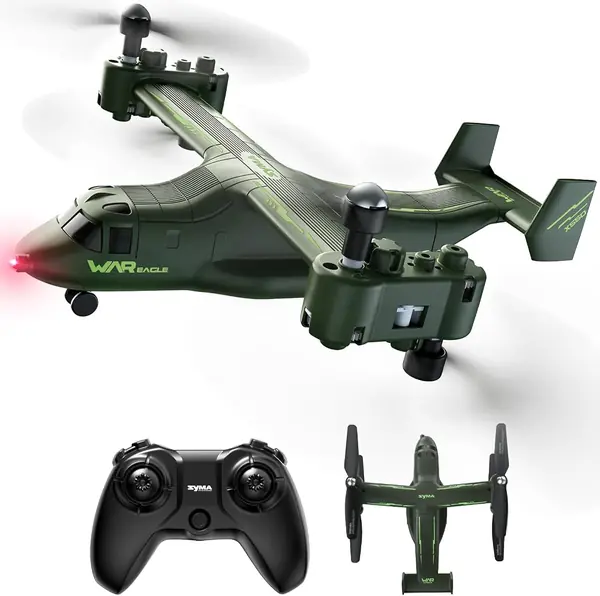
The X550 is a toy-grade stunt plane. Its military-style body looks good on a shelf, and the six stunt moves, one-key takeoff and landing, and two speed settings are designed to deliver instant spectacle. We like it for kids who want flips and circles without the pressure of a full hobby setup.

The 4-channel control is more natural than a two-stick toy, and the altitude hold makes it smoother to manage. In light wind it is stable enough for a backyard session, and the one-key landing brings it down without a hand catch.

The X550 is best understood as a toy for short, attention-grabbing flights. It earns its place for a kid who wants a cool-looking plane that does tricks, and it is honest about being a toy.

Worth Noting

  • One battery means downtime between flights
  • Not a true manual-flight trainer
Our Verdict

We see the SYMA X550 as a stunt toy for kids, not a trainer, and its one-battery package suits short backyard sessions.

Check Latest Price
5.

E-flite UMX Night Vapor Best Indoor Flyer

Yellow E-flite UMX Night Vapor slow flyer with LED lights and transmitter

Indoor night flying

Track Score 81/100
Stabilization
AS3X and SAFE Select
Battery
150mAh 1S LiPo included
Lighting
Factory-installed LEDs
Flight Area
Indoor or calm outdoor
View on Amazon

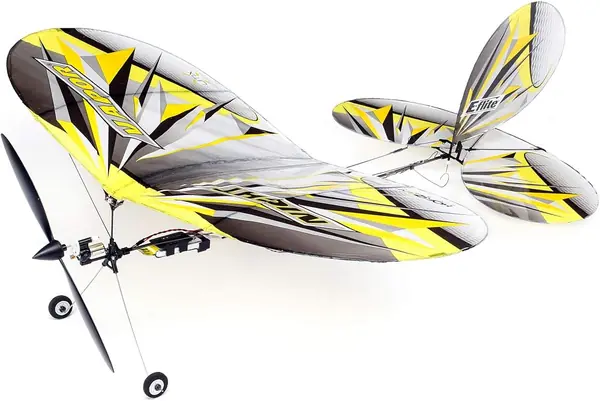
The Night Vapor is a slow flyer with factory LED lights, AS3X stabilization, and SAFE Select. It can fly in a large room or a calm backyard when the air is dead. We like that it turns a small space into a flying site, which is something none of the bigger warbirds here can do.

The airframe is light, and the lights make dusk flights feel like a small event. It flies slowly enough to hover and make walking-speed passes, which is a different pleasure from a fast warbird. The ready-to-fly box includes the battery, so a first charge is all that stands between you and a test flight.

For a beginner with a gym or a sheltered yard, the Night Vapor is a low-stress way to build orientation and throttle control. It is a niche plane, but it makes that niche feel special.

Worth Noting

  • Fragile prop shaft and motor mount
  • Cannot handle more than calm air
Our Verdict

We keep the Night Vapor for calm indoor and dusk flights; it is fragile and wind-shy, but it makes small spaces flyable.

Check Latest Price
6.

LEAMBE P51 Mustang

White LEAMBE P51 Mustang foam RC plane with propeller and landing gear

Aerobatic practice

Track Score 80/100
Flight Modes
Beginner, intermediate, experienced
Wingspan
15.75 inches
Radio Range
656 feet
Propeller Saver
Yes
View on Amazon

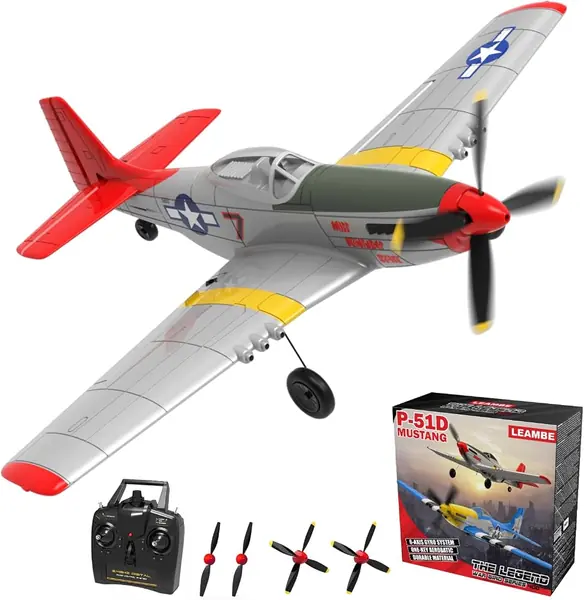
The LEAMBE P51 is the larger four-channel alternative: a 15.75-inch wingspan, three flight modes, a 656-foot stated radio range, and a propeller-saver mount that lets the prop pop off instead of snapping in a rough landing. It is aimed at pilots who want a warbird with a bit more presence than the tiny 3-channel toys.

We like the prop-saver design because it turns a common crash repair into a quick reinstall. The plane flies with the same 4-channel layout as our top pick, so it can teach aileron control and aerobatics. The foam airframe is light, and the prop saver is the feature that matters most in a rough landing.

The P51 is a good second plane or a larger park flyer, but it does not beat the Volantex on completeness or the Carbon Cub on trainer manners. It is a solid choice if you want a 4-channel warbird with a prop saver and a bit more wingspan. Just check the prop saver after every hard arrival.

Worth Noting

  • One battery limits flight time
  • Landing gear is fragile on grass
Our Verdict

We recommend the LEAMBE P51 as a larger four-channel alternative with a prop saver, though it is less complete than our top pick.

Check Latest Price

How We Tested the Best RC Planes

We started with manuals rather than marketing copy, since the box contents decide whether a plane flies on day one. We filtered for channel count, whether a transmitter, battery, and charger were actually included, wingspan and how visible it stays against a gray sky, and whether props, wings, and landing gear could be reordered. That narrowed the field to 11 planes, from toy-grade flyers to a meter-plus hobby trainer.

Testing ran six months, mostly in the calm first hour after sunrise on an empty school field, well away from people, pets, and overhead lines. The indoor model flew in a basketball gym on rainy weekends; the lit-up one got a mowed park at dusk. We hand-launched and taxi-launched, ran each pack flat with a stopwatch to see what flight time actually looked like, and separated what came in the box from what we had to go buy.

Wind was the great divider. We flew every plane on a still morning and again in an honest 8 to 10 mph breeze, watching whether beginner mode held a heading or drifted downwind, and whether the plane leveled itself when we let go of the sticks. Then we handed the transmitter to first-time pilots, kids included and within each maker's age recommendation, and timed how long it took them to make a controlled landing.

Hard landings are part of the job, so after every nose-over we pulled the battery, kept hands and faces clear of the prop, and checked the prop mount, nose foam, and wing attachments. We noted whether a prop saver did its work, whether replacement parts screwed on or needed glue, and how long a repair kept a plane grounded. Packs were charged on the supplied chargers, never unattended.

How to Choose an RC Plane

Match the plane to your flying space

A micro or slow flyer can work in a large room, a sheltered backyard, or a quiet park at dusk; a 1.3-meter trainer needs a real field with room for a wide turn and a long landing approach. Wind is the other half of the space question. Light foam planes get pushed around, so a calm morning is worth more than a bigger motor. If your only flying site is a small yard, start with a slow indoor model or a tiny toy-grade plane rather than a four-channel warbird.

We prioritize a plane that can be hand-launched and landed on grass if your field is rough. Wheels are nice on pavement, but they snag in thick grass and add parts to break. The E-flite Night Vapor is the extreme indoor answer; the Carbon Cub is the opposite end, a plane that wants open sky.

Pick a channel count you can grow into

Two-channel planes simplify steering to throttle and differential thrust, which is enough for a toy glider but limited in wind. Three-channel models add elevator and rudder or aileron-like control, and four-channel planes add ailerons for roll, making aerobatics and coordinated turns possible. More channels are not automatically better for a beginner; they are better once you have the space and patience to use them.

We like a model with switchable assist because it lets a new pilot fly in a reduced envelope and then step up without buying another plane. The Volantex P51D and HobbyZone Carbon Cub both use three-mode systems; the HAWK'S WORK 3CH is a simpler step for a younger pilot.

Check what ready-to-fly actually includes

RTF means the plane arrives assembled with a radio, but it does not always mean the box contains a flight battery and charger. HobbyZone sells the Carbon Cub as RTF Basic with both sold separately, while the Volantex and HAWK'S WORK packages include batteries and a charging cable. Read the included-components list before you compare prices, because a missing LiPo and charger can add a meaningful second purchase.

A spare battery is the other practical add-on. Charging usually takes longer than flying, so two packs turn a short session into an afternoon. If the plane includes only one, budget for a second before you head to the field.

Know which parts break and whether you can fix them

Foam is the right material for a first plane because it flexes and glues back together, but not all foam is equal. EPP is the more forgiving choice for a toy-grade model; the thinner airframes on indoor slow flyers save weight at the cost of toughness. Propellers, prop mounts, landing gear, and motor mounts are the parts that take the hit in a nose-over, so look for a prop-saver design or a replacement prop in the box.

We prefer a plane with a simple, repairable airframe to one with a scale finish that cracks on the first arrival. A little packing tape and foam-safe glue can keep a trainer flying, but a broken motor mount or stripped servo is a bench repair. Check whether parts are available before you commit to a hobby-grade model.

Plan for batteries, wind, and charging

Small toy packs often deliver short flights, while the four-channel models here can run from a few minutes to about fifteen depending on throttle and wind. That is normal for electric RC, not a defect. Buy at least one spare pack, charge at a safe surface away from anything flammable, and never leave a LiPo charging unattended.

Wind matters more than battery capacity for a beginner. A plane that feels stable in still air can be a handful in a gust, so check the forecast and fly early. If the breeze is steady, choose a larger, heavier trainer or stay home; a light indoor flyer is not a windy-day tool.

Frequently Asked Questions

Final Verdict

For most buyers, the Volantexrc P51D is the plane we recommend: it comes with two batteries, three assist modes, and enough control to keep a new pilot interested after the first weekend. It is not the calmest trainer, but it is the most complete package here.

If you want the calmest long-term teacher and are willing to buy a battery and charger separately, the HobbyZone Carbon Cub is the better trainer. If your flying space is a gym or a still backyard, the E-flite Night Vapor is the one that makes that space work.