Best Tank Model Kits of 2026

A tank kit can look like a steal on the shelf and still turn into a lost weekend: hundreds of parts, a track run that won't sit flat and two evenings of sanding seams that still show under paint. The good ones go together in a sensible order and leave you with something worth pointing at. Match the kit to your bench time, your display space and whether you'd rather glue and paint or snap together something pre-finished.

Tracks are where beginners quit. Belt-type and link-and-length runs both fight back, and how a kit handles them decides whether a first-timer finishes. We built 14 kits, from 1/35 armor with a couple hundred parts to 1/72 quick builds with fewer than a dozen, and the four picks run from a weekend desk build to a month-long project.

Our Top Picks

The Best Tank Model Kits

1.

Tamiya 1/35 M4A3E8 Sherman Easy Eight Best Overall
Tamiya 1/35 M4A3E8 Sherman tank model kit in green plastic

First armor kit

Track Score 93/100
Scale
1:35
Figures
Commander figure
Track Type
Belt-type T66 tracks
Clear Parts
Light lenses and cupola vision blocks
View on Amazon

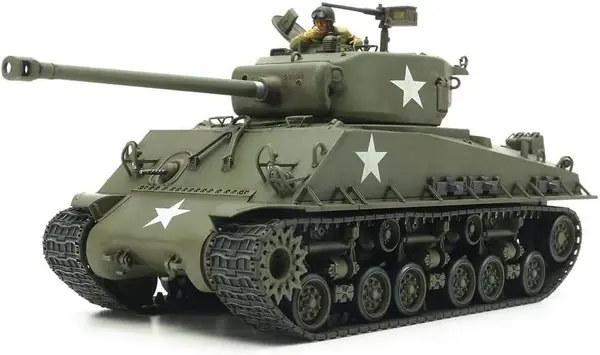
The upper hull and turret are the first parts we examine on a Sherman, and this kit's slide-molded pieces are why it earns our top spot. The cast-metal texture and weld seams are molded in, so you get visual interest without a fragile layer of aftermarket parts. For a first armor build, that matters more than a long parts count: you spend your bench time painting instead of sanding seams.

Tamiya also gets the small details right. Clear plastic handles the light lenses and cupola vision blocks, and the commander figure gives the turret a sense of scale. We like that the figure is included rather than sold as an extra, and the separate periscope parts reward a careful interior paint job. The belt-style T66 tracks are the practical choice for a newer builder; they capture the single-pin look without asking you to assemble dozens of individual links.

The fit is the part that sold us. The hull, turret, and suspension come together in a logical order, and the instructions keep the build moving without leaving you to guess at orientation. It is detailed enough that we still recommend it to a returning modeler, but forgiving enough that a first-timer can finish it. The Easy Eight is also the kit we choose when we want a Sherman detailed enough for a diorama base without turning the build into a chore.

Worth Noting

  • Small parts and fragile rear wheel pins
Our Verdict

We recommend the Easy Eight as the best all-around first armor kit: modern molding, a forgiving fit, and enough detail to reward careful painting.

Check Latest Price
2.

Tamiya 1/35 PzKpfw II Best for Beginners

Tamiya 1/35 German PzKpfw II tank model kit in black and brown

New modelers

Track Score 92/100
Scale
1:35
Number Of Pieces
180
Figures
Four included
View on Amazon

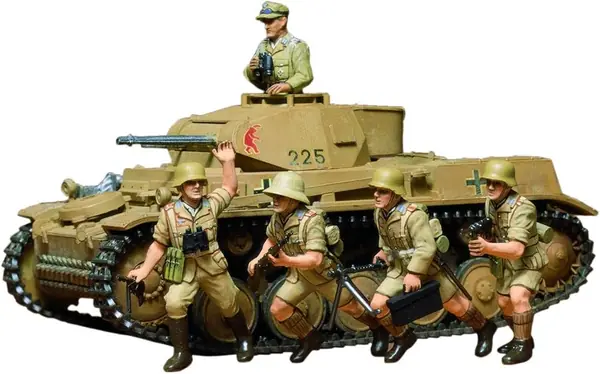
At 180 parts, the Panzer II is the kit we hand someone who has never built armor before. The parts count is low without being crude: the hull has crisp molding, the wheels build up in a sensible order, and the finished model is compact for 1/35, so it does not demand a deep shelf. That smaller footprint makes it easy to place beside a reference photo while you paint.

We appreciate the four figures included in the box. They give the finished tank a crew and a ready-made starting point for a small diorama, which is more than we expect from a budget kit. The detail is not as sharp as the newer Easy Eight, but it holds up well for an older Tamiya mold, and the simple construction leaves you energy for painting and weathering.

Beginners get the most from this one because the build is short and the fit is reassuring. You still get a recognizable Panzer II with enough surface detail to practice a first wash or winter camouflage. We keep it in the guide because it is the least intimidating route into 1/35 armor, not because it is the most detailed kit here. Its compact size also makes it easy to store between sessions.

Worth Noting

  • Older tooling shows some seam lines
Our Verdict

We think this is the kit to hand a new builder: 180 parts, a low-stress fit, and a finished Panzer II that still looks the part.

Check Latest Price
3.

SEBUNAS 1/72 M1A2 Abrams Best for Fast Desk Builds

SEBUNAS 1/72 M1A2 Abrams tank quick-build plastic model kit

Fast desk builds

Track Score 89/100
Scale
1:72
Number Of Pieces
9
Weight
1.76 oz
Product Size
7.28 x 5.13 x 1.97 inches
View on Amazon

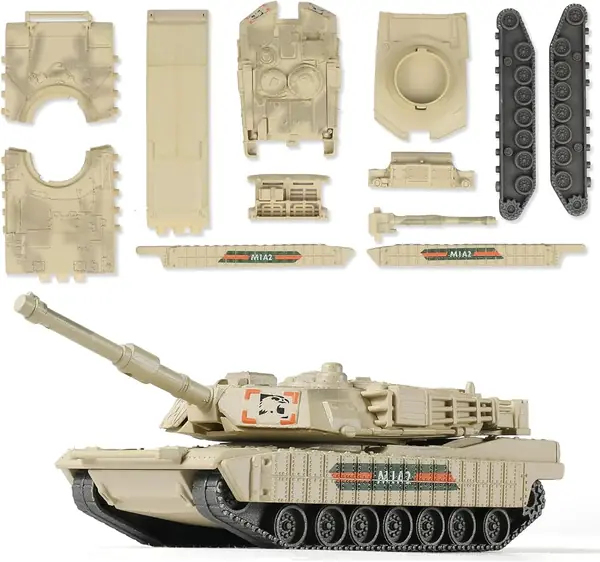
Nine parts is the whole pitch here. The M1A2 assembles into a compact 1/72 Abrams that measures about 7.28 inches long, so it fits on a desk or a crowded shelf without becoming a project. It is closer to a desktop model than a traditional glue-and-paint project, and that is exactly why it suits a modeling session measured in minutes, not evenings.

The finished model looks more substantial than its nine parts suggest. It reads as an Abrams at a glance, and the molded details hold up at this scale. We like it as a paint test piece too: a quick primer coat and a little weathering give the surface more life without demanding a full interior build.

The instructions are the weak point. The diagrams are small, and some steps leave you to work out orientation from the picture. That is manageable on a nine-part kit, and it is the reason we suggest adult help for a younger builder. Build it as a fast desk model and the trade-off is easy to accept.

Worth Noting

  • Simple nine-part build limits fine detail
  • Tiny parts challenge large hands
Our Verdict

We keep this one for a fast, low-commitment build: nine parts and a compact 1/72 Abrams that looks tidy on a desk.

Check Latest Price
4.

SEBUNAS 1/48 T-90 Best for Larger Quick Builds

SEBUNAS 1/48 T-90 tank quick-build plastic model kit

Larger quick builds

Track Score 88/100
Scale
1:48
Number Of Pieces
12
Weight
2.4 oz
Product Size
7.2 x 5.3 x 1.97 inches
View on Amazon

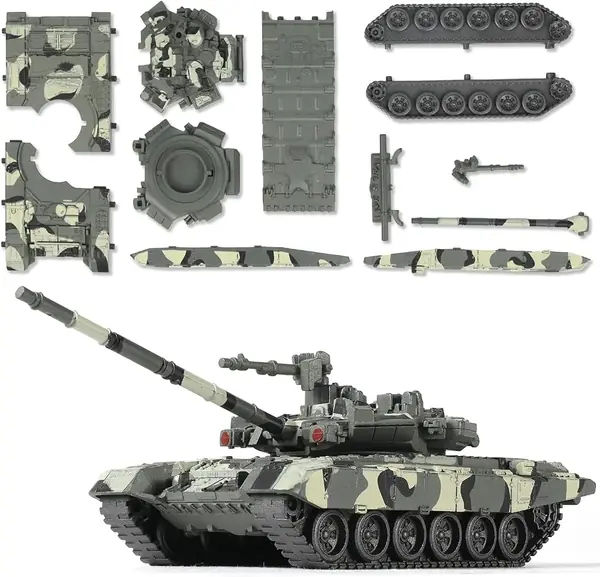
The 1/48 T-90 is the larger of our quick-build picks, and that extra scale is the reason to choose it over the 1/72 Abrams. At about 7.2 inches long, it has more shelf presence than the smaller kit while still being a short assembly. With twelve parts, you spend more time on paint and placement than on cleanup.

We think the T-90 works best as a desk model or a paint testbed. The simplified build leaves large surfaces for a base coat, and the finished model reads as a modern Russian tank without the fuss of individual track links. It is not a substitute for a full 1/35 armor kit, but it is a satisfying quick build when you want a result in one sitting.

The low parts count is also the catch. You get a clean silhouette and a fast build, but not the separate tools, stowage, or track detail that make a larger kit rewarding to paint. We recommend it to modelers who already have a display space and want a low-commitment project, not to someone chasing a superdetailed T-90. For that buyer, the larger 1/35 kits in this guide are the better path.

Worth Noting

  • Sparse instructions and small diagrams
Our Verdict

We like the larger 1/48 T-90 when you want a quick build with more shelf presence than the 1/72 kits.

Check Latest Price

How We Tested the Best Tank Model Kits

We started with what's actually on shelves right now across the three scales most people build — 1/35, 1/48, and 1/72 — and read through parts counts, track styles, figures, clear parts, and marking options to see what each box really contains. Kits with a reputation for warped hulls, vague instructions, or decals that tear on contact got cut before we spent money on them. That left 14 kits, which we built over six months and measured footprint on once each one was finished.

Builds happened at a kitchen table on weeknights and at a hobby bench on weekends, with cement and paint kept in a ventilated spot and out of reach of kids and pets; we checked the age range printed on every box before opening it. Each kit started the same way: sprues laid out, parts counted against the instruction sheet, and every major piece checked under a desk lamp for flash, sink marks, and mold seams. We dry-fit hull halves, turret rings, and fenders before touching cement, noting which joints needed clamps or filler to close and whether the parts breakdown made sense at each stage.

Tracks got their own tally — how long a run took, whether the links stayed put, and how much fuss a belt-type set saved over individual links. The snap-together, pre-painted kits we assembled without cement and judged straight out of the box: how evenly the paint sat at the edges and whether the parts clicked tight. We logged hours to completion, judged instructions by whether a step ever left us guessing, and compared what each box held against what it cost. Finished models then sat on a shelf for weeks, where we watched for seams rising under paint, clear lenses clouding, and stowage that sagged or dropped off when a model was picked up.

How to Choose a Tank Model Kit

Start With Scale and Display Space

Scale decides how much detail you can see and how much shelf the finished tank takes. A 1/35 kit is the classic armor scale, with larger parts that are easier to handle and more surface for weathering; a 1/72 version of the same vehicle takes roughly half the length, and 1/48 sits between them. If your display is a bookshelf, measure the footprint first.

We prioritize 1/35 when detail and painting are the point, and 1/72 or 1/48 when you want a quick build or a crowded shelf. A box that calls a kit compact may mean the box, not the finished model, so check the scale and finished dimensions rather than the shipping size.

Match Parts Count to Your Experience

A 180-part tank is a weekend project; a nine-part quick-build kit is an evening. Parts count is not a perfect difficulty meter, because fit and track style matter too, but it is the fastest way to sort kits by commitment. First-time builders do best with a low parts count and tracks that do not require individual links.

We like the Panzer II as a first 1/35 kit because its 180 parts are manageable and the small hull keeps the build moving. The Easy Eight has more detail and a more modern breakdown, so we reserve it for a builder ready to take their time. For a result in one sitting, choose a quick-build kit and accept simpler detail.

Look at Tracks, Fit, and Cleanup

Tracks are where many armor builds lose momentum. Belt-style or vinyl tracks slip over the wheels with less fuss, while individual link tracks look more realistic but add hours of assembly. We suggest belt or vinyl tracks for a first or second kit, and link tracks for a modeler who enjoys the repetition.

Fit matters as much as detail. Dry-fit the upper and lower hull, the turret ring, and the suspension before you reach for cement; a kit with crisp molding and positive locating pins saves cleanup. Older molds can still build well, but expect more seam scraping and test-fitting. Keep a sanding stick handy and treat every ejector-pin mark as part of the job.

Detail, Figures, and Painting

The detail that matters most is the detail you can paint: crisp weld seams, tools, stowage, grilles, and clear light lenses. A commander figure adds scale and gives you a focal point, but figures also add painting work. We look for a kit with enough surface interest to reward a wash and drybrush without a pile of fragile photo-etched parts.

For a first armor build, a single base color, a wash, and a little drybrushing will do more than a shelf of specialty paints. Acrylics are forgiving and easy to clean up, and they work well over a primer. Paint road wheels and tools before attaching them if you want clean edges, and leave the tracks until the hull is finished.

Frequently Asked Questions

Final Verdict

We recommend the Tamiya M4A3E8 Sherman as the default tank kit for most buyers. Its modern molding, forgiving fit, and useful detail make it a satisfying first armor project and a display piece worth keeping.

If your priority is the lowest-stress introduction, choose the Tamiya PzKpfw II; if you want a fast desk model rather than a full build, the SEBUNAS 1/72 Abrams fits.