Best Airbrushes for Miniatures of 2026

A miniature can be going perfectly until the airbrush spits a fat droplet across a face you spent an hour on, which is usually when people start shopping. The right brush lays thin, even coats that leave detail intact at the low pressures miniature work actually happens at.

Nozzle size decides more than any feature list. A finer nozzle buys detail but punishes paint mixed thicker than skim milk, so we judged brushes at the pressure we paint at, not the one on the box, across 28–32mm figures, terrain and a few hundred batch-painted infantry. The three picks split by job: eyes and freehand, a first brush on a budget, and terrain by the tray.

Our Top Picks

The Best Airbrushes for Miniatures

1.

Gaahleri Mobius 0.3mm Best Overall
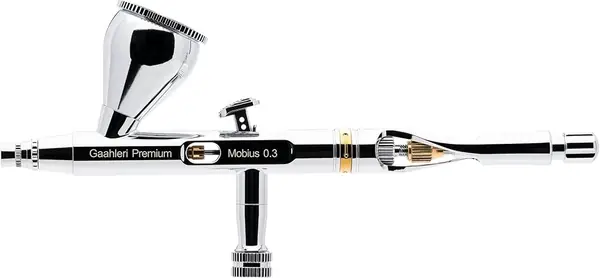
Gaahleri Premium Mobius 0.3mm airbrush with cutaway body and square trigger lever

Miniature detail work

Track Score 93/100
Cup
Mirror-polished inner cup
Weight
10.9 oz
Trigger
Square ergonomic lever
Nozzle Size
0.3 mm
View on Amazon

The 0.3 mm nozzle is the number that makes the Mobius feel right for miniatures: fine enough for a highlight on a shoulder pad, broad enough to lay a basecoat without building it up in a dozen passes. We like that Gaahleri did not simply shrink a general-purpose brush; the spiral-shaped nozzle is meant to keep airflow even, and the 0.3 mm version gets more air than the company's standard heads. The result is the balance we want on 28-32 mm figures, where a 0.2 mm brush can feel fussy and a 0.5 mm brush starts to feel like a spray can.

The square lever is another detail we appreciated. It has a short, smooth pull that makes it easy to stop before paint pools in a recess, and the cutaway body shows the paint path so a bubble is easier to spot before it reaches the nozzle. At the low pressures miniature painters use, that kind of feedback matters more than a long feature list. The brush also feels balanced in the hand, which we noticed during longer priming and basecoat sessions.

Cleaning is where the Mobius earns its keep. The nozzle assembly comes apart simply, and the mirror-polished cup wipes down without leaving a film that turns into a clog later. The trigger stays smooth after a full session, and the square lever is easy to find without looking. For most miniature painters, the stock 0.3 mm head is the reason to buy: it turns a basecoat into a controlled pass instead of a gamble.

Worth Noting

  • Larger needle setup sold separately
Our Verdict

We recommend the Mobius to any miniature painter who wants a precise 0.3 mm brush that sprays smoothly at low pressure and comes apart easily for cleaning.

Check Latest Price
2.

Gaahleri GHAD-39 Best Value

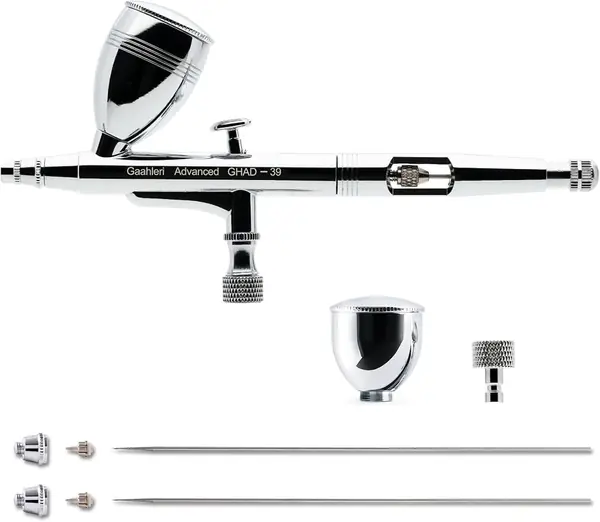
Gaahleri GHAD-39 silver airbrush with two needle sets and removable fluid cups

Budget first airbrush

Track Score 92/100
Feed
Gravity
Fluid Cups
1/2 oz and 1/4 oz
Nozzle Sizes
0.35 mm and 0.5 mm
Body Material
Copper
View on Amazon

Two needle sizes in one box is the reason the GHAD-39 belongs in a beginner's kit: the 0.35 mm head handles basecoats and general detail, while the 0.5 mm head moves more paint for primer and larger models. We like that Gaahleri includes both cups, too. The 1/2 oz cup is big enough to prime a squad without stopping to refill, and the 1/4 oz cup keeps a small mix from climbing the walls.

What surprised us was how much the self-centering nozzle changes cleanup. The nozzle drops into place without the usual fiddling, and the smooth inner cup rinses out quickly. For a first airbrush, that is the difference between practicing and giving up. The trigger has a predictable pull, and the 0.35 mm setup atomized thinned acrylics well enough for us to lay down a clean basecoat and pick out a few details.

What the Gaahleri does give you is room to learn. The two needle sizes cover primer, basecoat, and general detail without asking you to buy a second brush, and the two cups let you mix a small batch or a full squad's worth. The body comes apart without drama, which matters when a beginner is still figuring out how much to thin paint. For a first airbrush, that is a generous package.

Worth Noting

  • No 0.2 mm head for ultra-fine detail
Our Verdict

We think the GHAD-39 is the smart first airbrush for miniatures, with two needle sizes and simple cleaning at a budget price.

Check Latest Price
3.

Harder & Steenbeck Ultra 2024 Best for Terrain and Basecoats

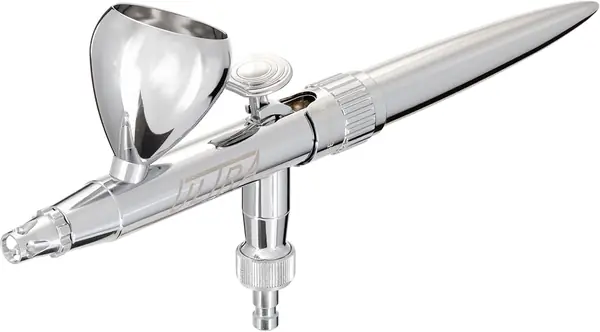
Harder & Steenbeck Ultra 2024 airbrush with 5 ml cup and self-centering nozzle

Terrain and basecoats

Track Score 90/100
Cup
5 ml
Feed
Gravity
Nozzle
0.45 mm self-centering
Assembly
Tool-free
View on Amazon

A 0.45 mm nozzle tells you what the Ultra 2024 is for: broad, even coverage on large models, vehicles, and terrain, not a single eyelash. The self-centering head is the centerpiece. We found it seats without the delicate alignment that makes some nozzles a chore to reinstall, and the whole airbrush comes apart by hand for cleaning. That is a welcome change if you have spent time hunting for a tiny wrench.

We recommend the Ultra to painters who want a premium basecoat tool and do not mind giving up the finest detail. The 5 ml cup is large enough for a long session, the trigger has a useful stop for beginners, and the German build feels solid in the hand. The 0.45 mm head lays down a wider pattern than the 0.3 mm Mobius, so priming a tank or a piece of scenery takes fewer passes.

That width is also the limit. For eyes, edge highlights, and scratch work, the Ultra is the wrong tool unless you add the FineLine headset, which is a separate purchase. It is a basecoat and terrain airbrush first, and it is very good at that. Keep it for the jobs where coverage matters, and reach for a finer brush when the job gets small.

Worth Noting

  • Trigger can feel gritty
Our Verdict

We recommend the Ultra 2024 for large models and terrain, where its 0.45 mm nozzle and tool-free build shine, not for fine eyes and edges.

Check Latest Price

How We Tested Airbrushes for Miniatures

We started with the brushes miniature painters actually argue about, then narrowed by nozzle size, gravity feed, whether replacement needles and nozzles are sold separately, and what the whole setup costs once you add a compressor. That left 11 airbrushes, and we spent nine months with them.

Testing happened at the kitchen table inside a spray booth, in a ventilated room, with a respirator rated for the paints we used, and solvent-based products kept well clear of any flame or ignition source. We sprayed thinned acrylics, inks, and primer onto primed plastic figures and terrain, starting at the bottom of each brush's pressure range and watching for spatter, tip dry, and spider-webbing. Every cup got filled to the same line so we could see whether bubbles worked back up through the paint or crept around the nozzle. Each trigger went through fine dots, thin lines, and full coverage so we could judge the air-first, paint-second pull and how the brush balanced during two-hour painting sessions.

Between colors we timed a full teardown, counted how many tools it took, and noted whether the nozzle could be reached without pulling the whole brush apart. We also compared what came in each box and priced out needles, nozzles, and seals, since a bargain brush with no parts support stops being a bargain the first time you bend a tip.

How to Choose an Airbrush for Miniatures

Start with the Nozzle, Not the Feature List

For 28-32 mm figures, a 0.2-0.35 mm nozzle gives you the control to shade a cloak and pick out a face, while a 0.4-0.5 mm head is better for primer, basecoats, and terrain. We prefer a single 0.3 mm head as the default because it handles both basecoats and detail without feeling fragile. A box with three needles is only useful if the body and trigger are worth keeping; more nozzles do not rescue a rough airbrush. Match the head to the work you do most, then add a second size later if you need it.

Spray Quality Shows Up at Low Pressure

Miniature work rewards a brush that atomizes thin paint at low pressure rather than one that needs high pressure to push it. We look for a smooth trigger with a predictable stop, because a jumpy pull makes it hard to build color slowly. A clog-resistant nozzle matters more than a long spec sheet: if the brush spits or stops between colors, you will stop reaching for it. You cannot judge atomization from a nozzle size alone, so favor a design with a reputation for even flow and a return policy that lets you test it.

Cleaning Design Matters More Than You Think

Look at how the nozzle comes off before you look at how many parts are in the box. A self-centering or drop-in nozzle saves the fiddly alignment that leads to bent needles, and a body that comes apart by hand makes between-color cleaning realistic. The GHAD-39 and the Ultra 2024 both use self-centering heads for this reason, and the Mobius's simple nozzle assembly is part of its appeal. The trap is assuming 'easy to clean' means fewer parts; what you want is access to the paint path without a wrench.

Cup Size and Balance

Most miniature airbrushes are gravity-feed, which lets a small amount of paint flow with less pressure and less waste. A 1/4 oz or 5 ml cup is plenty for a squad; a 1/2 oz cup is useful for primer and larger models but adds bulk. Balance matters as much as capacity: a top-heavy cup makes long sessions tiring, while a body that sits well in your hand gives you steadier lines. Fill the cup only as much as you need, and keep the airbrush level so paint does not creep into the air cap.

Budget for Parts, Not Just the Brush

A cheap airbrush is only a bargain if you can get replacement needles and nozzles. Before you buy, check that the nozzle size and needle are available separately and that the air fitting matches your hose. We prefer to spend a little more on a brush with a one-year warranty and a clear parts path than replace a disposable body every few months. A spare needle is the first accessory to add, because a dropped brush often costs more in downtime than in parts.

Frequently Asked Questions

Final Verdict

The Mobius is the airbrush we recommend first for miniatures. Its 0.3 mm head is the most useful middle ground here for basecoats and detail, and the smooth trigger and simple nozzle assembly make it easy to live with. If you are equipping a beginner on a tight budget, the GHAD-39 gives you two needle sizes and two cups for less; if your painting is mostly tanks and terrain, the Ultra 2024's wider 0.45 mm pattern is the better fit.