Best Helping Hands for Soldering of 2026

A clean solder joint takes about three seconds, and one flinch undoes it. A helping hands station removes the flinch by holding the board or wire while one hand runs the iron and the other feeds solder. Arm count gets the attention in product photos, but base weight decides whether a station stays put.

Long arms on a light base make a paperweight that walks, a pattern that held across 12 stations on garage benches, a shared shop table and a kitchen counter. Magnetic arms slide to the joint but can shift under a firm hand; bolted arms stay put and give up reach. The picks cover bare circuit boards that want pillars and a magnifier, wire joints that want a small heavy footprint and mixed work that just needs arms that hold.

Our Top Picks

The Best Helping Hands for Soldering

1.

QuadHands Workbench Best Overall
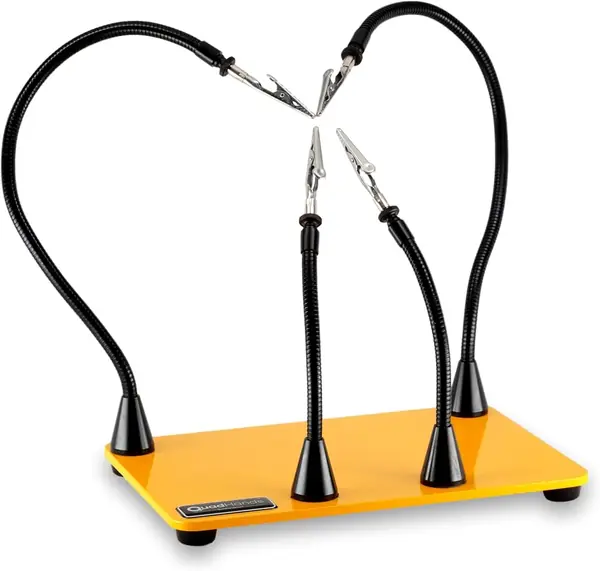
QuadHands Workbench helping hands with four steel gooseneck arms and silicone-covered clips on a steel base

Mixed-use workbenches

Track Score 96/100
Base
Powder-coated steel plate with rubber feet
Arms
Four magnetic goosenecks, 16 in. and 8 in.
Clamps
Four rotating alligator clips with silicone covers
Arm Mounting
Rare-earth magnets, no fixed posts
View on Amazon

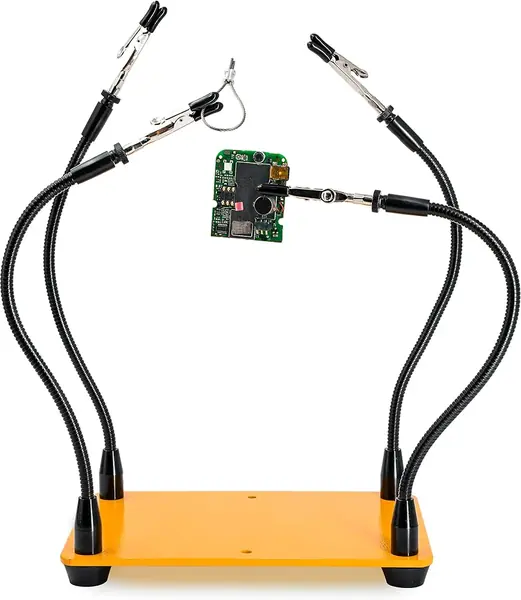
The steel plate is the whole idea. Six by nine inches of powder-coated steel, four rubber feet underneath, and every arm held by a rare-earth magnet instead of a threaded post — so you can put a board at one end, a pair of wire ends at the other, and work in the space between.

What we like most is how quickly the plate rearranges. An arm slides out of the way when the iron needs that spot and goes back when the joint is done, with nothing to unscrew. Two of the goosenecks measure 16 inches, long enough to come in over a standing board or down into a connector held below the plate.

The alligator clips rotate a full turn and lock with thumb nuts, and each one carries a removable silicone cover — that cover is the difference between a clamp that holds a wire and one that bites through its insulation. The goosenecks do spring back slightly after you bend them, so push a little past the point you want and let them settle.

It wants about a foot of clear bench once the arms are swung out, which is the cost of the room it gives you. For a bench that sees soldering, jewelry repair and the occasional model, this is the station we keep set up.

Worth Noting

  • No magnifier or light for fine work
Our Verdict

We recommend the QuadHands for anyone who solders on a shared bench: the plate gives you room to stage a whole job, and the arms move without tools.

Check Latest Price
2.

Fstop Labs Four-Arm Soldering Station Best Value

Fstop Labs helping hands station with four magnetic gooseneck arms, steel base and alligator clips

Value-minded hobbyists

Track Score 95/100
Base
2 lb weighted steel with rubber feet
Arms
Four flexible magnetic goosenecks
Clamps
Stainless alligator clips with thumb-nut locks
Extras
Soldering iron holder and spare clips
View on Amazon

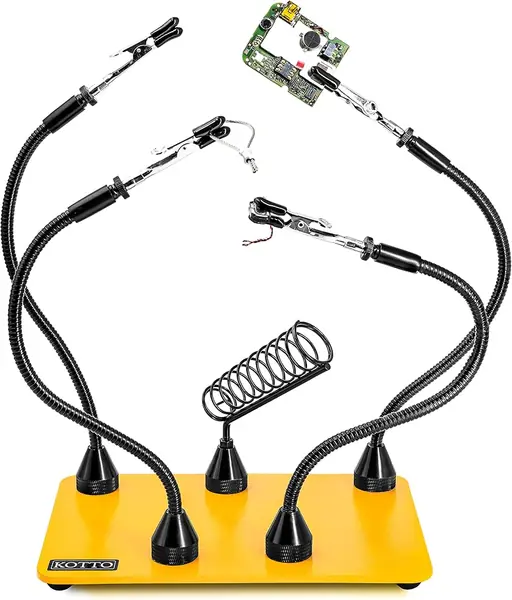
Four magnetic goosenecks, a two-pound steel plate with rubber feet, stainless alligator clips that lock with knurled thumb nuts, a soldering iron holder and two spare clips: that is a lot of kit for the least expensive four-arm station in this guide.

Magnet strength is the thing we check first, because a weak foot turns a gooseneck into a metronome. These hold on anything ferrous — the plate, a bench vise, the chassis you are working on — which is the advantage a magnetic arm has over a bolted one. The clips lock at any angle with their thumb nuts, and the spare pair in the box means a worn jaw is not the end of the tool.

Where it earns its place is as the station that goes to the work: the arms lift off, the plate is light enough to carry to another bench, and the iron holder keeps the hot end off the mat while you reposition a part. Nothing else here holds as much for the money.

Worth Noting

  • No magnifier or light
  • Plate covers less bench than big stations
Our Verdict

This is the station we suggest when the budget is real but the work isn't toy-sized: four magnetic arms, an iron holder, and a plate that stays put.

Check Latest Price
3.

SainSmart Magnetic Helping Hands Station (PCBH) Best for PCB Work

SainSmart magnetic helping hands station with PCB pillars, four gooseneck arms, and an LED magnifying lamp

Bare PCB soldering

Track Score 94/100
Base
11.1 x 7.1 in. powder-coated steel, 2.4 lb
Arms
Two 7.5 in. and two 14 in. goosenecks
Magnifier
5X LED magnifying lamp
PCB Holders
Four magnetic pillars
View on Amazon

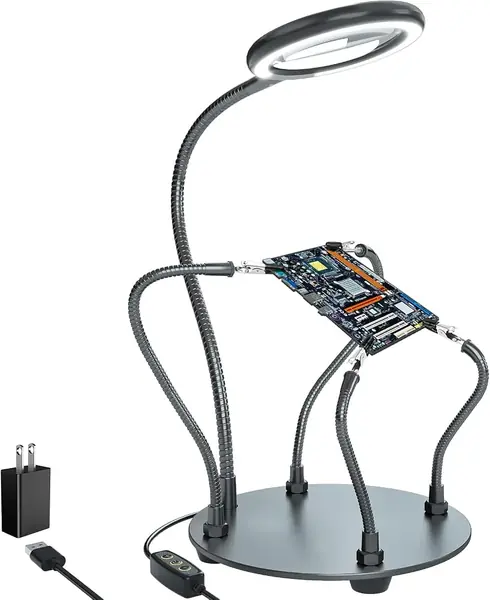
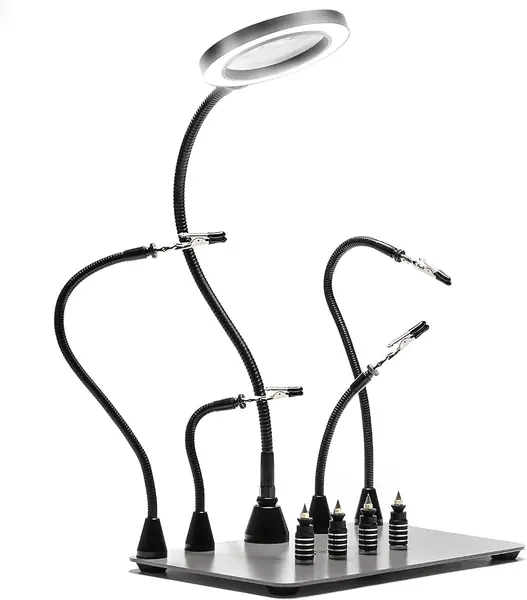
Four magnetic pillars are what put this station in a different class for board work. Stand a bare PCB on them and the board sits above the plate, held near its edges, with room for the iron to come in from either side and no clip sitting on the joint you are trying to reach.

That, plus an 11.1-by-7.1-inch plate that swallows a project's worth of parts and a 5X LED lamp on a swing arm, is why this is the station we set up when the job is a board rather than a cable. The arms come in two lengths — two at 7.5 inches and two at 14 — so a short precise hold and a long reach are both available from the same plate.

One thing to understand before you buy: 5X is a working distance as much as a magnification. Your eyes end up close to the joint, and the iron comes in on an angle you have thought about rather than straight down from wherever your hand happens to be. For fine-pitch work that is the point; for a chunky switch you will wish for a 2X lens.

Worth Noting

  • Lamp may need your own USB power block
  • Wide plate takes real bench space
Our Verdict

Our pick for anyone soldering bare boards: pillars hold the PCB clear of the plate, and the 5X lamp puts the joint in plain view.

Check Latest Price
4.

XYK Helping Hands Station with LED Magnifier Best Midrange with a Light

XYK helping hands station with round steel base, gooseneck arms, and LED magnifier

Lighted fixed benches

Track Score 93/100
Base
7 in. round powder-coated steel
Arms
Two 7.5 in. and two 5 in., screwed to the base
Magnifier
3X LED, 28 beads, 500 lumens, 6 levels
Weight
3.22 lb
View on Amazon

Assembly is the first task. The arms bolt to the base with Phillips screws, and the box includes a small wrench and a screwdriver for the job. It is a few minutes of work, and it is worth doing properly the first time — a bolt that is not snug turns into a drooping arm halfway through a joint.

Once it is together, the lamp is the reason to buy it: a 3X lens ringed with 28 LEDs and six brightness levels, on a base seven inches across and heavy enough to sit still while you work under it. Four arms, four rubber covers for the clips, and a US plug in the box.

We rate the XYK as the sensible middle of the group: a lighted lens and four arms without big-station money. The arms are bolted down, so they never drift and never slide out of the way either; if you like shoving an arm aside mid-job, one of the magnetic plates is the better tool. For a station that lives in one spot, the bolted arms are the calmer design.

Worth Noting

  • Round base stages less than a rectangular plate
Our Verdict

We point people here when they want a lighted lens without a big-station price, and can live with arms that stay bolted where they put them.

Check Latest Price
5.

Pro'sKit 900-015 Helping Hands Soldering Aid Best Budget

Pro'sKit helping hands soldering aid with two alligator clips on adjustable arms and a weighted base

Small light parts

Track Score 92/100
Base
Weighted, 2.5 x 3.5 in.
Clips
Two alligator clips on ball joints
Adjustment
Several points per arm
View on Amazon

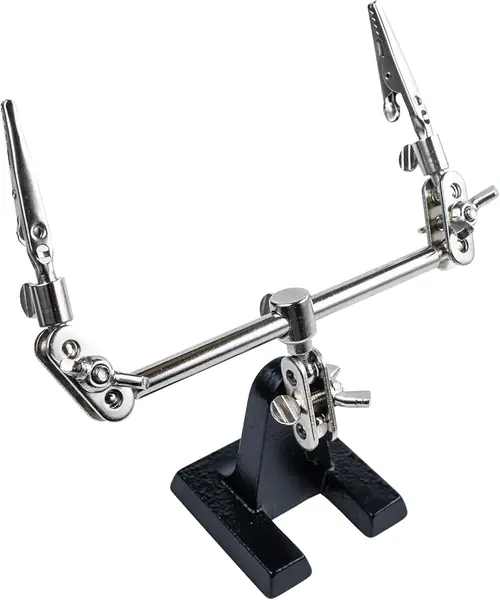
The Pro'sKit is what we hand someone who wants a plain third hand and nothing more: two clips, a weighted base, several points of adjustment, and the smallest footprint in this group. Judged as a small-parts holder rather than a workstation, it is a lot of tool for the least money here.

The hardware is more substantial than the dimensions suggest. The alligator clips are strong, the ball joints move smoothly and then hold where you leave them, and the base has enough mass that a wire splice does not drag it across the bench. Where it runs out of headroom is anything bigger than a small board or a pair of wires: the base measures about two and a half by three and a half inches, and a long arm carrying weight will tip it.

Two habits keep it useful. Check the screws that hold the clips every so often, since they work loose, and keep the work close to the base rather than out at the end of an arm. For hook-up wire, jewelry and the small jobs that make up most of a hobbyist's soldering, that is the whole tool.

Worth Noting

  • No magnifier or light included
Our Verdict

Buy it if your soldering is small parts and wire splices and you want the least expensive tool that genuinely holds them.

Check Latest Price
6.

NOEVSBIG Magnetic Dual-Clamp Helping Hands Best for Small Wire Joints

NOEVSBIG magnetic helping hands clamp with two yellow rubber-coated jaws on a small square iron base

Wire splicing jobs

Track Score 91/100
Base
3.94 x 3.94 in. iron with non-slip pad
Weight
10.6 oz
Jaws
Dual-head, rubber-coated, quick-release
Mount
Magnetic base
View on Amazon

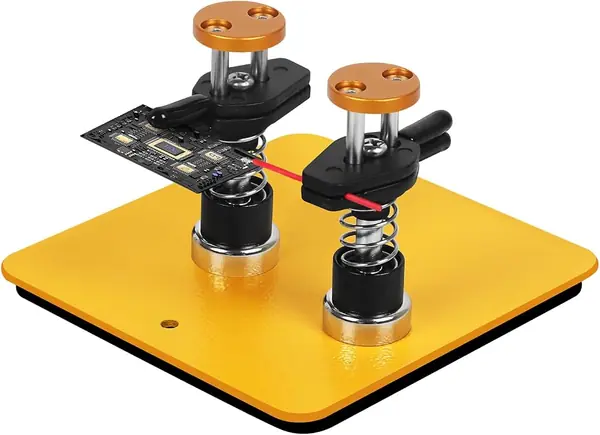
Two jaws on one arm is the idea that sold us: put the board in one and the wire in the other and the splice lines itself up, which is exactly the job that sent you shopping. Both jaws are rubber-coated, so they hold without nicking insulation or plating, and the quick release makes loading a wire a one-hand job.

The NOEVSBIG's base is a 3.94-inch square of iron with a non-slip pad, the clamp's foot is magnetic, and the whole thing weighs about eleven ounces — small enough to live in a drawer and come out for a single joint. The joints are screw-type, so the head stays where you put it instead of sagging the way a tired gooseneck can.

What it is for is repair, not assembly: a connector, a switch, two wires that need to meet, one joint at a time. It handles that better than a four-arm plate that needs clearing space first, and it costs less because that is all it does.

Our Verdict

We keep this one for repair joints: two coated jaws line up a wire and a pad, and the magnetic foot parks it wherever there is steel.

Check Latest Price
7.

KOTTO Four-Arm Helping Hands Station Best for Set-And-Forget Work

KOTTO four-arm helping hands station with rubber-cushioned clips and a weighted steel base

Set-and-forget work

Track Score 90/100
Base
2.78 lb weighted steel plate
Arms
Four flexible goosenecks, bolted to the base
Clamps
Alligator clips with rubber cushions
View on Amazon

The first thing we did after bolting the plate together was shove it across the bench with the heel of a hand. It did not budge, which is the first thing we want from a holder.

The KOTTO's 2.78-pound steel plate is most of the reason, helped by rubber feet at the corners. The four arms are goosenecks that bolt into threaded holes rather than magnets, so each one holds the position you bend it to and never slides. The clips come with rubber cushions, which matter when the wire you are holding is a strand or two thick.

Assembly runs a few minutes, and the threads are worth checking before the first project — a cross-threaded arm is much easier to catch in your hand than in the middle of a harness repair. The goosenecks are also stiff enough that setting a position takes a deliberate push, which is what you want from four arms and not what you want if you are used to nudging an arm mid-job.

So it suits work that stays where you set it: a board, a harness, a row of parts you would rather not chase around the plate. If sliding an arm aside without unbolting it matters more than rock-solid arms, choose one of the magnetic plates instead — that is the only real fork in this decision.

Worth Noting

  • Jaws can mark polished silver and soft metals
Our Verdict

Ours stays on the bench for harness and board work that needs four firm holds and a plate that will not skate.

Check Latest Price

How We Tested Soldering Helping Hands

We started with a little over 40 stations and narrowed to 12 by comparing published base weight, footprint, arm reach, and how the arms attach — magnetic or bolted — setting aside anything whose base weight wasn't published. Then we spent six months using them where soldering actually happens: a garage bench rewiring a guitar cable and a trailer harness, a kitchen table fixing a necklace clasp, a shared shop table running bare circuit boards. Each one was weighed on a kitchen scale and measured against its longest arm reach, because a base is only as stable as its weight relative to the arm it has to hold.

To test holding force, we clamped a part and pressed a hot tip into it the way you do mid-joint, watching for an arm to sag or the base to skate. We slid magnetic arms to every position the base allowed and noted where reach ran out; on bolted models we counted the turns it took to reposition one. Jaws got checked from both sides — bare metal on stranded wire to see what it crushed or marked, sleeves on plated parts where the work needed a lighter touch. Irons stayed in their own stands all six months; a clip is not an iron rest.

Magnifiers got their own pass: working distance from lens to joint, and whether the light ran on batteries, USB, or a wall plug. Stations with board pillars were loaded with a real bare board and shifted between joints. We timed assembly out of the box and noted where the hardware didn't match the instructions, then judged durability at the end — clips opened and closed hundreds of times, joints checked for wobble, thumb threads checked for stripping. Value came down to whether the extras were things we reached for or moved out of the way.

How to Choose a Helping Hands Station

Magnetic or bolted arms

An arm on a magnet lifts off and lands wherever you want it, which is what turns a steel plate into a work surface: a board at the back, two wire ends at the front, all within reach. A bolted gooseneck holds the position you bend it to and never drifts. The trade is that clearing a bolted arm out of the way takes a screwdriver.

One trap worth knowing before you order: magnetic means magnetic to the plate, not to your bench. Aluminum and many stainless tops will not hold the arms, so plan on the included steel plate as the working surface and test anything else with a fridge magnet first.

Base weight and arm reach

Weight only matters next to reach. A two-pound plate with a clip full of wire is steady; the same plate with a 14-inch arm levered sideways is not, so match the base to the gooseneck length you plan to use. Rubber feet count for more than they look like they do on a smooth bench.

The check we run before trusting a station is simple: clamp a scrap of wire, press it with a screwdriver the way an iron would, and watch whether the base walks or the arm dips.

Jaws and what they leave behind

Alligator jaws are standard, and the differences that decide an order are opening width and what is on the metal. Bare steel holds a heavy connector and will mark polished silver or soft brass. Rubber and silicone sleeves give up a little grip to protect insulation and plated parts, which is the right trade for nearly everything a hobbyist solders.

Thumb nuts that lock a clip at an angle beat spring clips when you are positioning with one hand and holding a wire with the other.

Magnifiers and working distance

2.5X to 5X covers most soldering. What changes with power is distance: at 5X your eyes sit close to the joint and the iron comes in on a planned angle; at 2.5X you get room and less detail. A lighted lens earns its space on board work, and a dimmable one earns more.

Check what powers the lamp before you commit, since a USB light without a power block in the box means a trip to the adapter drawer.

Room for the board

A four-arm plate takes roughly a foot of bench once the arms swing out. If your bench doubles as a desk, a clamp-sized unit with a four-inch base holds a single joint in a fraction of that space.

And if you solder bare boards, look for pillars or posts: holding a PCB off the plate at its edges leaves both sides of a joint open, which no alligator clip can do.

Frequently Asked Questions

Final Verdict

For most benches, the QuadHands Workbench is the one to buy. The six-by-nine steel plate and four magnetic arms handle more kinds of work than any single-post holder here, and the long goosenecks reach joints the short two-clip units cannot.

If the price matters more than the reach, the Fstop Labs station does the same magnetic trick on a smaller plate and throws in an iron holder. And if bare circuit boards are the job, the SainSmart's pillars and 5X lamp are worth the step up.