Best Solder for Electronics of 2026

Three joints into a repair, with the iron at temperature, the solder sits in a gray bead instead of flowing onto the pad. Usually the wire is to blame, not your technique. Alloy, flux and diameter decide whether a joint wets cleanly or cools grainy and dull, and the right spool removes a whole variable from the bench.

A eutectic 63/37 goes from liquid to solid at a single temperature with no pasty stage, which matters more on a small pad than any spec sheet suggests, and a 3.3% flux core pulls solder onto an oxidized joint that a 1.8% core won't touch. We worked through 14 spools over five months, from re-capping a receiver to tinning heavy wire for connector cups, and the eight picks cover fine-pitch boards, wire and connectors, lead-free work and a first-timer's small roll.

Our Top Picks

The Best Solder for Electronics

1.

Kester 24-6040-0027 Solder Wire Best Overall
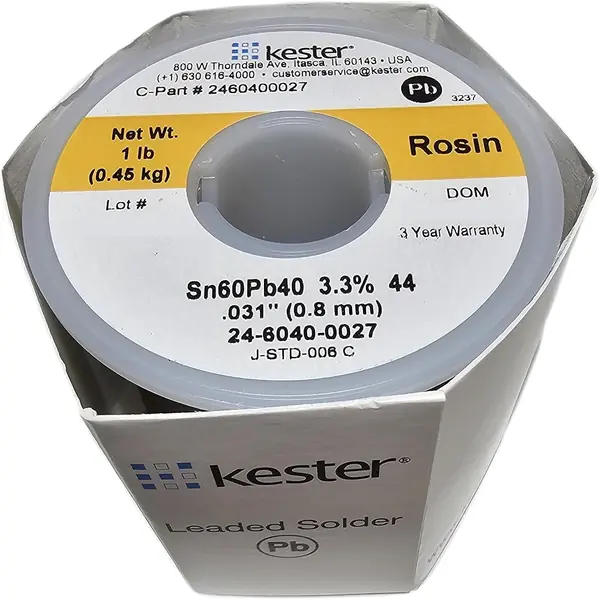
Kester 24-6040-0027 rosin-core solder wire spool, 60/40 alloy, 0.031 inch diameter

Regular bench work

Track Score 97/100
Alloy
60/40 tin-lead
Wire Diameter
0.031 in
Spool Weight
1 lb
Flux Core
3.3% rosin
View on Amazon

A one-pound spool changes how you treat solder. It stops being the thing you hoard for a good project and becomes the thing that is always on the bench, which is the right way to think about a consumable. Kester's 24-6040-0027 rosin-core wire is the traditional electronics formula, and at 0.031 inch it is a general-purpose gauge that reaches most through-hole joints without being fussy.

Sixty-forty isn't eutectic, and that is the first thing to understand about it. The alloy passes through a slushy stage as it drops from liquid to solid, so a joint you bump while it sets can end up grainy. The rosin core runs 3.3%, generous next to the 1.8% to 2.2% rolls that fill out this list, and we noticed it on older boards with lightly oxidized pads where we normally reach for a flux pen.

What sold us was consistency. Joints came out bright, the flux burned off cleanly instead of leaving a sticky patch, and the wire feeds off the spool without kinking. Of everything we handled for this guide, this is the one whose behavior changed least from joint to joint, and that reliability is worth more than any single figure on the label.

The gauge is the one thing to check against your own work: at 0.031 inch this wire gets clumsy around 0.5 mm pitch, where the thinner YI LIN roll is the better tool. For through-hole parts, headers, connectors, and general repair, we haven't found anything here we prefer within reach.

Worth Noting

  • Premium outlay for a one-pound spool
Our Verdict

We recommend this spool to anyone who solders most weeks: the flow is the steadiest we handled, the rosin core is generous, and a pound keeps the bench stocked.

Check Latest Price
2.

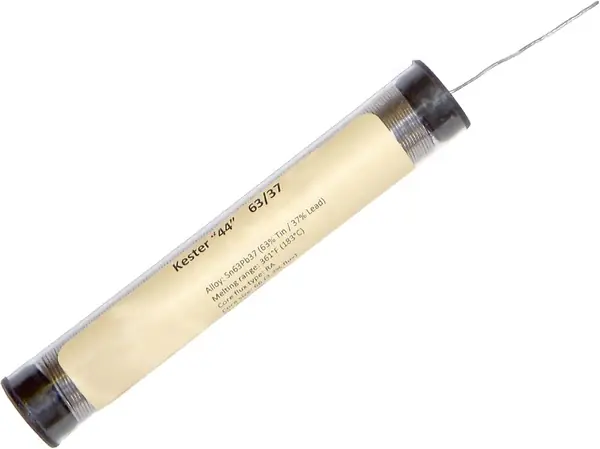
Kester 44 Rosin Core Solder Best Small Pack

Kester 44 solder wire in a small dispenser tube, 63/37 RMA rosin core

Occasional repairs

Track Score 96/100
Alloy
63/37 tin-lead
Wire Diameter
0.031 in
Flux Type
RMA activated rosin
Pack Size
1 oz (about 24 ft)
View on Amazon

Twenty-four feet of solder in a dispenser tube is the right amount for someone who fixes a few things a year, and we like this one because the flux does as much work as the alloy. Kester 44 is an activated rosin formula that wets quickly — on a clean pad the joint takes solder almost the moment the tip touches it, with no extra flux involved.

The 63/37 alloy handles the rest. It melts at 361 °F / 183 °C and passes from liquid to solid with almost no pasty window, which is what you want when one hand holds a wire and the other holds an iron. The tube also keeps the wire from uncoiling across the bench — a small thing until you have chased a springy coil of solder out from under a monitor.

Worth Noting

  • Small pack, premium cost per joint
Our Verdict

This is our pick for the repair drawer rather than the workbench: genuine Kester 44 flux and eutectic alloy in a tube small enough to justify.

Check Latest Price
3.

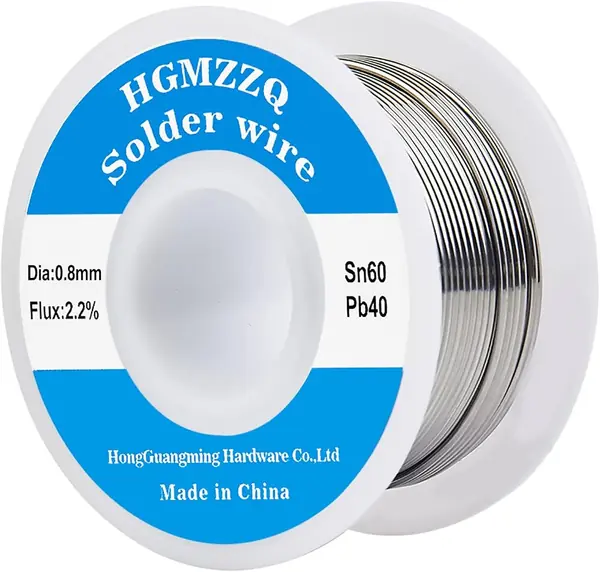
HGMZZQ 60/40 Rosin Core Solder Best Budget

HGMZZQ rosin-core solder wire spool, 60/40 tin-lead, 0.8 mm, 50 g

First-time buyers

Track Score 95/100
Alloy
60/40 tin-lead
Wire Diameter
0.8 mm (0.031 in)
Flux Content
2.2%
Spool Weight
1.76 oz
View on Amazon

The HGMZZQ roll carries the most flux of any 50 g spool here at 2.2%, and that one number explains how it behaves. More rosin in the core means more cleaning action on a pad that has been sitting in a parts drawer, and it forgives a tip that isn't quite as clean as it should be.

For a first roll, this is the one we point people to. It wets and flows without a fight, the joints come out shiny, and it doesn't demand a temperature-controlled station — a basic adjustable iron is enough. Nothing about the handling made us work around it, which is more than we can say for a couple of the cheaper 63/37 rolls in this group.

Sixty-forty gives you a slushy window while the joint sets, so hold the wire still for a beat longer than a eutectic alloy needs. The 0.8 mm gauge is the sensible middle for through-hole work: fine enough for a header pin, heavy enough for a switch lug.

Worth Noting

  • Small 50 g roll empties fast on big builds
Our Verdict

For a first roll we point people here: the highest flux content of the small spools, clean flow on a basic iron, and nothing in the handling to work around.

Check Latest Price
4.

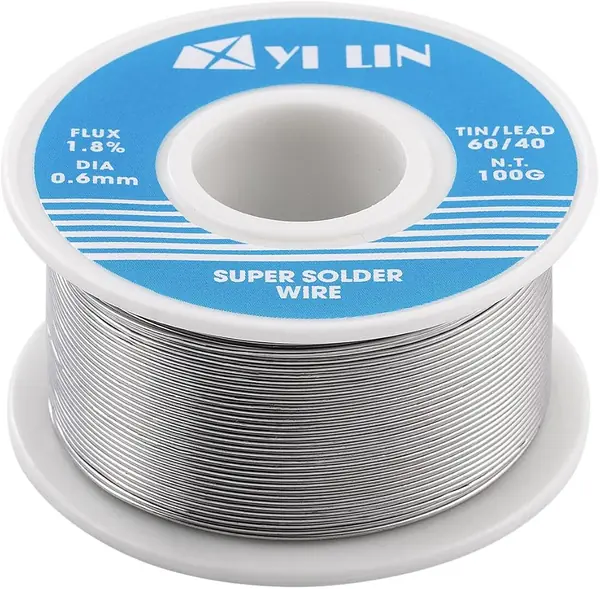
YI LIN 60/40 Solder Wire Best for Fine Work

YI LIN tin-lead solder wire spool, 60/40 alloy, 0.6 mm, 100 g

Fine-pitch board work

Track Score 94/100
Alloy
60/40 tin-lead
Wire Diameter
0.6 mm
Flux Content
1.8%
Spool Weight
3.53 oz
View on Amazon

Thin wire is the tool for close-quarters work, and at 0.6 mm this is the finest roll among our main picks. It feeds slowly, which sounds like a drawback until you are adding a whisper of solder to a joint you can barely see and a thicker wire dumps three times as much onto it.

The 100 g spool is the other sensible part: twice the solder of the 50 g rolls without the commitment of a pound. The YI LIN wire is sold in six combinations of diameter and weight, so check which one is in your cart before you order — the option menu, not the photo, tells you what arrives.

Flow is where this wire earns its place. The 1.8% core wets cleanly and the joints finish bright, with no second pass or flux touch-up needed on clean boards, and the thin gauge lets you stop feeding the instant a joint is full. It is the roll that stays next to the fine-tip iron.

Worth Noting

  • Thin gauge is slow on heavy wire
Our Verdict

Made for small pads and rework: the 0.6 mm wire feeds in fine increments and wets cleanly, and 100 g doubles the usual small roll.

Check Latest Price
5.

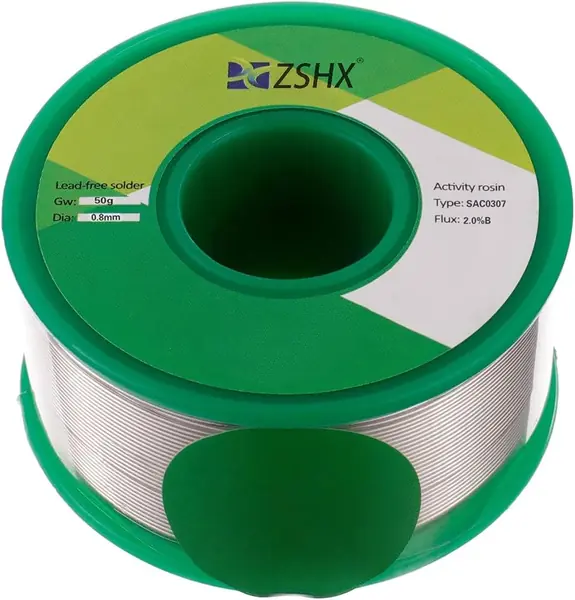
ZSHX Lead-Free Solder Wire Best Lead-Free

ZSHX lead-free solder wire spool, Sn99 silver-copper alloy, 0.8 mm, 50 g

Lead-free requirements

Track Score 93/100
Alloy
Sn99 Ag0.3 Cu0.7
Wire Diameter
0.8 mm
Flux Content
2%
Melting Point
217 °C / 422.6 °F
View on Amazon

Some buyers need lead-free and the rest are expressing a preference, so start there. If the board is going into something you will sell, if your shop or school requires it, or if you would rather not keep lead at the kitchen table, this is the roll we recommend — Sn99 with a little silver and copper, the standard SAC-family alloy, at 0.8 mm for general board work.

Plan around 217 °C, roughly 34 degrees hotter than the leaded wires here. Joints also come out duller and faintly grainy, and that is the alloy rather than a bad connection; judging SAC by its shine is how people end up overheating good joints trying to make them look like 63/37.

The 2% flux core is generous for lead-free and helps on a joint you reflow two or three times. Fifty grams is enough for repair work and modest for a full build, and the ZSHX wire handles like leaded solder right up until the iron runs cool.

Worth Noting

  • Needs a hotter iron than leaded wire
Our Verdict

This is the lead-free roll we recommend: a standard SAC alloy in a usable gauge, provided your iron can hold a temperature well above 217 °C.

Check Latest Price
6.

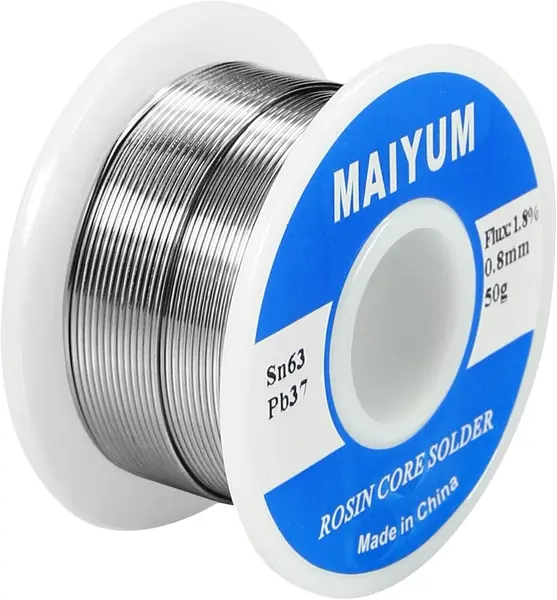
MAIYUM 63/37 Solder Wire

MAIYUM rosin-core solder wire spool, 63/37 tin-lead, 0.8 mm, 50 g

Cheap eutectic alloy

Track Score 92/100
Alloy
63/37 tin-lead
Wire Diameter
0.8 mm
Flux Content
1.8%
Melting Point
361 °F / 183 °C
View on Amazon

Eutectic 63/37 at a bargain-roll price is the pitch, and it is a good one. The alloy melts at 183 °C and freezes almost the moment you lift the iron, so a joint stops moving while you are still looking at it. The MAIYUM range covers six diameters and two spool weights, from 0.6 mm rework to 1.0 mm connector work.

Our hesitation is consistency. A good roll wets quickly, finishes bright, and needs nothing extra; the same wire can also arrive pasty, sitting on the pad instead of spreading and setting dull no matter how clean the surface or how hot the tip. That is roll-to-roll variance rather than an alloy problem, and it is why we suggest starting with one small spool.

The 0.8 mm version is the general-purpose size — thin enough for through-hole pads, heavy enough for a switch lug — and nothing else about the roll is exotic. Solder a few joints before you judge it; if the wire wets well, you bought a bargain.

Worth Noting

  • Flow varies noticeably from roll to roll
Our Verdict

A cheap route to eutectic alloy with six size options, worth trying in a small roll before you commit to a larger one.

Check Latest Price
7.

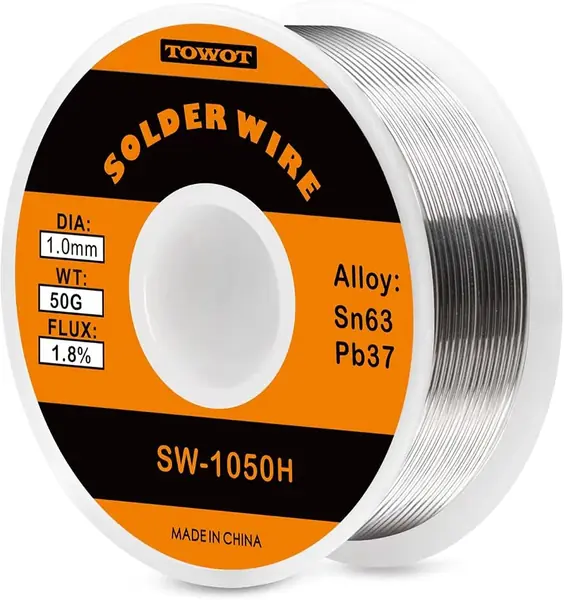
TOWOT 63/37 Rosin Core Solder Best for Wire and Connector Work

TOWOT tin-lead rosin-core solder wire spool, 63/37 alloy, 1.0 mm

Wire and connector work

Track Score 91/100
Alloy
63/37 tin-lead
Wire Diameter
1.0 mm
Flux Content
1.8%
Spool Weight
1.76 oz
View on Amazon

One millimeter is where solder stops being a board tool and starts being a wire tool. This TOWOT roll feeds fast — a connector, a switch lug, or a spliced lead takes solder in a couple of seconds — and it is the right gauge when the joint is bigger than a pin.

The alloy is 63/37 with 1.8% rosin, so it melts at 183 °C and sets quickly. That matters more at this thickness than at 0.6 mm: a fat bead holds heat longer and stays molten longer, and a eutectic alloy shortens the window where a bumped joint goes grainy.

The packaging takes a minute to decode. It is sold in several styles and several weights, from 0.6 mm to 1.2 mm and from 50 g to a pound, and the option you pick is the option you get — confirm the diameter in the cart before checkout.

This is the cheapest roll in the group, and it does its job without drama or bad habits. We keep it as the second spool, next to a thin wire rather than instead of one, because no single gauge covers both a header pin and a battery lead.

Worth Noting

  • Too coarse for fine-pitch board work
Our Verdict

Our second-spool pick for wire and connector work, where the thicker 1.0 mm gauge feeds fast and the price stays at the bottom of the group.

Check Latest Price
8.

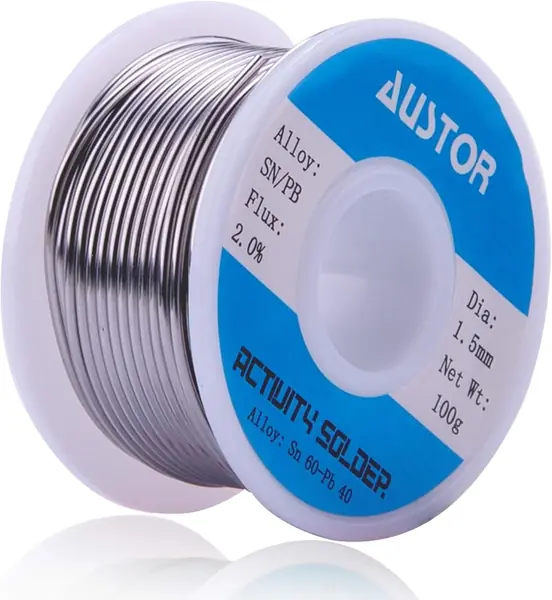
AUSTOR 60/40 Solder Wire Best for Heavy-Gauge Wire Joints

AUSTOR tin-lead rosin-core solder wire spool, 60/40 alloy, 1.5 mm, 100 g

Heavy-gauge wire joints

Track Score 90/100
Alloy
60/40 tin-lead
Wire Diameter
1.5 mm (0.059 in)
Flux Content
2.0%
Melting Range
185-190 °C (365-374 °F)
View on Amazon

At 1.5 mm, the AUSTOR roll is nearly twice the diameter of the 0.8 mm wires that make up most of this list, and that is the whole story. It isn't a finer version of anything; it is a different tool for a different joint.

The alloy is 60/40 with 2% flux and a melting range of 185 to 190 °C, so it behaves like the other leaded wires here, only with far more metal moving per inch. A hundred grams at this gauge is a lot of solder — you measure this wire in inches, not feet.

Where it earns its spot is chassis wiring: tinning 12- and 14-gauge leads, filling a connector cup, landing a ground strap on a terminal. A 0.6 mm wire gets there eventually, but this one does it in a single pass with a hot iron and leaves a full, rounded fillet.

We keep it as the heavy-gauge option and not as a board solder, and that boundary is the important part. If your work is through-hole and small pads, one of the thinner picks serves you better; if you are rewiring a guitar, a harness, or a power lead, this is the roll that saves the afternoon.

Our Verdict

The heavy gauge for chassis leads, ground straps, and connector cups, not for board work — useful if those joints are on your bench.

Check Latest Price

How We Tested Solder Wire on the Bench

We started by setting aside any spool that wouldn't state its alloy, flux percentage, or diameter — if a seller can't tell you whether the wire is 60/40 or 63/37, it isn't a spool you can plan a repair around. That left a shortlist spanning eutectic 63/37 and 60/40 tin-lead, one lead-free SAC alloy, wire from 0.6 mm up to 1.5 mm, and packs from a 1-ounce tube to a full pound. We bought 14 of them and worked through them over five months.

Testing happened at a home bench, mostly on weeknights with a few long weekend sessions: re-capping a receiver, soldering header pins onto a fine-pitch board, tinning heavy-gauge wire and filling connector cups, building a couple of patch cables and a pedal, and rewiring a lamp. Every spool ran at the same iron temperature. We watched how the wire melted into the joint, whether the cooled joint came out glossy or grainy, and how it behaved on the way back to solid — the 63/37 spools set the moment the iron lifted, while the 60/40s stayed half-set for a beat and needed a steady hand.

Handling got as much attention as chemistry. We noted whether the wire fed straight or kinked, whether the spool dragged or spun freely in the hand, and how much residue the flux left once a joint cooled; running a 1.8% core and a 3.3% core over the same oxidized pad made the difference plain. We weighed each spool before and after and counted joints per gram, then set that against how much soldering a buyer would realistically do in a year. Throughout, food and drink stayed off the bench, fume extraction ran at every session, hands were washed after handling leaded wire, and leaded spools were labeled and stored apart from anything lead-free.

How to Choose Solder for Electronics

Start with the alloy

63/37 tin-lead is eutectic: it melts at 183 °C and solidifies with almost no pasty stage, so a joint stops moving the instant you lift the iron. 60/40 melts at the same temperature but passes through a slushy window on the way back, which is why older guides tell you to hold the wire still. Both are easier to work with than lead-free SAC alloy, which needs about 217 °C at the joint and a hotter, heavier tip.

We default to 63/37 when a temperature-controlled iron is on the bench and to 60/40 when it isn't, because that slushy window forgives a tip running cool. Lead-free is the choice when the board will be sold, is subject to RoHS, or falls under a shop or school rule — and whichever you pick, wash your hands after handling leaded wire and keep food and drink off the bench.

Match the diameter to the joint

0.6 mm is for crowded pads, fine-pitch rework, and anything where a stray blob would bridge two joints. 0.8 mm is the general-purpose size and covers most through-hole work; 1.0 mm is for connectors, switch lugs, and heavier leads; 1.5 mm lives in chassis and connector-cup territory.

The trap is buying the thinnest wire on the assumption that finer means more precise. On a ground plane or a battery lead, a 0.6 mm wire takes so long to lay down enough solder that heat spreads into the board while you wait. The opposite mistake — a 1.5 mm roll on fine board work — is just as common and harder to recover from, because the wire delivers more solder than the joint can hold before you can stop it.

Decide how much flux the core carries

The budget rolls here sit around 1.8% flux by weight, the more forgiving ones run 2% to 2.2%, and the Kester 60/40 spool carries 3.3%. More flux means more cleaning action on an oxidized pad and less need for a separate flux pen, and it also means more residue left on the board when the joint is done.

We treat 1.8% as the floor for new parts and switch to a higher-flux roll when we are reworking something old or reflowing the same joint a third time. On fresh perfboard with newly stripped leads the difference is small; on vintage gear it is not.

Buy a spool size you will actually finish

A 50 g roll is a season of repairs for most people, 100 g roughly doubles it, and a pound is bench stock for someone who solders most weeks. Bigger is not automatically better if the roll sits in a drawer for two years between uses.

Our preference is two small rolls in different diameters rather than one large roll in one: a 0.6 mm and a 1.0 mm cover nearly every joint on a bench, and both get used. Watch products sold in several sizes on a single page — the diameter in the option menu is the diameter that arrives, whatever the photo shows.

Frequently Asked Questions

Final Verdict

The Kester 24-6040-0027 is what we keep on the bench when soldering is a habit rather than a one-off: consistent wetting, a rosin core generous enough for older boards, and a pound of wire that will not run out mid-project.

If you are starting out, the HGMZZQ roll does the same work in a smaller package for a fraction of the outlay, and its 2.2% core is the more forgiving of the two. If lead-free is a requirement rather than a preference, buy the ZSHX SAC roll and give it a hotter iron.