Best Temperature-Controlled Soldering Irons of 2026

An iron that can't hold its heat turns a five-minute repair into a ruined board: you linger on the joint, the pad lifts, and the fix costs more than the tool. Temperature control prevents that, because a good iron senses the dip as solder starts to flow and pushes power back in before you notice.

Wattage buys recovery, not temperature, so a modest iron with a chunky tip can out-solder a hotter one wearing a needle point. Tip cost and handle comfort counted as much as the dial. We soldered hookup wire and header pins, stained-glass foil and ground planes that drain a tip in a second with 12 irons and stations, and the six picks run from bench stations to a dial-in-handle iron and a USB-C pen, since a garage bench and a kitchen table ask for different tools.

Our Top Picks

The Best Temperature-Controlled Soldering Irons

1.

Weller WE1010NA Digital Soldering Station Best Overall
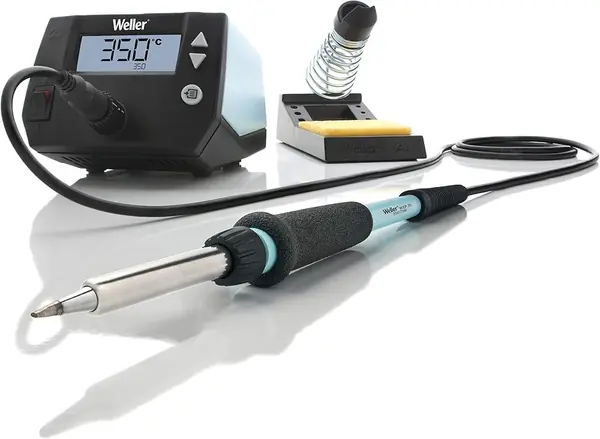
Weller WE1010NA digital soldering station with LCD panel, WEP70 iron, and safety rest

Regular bench work

Track Score 94/100
Wattage
70W
Temperature Range
200-850°F
Depth
12.5 inches
Temperature Stability
±4°F
View on Amazon

Two lines on the WE1010NA's spec sheet are what earned it the top spot here: a stated temperature stability of ±4°F, and a lock that holds the setpoint once you have found it. Plenty of irons quote a range; far fewer tell you how tightly they hold a point on that range. On a board with small pads and parts you cannot replace, that combination is the difference between a joint you can repeat and one you rework.

As a working station we found very little to argue with. The 70W element brings the tip up quickly and gets back to temperature after a ground plane pulls heat out of it, the LCD reads clearly from a seated position, and the front power switch means you are not hunting for a cord. The detail we appreciated most is the tip change: twist the knurled nut by hand, pull the tip, push the next one in, no tool and no cooldown.

ESD safety matters more than most hobbyists assume, and the station, iron and cable are all rated for it, which is why we do not think twice about using it on boards without a mat. The PH70 rest also does its job: the iron sits deep and stays put between joints. The cost is bench space, because 12.5 inches of depth and 5.5 pounds of die-cast housing do not tuck into a drawer the way a pen iron does.

Heating elements are the part that fails on every iron in this guide, so treat the purchase as a support question: buy where returns are simple, register the one-year warranty the week it arrives, and keep a spare ETA tip in the drawer. If you solder a couple of times a year rather than most weeks, the PINECIL handles the one joint you have for far less outlay, and the Plusivo kit covers a first repair outright.

Worth Noting

  • Takes up 12.5 inches of bench depth
Our Verdict

We recommend the WE1010NA as the default bench station: a stated ±4°F hold, a temperature lock, and tool-free tip changes make repeatable joints routine for anyone soldering most weeks.

Check Latest Price
2.

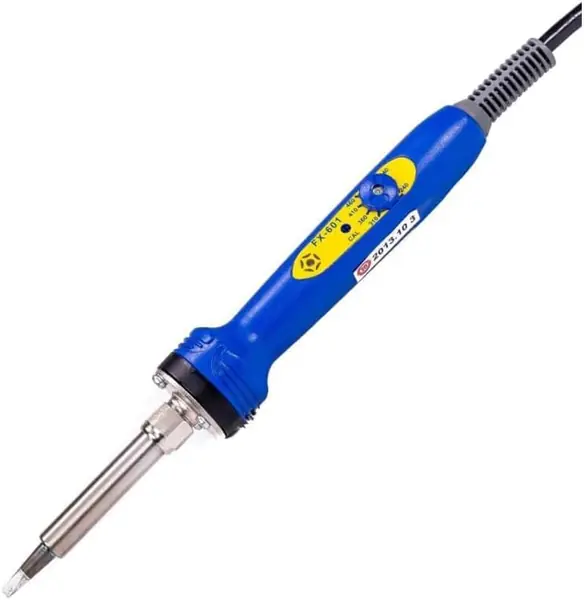
Hakko FX601-02 Adjustable Temperature Controlled Soldering Iron Best for Stained Glass and Long Reach

Hakko FX601-02 pencil soldering iron with temperature dial in the handle and standard tip

Stained glass work

Track Score 93/100
Wattage
67W
Upper Limit
540°C
Standard Tip
T19-D5
Temperature Control
Closed-loop, dial on handle
View on Amazon

Hakko put the temperature dial on the handpiece, right where your thumb rests, and that one decision explains why this iron keeps turning up in stained-glass shops. You can drop the heat a notch while a bead is still molten without moving your hand to a base unit. Behind the dial is closed-loop electronic control with the sensor in the heater, so the tip climbs back to its setpoint after it dumps heat into a seam — the behavior we care about more than any number on a display.

We liked it most for work where the iron has to travel: lead came and zinc framing on a panel, a heavy splice in a harness, a joint up under a dashboard. The handpiece is slender and light because there is no transformer in your palm, and 67W keeps a broad chisel wet on joints that would stall a pen iron. The standard T19-D5 tip is a good match for dragging solder along a seam, and replacements are easy to find.

This is the pick for someone whose soldering is structural rather than electronic: a panel, a splice, a repair where the joint is big and visible. If you need an exact number in front of you for small pads, the Weller is the better station. Where this one wins is at the far end of a workpiece, and a wide chisel tip, a light hand and fast recovery finish a long seam faster than a heavier station iron does.

Worth Noting

  • Dial only with no temperature readout
  • Stiff power cord is awkward at the bench
Our Verdict

Buy the FX601-02 if your soldering is structural — stained glass, heavy wire, long reach — because the dial sits under your thumb and the light handpiece keeps a big joint fed.

Check Latest Price
3.

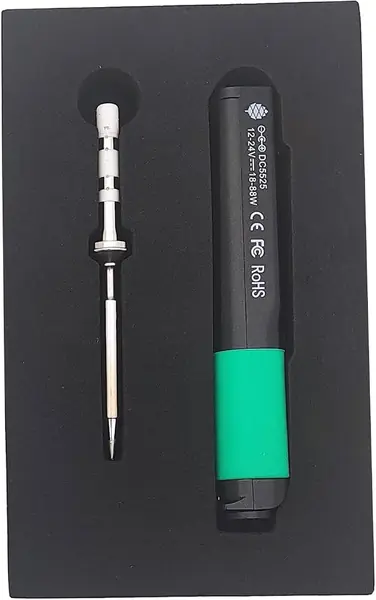
PINECIL Smart Mini Portable Soldering Iron Best Portable

PINE64 PINECIL mini portable soldering iron in stainless steel with OLED display and short tip

Field repairs

Track Score 92/100
Temperature Range
100-400°C
Weight
2.12 oz
Power Input
USB-C PD or DC5525
Stated Warm-Up
12 seconds
View on Amazon

Twelve seconds is what PINE64 claims from cold to operating temperature, and that number reframes what a soldering iron is for. It is not a tool you set up for the afternoon; it is one you switch on when a joint appears, which is exactly the situation in a pit box, a trailer, or on a bench you are borrowing.

Under the shell is a 65W element, a 0.69-inch OLED showing set and actual temperature, and a 32-bit controller running IronOS with auto standby — a lot of configuration in something that weighs 2.12 ounces and measures about six inches. It wants 20V at 3A over USB-C Power Delivery, or 12 to 21V on the DC5525 barrel jack, so the 65W laptop brick already in your bag is the obvious partner.

We kept reaching for it on jobs where dragging out a station is more work than the soldering: swapping a connector on a slot-car chassis, reflowing a single pad, fixing a lead at the track. The slim stainless handle takes a session to get used to if you are coming from a fat pencil grip, and the fine tip will stall on a heavy ground plane — that is a station job, not a pocket-iron job. What surprised us is how much the OLED changes the way you work: watching the actual temperature drop and climb back teaches you more about heat transfer than any tutorial.

Worth Noting

  • No power supply in the box
  • 30-day warranty is short
Our Verdict

Our pick for soldering away from a bench: at 2.12 ounces it disappears into a bag, and 12-second heat means you can fix one joint without setting up a station.

Check Latest Price
4.

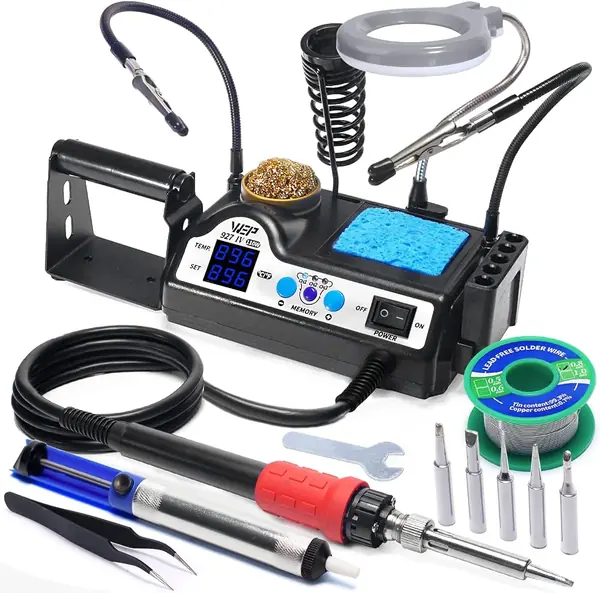
WEP 927-IV Soldering Station Kit Best All-In-One Bench Kit

WEP 927-IV soldering station with helping hands, LED magnifier, iron holder, and spare tips

Cramped hobby benches

Track Score 91/100
Wattage
110W
Weight
2.25 lb
Preset Channels
3
Upper Temperature
896°F
View on Amazon

If your soldering bench is the end of a kitchen table, the 927-IV was built for you. The iron holder, brass-wool cleaner, solder spool, two helping hands, LED magnifier and tip storage are all part of one body roughly six inches wide and a little over two pounds, so nothing gets unpacked and nothing gets lost between projects.

We liked the 110W element more than we expected to. High wattage does not mean a hotter tip; it means the tip returns to its setpoint after a big joint drains it, and that is what separates this from the pen irons when you are splicing wire or working through-hole parts with any mass. Three preset buttons cover the temperatures you actually use, and the calibration routine — enter what a meter reads at the tip — is the feature that keeps the display honest as the element ages.

What you are buying is consolidation rather than a lifetime tool. It is a single-channel unit, so one failed handle takes the whole bench down until a replacement arrives, and the temperature it reports can drift from the tip's real temperature, which is precisely what calibration exists to correct. Calibrate once when it arrives and again whenever joints start behaving differently than they did last month.

Worth Noting

  • Magnifier is small for fine-pitch work
  • Bundled solder wire is worth replacing
Our Verdict

For a small bench that has to hold everything, this station folds the iron, the helping hands and the cleaning kit into one footprint and brings 110W to heavy joints.

Check Latest Price
5.

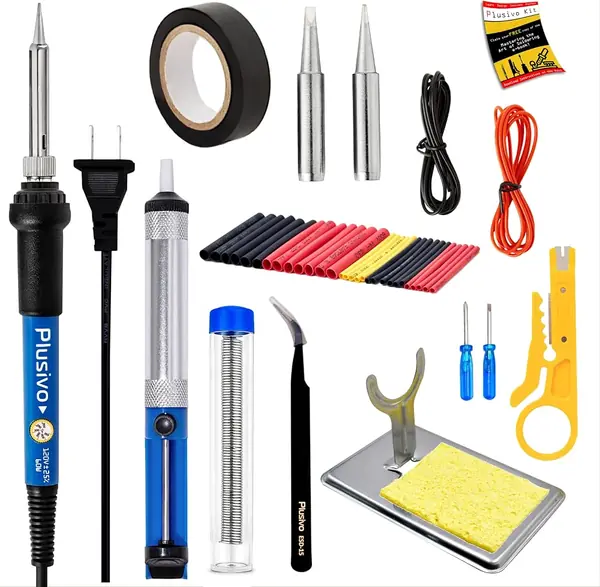
Plusivo 60W Soldering Iron Kit Best Starter Kit

Plusivo 60W soldering iron kit with stand, spare tips, solder wire, and desoldering pump

First soldering jobs

Track Score 90/100
Wattage
60W
Temperature Range
392-842°F
Kit Contents
15 pieces
Heating Element
Ceramic
View on Amazon

Open the box and you get an iron, a stand and sponge, a roll of 0.8mm solder wire, a desoldering pump, two spare tips and a set of heatshrink tubes — fifteen pieces aimed at a first repair, with nothing else to order before you start.

The iron itself is a 60W ceramic-heater pencil with a knob running from 392 to 842°F. There is no readout, so the dial is a starting point rather than a setting: you turn it up until solder wets a scrap joint and work from there. That is a real adjustment if you are used to a station, but it is also why the kit lands where it does, and for a controller, a guitar jack or a wiring harness it is plenty.

We think of it as the kit to buy when you have one job and no tools. If soldering turns into a hobby, the PINECIL is a better second purchase than a second kit of this kind. For occasional repairs everything in the box works, and the desoldering pump — the piece budget kits usually get wrong — is genuinely useful for lifting a component off a board.

Worth Noting

  • Stand is flimsy and slides easily
  • Low dial settings won't melt solder reliably
Our Verdict

If you have one repair and no tools, this kit covers it: iron, solder, pump and spare tips in one box, with a knob that is honest about being a starting point.

Check Latest Price
6.

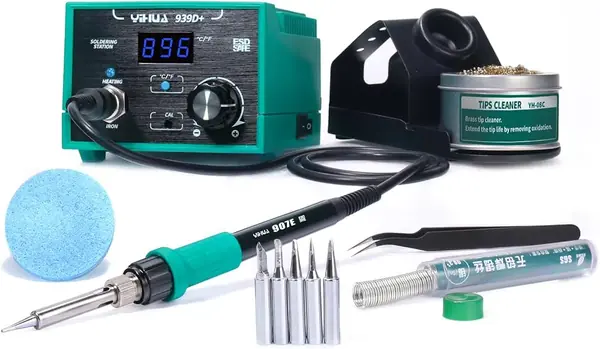
YIHUA 939D+ Digital Soldering Station Best for Calibrated Bench Work

YIHUA 939D+ green digital soldering station with aluminum front panel and detached iron

Calibrated bench work

Track Score 89/100
Wattage
75W
Temperature Range
392-896°F
Control
PID program
Display
Digital °F/°C
View on Amazon

The feature to look at on the 939D+ is the calibration routine: you measure the tip, enter the real number, and the station trims its PID program to match, so the display and the tip stop disagreeing. That is professional-station behavior at a mid-range price, and it comes with a brushed aluminum front panel that shrugs off a stray iron, a 75W element, and a 392 to 896°F range with a °F/°C display.

What you do not get is Weller's tip selection or its die-cast housing; this is a lighter, single-channel station that you place rather than plant. In exchange it takes up very little room, detects the handle's status on its own, and gives you a setpoint you can actually verify. For a small bench where one dependable temperature and a way to check it matter more than a catalog of tips, this sits comfortably between the PINECIL and the WE1010NA.

Our Verdict

We point readers at the 939D+ when they want PID control and a calibration routine without paying for a flagship station — a sensible middle for a small, tidy bench.

Check Latest Price

How We Tested the Best Temperature-Controlled Soldering Irons

We built the shortlist from spec sheets and parts catalogs rather than star ratings: irons and stations with a published temperature range and stability figure, replacement tips and heating elements for sale, written warranty terms, and a clear answer on what each one needs at the outlet.

Twelve units came to the bench for eight months. Testing happened where soldering actually happens: a basement workbench, a cramped hobby bench in a spare room, an open garage door. We ran the same jobs on every unit — 22-gauge hookup wire, header pins on a scrap board, heavy wire into a copper pad that pulls heat out of the tip, foil for stained glass — with a window open and a fan moving air across the bench.

A thermocouple clamped to the tip told us whether the display was honest and how far the temperature swung between joints. We timed warm-up from cold with a stopwatch, then timed recovery after that copper pad drained the tip, which predicts how a station behaves on real boards. Tip changes ran against a clock, tools or no tools. Each iron idled ten minutes in its stand so we could see what sleep or standby did, and anything claiming ESD safety ran on a grounded outlet.

Handpiece comfort got a three-hour session on one board, with notes on grip heat, cord drag, and where the controls fell under the thumb. We priced a replacement tip and a heating element for every unit and counted what shipped in the box, since accessories decide whether a first-timer needs a second order. After the structured tests ended, we kept reaching for the finalists for odd repairs, watching for the flicker and cold joints that signal a tired heating element.

How to Choose a Temperature-Controlled Soldering Iron

Read Stability Before You Read the Range

A headline range of 200 to 850°F or 392 to 896°F tells you where the dial goes, not how well the iron stays there. What we look for is a stability figure or a control scheme: the Weller states ±4°F, the Hakko runs closed-loop control with the sensor in the heater, the YIHUA runs a PID program. Those three are describing the same virtue from different angles.

The trap is a wide range on a cheap pencil. It usually means a bigger resistor, not better regulation, so when a maker gives you a maximum temperature and nothing about how it holds one, assume you are setting a rough dial position rather than a temperature you can return to.

Match the Form to the Work

A soldering station keeps a stand, a spare tip and a stable base in one place, and it is what we choose for a permanent bench. A dial-in-the-handle iron reaches where a base unit and a cord cannot. A portable pen is for the joint that appears away from home. Decide which of those three describes most of your soldering and the shortlist collapses quickly.

Watch the word compact in a studio. On a station it means it fits a shelf, not a drawer: the WE1010NA is 12.5 inches deep and needs that footprint kept clear. On a pen iron it may mean the handle is short enough that your fingers sit close to a hot tip.

Wattage Buys Recovery, Not Temperature

Sixty watts and 110 watts both reach 700°F; the difference is what happens when the joint pulls heat away. A high-wattage element like the WEP's 110W returns to the setpoint faster, which matters on wire splicing, through-hole work and anything with mass. On small pads a 60 to 70W iron with a fine tip is easier to keep under control.

The failure mode to watch for at the other end is a kit that advertises a broad range but cannot melt solder at the bottom of the dial. Buy output for the joints you actually make, not for a number you will never set.

Budget for Tips and the Heating Element

The tip is a consumable and so is the heating element; on every iron here the element is the part that eventually wears out. That makes the supply chain part of the purchase: tips you can buy in the shape you need, an element that can be replaced, and a warranty long enough to cover an early failure.

Coverage across this set runs from 30 days on the PINECIL to a year on the Weller and the WEP. Register the card the week the iron arrives, and keep one spare tip for the shape you use most — a worn tip is the most common reason a perfectly good station seems to stop working.

What's in the Box Decides Your First Week

A kit and a station solve different problems. A kit like the Plusivo gets a beginner soldering the day it arrives with iron, solder, pump and spare tips, while a bare station assumes you already own solder, flux and a way to clean a tip. Buy the kit if your next job is your first one, and buy the station once you know you will keep going.

Either way, treat bundled solder as a sample and buy fresh wire you trust. The iron is usually the best part of a budget kit; the solder and the stand are where the corners were cut.

Frequently Asked Questions

Final Verdict

The WE1010NA is the iron we recommend to anyone who solders most weeks. The temperature lock and the stated ±4°F stability do more for a repeatable joint than another hundred watts of peak heat, and the tool-free tip change means you actually swap to the right shape instead of making the wrong one work. Buy it once, register the warranty, and keep a spare tip in the drawer.

Two cases change the answer. If the work travels — a pit box, a panel class, a friend's garage — the PINECIL at 2.12 ounces and 12-second heat is the one that comes along, provided you pack a charger that can deliver 20V at 3A. And if the joints are big and visible rather than small and green, the Hakko's dial-on-handle design is worth the stretch.