Best Soldering Irons for RC Cars of 2026

A joint can look perfect on the bench and let go four laps into a main, and an XT90 on a battery lead is where that usually happens. Connector work on an RC car is a heat problem first: thick wire, big metal tabs and a joint that has to be finished in seconds before the insulation pulls back. A good iron gets heat into the joint fast, holds it there and gets out.

Watts are a poor shorthand. A modest station with a wide screwdriver tip and tight regulation beats a hotter pencil with a needle tip on a battery connector, because the heat has to travel through the tip first. Where you solder matters as much: a home bench can carry a station with a stand and temperature lock, a pit table wants USB-C or LiPo power, and no outlet means butane. We soldered connectors onto pigtails and tinned heavy wire with 11 irons over nine months.

Our Top Picks

The Best Soldering Irons for RC Cars

1.

Weller WE1010NA Soldering Station Best Overall
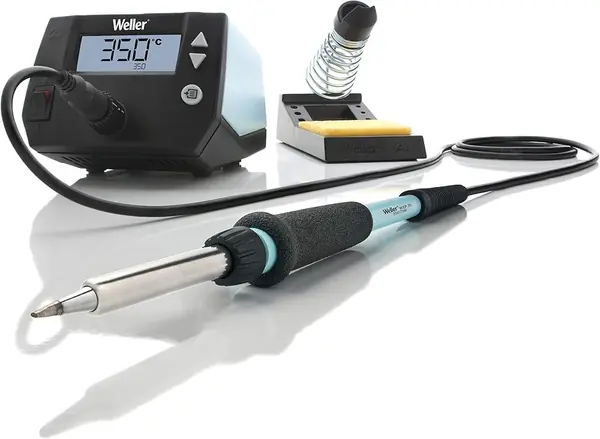
Weller WE1010NA soldering station with digital display, iron and safety rest

Bench-side connector work

Track Score 95/100
Temperature Stability
±4 °F
Wattage
70 watts
Included Tip
ETA 1.6 mm screwdriver
Temperature Lock
Yes
View on Amazon

The figure that decided this one for us isn't the wattage, it's the ±4°F temperature stability. A big XT90 joint pulls heat out of a tip in a hurry, and an iron that answers by dropping temperature is how you end up with a dull, grainy joint that lets go under load. The WE1010NA is a 70-watt closed-loop station that holds its set point through the joint, and it locks that set point so a stray button press can't change it mid-solder.

At the bench it behaves like an appliance rather than a gadget: a front power switch, three buttons, an LCD you can read from standing height, and a weighted rest with a sponge that keeps the iron where you parked it. Tips come off by hand, twisting the knurled nut on the handle, so going from a fine point for a receiver board to a chisel for battery cable takes seconds and no wrench.

The supplied ETA tip is a 1.6 mm screwdriver, a good all-rounder for 14-gauge and XT60 work and thin for 12-gauge and XT90 posts, so put a wide ET chisel on the same order. It's the most expensive iron here, and the honest reason we can still point you to it is the tip line: genuine ET tips are sold everywhere in every shape, and that's the part of the price you keep using.

Worth Noting

  • Element failures show up beside years-long units
Our Verdict

We point anyone soldering XT90s and 12-gauge at a bench toward this: 70 watts with ±4°F stability and a tip line deep enough to match any connector.

Check Latest Price
2.

Pinecil Portable Soldering Iron Best for the Track

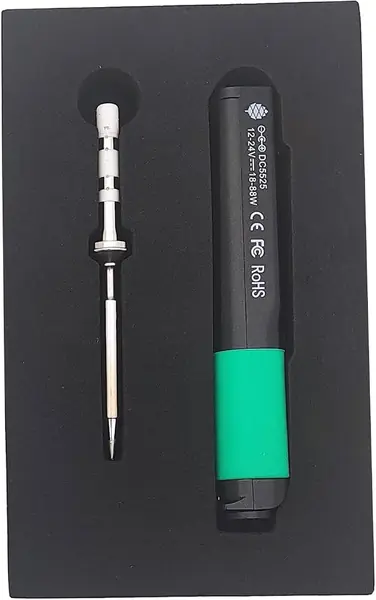
Pinecil portable soldering iron in stainless steel with OLED display and pointed tip

Track-side repairs

Track Score 94/100
Power
65 watts
Heat-up Time
12 seconds
Weight
2.12 oz
Input
USB-C PD or 12–21V DC
View on Amazon

Ten minutes between heats, the car on the pit mat, and a battery lead that pulled out on the last run: that's the situation this iron is built for. The Pinecil lives in a pocket of a race box, reaches working temperature in about 12 seconds, and runs from USB-C PD or a 12–21V DC barrel plug, so a 4S or 6S pack in your pit box can feed it all afternoon.

We reach for it more than any other iron here once we're away from a bench. The OLED is legible outdoors, two buttons cover the whole menu, and at just over two ounces it disappears into a tool bag next to a set of tires. Temperature runs from 100 to 400 °C, enough for lead-free solder on connectors and 12-gauge leads.

It ships without a supply, so plan for a 20V/3A USB-C brick, because a phone charger negotiates a fraction of the 65 watts this iron can use, or run a barrel plug off a pack. Be realistic about gauge too: XT60s, 12-gauge and receiver wiring are easy, while 10-gauge into an XT90 wants a wide tip and a slower hand.

Worth Noting

  • Some units stop working within weeks
Our Verdict

Our pick for the race box: 12-second heat, two ounces of stainless steel, and the option to run it straight off a LiPo pack.

Check Latest Price
3.

Q-MING 80W LCD Soldering Iron Kit Best Budget

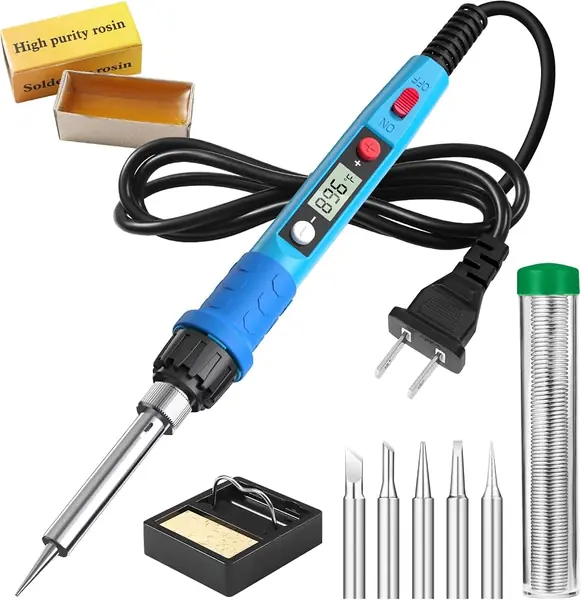
Q-MING 80W blue soldering iron with LCD display and five spare tips

First RC iron

Track Score 93/100
Power
80 watts
Heat-up Time
About 20 seconds
Display
LCD
Temperature Range
356–896 °F
View on Amazon

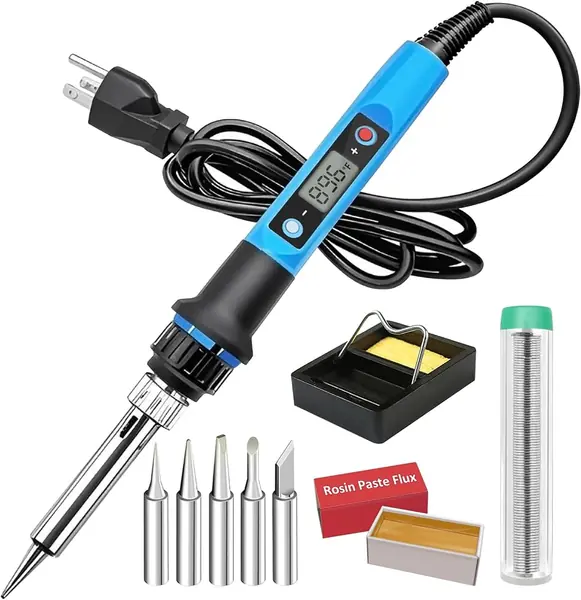
Eighty watts and a digital temperature readout at the very bottom of the price range is the kind of claim worth testing. This one survives it: the ceramic element comes up to working heat in about 20 seconds, the LCD tracks what you dial in, and the range runs from 356 to 896°F.

The pencil is light and the four vent holes in the collar keep the handle from cooking your fingers through a run of joints. Five tips come in the box with a stand, a sponge, a length of solder and a small pot of flux paste, so the kit is genuinely usable on the day it lands rather than merely close.

The first joints we made with it were pack leads and an XT60, and the readout stayed where we set it while the solder went shiny in a couple of seconds. For XT60s, 12-gauge leads and receiver wiring it has been enough iron every time; 10-gauge into an XT90 wants a wider tip and a slower hand. Everything else about it, including the soldering, we've had no argument with.

Worth Noting

  • Simple wire stand shifts on the bench
Our Verdict

The cheapest iron here still gives you 80 watts and a real temperature readout, which makes it our pick for a first RC soldering setup.

Check Latest Price
4.

HANDSKIT 90W Soldering Iron Kit Best Complete Kit

HANDSKIT 90W soldering iron kit with tips, pump, tweezers and carry case

Starter kit

Track Score 92/100
Power
90 watts
Heat-up Time
About 10 seconds
Tips Included
6
Temperature Offset
−99 °C to 99 °C
View on Amazon

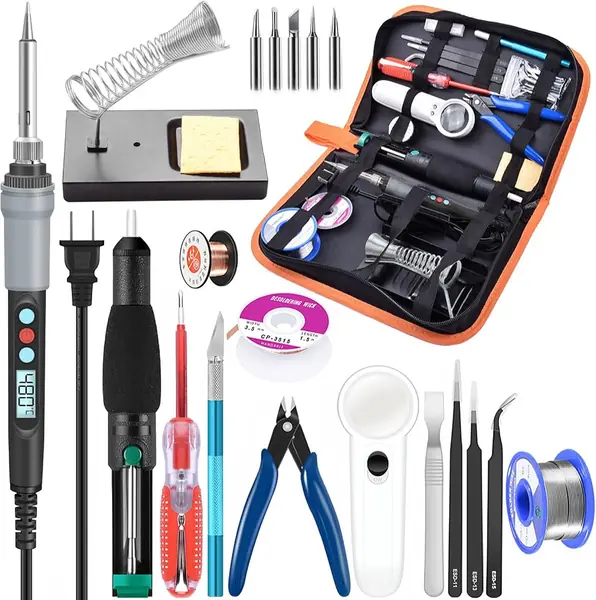
Zip the case open and you have a soldering setup rather than a soldering iron: the 90-watt pencil, six 900M tips, a desoldering pump, tweezers, a magnifier, a stand and a length of solder, all held in a soft PU bag that stays shut in a toolbox.

Starting from nothing, that completeness is the feature we care about most, and the iron behind it is better than the money suggests. The ceramic core is rated to working heat in about 10 seconds, and the temperature calibration lets you trim the readout to match another thermometer instead of learning to live with an offset.

Sleep and memory are the two settings that matter day to day. Leave it idle and it drops temperature rather than cooking the tip; power it back on and it returns to the setting you last used, which saves a minute of fiddling every session. The six tips are the common 900M pattern, so adding a wide chisel for battery work is a small, easy order.

What it isn't is a station: there's no weighted base, the stand is a separate piece, and 10-gauge still asks for patience. For connectors, receiver wiring and the occasional set of motor leads, we haven't found a gap in it.

Worth Noting

  • Menu settings take a few sessions to learn
Our Verdict

We recommend this one when you own nothing yet: 90 watts, six tips and every accessory in one zippered case.

Check Latest Price
5.

YIHUA 939D+ Soldering Station Best Station Value

YIHUA 939D+ black soldering station with brushed aluminum panel and iron holder

Weekly hobby bench

Track Score 91/100
Display
LCD
Temperature Range
392–896 °F
Temperature Stability
±5 °C
Iron
907F detachable
View on Amazon

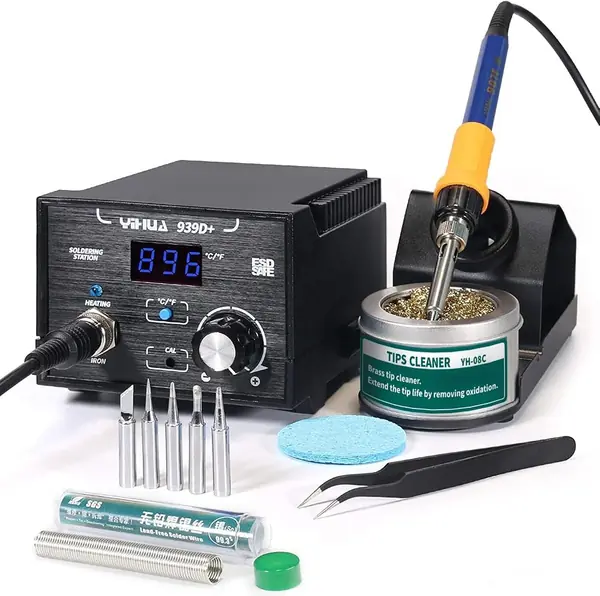
The brushed aluminum front panel is a small thing we've come to appreciate: a hot tip gets set down in a hurry, and a panel that shrugs off a scorch mark still looks like a tool a year in. Underneath it this is a real station, with a built-in transformer, an ESD-safe build, a detachable 907F iron, a weighted holder and a brass tip cleaner, for a good deal less than the premium pick.

The display reads in either scale, the station holds its settings, and the temperature is specified to hold within ±5 °C. A 392–896 °F range covers everything from receiver board work up to lead-free solder on a battery connector, which is more range than most of us need in an RC toolbox.

896 °F at the top end is enough to move lead-free solder onto an XT90 without holding the tip there until the housing softens, and the brass cleaner lets you refresh a tip between joints instead of wiping it on a damp sponge and hoping. If the pencil ever dies, the 907F detaches, so it's a part rather than a whole new station.

Worth Noting

  • Readout can drift from the set temperature
Our Verdict

A real station with a brass cleaner and stable heat for a lot less than the premium pick, which suits anyone soldering every week.

Check Latest Price
6.

Power Probe PPSK Butane Soldering Kit Best Without an Outlet

Power Probe PPSK black butane soldering kit with torch body and accessories

No-outlet repairs

Track Score 90/100
Weight
12.7 oz
Fuel
Butane
Ignition
Electronic
Run Time
Up to 2 hours
View on Amazon

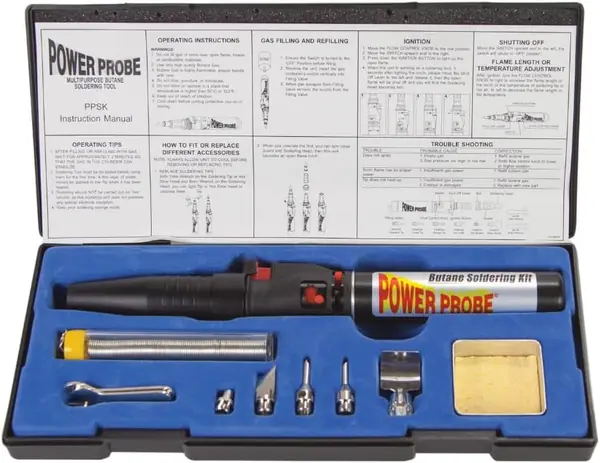
At the far end of a pit table there is no outlet, and the person with the butane iron is the one still racing. That's the case for the PPSK: electronic ignition, an adjustable flame, and a soldering tip that reaches working temperature in seconds without a cord trailing across the bench.

A refill lasts up to two hours, which is the difference between a tool you use and a tool you leave in the box. The flame locks on for longer jobs, and the exhaust port doubles as a heat-shrink gun, so one tool covers two of the jobs that come up most on a race weekend.

We keep reaching for it on chassis wiring and repairs away from the shop, and it covers the whole range: 18-gauge signal wire down through 10-gauge leads without drama, provided you keep the flame low and let the tip do the work.

Butane and tips are the running costs. The kit ships dry, and the soldering tips wear faster than a bench iron's, so a spare or two in the box is worth the money. What you get in return is a tool that solders heavy wire where there's no power at all, which is the whole reason it earns a place in the car.

Worth Noting

  • Soldering tips wear faster than bench irons
  • Butane fuel is not included
Our Verdict

Our pick for pit-lane repairs: no cord, up to two hours per fill, and enough heat for 10-gauge leads.

Check Latest Price
7.

Liouhoum 936H 80W Soldering Iron

Liouhoum 936H 80W soldering iron with LCD display and conical tip

Spare bench iron

Track Score 89/100
Power
80 watts
Heat-up Time
About 30 seconds
Display
LCD
Auto Sleep
5 minutes
View on Amazon

Leave it sitting and it drops its own temperature after five minutes; switch it back on and it returns to the number you last used. Auto-sleep and temperature memory are the two conveniences that separate a pleasant iron from an annoying one, and this 80-watt pencil has both.

It heats in about 30 seconds and puts the temperature on an LCD, and the box carries a stand, a set of tips, solder and flux, along with a 24-month replacement promise from the maker. Nothing in the kit feels expensive, but nothing is missing either.

We rate it as a second iron rather than the only one in the box. For one connector at a time, or a receiver lead that needs redoing, it does the job without fuss, and at this money a spare you don't have to baby is a sensible thing to own.

Worth Noting

  • Long joints can outrun the set temperature
Our Verdict

We like it as a second iron: 80 watts, auto-sleep and temperature memory for very little money.

Check Latest Price

How We Tested Soldering Irons for RC Cars

We built the shortlist from spec sheets, sorting candidates by power source, temperature control, and the tip shapes each one accepts, then setting aside anything we couldn't find replacement tips for. That left 11 irons, which we ran for nine months — from full stations down to pocket pencils and a butane tool.

On the bench, we soldered XT60 and XT90 connectors onto 12-gauge pigtails — never onto a pack itself — and tinned 10- through 14-gauge wire. We timed how long each iron took to flow a joint and how quickly it recovered for the next one, checked what the display claimed against a thermocouple, and watched for overshoot after a heavy pull. A fan ran the whole time, and we washed our hands after handling leaded solder.

Then we took them where RC cars actually get repaired: a folding table at the track, a parking lot, a bench with no outlet in reach. We ran the USB-C and LiPo-pack irons off a power bank, weighed each one after it went back in its case, and lit and refilled the butane tool outdoors and away from fuel, letting it cool fully before it went back in the box. Over the months we tracked element life, how cords and handles held up, and whether the temperature we set was still the temperature we got on the tenth session.

We also logged what shipped in the box — tips, stands, solder, cases — and priced out the extra tips each iron would need for heavy connector work, since a bargain iron with pricey tips stops being a bargain. Anything that arrived without a safe place to park a hot tip got marked down rather than ruled out.

How to Choose a Soldering Iron for RC Cars

Watts Matter Less Than Where the Heat Goes

An 80-watt pencil wearing a needle tip will lose to a 65-watt iron wearing a wide chisel every time you touch a 12-gauge lead, because the tip is what carries heat into the joint. Wattage buys recovery, tip mass delivers it. Look for a maker who sells chisel and wedge shapes in the same tip series and order one with the iron, since a 3–4 mm chisel is what makes XT90 posts and motor tabs behave.

Our rule of thumb: if a maker's tip line stops at fine points, it isn't an RC iron no matter what the wattage says.

Where You Solder Decides the Power Source

Bench work and pit work are different purchases. A station with a weighted holder and a brass cleaner is the right answer for a garage bench, while anything that has to travel wants USB-C PD, a DC barrel jack that can run off a pack, or butane and no cord at all.

The trap with USB-C irons is the supply. PD negotiation can leave a 65-watt iron running at half that on a phone charger, so match the brick's voltage and current to the iron's input rating before you blame the tool.

Temperature Control You Can Trust

Numbers on a dial are an estimate; numbers from closed-loop control are a setting. Heavy connectors reward working hot and fast, somewhere around 700 to 800 °F for lead-free solder, flowing the joint in a second or two and getting off before the plastic housing softens. That only works if the iron holds what you asked for.

Look for a stability figure or a calibration feature, and treat a temperature lock as a small luxury that saves one good joint. A butane kit has none of this, so reserve it for field repairs.

Tips, Solder, and the Cost After You Buy

The iron is the cheap part. Tips wear, brass or a damp sponge keeps them alive longer, and the solder and flux in a kit are usually starter portions. Budget for a wide chisel, a spare or two, and a roll of decent 60/40 or lead-free solder, and the total stays modest next to a set of race tires.

We would rather buy from a maker whose tips are easy to find in the shapes we want a few years on; that availability is the hidden cost of a bargain iron.

Frequently Asked Questions

Final Verdict

The Weller WE1010NA is what we tell a friend to buy for a bench that sees XT90s and 12-gauge. It holds temperature through the joint instead of sagging, and its tip line means you match the tip to the connector rather than the other way around.

If the bench isn't where you solder, the Pinecil does most of that job from a LiPo pack at the track for a fraction of the money. Bring a proper 20V supply and a wide tip and it will finish the job.