Best Mini Drones of 2026

Two hundred and forty-nine grams decides a lot. Cross it and you're registering with the FAA and fitting a Remote ID module; stay under it and a recreational pilot can simply fly. Within that limit, a mini drone's job is steady, watchable aerial footage without turning a Saturday into paperwork.

Equal resolution doesn't mean equal video. A mechanical gimbal holds the camera steady, while electronic stabilization crops and shifts the frame, and a panning shot through it can look like it was filmed through heat shimmer. We flew these in backyards, over an open field on breezy afternoons and in a living room where a palm-launched model buzzed the ceiling fan, judging each on how it held a hover in a breeze and what the kit costs once you add the extras you'll need.

Our Top Picks

The Best Mini Drones

1.

DJI Mini 3 (DJI RC) Best Overall
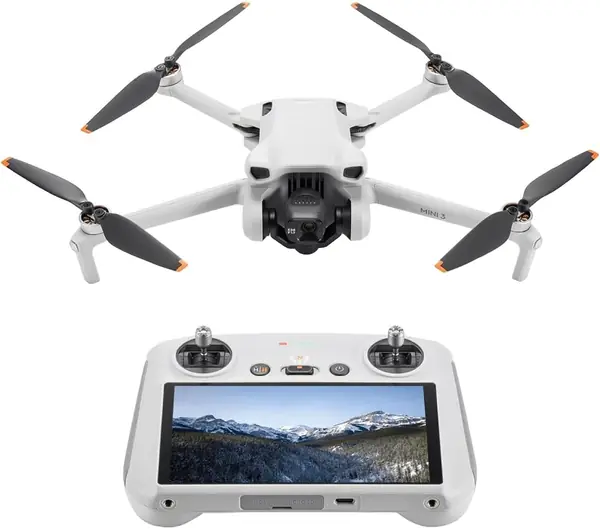
DJI Mini 3 gray camera drone with a three-axis gimbal camera underneath

Travel video

Track Score 91/100
Flight Time
38 minutes
Takeoff Weight
Under 249 g
Video
4K HDR
Gimbal
3-axis mechanical
View on Amazon

Four things separate a camera drone from a flying toy, and the Mini 3 has all of them: a real 3-axis mechanical gimbal, 4K HDR video, a body under 249 grams, and a battery rated for 38 minutes. That combination is why it tops this list. Backlit shots hold their highlights, which is more than we can say for the cheaper cameras here.

True vertical shooting is the feature we ended up using most. Rotate the camera and you record tall, phone-shaped video of a waterfall or a building without cropping a horizontal frame, and it plays full-screen on the device where most people actually watch. For travel footage that never gets edited, that matters more than resolution.

The aircraft is rated for level-5 wind, and the 10 km transmission figure is generous enough that you'll lose sight of it long before you lose signal. The trap is the battery upgrade: DJI's 51-minute Intelligent Flight Battery Plus pushes the drone past 249 grams and takes the registration-free status with it. Buy spare standard packs instead and stay in the easy category.

We tested the DJI RC version, which pairs the aircraft with DJI's own remote, and DJI also sells the same drone in other kit configurations — so confirm which controller you're ordering before checkout. The aircraft itself is identical either way.

Our Verdict

The smoothest 4K here in the smallest body: we pick the Mini 3 for its gimbal, vertical video, and 38 minutes under the registration weight.

Check Latest Price
2.

Potensic ATOM SE Best Starter Kit

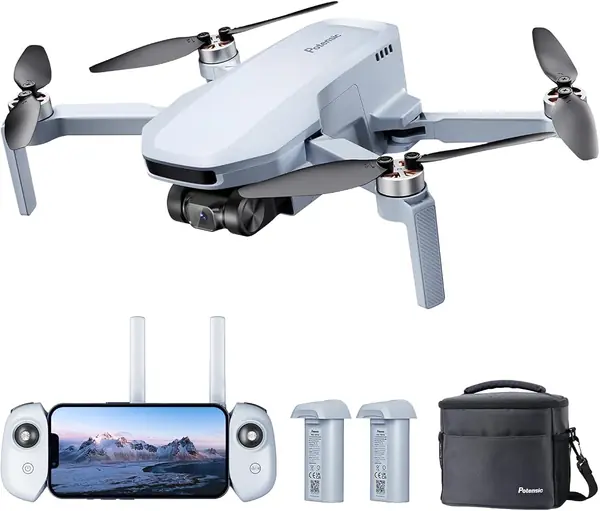
Potensic ATOM SE gray foldable drone shown with controller and two batteries

First-time pilots

Track Score 90/100
Flight Time
62 min total (two batteries)
Takeoff Weight
Under 249 g
Camera
4K EIS with 1/3-inch CMOS sensor
Transmission Range
4 km
View on Amazon

The expansion kit is what makes the ATOM SE worth a look: two 2,500 mAh batteries, a carry bag, and the three adapter cables you need for whatever phone you own, all in one box. That's 62 minutes of flying before anyone touches a charger, and it's why we rank it as the best starter package here.

The camera is a 1/3-inch Sony CMOS shooting 4K at 30 fps and 12 MP stills, and GPS holds the quadcopter steady enough to hover hands-off between shots. Beginner Mode and three flight modes keep the first few outings uneventful, and Sport mode reaches 16 m/s — more speed than this class of drone needs.

Check your phone against the controller's clamp before you order. Large handsets in thick cases are a tight squeeze, and the clamp is the one place where the ATOM SE feels like the budget drone it is. Everything else in the box — the bag, the spare props, the extra battery — feels like more than you paid for.

Worth Noting

  • No mechanical gimbal for gusty conditions
Our Verdict

We recommend the ATOM SE to first-time flyers who want two batteries, GPS return, and steady 4K without paying DJI prices.

Check Latest Price
3.

DJI Neo Best Budget

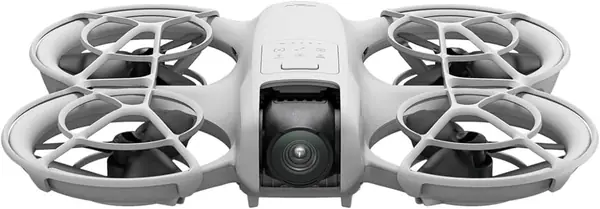
DJI Neo compact gray drone with built-in propeller guards and palm-sized body

Hands-free selfies

Track Score 89/100
Video
4K UHD
Weight
4.76 oz
Stills
12 MP
Control
Controller-free, voice, or app
View on Amazon

Press the button on top and the Neo lifts off your palm, flies a preset arc around you, and lands back in your hand. It weighs 135 grams, needs no FAA registration, and records 4K — a spec list that stops mattering the moment you're standing on a beach with nothing in your hands but a drone the size of a paperback.

That freedom is the draw. The Neo flies itself through eight QuickShots and tracks you while you walk, so you get usable footage of yourself without a pilot, a selfie stick, or a second take. We found the tracking holds well at walking pace, and the guarded props make a clumsy catch a minor event rather than a repair.

Two things to sort out before your first flight. There's no obstacle sensing aboard, so the same tracking that makes it fun will fly it into a tree if you let it — start in open space. And the DJI Fly app has to be downloaded from DJI's own site rather than Google Play, so install it at home.

Worth Noting

  • Remote controller sold separately
  • Short flight time per charge
Our Verdict

The Neo is our pick for hands-free 4K of yourself: palm launch, subject tracking, and 135 grams that need no registration.

Check Latest Price
4.

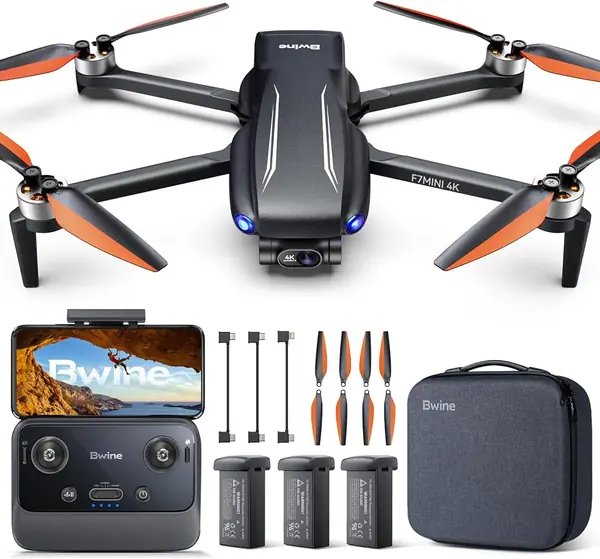
Bwine F7MINI Best Flight Time

Bwine F7MINI dark gray drone with orange propellers and a gimbal camera

Long shooting days

Track Score 88/100
Flight Time
96 min total (three batteries)
Takeoff Weight
Under 249 g
Camera
4K/30 video, 48 MP photos
Transmission Range
20,000 ft (6 km)
View on Amazon

Ninety-six minutes is the number that gets the F7MINI onto this list. Bwine ships three 2,200 mAh packs at 32 minutes each, plus a carrying case and charging cables, so a long afternoon of shooting doesn't depend on finding an outlet between flights.

The camera is the surprise: a 1/2-inch CMOS sensor behind an f/1.8 lens, 48 MP photos, 4K at 30 fps, and a 3-axis brushless gimbal holding all of it steady. We were also impressed by how well it holds a hover in a stiff breeze, which is the difference between usable footage and a shivering horizon.

We rate it the best flight-time buy here: three batteries, a real gimbal, and GPS return, for noticeably less than our top pick. The gimbal makes it more than a battery carrier — it's the same class of stabilization the DJI drones use, at a price that leaves room for a spare card.

Worth Noting

  • Some packs arrive unable to hold a charge
Our Verdict

Buy the F7MINI if your shooting days run long: three batteries, 96 minutes, and a 3-axis gimbal for less than our top pick.

Check Latest Price
5.

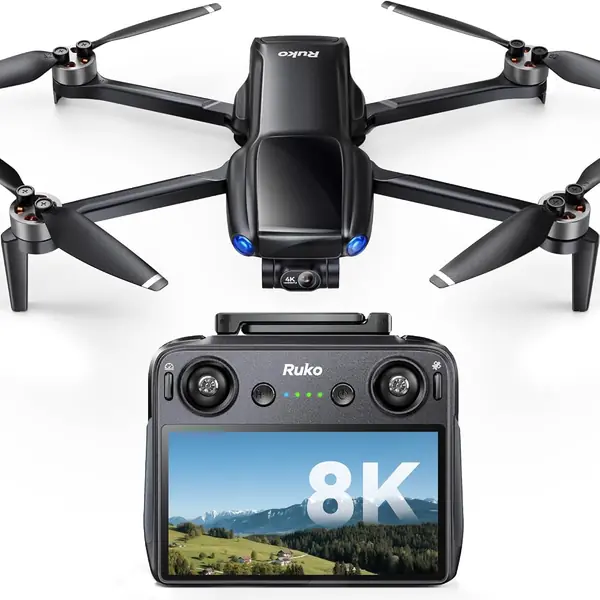
Ruko U11MINI 4K (RC3) Best Built-In Screen

Ruko U11MINI 4K black drone with a 5.5-inch touchscreen controller

Phone-free flying

Track Score 87/100
Flight Time
64 min (two batteries)
Takeoff Weight
Under 249 g
Camera
8K photos, 4K/30 video
Controller
5.5-inch 1080p touchscreen
View on Amazon

The controller is the story here: a 5.5-inch 1080p touchscreen built into the remote, with the live view and the flight app living in your hands instead of on your phone. No clamp, no cable, no handset baking in the sun while you fly.

Behind the screen sits a 3-axis mechanical gimbal on a 1/2-inch sensor, shooting 4K at 30 fps and 8K stills. GPS brings the drone home on its own if the signal drops, and the R2 digital transmission is rated to 20,000 feet — far beyond what you'll ever keep in sight.

Two batteries cover a combined 64 minutes, and the kit arrives with a carrying case, spare props, and a screwdriver. It's a complete package rather than a drone you have to finish buying accessories for.

Here's the decision. The screen is what you're paying for, and we think it's a genuinely nicer way to fly than clamping a phone into a holder — but the U11MINI lands close to our top pick on price, and that money buys DJI's gimbal, camera processing, and app ecosystem instead. Pick the Ruko if a self-contained controller matters more to you than the last increment of image quality.

Worth Noting

  • Gimbal faults surface on some units
  • Batteries can stop holding charge
Our Verdict

For a controller with a screen built in, the U11MINI is the one we suggest: no phone, no cable, and a 3-axis gimbal on the camera.

Check Latest Price
6.

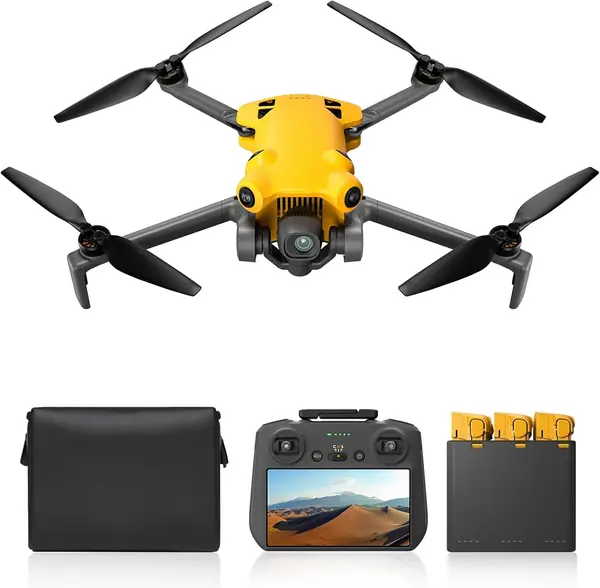
SKYROVER X1 Best Premium

SKYROVER X1 yellow drone with obstacle sensors and a screen controller

Confident beginners

Track Score 86/100
Flight Time
96 min (three batteries)
Takeoff Weight
Under 249 g
Video
4K/60 HDR, 48 MP photos
Obstacle Sensing
360-degree
View on Amazon

On paper the SKYROVER X1 reads like a drone from a much bigger brand: a 1/1.32-inch sensor at f/1.7, 4K at 60 fps in HDR, 48 MP stills, 360-degree obstacle avoidance, and a body under 249 grams. It also ships with three batteries and a charging hub, which works out to 96 minutes in the combo box.

The controller carries a 5.5-inch, 700-nit touchscreen that stays readable in direct sun, and the SkyBridge link is rated to 9.32 miles with a 1080p/60 live view. We never needed that range — the picture was still clean at the distances we actually flew, which is the part that matters.

Where we land: this is the most capable single package here, and the one to buy if you want obstacle sensing and a screen without assembling a kit. Against the Ruko U11MINI, which also puts a screen in the controller, the X1 adds 4K at 60 fps, a brighter display, and 360-degree sensing — for a good deal more money.

The sensing changes how you fly. It's the difference between threading a gap with your shoulders up and threading it with confidence, and for a first serious drone that alone justifies the step up.

Worth Noting

  • Spare parts are hard to source
Our Verdict

We point confident flyers to the X1: obstacle sensing, a bright screen controller, and 4K/60, at the top of this group's prices.

Check Latest Price
7.

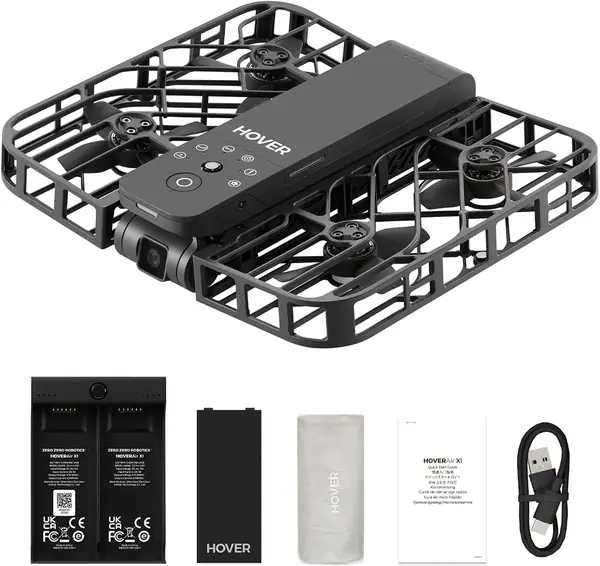
HOVERAir X1

HOVERAir X1 black foldable drone with an enclosed propeller cage

Solo travel footage

Track Score 85/100
Video
2.7K at 30 fps
Weight
4.41 oz
Frame
Enclosed and foldable
Flight Modes
Five presets plus manual
View on Amazon

The HOVERAir X1 folds into something you can genuinely pocket, and its props live inside a full cage, so you can start it up in a living room without endangering the lamps. One button begins a preset flight, another ends it, and it lands on your palm.

We like it most as a travel camera rather than as a drone. Hand it to someone at a trailhead, press follow, and you get a smooth tracking shot of yourself walking without anyone piloting anything. Five presets — hover, follow, zoom out, orbit, bird's eye — cover most of what a solo traveler wants.

The limits are practical rather than mysterious: the 15 mph follow speed is happy with walking and slow biking but won't chase a ski run, and the app's manual mode is there if you want it, though piloting isn't really the point of this thing.

Worth Noting

  • Video tops out at 2.7K
  • Battery falls short of a full outing
Our Verdict

The X1 suits travelers who want footage of themselves without a pilot; we pick it for the caged frame and preset flights, not for manual flying.

Check Latest Price

How We Tested Eight Mini Drones

We started with every sub-250-gram model we could find with a real camera and a stabilization claim, then cut the field to eight on what shoppers actually compare: weight, whether the camera sits on a gimbal or relies on software, how many batteries ship in the box, and whether spare props are listed and orderable. Each went on a kitchen scale twice — with the battery in the box, then with the optional larger one, since on more than one model that upgrade pushes it past the FAA's 249-gram line and into registration and Remote ID.

Then we flew them for eight months in backyards, over an open field on breezy afternoons, and indoors for the palm-launched, self-flying models. We timed every battery from takeoff to the point the drone forced itself down, hovering at a steady altitude rather than racing around, and counted how many packs actually came in each kit. On windy days we watched how far each drone drifted in a hover and whether it fought the gusts or gave ground, and every flight stayed inside our unaided line of sight regardless of what the advertised range promised.

We handed the controller to people who had never flown one and clocked the gap between unboxing and a stable first hover. We triggered return-to-home from the far end of the field to see how close each drone came back, steered toward a tree line to see whether obstacle sensing caught it, and shot the same slow pan on every camera, watching on a big screen for jitter, crop, and color. After each first hard landing we checked what broke, whether the box held the right spare props, and how easy replacements were to order; months of repeat flights turned up gimbal drift and batteries that faded faster than advertised.

How to Choose a Mini Drone

Start With Weight, Then Read the Battery Fine Print

In the U.S., a recreational drone under 249 grams skips FAA registration and Remote ID, which is why nearly every model here is built to that ceiling. The catch is that the battery is the heaviest single part of a small quadcopter, so an upgrade can push you over.

The DJI Mini 3 is the clearest example: the standard pack keeps it registration-free for recreational flying, and the 51-minute Intelligent Flight Battery Plus does not. If paperwork-free flying is why you're shopping, put your money into spare standard batteries instead of the long-range one.

A Gimbal Is Not the Same as Stabilization

Both get sold as stabilization, and they behave differently. A 3-axis mechanical gimbal physically holds the camera level, so gusts and fast turns never reach the footage. Electronic stabilization smooths the image afterward by cropping and shifting frames — convincing in calm air, and visibly out of its depth once the drone is working hard.

The DJI Mini 3, Ruko U11MINI, and Bwine F7MINI carry real gimbals; the DJI Neo and Potensic ATOM SE rely on electronics. For stills and slow scenic passes, either is fine. For video you intend to keep, pay for the gimbal.

Count Batteries, Not Headline Flight Time

Rated flight time is measured in still air and flown until the battery reaches its warning, so you'll land before the number. What actually shapes a flying day is how many packs are in the box: the Bwine F7MINI and SKYROVER X1 ship three, the Potensic ATOM SE and Ruko U11MINI ship two, and the DJI kits here ship one.

If two drones have similar cameras, take the one with the extra battery. It changes how the drone feels to own more than any accessory you can add later.

Decide How You Want to Hold the Controls

A controller with a built-in screen keeps the live view, the settings, and the flight app in one device and asks nothing of your phone — that's the Ruko U11MINI and SKYROVER X1 route. A phone-holder controller clips your handset into a clamp and costs less. The DJI Neo skips the controller entirely and launches from your palm.

Screens are the upgrade we notice most on a bright day, when a phone at full brightness overheats and dims. If you fly often, it's worth the premium.

Plan for Parts Before You Crash

Small drones meet trees, fences, and gravity, and what happens next depends on the maker's spare-parts line. Most kits here include a spare set of props and sell extra batteries; the SKYROVER X1 is newer, and parts take more hunting.

Before you buy, price a spare battery and a prop set for the exact model. If either is hard to find now, expect the same in a year, when you actually need it.

Frequently Asked Questions

Final Verdict

The DJI Mini 3 is the drone we point most people to, because it gets one trade right: a mechanical gimbal, 4K HDR, vertical video, and 38 minutes of flight in a body that stays under the registration weight. Nothing else here puts those four things together as neatly.

If the budget is tighter, the Potensic ATOM SE gets you flying with two batteries and GPS return for much less, and you accept electronic stabilization in exchange. If a built-in screen matters more to you than the last bit of image quality, the Ruko U11MINI is the better fit.