Best Paints for Diecast Cars for Clean, Durable Finishes of 2026

Repainting a diecast car is a small job with a long memory: one heavy coat and the door line fills in, one hot spray and the finish underneath wrinkles. A paint that works at this scale grips bare metal and primed zamak, goes on thin enough to leave panel gaps and script badges intact, and gives the right finish, flat black on window trim, gloss on a body panel, chrome on a bumper.

Test every new paint somewhere hidden, like the inside of a trunk lid, because a lacquer that lifts the layer beneath can cost a weekend's work. Over four months we brushed door jambs and wheel wells on 1:24 bodies, sprayed full 1:18 shells on a cardboard turntable and airbrushed chrome bumpers and mirrors with 14 paints, and the seven picks span brush bottles, rattle cans and airbrush sets.

Our Top Picks

The Best Paints for Diecast Cars for Clean, Durable Finishes

1.

Testors Enamel Paint Set 9115X Best Overall
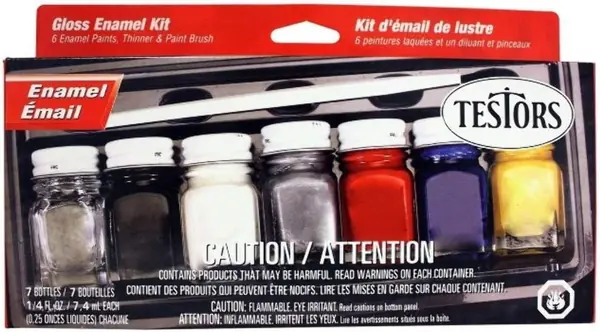
Testors Enamel Paint Set with six gloss color bottles thinner brush and tray

Brush-painting diecast cars

Track Score 95/100
Paint Type
Enamel
Bottle Size
0.25 fl oz each
Set Contents
Six gloss colors, thinner, brush, tray
Cure Time
48 hours
View on Amazon

The Testors 9115X set is the closest thing to a complete brush-painting kit for a diecast car: six gloss enamels, a bottle of thinner, a brush, and a tray. We like that the enamel is explicitly rated for metal, because that is the surface that decides whether a repaint holds at the edges or flakes away. The colors are basic rather than exotic—red, dark blue, yellow, white, silver, black—but they mix, and the thinner lets you lay them thin enough to preserve body lines and door seams.

The solvent enamel dries to the touch in about five minutes and cures in 48 hours. That fast touch-dry is convenient for small parts, but we treat the cure time as the real deadline: handle a freshly painted body sparingly until it has had a couple of days. The included thinner lets you pull the enamel back to a thin coat, which is how we keep panel gaps and raised details from disappearing under paint.

What we appreciate most is the control at model scale. A brush lets you work around windows, panel gaps, and raised details without masking an entire car, and the included thinner makes it easy to pull paint back from a too-heavy coat. For a first diecast project, this is the least intimidating way to get a smooth, glossy finish without buying an airbrush or a spray rig.

The silver and black get the most use on trim, where the gloss enamel is easiest to control with a brush. If you are painting a whole body and want a factory-smooth surface with no brush marks, the spray pick below is the better tool.

Worth Noting

  • Small bottles run out during full-body work
Our Verdict

We recommend this set as the easiest brush-paint start for diecast cars: six metal-safe gloss enamels, thinner, and a brush cover body colors and detail work.

Check Latest Price
2.

Rust-Oleum 2X Acrylic Enamel Spray Paint Best Spray for Full Bodies

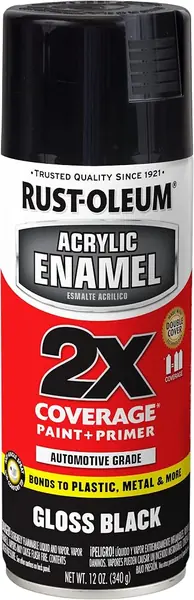
Rust-Oleum 2X acrylic enamel spray can in gloss black

Large body panels

Track Score 94/100
Paint Type
Acrylic enamel spray
Finish
Gloss black
Dry To Touch
20 minutes
Coverage
Up to 12 sq ft
View on Amazon

A full diecast body is a different job from a touch-up: you need an even coat across curves, shut lines, and the roof without the paint puddling in the door seams. That is where the Rust-Oleum 2X Acrylic Enamel earns its spot. It is an aerosol paint-and-primer in one, rated for metal, with an any-angle spray tip that lets you work underneath a body or into a wheel well without turning the can upside down and hoping.

We think it is the best spray here for large areas because it lays down color and primer together and covers up to 12 square feet per can. A 12-ounce aerosol covers a lot of area quickly, so we work in short passes and keep the can moving. The gloss black is deep and shiny, but the finish is only as good as your prep; light passes beat one heavy coat, especially around edges.

The can dries to the touch in about 20 minutes, which makes it tempting to keep spraying. We prefer to let each light coat flash off and build slowly. A heavy pass can wrinkle or stay soft, and a greasy surface can keep the paint from bonding; thin coats over clean metal hold up better. The any-angle tip is genuinely useful for the underside of a car, especially when the body is mounted on a temporary stand.

For a slot car or a larger diecast rebuild, the can gives you a fast, smooth base without a compressor. That is the job we bought it for.

Worth Noting

  • Too broad for fine detail work
Our Verdict

This is the spray for a whole diecast body that needs even color and a primer coat in one step, though it is too broad for tiny details.

Check Latest Price
3.

Vallejo Model Air Chrome Best Airbrush Metallic

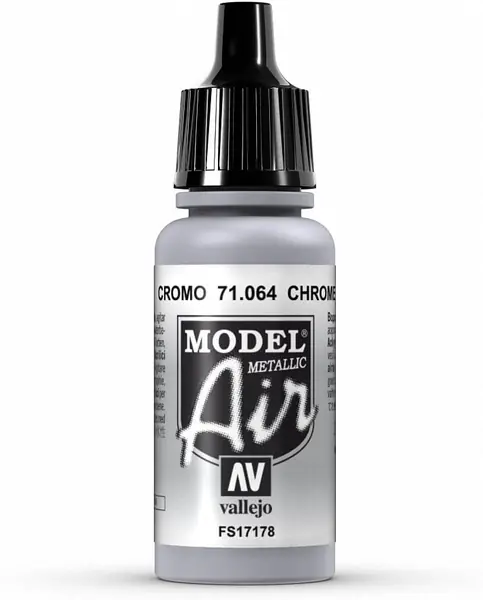
Vallejo Model Air metallic chrome acrylic paint in a 17 ml dropper bottle

Chrome trim details

Track Score 93/100
Paint Type
Acrylic
Finish
Metallic chrome
Application
Airbrush-ready
Volume
17 ml
View on Amazon

Chrome is the finish that sells a diecast car, and it is also the one most likely to disappoint. Vallejo Model Air 71064 is a water-based acrylic made for airbrush work, and the 17 ml eyedropper bottle keeps the paint from drying out between sessions. The label sets an expectation, but we judge a metallic by how it reads on a bumper, a window surround, or a wheel center.

The pigment is finely ground, and it sprays smoothly at low pressure without the clogging we associate with thicker metallic acrylics. We also like that it cleans up with water, which matters when you are switching colors on a small model. Two thin coats over a dark primer give the most convincing metal effect; a wet coat can pool and lose the fine grain.

We think this is the best airbrush metallic here for brightwork because it builds a believable metal accent without a mirror-hard surface. The first pass can look thin and grainy; the second brings up the sheen. It is not a substitute for a full-body color, and it will not hide surface scratches the way a heavier enamel might. For a slot car's bumpers and trim, that trade-off is easy to accept.

The color shifts with the undercoat: over black primer it reads darker and more metallic, while over white it turns cooler and brighter. We test it on a scrap piece before committing to a bumper because the base changes the result more than it does with a flat color. That makes it a trim paint rather than a body paint.

Worth Noting

  • Reads more silver pearl than mirror chrome
Our Verdict

We like this bottle for airbrushed chrome trim and brightwork, as long as you expect a bright metallic silver rather than a mirror finish.

Check Latest Price
4.

HOMY ARTY Airbrush Paint Set Best Airbrush Color Set

HOMY ARTY airbrush paint set with thirty color bottles and three thinners

Airbrush color mixing

Track Score 92/100
Paint Type
Water-based acrylic
Bottle Size
0.67 fl oz each
Set Contents
30 colors plus 3 thinners
Dry Time
3 hours
View on Amazon

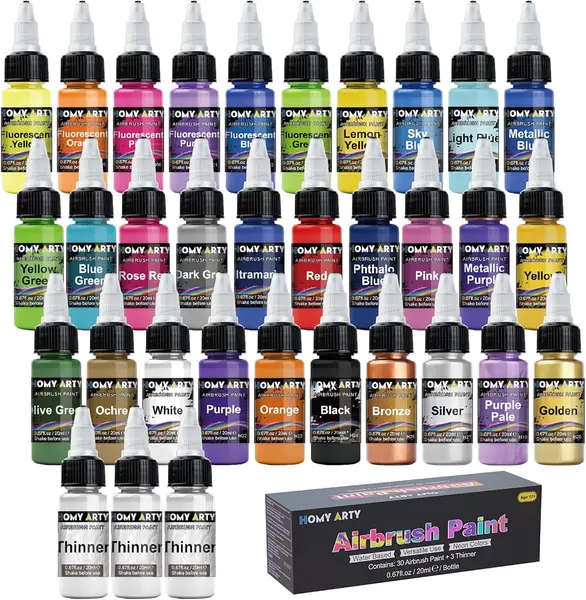
A first airbrush setup usually starts with a color problem: you need enough shades to paint a diecast body, its interior, and the small details without buying ten separate bottles. The HOMY ARTY 30-color set answers that with 30 acrylic colors plus three thinners in dropper bottles. The range includes common colors, fluorescents, and metallics, which is more variety than most model-car projects need in one box.

The paint is water-based and pre-thinned for airbrush use. That means you can pour a little into the cup and spray without measuring thinner first. The included thinners are useful when a bottle sits or when you want a more transparent coat. It cleans up with soap and water, and the dropper bottles keep the unused paint from drying out in the jar.

Coverage is decent for a budget acrylic, especially on primed metal, but the set is not uniformly ready to spray. Some bottles are thicker than others, and the metallics can separate if you do not shake them hard. We keep a small cup of thinner nearby and add a drop or two when the spray starts to stutter. For a beginner, that is a small habit to learn; for someone expecting a single consistency across 30 colors, it is the catch.

We think this is the best airbrush color set here for a first diecast project because the range lets you mix and match without a big investment. The finish is gloss, and the colors are vivid enough for slot-car liveries and interiors. It is not the set we choose for a concours-level metallic finish, but it is the one we hand to someone who wants to learn by spraying a lot of test bodies.

Worth Noting

  • Replacing one color means buying the set
Our Verdict

For airbrush beginners who want many colors without mixing every shade, this set is our pick, though some bottles need thinning for smooth flow.

Check Latest Price
5.

Rust-Oleum Automotive Custom Lacquer Best Lacquer for a Custom Finish

Rust-Oleum automotive custom lacquer spray can in gloss Nardo Gray

Smooth custom finishes

Track Score 91/100
Paint Type
Lacquer spray
Finish
Gloss Nardo Gray
Dry To Touch
20 minutes
Can Size
11 oz
View on Amazon

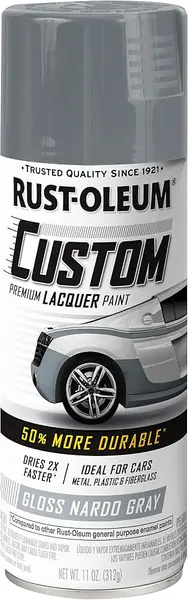
Nardo Gray is the kind of flat-clean custom color that makes a diecast car look built rather than painted, and Rust-Oleum's Automotive Custom Lacquer puts it in an aerosol can. The lacquer is fast-drying, rated for metal and chrome, and can be recoated at any time. For a smooth, single-color body with a factory-style sheen, that combination is appealing.

We think this is the best lacquer here for a custom finish because it lays down thin and builds gloss without a long wait between coats. The 20-minute touch-dry time is realistic, and the can is easy to control in short passes. But lacquer is a hot finish: it can lift an existing enamel or factory paint if you spray it too wet. We test it on the inside of a body or a scrap panel before committing, and we keep the first coats very light.

The color is a gloss Nardo Gray, so it reads as a solid gray with a soft shine rather than a metallic. That makes it a good choice for a modern custom look, especially on a car with black trim and silver wheels. The lacquer resists smudging once cured, but it is not a clear coat; you still need a compatible clear if you want extra protection. We like it for body shells and larger panels, not for brush-level detail.

We also treat the recoat-anytime claim with care: in practice, we recoat within the window or wait until the finish is fully hard, because a heavy pass over a soft coat can wrinkle. For a smooth custom color on a metal body, it is a useful specialty spray; for a beginner's first repaint, the acrylic enamel is more forgiving.

Worth Noting

  • Small can limits multi-car projects
Our Verdict

We choose this lacquer when you want a fast, smooth custom color and the freedom to recoat, and you have tested it over your existing finish.

Check Latest Price
6.

Testors Flat Black Enamel Paint Best for Black Trim and Touch-Ups

Testors flat black enamel paint in a small glass bottle

Black trim touch-ups

Track Score 90/100
Paint Type
Enamel
Finish
Flat black
Bottle Size
0.25 fl oz
Dry Time
1 hour
View on Amazon

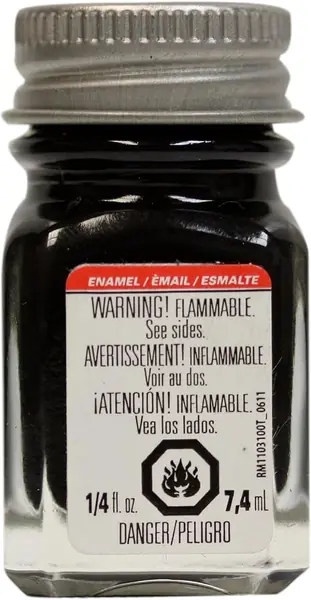
Not every diecast paint job needs a full palette. A black window surround, a tire sidewall, an interior tub, or a chipped bumper often needs one small bottle of flat black that brushes on without a spray setup. Testors Flat Black Enamel is that bottle: a 0.25-ounce jar of solvent enamel rated for metal, wood, and plastic, with a flat finish that kills shine instead of adding it.

The paint dries to the touch in about an hour, which is slower than the gloss enamel set but still reasonable for detail work. It brushes on smoothly and covers in one coat on small parts, and the flat finish is genuinely flat, not a satin that catches the light. We use it for interiors and under-hood areas where a glossy black would look wrong.

We think this is the best single color here for black trim and touch-ups because it saves opening a whole set for a job that needs a few drops. The flat finish also hides small surface imperfections better than gloss, which is useful on a driver-quality model. For a full body in black, the spray can is the more sensible buy; for a grille, a tire, or a scratch, this is the bottle to use.

The solvent formula means you need thinner for cleanup and a ventilated space, but the jar is easy to keep on a bench without taking over a drawer. We label the cap with the date because enamel can skin over between projects. For detail work, a little goes a long way.

Worth Noting

  • Tiny bottle runs out on larger areas
Our Verdict

We keep this bottle around for black trim, interiors, and touch-ups because it brushes on flat and metal-safe without buying a full set.

Check Latest Price
7.

X ARTY HUB Model Paint Set Best for Budget Airbrush Starters

X ARTY HUB model paint set with twenty color bottles and three brushes

Budget airbrush starters

Track Score 87/100
Paint Type
Acrylic
Bottle Size
0.67 fl oz each
Set Contents
20 colors and 3 brushes
Application
Brush or airbrush
View on Amazon

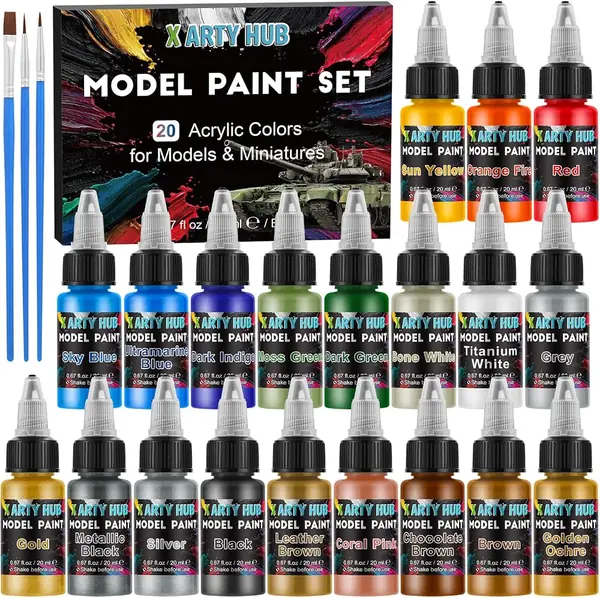
The X ARTY HUB set is a beginner bundle in the most literal sense: 20 acrylic colors, three brushes, and dropper bottles, all aimed at model cars and miniatures. We think it is a sensible budget entry for someone who wants to brush-paint details and try airbrushing without buying a full hobby paint line. The colors include base, skin, shadow, and metallic shades, so it covers more than a car body.

The paint is pre-thinned for airbrush use, which makes it convenient but also means it is thin out of the bottle. On a primed surface it sprays smoothly and dries quickly. The three brushes are a useful starter set, though the fine brush is the one we use most for trim and small details.

Coverage is good for the price, and the dropper bottles make it easy to mix a custom color without wasting a whole jar. The solid colors build nicely in two thin coats, and the set has enough variety for interiors and small details without needing a second palette.

For a first model-car paint set, the value is hard to argue with, but it is not our choice for a show-quality metallic finish. It is better as a brush-detail kit with airbrush flexibility than as a one-stop body paint. If you want a single set for learning and experimenting, it earns a place; if you need a guaranteed smooth gloss coat, look to the enamel set or the spray.

Worth Noting

  • Metallic shades are runny and uneven
Our Verdict

We see this as a budget brush-and-airbrush starter for model cars, though the metallics and slick surfaces need extra care.

Check Latest Price

How We Tested Diecast Car Paints

We built the shortlist from what modelers actually reach for on diecast: brush-ready enamels, aerosol acrylic enamel and lacquer, and airbrush acrylics. Metal adhesion carried the most weight, followed by whether a coating would sit safely over a factory finish, how much control each one gave at model scale, and how wide a color and finish range it offered. Volume, set contents, and thinner requirements rounded out the list. That narrowed to 14 paints and sprays, which we used over four months.

Testing happened at a workbench, not a lab bench. We brushed door jambs, wheel wells, and window trim on 1:24 bodies, sprayed full 1:18 shells on a cardboard turntable in the garage with the door up, and ran airbrush colors over chrome bumpers and side mirrors. Before any lacquer or solvent enamel touched a finished car, it went onto a hidden patch inside a trunk lid to see whether it lifted the paint underneath. We also tracked how much thinner each one needed and whether cleanup took water or solvent.

At each step we wrote down what we saw, not what the can promised. A good coat covered in one pass without pooling in panel gaps; a bad one pulled away from edges or dried with visible brush marks. We timed dry-to-touch by touching a hidden edge at intervals, then left bodies alone until full cure before handling them and checked the edges afterward for chipping. We held finished panels under a desk lamp at an angle to judge leveling, orange peel, and metallic flake, and counted how many bodies a bottle or can covered to see where the value sat. Sets that threw in thinner and brushes saved a step; singles that demanded a specialty thinner did not.

How to Choose Paint for Diecast Cars

Match the Coating to the Metal

Enamel, acrylic, and lacquer behave differently on a diecast body. Solvent-based enamels and lacquers generally bite into clean metal and hold up to handling, while water-based acrylics rely more on a primed surface and a careful build. For brush work, we prefer a metal-rated enamel like the Testors set because it covers small areas without a spray setup. For airbrush work, a pre-thinned acrylic is easier to control but needs a primer underneath. Aerosol acrylic enamel is the practical middle ground for a full body because it combines paint and primer in one can.

Choose the Application Before the Color

A brush gives you the most control around windows, panel gaps, and raised trim, but it can leave marks on a large flat body. An airbrush lays down the smoothest coat and is the best way to handle metallics and fine gradients, though it requires thinning, cleaning, and a compressor. Spray cans are fastest for a whole shell, but the fan is too wide for small details. We decide the application first, then buy the color line that supports it. A model paint sold as airbrush-ready is not always brush-ready.

Read the Finish as Carefully as the Color

Gloss, flat, and metallic paints are not interchangeable, and the same color can look wrong in the wrong sheen. Gloss enamel gives a factory-like body finish, flat black is for trim and interiors, and metallic acrylics are for brightwork and wheels. Chrome is the most misleading label in the category: many hobby chromes dry to a bright silver pearl rather than a mirror. We test a metallic over the primer we plan to use, because the undercoat changes the final look more than it does with a solid color.

Plan for Cure Time and Recoating

Dry-to-touch and fully cured are different numbers. A spray enamel may feel dry in 20 minutes but still be soft enough to fingerprint after handling; a brush enamel can touch-dry in minutes and need 48 hours to cure. Lacquer can be recoated quickly, but a wet coat over a soft finish can lift it. We build thin coats, wait the recoat window, and let the body sit longer than the label's touch-dry time before assembly. If you are painting a car you care about, the cure schedule matters as much as the color.

Frequently Asked Questions

Final Verdict

For most diecast car projects, we start with the Testors Enamel Paint Set 9115X. Six gloss enamels, thinner, a brush, and a tray give you a metal-rated brush system for body colors and details without shopping for each piece.

If you are spraying a whole shell, the Rust-Oleum 2X acrylic enamel is the better tool because it combines paint and primer in one can. Choose the lacquer when you want a fast, smooth custom color and have tested it over the existing finish.