Best Pin Vises of 2026

A pin vise is about as simple as a tool gets: a handle, a chuck and a collet that closes on a bit thin enough to hide under a fingernail. Simple isn't forgiving. A chuck that closes slightly off-center wobbles a tiny bit until it snaps, and a handle that grinds your palm turns an evening of drilling a resin figure into a hand cramp.

The smallest bit a chuck holds matters far more than the largest. Nearly anything grips a 3mm bit; the good ones close on 0.3mm without letting it wander. Check that the chuck runs true before falling for a silky rotating handle, since a smooth handle on a wobbly chuck just makes the wobble easier to repeat. We drilled resin, polystyrene, basswood, brass sheet and blank PCB with 14 vises, and the eight here range from bare all-metal tools to full kits with labeled bits.

Our Top Picks

The Best Pin Vises

1.

Tamiya Fine Pin Vise D-R Best Overall
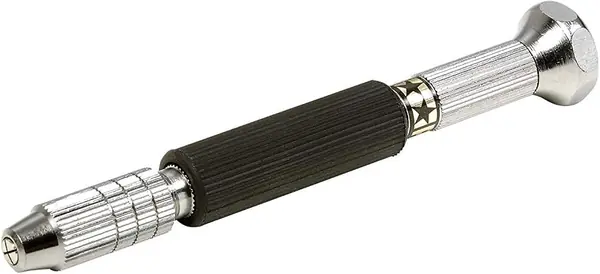
Tamiya Fine Pin Vise D-R with nickel-plated brass body and elastomer grip

Precision model drilling

Track Score 94/100
Chuck Range
0.1-3.2mm
Body Material
Nickel-plated brass with elastomer grip
Rotation
Ball-bearing rotating grip end
View on Amazon

The number that matters on the Tamiya is 0.1mm. That lower limit lets the D-R hold the wire-thin bits modelers use for grab handles, ignition wiring, and resin detail, and the chuck opens to 3.2mm for larger pins and tubing. The rotating tail runs on ball bearings, so pressure comes from your palm while the bit stays put. We noticed the difference most on plastic: the tool turns without the gritty, binding feel that makes a small hole wander.

Nickel-plated brass gives the body a reassuring heft without making it feel like a screwdriver, and the elastomer grip stays put when your fingers are dusty from sanding. We like that the grip stays comfortable during a slow, controlled cut, which is how most modelers drill a 0.5mm hole. The tail's ball bearings matter just as much: they let the handle spin while your palm holds steady pressure, so the bit does not skate when it first bites.

At midrange money, the Tamiya is a precision tool first. If your smallest bits are 0.8mm and up, the 16-piece hand vise is the easier start; if you routinely work below 1mm, this is the one we keep within reach. The practical test is your own smallest bit: insert it, tighten, and turn the tool by hand before you drill a visible part.

Our Verdict

For modelers and jewelers who need a precise, smooth-running tool across 0.1-3.2mm, the Tamiya is the pin vise we recommend first.

Check Latest Price
2.

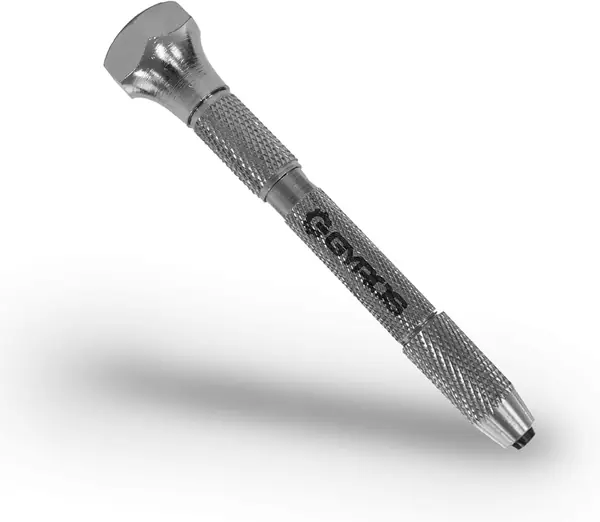
Gyros Swivel Head Pin Vise Best All-Metal Build

Gyros Swivel Head Pin Vise with nickel-plated steel body and two reversible collets

All-metal everyday use

Track Score 92/100
Chuck Range
0" (0mm) to 1/8" (3.175mm)
Body Material
Nickel-plated steel
Collets
Two reversible collets
Special Feature
Swivel head and octagonal anti-roll body
View on Amazon

A pin vise that rolls off a workbench is a pin vise you find under a shelf with a bent bit. The Gyros avoids that with an octagonal nickel-plated steel body, and the all-metal build feels more substantial than the budget aluminum handles here. Its swivel head sits comfortably in the palm, while two reversible collets cover the stated 0 to 1/8-inch range. We liked the way the flat sides keep the tool parked between holes, especially when switching between bits.

The two-collet design is quick to change, but it is not a substitute for a dedicated micro chuck at the very smallest sizes. If your work lives below 0.7mm, the Tamiya is the safer choice; for 0.8mm and up, the Gyros is simple, sturdy, and easy to live with. We tested the fit with our smallest bit and suggest you do the same before trusting a visible hole.

At a budget price, it is the one we hand to someone who wants metal rather than plastic. The all-metal build is why we are comfortable keeping it loose in a drawer, and the two collets make switching between everyday bit sizes quick. It is not the most delicate tool here, but it is the one that feels like it belongs in a toolbox.

Worth Noting

  • Can slip on 0.5mm and 0.6mm bits
Our Verdict

The Gyros is our all-metal choice for everyday bits, with a swivel head and a no-roll body that suit bench work.

Check Latest Price
3.

Hand Pin Vise 16-Piece Set Best Budget Starter Kit

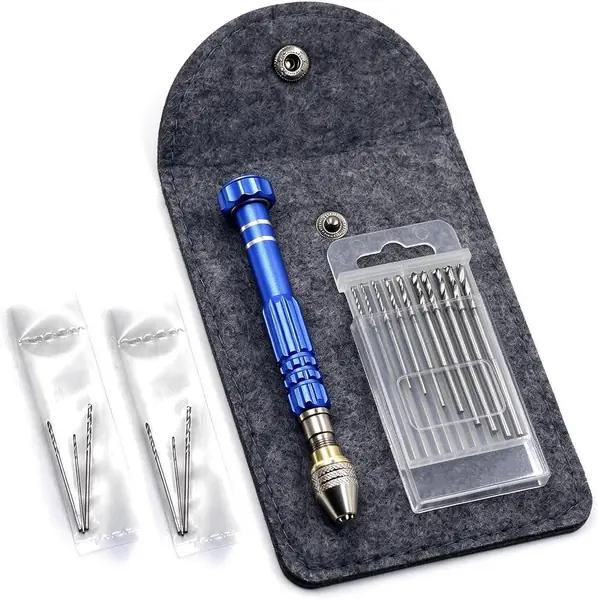
Hand Pin Vise 16-piece set with blue anti-slip handle and HSS drill bits

First pin vise

Track Score 91/100
Chuck Range
0.3mm to 3mm
Included Bits
16 HSS bits, 0.8mm to 3.0mm
Rotation
Ball-bearing rotating grip
Storage
Carrying case and handle bit storage
View on Amazon

The appeal of this 16-piece set is that it removes the first-order problem: you open the pouch, pick a bit, and drill. The three-jaw chuck closes down to 0.3mm and opens to 3mm, and the included HSS bits run from 0.8mm to 3.0mm, which covers most plastic-model, resin, and light wood tasks. We found the ball-bearing tail and anti-slip handle make it easy to keep a slow, even rotation, even when the hole is in a curved surface.

We found the handle comfortable for longer sessions, but it is not the most delicate option here for 0.4mm work. The Tamiya has the edge when the hole is smaller than the bit set goes. The little carrying case and handle storage keep the bits together, which matters more than it sounds when you are working at a kitchen table.

At a budget price, it is a straightforward first pin vise or a backup that can live in a travel kit. We like that the bits are standard HSS rather than mystery metal, and the tool is light enough to carry without thinking about it. The pouch is plain, but it keeps the bits with the tool, which is more than many budget sets manage.

Our Verdict

We think this 16-piece set is the easiest first pin vise, with useful bits and a smooth, comfortable grip for the money.

Check Latest Price
4.

Starrett 162C Pin Vise Best Premium Precision

Starrett 162C pin vise with knurled nickel-plated handle and tapered collet

Taps and wire

Track Score 90/100
Chuck Range
.050-.125 inch
Body
Nickel-plated with knurled handles
Model
162C
Collet
Tapered collet
View on Amazon

The Starrett 162C is the precision instrument of this group. Its stated range begins at .050 inch, about 1.27mm, and runs to .125 inch, so it is built for small taps, number drills, and wire work rather than the sub-millimeter holes that define a lot of model and jewelry drilling. The nickel-plated body, knurled handles, and tapered collet feel like a machinist's tool: compact, solid, and meant to be turned between thumb and finger. We think it is the most reassuringly solid tool here for 1.3mm-and-up work.

The reduced handle diameter lets you spin the tool without repositioning your hand, and the tapered collet puts clamping pressure over more of the bit shank. That is worth paying for if you drill brass, aluminum, or plastic where a wandering bit ruins the part. The trade-off is that it is a single precision tool at a premium price, so it makes sense for someone who already knows which bits they use.

If your work starts around 1.3mm, the Starrett is our choice for feel and clamping security. For 0.5mm holes, the Tamiya is the more sensible pick; a collet that cannot close on the bit is the wrong tool no matter how well it is made.

Our Verdict

We keep the Starrett for work that starts around 1.3mm, where its premium tapered collet rewards careful use.

Check Latest Price
5.

General Tools 93 Pin Vise Best for Files and Deburring

General Tools 93 adjustable pin vise with steel three-jaw chuck and plastic handle

Files and deburring

Track Score 89/100
Chuck Range
0 to 1/4 inch
Chuck
3-jaw hardened steel keyless chuck
Handle
Sturdy plastic ergonomic handle
Weight
6.4 oz
View on Amazon

The General Tools 93 is less a jeweler's pin vise than a small workholding handle. Its three-jaw keyless chuck opens to 1/4 inch, so it can hold drill bits, deburring tools, wire, files, and reamers that are too small for a bench vise and too awkward for fingers. We reached for it when a job needed a firm grip rather than fingertip precision, and the plastic handle gives you something substantial to turn.

That bulk cuts both ways. At 6.4 ounces it is the heaviest tool here, and the 5.75-inch body is not the one we choose for a 0.5mm hole in a fragile resin part. Check runout with the smallest bit before committing to a visible hole, especially if you are used to a jeweler's collet. For filing, deburring, and opening up a hole by hand, the extra mass helps steady the cut.

The General is the pick for a workshop drawer, not a traveling jewelry kit. We appreciate that the chuck accepts ordinary small tool shanks, which makes it more versatile than a dedicated drill chuck, and the sturdy handle gives you leverage without squeezing hard. It is a practical second pin vise for someone who already has a delicate one.

Worth Noting

  • Jaws can close slightly off-center
Our Verdict

The General Tools 93 is our pick for hobbyists who need one sturdy handle for small bits, files, and deburring tools rather than a delicate jeweler's vise.

Check Latest Price
6.

Craft911 Professional Pin Vise Set Best for PCB and Resin

Craft911 Professional pin vise set with blue handle and assorted micro drill bits

PCB and resin

Track Score 88/100
Included Bits
10 HSS micro bits and 10 PCB bits
Power Source
Manual
PCB Bit Range
0.1mm to 1mm
Maximum Chuck Size
3.18mm
View on Amazon

The reason to look at the Craft911 Professional set is the row of PCB bits from 0.1mm to 1mm. Those are the sizes for cleaning through-holes, opening pilot marks in resin, and drilling delicate plastic where a standard HSS bit feels like a fence post. The set also includes 10 HSS micro bits, and the three-jaw chuck opens to 3.18mm. We liked having the two bit types separated, because you can reach for an HSS bit for wood or plastic and save the PCB bits for fine, low-pressure work.

The pin vise itself is a simple aluminum-handled tool with a three-jaw chuck, not a precision instrument on the level of the Tamiya or Starrett. We found the chuck easy to tighten and the handle comfortable for short sessions, but the set's weak point is the bits: the finest ones are brittle and can snap with side pressure or a deep cut. Treat them as consumables, keep the tool straight, and clear chips often.

As a budget kit for someone who already knows they need ultra-fine sizes, it makes sense. We think the color-coded bit box is a small but real convenience when you are switching between 0.3mm and 0.8mm, and the manual action gives you control that a rotary tool does not. If you need one tool to last for years of daily work, spend more; for occasional PCB and resin jobs, this set covers the range.

Worth Noting

  • Ultra-fine bits snap under side load
Our Verdict

We see the Craft911 Professional set as a budget route to ultra-fine PCB bits, as long as you treat the finest bits as consumables.

Check Latest Price
7.

Mudder 57-Piece Pin Vise Set

Mudder 57-piece pin vise set with aluminum hand drill and assorted micro bits

Budget bit assortment

Track Score 87/100
Chuck Range
0.3mm to 3.4mm
Body Material
Aluminum alloy
Included Bits
46 micro twist bits and 10 PCB bits
Bit Sizes
0.1mm to 3mm
View on Amazon

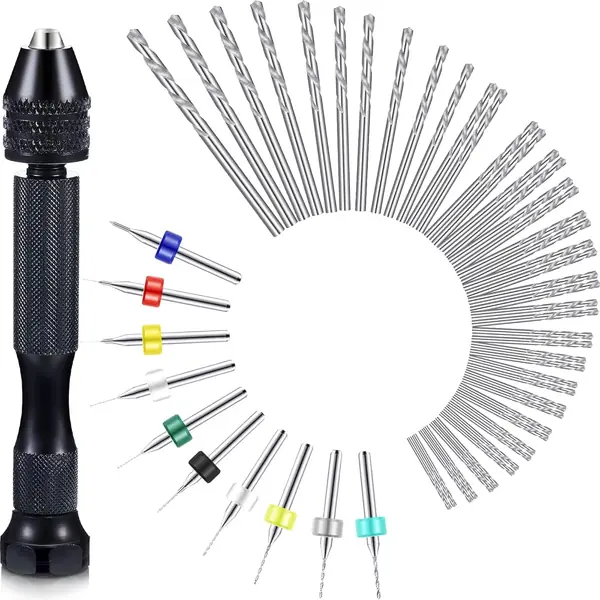
The Mudder set is the volume play: one aluminum pin vise, 46 micro twist bits, and 10 PCB bits, all for a budget price. The chuck adjusts from 0.3mm to 3.4mm, so it will hold the included bits and most others you already own. We liked having a broad range on the bench for a single project, especially when a hole needed to be opened in small steps rather than forced with one bit.

The pin vise itself is an aluminum three-claw tool with a rotating tail and a 0.3mm-to-3.4mm chuck. It tightens evenly and feels light in the hand, but it is not the tool for a hole that has to be perfectly placed. For craft work, the rotating tail helps keep the bit moving without fighting the handle.

The set includes 46 micro twist bits and 10 PCB bits, enough sizes to open a hole in small steps. We sorted ours with calipers and kept the finest for plastic and resin; that is the way to get predictable results from a budget assortment. The bits are the compromise here, not the vise.

We recommend the Mudder when you want the widest bit assortment here for occasional craft drilling and can work gently. It is a budget set, and it behaves like one: the vise is serviceable, and the value is in the range rather than the finish. If you need one bit to survive daily metal work, buy a premium vise and separate bits instead.

Worth Noting

  • Bits are brittle and unmarked by size
Our Verdict

When you want the widest bit assortment here for occasional craft drilling, the Mudder set fits, as long as you work gently.

Check Latest Price
8.

LEOBRO 222-Piece Hand Drill Kit Best for Jewelry and Keychains

LEOBRO 222-piece hand drill kit with stainless steel pin vise and jewelry findings

Jewelry and keychains

Track Score 86/100
Body Material
Stainless steel
Included Bits
10 bits, 0.8mm to 3mm
Chuck
3-jaw chuck
Kit Contents
222 pieces including pliers and jewelry findings
View on Amazon

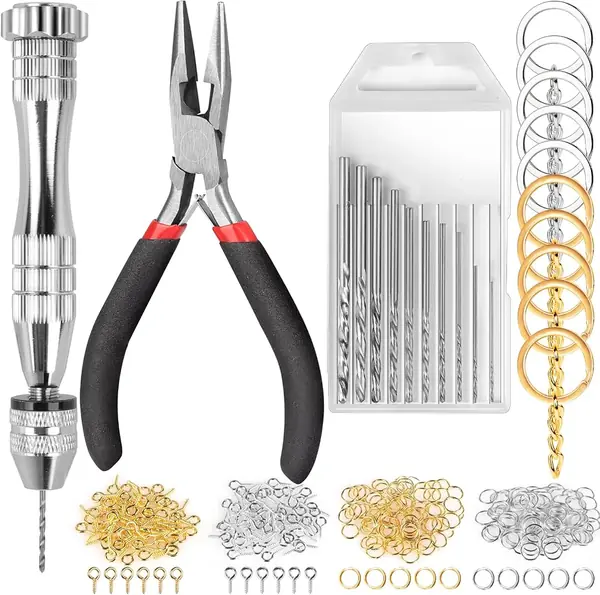
This is less a pin vise with extras than a jewelry-making starter box. Alongside the stainless steel hand drill and 10 bits from 0.8mm to 3mm, you get needle-nose pliers, 10 key rings with chains, 100 jump rings, and 100 screw eye pins. We liked that the kit anticipates the next step: drill the hole, grip the eye pin, close the loop. For someone making resin keychains or simple charms, that saves a second shopping trip.

The drill itself is a simple three-jaw tool with a textured collar and a comfortable stainless handle. It is not the most precise pin vise here, because the Tamiya and Starrett have better small-bit control, but it is entirely adequate for soft resin, polymer clay, wood, and beads. The drill is at its best when you stay in those softer materials and use a light hand.

The pliers are the pleasant surprise: fine enough for eye pins, sturdy enough for light wire bending. We appreciate that the findings come in two colors, so one box covers gold and silver finishes. The pieces are simple craft-grade hardware, but they are the right sizes for the drill and the projects it serves.

We recommend the LEOBRO kit when the project starts with a finished charm and ends with a keychain. It is not the set for a modeler chasing 0.3mm holes, but the extras are useful rather than filler, and the pliers alone justify keeping the box together. If you already have a good pin vise, buy findings separately; the kit's value is in starting from nothing.

Worth Noting

  • Drill bits stop at 0.8mm
Our Verdict

Jewelry and keychain makers get the drill, pliers, and findings in one box with the LEOBRO kit, which is why we keep it on our craft list.

Check Latest Price

How We Tested the Best Pin Vises

We started with more than 30 pin vises gathered from hobby suppliers, jewelry-tool catalogs, and machinist suppliers, then narrowed to 14 based on published chuck range, collet or jaw type, whether the included bits were labeled, body material, and price. Anything whose maker couldn't state a chuck range, or that relied on a plastic chuck, came off the list before we ordered it.

Runout came first. We chucked the smallest bit each tool would accept, held the tip against a sheet of paper, and turned the handle to see whether the tip stayed in one spot or traced a circle. Then we drilled 50 holes in 2mm basswood and counted how many the bit walked off center. Grip got the same treatment: 20-minute drilling sessions, a dab of cutting oil on our fingers to see whether the knurling held, and a note on exactly where each handle dug into a palm.

Bits were measured with calipers against their labels, and a surprising number of kits had a slot marked 0.8mm holding something closer to 1mm. We drilled each included bit until it broke, since micro bits always fail under side load, and noted how easily the broken stub cleared the chuck. Kits were repacked and shaken to see whether bits stayed in their slots, and every tool went on a kitchen scale and into an apron pocket. Safety glasses stayed on for every drilling run, and loose bits lived in a lidded tray out of reach of small hands.

Over three months we tightened and loosened each chuck hundreds of times, watching for burrs, collet wear, and handles that worked loose at the joint. Eight made the final cut.

How to Choose a Pin Vise

Start With the Smallest Bit You Use

Pin vises are sold by range, and the lower number matters more than the upper one for model, jewelry, and resin work. A vise that starts at 0.8mm cannot hold the 0.5mm bit you need for a delicate hole, no matter how comfortable the handle is. We put the lower number first when we compare pin vises. Look for a stated minimum below your smallest bit and a continuous range that reaches your largest. Pin vice is the spelling you will see in some machinist catalogs; the tool is the same.

The Tamiya covers 0.1-3.2mm, the Gyros uses two reversible collets across 0 to 1/8 inch, and the Starrett begins at .050 inch. Test your smallest bit in the chuck before you drill a visible part.

Check the Chuck for Runout

A pin vise is only as precise as the line it holds. A three-jaw chuck is convenient and covers a wide range, but a poorly made one can let the bit sit off-center, which makes the tip wander and the hole oversized. A tapered collet, like the Starrett's, grips over more of the shank and tends to center small bits well.

We check runout before trusting any vise: insert a straight bit, tighten it, and sight along the shank as you turn the handle. If the tip describes a circle, exchange the tool or save it for rough work.

Match the Handle to the Work

Fine drilling is a fingertip job, so a light body, a narrow grip, and a tail that rotates freely matter more than a fat handle. Ball bearings in the tail, as on the Tamiya and the 16-piece hand vise, let you apply pressure with your palm while your fingers turn the tool. A swivel head such as the Gyros's serves the same purpose.

Heavier handles, including the General Tools 93, suit deburring and filing better than a 0.5mm hole. We choose the weight for the task, not for the toolbox.

Decide Between a Bare Tool and a Kit

Bits are consumables, and the cheapest sets often make you pay in snapped tips and lost sizes. A kit is the easier start if you need a case, a range of bits, and perhaps jewelry findings; the LEOBRO box and the Mudder assortment serve that buyer. A bare precision vise makes more sense if you already own good bits and want the money in the chuck.

Either way, label the sizes. We prefer a small index or a divided box because unmarked micro bits all look alike until you are holding the wrong one over a finished part.

Frequently Asked Questions

Final Verdict

The Tamiya comes first because its 0.1-3.2mm chuck covers the holes most modelers and jewelers actually drill, and the ball-bearing tail makes fine control feel natural. If you want an all-metal tool that stays put on the bench, the Gyros is our everyday choice for bits from 0.8mm up.

For work that starts around 1.3mm and calls for a machinist's collet, the Starrett earns its premium; below that, stay with the Tamiya. The right pick is the one whose stated range and handle match the holes you drill most.