Best RC Jets of 2026

Every RC jet promises speed, but who holds the transmitter decides whether it's fun. A two-channel model with altitude hold hovers and self-levels, so a first flight feels like a magic trick. A four-channel jet with elevator and aileron flies on its wings instead and punishes a late turn. They are different hobbies wearing the same foam.

Top speed is what shoppers fixate on, and it matters far less than whether you can see the jet and recover from a bad turn. We hand-launched 12 jets over a grass field before the morning wind, ran packs down at dusk to see how the LED strips read against a treeline and planted a few in the dirt to see what broke. A first-timer's plane opens the list; a brushless ducted fan for pilots with hours on the sticks closes it.

Our Top Picks

The Best RC Jets

1.

DEERC X-62A VISTA RC Jet Best Overall
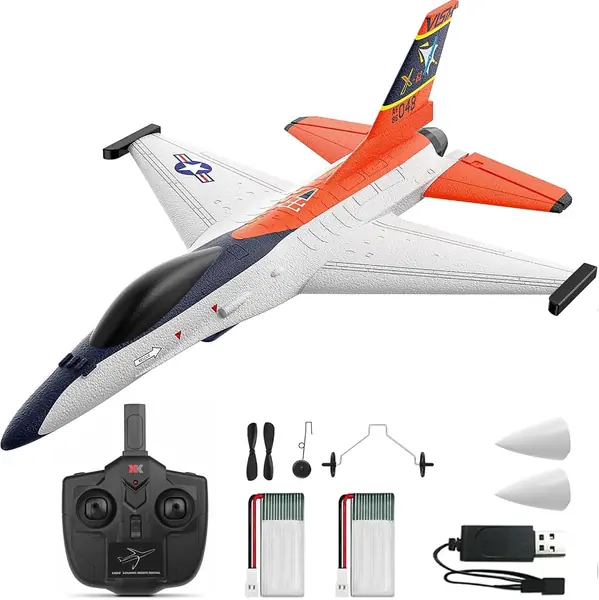
Orange DEERC X-62A VISTA F-16-style foam RC jet with two batteries

First-time jet pilots

Track Score 84/100
Batteries Included
Two 400mAh LiPo
Airframe
EPP foam with rubber nose
Control Channels
4
Gyro
6-axis stabilization
View on Amazon

Four channels and a six-axis gyro are the two specifications that decide whether an RC jet teaches you to fly or just tests your patience, and the DEERC X-62A is the least expensive model here that has both. You get separate throttle, elevator and aileron inputs, plus a gyro that levels the wings the moment you release the stick, so a first flight is a series of small corrections instead of a countdown.

This is the one we hand to a friend who has never flown anything but wants something that behaves like an airplane. The 4400KV coreless motor has enough pull for loops and rolls, the gyro turns a clumsy input into a wide recoverable turn, and the EPP airframe with its soft rubber nose is built for the arrival that would have ended a balsa model. It isn't fast by ducted-fan standards; it's the jet that gets you to the point where fast is a good idea.

Two 400mAh packs come in the box with a claimed 20-plus minutes between them, which works out to two flights of roughly ten minutes with a cooldown in the middle, about right for a first session. Pick your hour as carefully as your field. This is a small foam airframe, and the calm after sunrise is worth more than any specification on this page.

The ailerons are what separate it from the two-channel jets further down this list. Those planes circle and hover; this one holds a line through a turn and rolls when you ask, so the tenth flight looks different from the first.

Worth Noting

  • Fuselage can crack in hard nose-first crashes
Our Verdict

We recommend the DEERC X-62A to anyone who wants a jet that flies like a plane without paying EDF money: four channels, a forgiving gyro, and two batteries in the box.

Check Latest Price
2.

FLYCOLOR F-16 Falcon EDF Best Brushless EDF

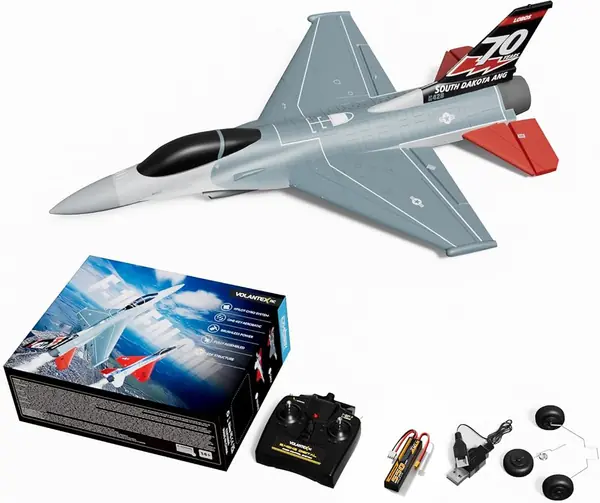
Grey FLYCOLOR F-16 Falcon brushless EDF RC jet with transmitter

Experienced hobby pilots

Track Score 83/100
Airframe
EPO foam
Control Channels
4
Gyro Modes
Full, medium, and light assist
Battery Included
One lithium-ion
View on Amazon

A ducted fan is what separates an RC jet from an RC plane wearing a fighter-jet body, and the FLYCOLOR F-16 is the only model here that has one. Air is accelerated through a shrouded fan instead of pulled by an exposed propeller, which is where the thrust and the whoosh come from, and it is most of why this one costs what it does.

The Xpilot gyro has three switchable assist levels, and that is the feature we care most about. Full assist covers the first flights, medium takes over once the model stops surprising you, and light lets the airplane do what you asked rather than what the gyro permits. The low-voltage and lost-signal alarms are the other useful pair; both tell you to come back before the battery makes that decision for you.

It arrives assembled, with the fan, servos and linkages installed, so day one is a charge and a range check rather than an evening at the workbench. EPO foam is the right material at this level: stiffer and cleaner-finishing than the EPP on the cheap jets, and repairable with foam-safe glue after the inevitable nose-over.

Whether the premium is worth it comes down to how you plan to fly. Over a decent field on a still morning, the extra thrust and the fan sound are the difference between a toy and a hobby, and the three gyro modes leave you somewhere to go as your thumbs improve. If your flying happens in a small park twice a summer, the four-channel foam jet at the top of this list delivers most of the fun for far less.

Worth Noting

  • Single battery limits a session to one flight
Our Verdict

We point pilots who already have a field and a routine here: a real ducted fan, three gyro modes, and low-voltage and signal alarms, at a price that reflects the brushless hardware.

Check Latest Price
3.

Volantex F-16 Fighting Falcon Best for Small Parks

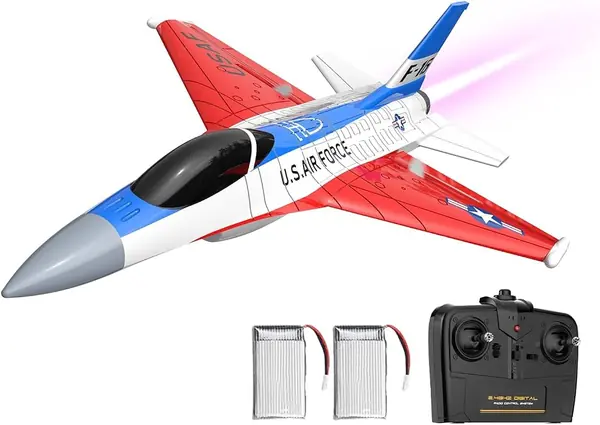
Red Volantex F-16 Fighting Falcon foam RC jet with LED strips

Small parks

Track Score 82/100
Batteries Included
Two
Control Channels
2
Claimed Flight Time
15 to 20 minutes per battery
Wingspan
400mm
View on Amazon

Two channels is a real limit, and we think it is the right one for the pilot this plane is built for. There is no separate elevator or aileron, so the F-16 turns on differential thrust and climbs on throttle rather than on the sticks: point it, add power, and it goes roughly where you aimed. A beginner gets a jet that loops a park without a lesson in orientation, and that is the trade.

The 400mm wingspan, about 16 inches, is the other half of the argument. It fits a baseball diamond, it launches from a hand, and the LED strips are bright enough to make a dusk flight easy to follow. Two batteries are included, with 15 to 20 minutes claimed per pack.

The FHSS radio matters more than it sounds if you fly with anyone else, since several of these can be in the air at once without one person waiting on the sidelines. Soft rubber bumpers and a flexible FLEEX foam airframe take the first few arrivals.

Worth Noting

  • Prop mount is the first part to break
Our Verdict

For a small park or a first solo flight, we like this 2-channel F-16: about 16 inches of wingspan, two batteries, and enough LED light to fly at dusk.

Check Latest Price
4.

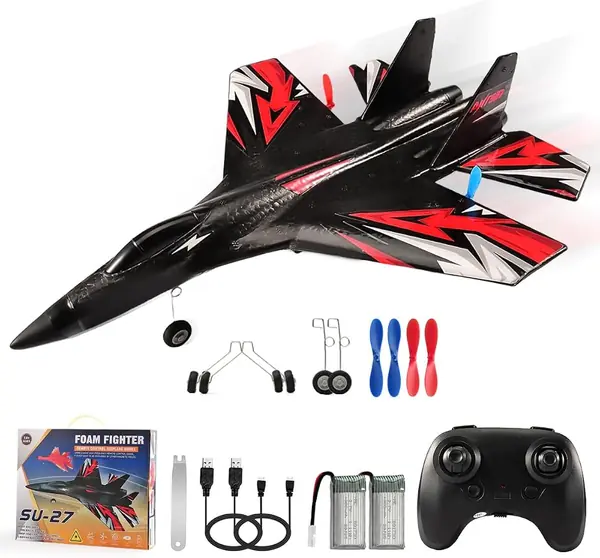
Fremego Su-27 RC Jet Best Budget

Black Fremego Su-27 foam RC jet with LED lights and batteries

Budget family flying

Track Score 81/100
Batteries Included
Two 250mAh
Airframe
EPP foam
Control Channels
2
Gyro
6-axis stabilization
View on Amazon

Set next to our top pick, the Fremego Su-27 gives up two channels and a little precision and keeps most of what makes a jet fun to own: two batteries, a stabilizing gyro, LED lights for dusk, and a molded Su-27 body that looks the part sitting on a picnic table. Two channels take about five minutes to learn, throttle and a differential-thrust turn, so the first flight is fun rather than a lesson.

We keep coming back to it as the value pick. It flies well in light wind, the packs run about ten minutes each, and the foam is cheap enough that a hard landing is an inconvenience rather than an ending. Buy two if there is a flying buddy in the house, because the 2.4GHz link lets both fly at once. Landing is the part that takes practice: bring it down in a long shallow glide instead of chopping the throttle at height.

Worth Noting

  • Nose takes the damage in hard impacts
Our Verdict

At the low end of what still flies like a plane, we make this Su-27 the budget pick: two batteries, a stabilizing gyro, and enough speed to be fun.

Check Latest Price
5.

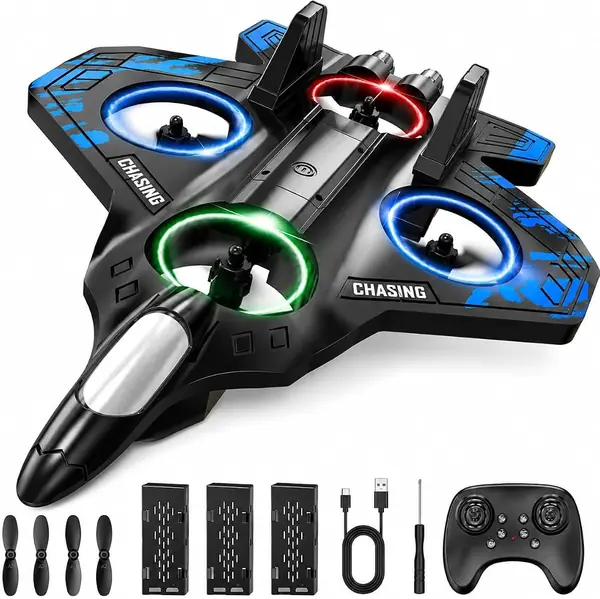
PRIMEX PRO Stunt Jet

PRIMEX PRO foam RC stunt jet with three rechargeable batteries

Cheapest backyard stunter

Track Score 80/100
Batteries Included
Three rechargeable
Takeoff
One-key takeoff and landing
Stunts
360-degree flips and rolls
Altitude Hold
Yes
View on Amazon

Three batteries in the box is the reason this one is worth a look: it is the least expensive jet here, and the extra packs mean a kid gets three sessions out of a single charging cycle. We like it as the cheapest way into the hobby, provided the hobby in question is hovering over the backyard rather than flying circuits.

One-key takeoff and landing plus altitude stabilization do most of the work for a new pilot, and the 360-degree flips sit on a button. It is not a wing-borne jet, though: there is no throttle-to-climb relationship to learn and no aileron to master, so treat it as a stunt toy with a jet body. The transmitter handles speed changes and flips, and the three packs mean a dead battery does not end the afternoon.

Worth Noting

  • Short flights per battery charge
Our Verdict

We like it as the cheapest way into the hobby, provided the hobby in question is hovering over the backyard rather than flying circuits.

Check Latest Price
6.

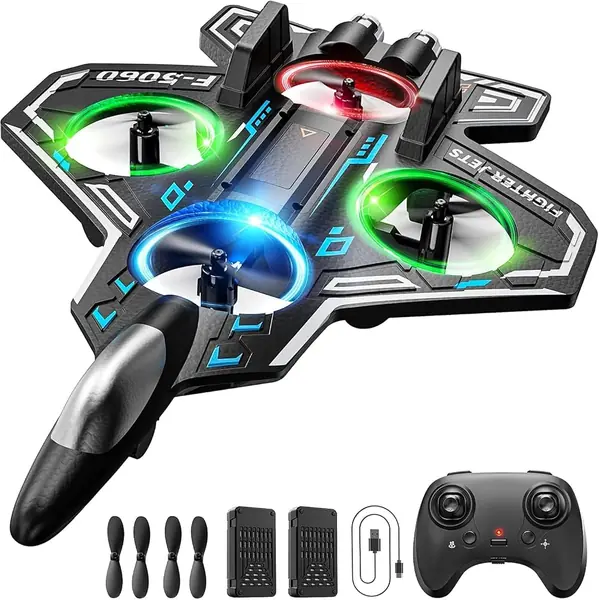
RCGEAST F12 RC Jet Best for Dusk Stunt Flying

Black RCGEAST F12 foam stunt jet with LED lights and two batteries

Dusk stunt flying

Track Score 79/100
Batteries Included
Two 1200mAh Li-Po
Airframe
EPP foam
Claimed Flight Time
Up to 16 minutes
Flight Assist
Altitude hold and headless mode
View on Amazon

Flying this one is closer to hovering a drone than to flying a plane. Altitude hold keeps it at a fixed height, headless mode makes the controls follow you rather than the nose, and a flight is a run of flips and circles rather than a circuit. That is the honest description, and for a kid with a yard it is also the fun part.

The two 1200mAh packs are the largest in this group, with up to 16 minutes claimed between them, and the EPP body arrives ready to fly with nothing to assemble. The LED bar makes it easy to keep track of after sunset.

What it will not do is teach you to fly an airplane: nothing here asks you to manage airspeed or hold a turn, and there is no wing to stall. Buy it for stunts and dusk flying; buy a two- or four-channel jet when the goal becomes flight.

Worth Noting

  • Propeller bracket is the weak point
Our Verdict

We rate it the best of the hover-style jets here on battery life and on how steadily the altitude hold sits, which makes it an easy backyard pick for stunts and dusk flying.

Check Latest Price
7.

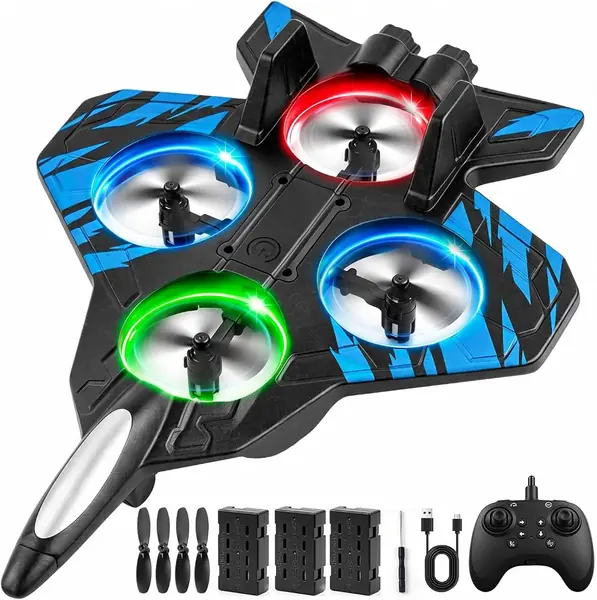
MIRUMAN FLY001 Stunt Jet Best for Backyard Tricks

Blue MIRUMAN FLY001 foam stunt jet with LED lights and two batteries

Backyard tricks

Track Score 78/100
Batteries Included
Two rechargeable
Takeoff
One-key takeoff and landing
Speed Modes
Three
Recommended Age
14 years and up
View on Amazon

Three speed modes are the feature worth knowing about. The low setting is slow enough for a first flight in a yard, and the top setting gives the flips and rolls enough authority to look deliberate rather than accidental. One-key takeoff and landing plus altitude hold mean you can hand the transmitter to someone who has never flown and let them get a feel for it before they touch a stick.

Two rechargeable batteries, a foam body light enough to forgive its own mistakes, and a 2.4GHz link round out the package. The box puts it at 14 and up, so plan on a teenager or an adult at the controls rather than a young child.

What we like is the control the speed switch gives you: a beginner can spend a whole pack in low, and the same jet will flip and roll when someone with quicker thumbs takes over. What it will not do is teach you to fly a wing, because there is no aileron to learn and no stall to manage.

Our Verdict

We recommend this one for backyard stunts: three speeds, one-key takeoff, and altitude hold make it the easiest thing here to hand to someone who has never flown.

Check Latest Price

How We Chose and Flew the Best RC Jets

We built the shortlist from spec sheets rather than marketing copy: channel count, whether power comes from a brushed motor, a brushless outrunner, or a ducted fan, foam type, wingspan, and packs in the box. We also confirmed that props, nose cones, and wings are sold as spares, since a jet with no parts support is a one-crash purchase. Twelve made the cut and flew with us for eight months.

Most of that flying happened on a grass sports field in the hour after sunrise, before the wind built, plus evening sessions in a backyard and dusk runs to see how each jet's LEDs read against a treeline. We hand-launched everything, then repeated launches with one-key takeoff where a model had it. Every pack was timed from launch to low-voltage cutoff, and packs were left to cool before going back on the charger.

We flew in rising afternoon wind until each jet started getting pushed around — never past the maker's stated limit — and flew two at once to watch for 2.4GHz interference. On the gyro-stabilized models we flew with assists on, then dialed them down where the radio allowed, and ran each stunt model's flips and rolls a dozen times to see whether it came out upright. Beginners with no flight time took the transmitter to see if they could launch, turn, and land without help.

Then we crashed them, mostly by accident: nose-first arrivals, cartwheels on touchdown, one jet into a hedge. After each, we checked the foam for compression and cracking, how the nose had held up, and whether a prop had spun off its mount — then how long the repair took and what the part cost.

How to Choose an RC Jet

Channels Decide Who Can Fly It

A two-channel jet gives you throttle and a differential-thrust turn, and altitude comes from power. A four-channel jet separates throttle, elevator and aileron, and usually adds a gyro that levels the model when you let go. The hover-style models sold as stunt or 4D jets give you altitude hold and a flip button but no wing-borne flight at all.

Our rule: if the goal is learning to fly, buy four channels and a gyro even at twice the price of a two-channel. If the goal is a gift that flies in a yard this weekend, a two-channel or hover-style jet is honest about what it does. Just do not expect it to teach aileron control.

Brushed, Brushless, and Ducted Fan

Brushed coreless motors are what make a four-channel RC plane possible at a moderate price: light, cheap, and adequate for a season of park flying. Brushless motors cost more, last longer and hold their thrust in wind. A ducted fan, the EDF, accelerates air through a shrouded fan, draws more current, needs more speed and more open space, and sounds like the real thing.

We think the progression is worth following. Learn on brushed foam or two channels, spend on brushless when you can land consistently, and move to an EDF once you have a proper field and a routine. Buying the fastest jet first usually buys a short season.

Foam, Spares, and the First Crash

All foam is not the same. EPP is rubbery and springs back from the crumple that cracks a stiffer shell. EPO is stiffer, finishes better and repairs cleanly with foam-safe glue. Plastic-bodied toys crack and stay cracked.

Whatever you buy, order the expendables with it: propellers, prop mounts and a spare nose. The prop mount and the propeller are the parts that give out first on this class of jet, and a spare in the box turns a grounded model into a two-minute repair instead of a lost weekend.

Size, Wind, and Your Flying Site

Wingspan sets the site. A 400mm to 16-inch foam jet fits a baseball diamond or a large yard and needs genuinely calm air; a bigger model with a brushless fan wants an open field and a wider margin for error.

A practical rule for wind: if the treetops are moving and you can feel the breeze on your face, these small jets stay in the car. The reliable slot is the calm hour after sunrise, which also happens to be the smoothest air for a first flight.

Batteries and Real Session Length

Claimed flight times are ceilings. Packs in this group run from 250mAh to 1200mAh, and the honest expectation is somewhere between five and fifteen minutes depending on how much of the flight is spent at full throttle.

Two or three packs are worth more than any other accessory, because charging takes about as long as flying. Land when the low-voltage alarm sounds rather than gliding on a tired pack, and let packs cool before they go back on the charger.

Frequently Asked Questions

Final Verdict

We recommend the DEERC X-62A. Four channels and a self-leveling gyro at a mid-range price is the combination that turns a first jet into a hobby instead of a story about the tree, and the two included batteries mean a second flight without waiting on the charger.

If you already fly and want the real thing, the FLYCOLOR's ducted fan is where the money goes. If your flying site is a small park and the pilot is new, the Volantex will simply log more airtime.