Best RC Gliders of 2026

The best moment in glider flying comes when you cut the motor. The prop stops, the nose settles and the plane keeps going on whatever lift the afternoon offers. Weak gliders fail right there: they sink, wander or drift out of radio range before you've learned anything, and they turn a clumsy landing into a cracked fuselage.

A gyro or selectable beginner mode smooths out a gusty launch, but it can't fly the plane for you. Staying under 250 grams keeps you clear of FAA registration at little cost. Over nine months of hand launches above park and school-field grass, the differences between 12 gliders were clearest with the motor off, and the five picks run from bind-and-fly models under 250 grams to a larger sport glider.

Our Top Picks

The Best RC Gliders

1.

E-flite UMX Radian BNF Basic Best Overall
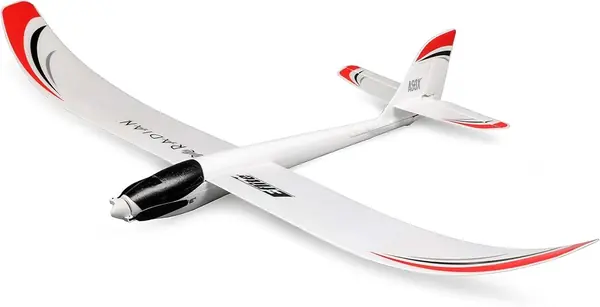
E-flite UMX Radian motor glider with slender high wing and folding propeller

Calm-day park soaring

Track Score 86/100
Battery
1S 150–200mAh LiPo
Flight Time
10 to 20-plus minutes
Completion Level
Bind-N-Fly Basic
FAA Registration
Not required (under 250 g)
View on Amazon

The figure that decides most of this review is 250 grams. The UMX Radian flies under it, which keeps it below the FAA registration threshold and, more usefully, makes it a glider you can launch in a gym, a yard, or the corner of a park. It is a genuine motor glider rather than a powered plane with long wings: cut the throttle and it keeps flying, sinking slowly while you look for lift. On a 1S 150–200mAh pack that stretches into 10 to 20-plus minutes of mixed power-on and power-off flying, and that combination is why it is the one we point most people to first.

What surprised us is how much of a larger model's feel the electronics give it. AS3X smooths out the bumpy air that would otherwise toss something this light, and the optional SAFE Select mode hands you a self-leveling bailout while you work out where the sticks belong. The one-piece wing slides out with its composite spar still in place, so it rides on a back seat without a fight, and the receiver passes live pack voltage to a compatible transmitter so you land on your own terms rather than on the low-voltage cutoff.

Where it earns its keep is the slow stuff. Give it a sun-warmed parking lot or a low slope and it will hang there, motor off, trading height for time in a way a heavier sport glider cannot match. We do keep our flights short once the wind gets up, because a model this light gets pushed rather than fought, but on a calm morning it is about as relaxing as this hobby gets.

Worth Noting

  • Bind-N-Fly completion
Our Verdict

For anyone who already flies Spektrum, we think the UMX Radian is the best first glider here — stable, slow, and light enough to fly almost anywhere.

Check Latest Price
2.

VolantexRC Ranger600 Best Ready-To-Fly for Beginners

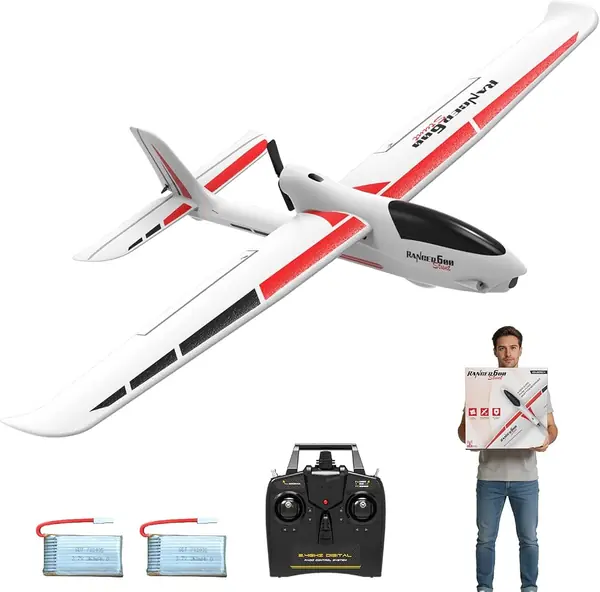
VolantexRC Ranger600 white foam RC glider with pusher propeller and radio transmitter

First-time pilots

Track Score 85/100
Wingspan
600 mm
Control Range
656 ft
In The Box
Plane, transmitter, batteries and spare parts
Flight Modes
Beginner, intermediate and expert assist
View on Amazon

The Ranger600 arrives as a complete kit: airframe, 2.4GHz transmitter, flight batteries, a spare parts bag and a manual. For a household that has never flown anything, that removes the shopping trip that stops a lot of first attempts before they start — nobody has to work out which receiver binds to which radio before the first launch. The 656-foot control range is comfortable for a park or a sports field, and the 2.4GHz link lets several of them fly at once without stepping on each other.

Three flight modes are what make it teachable. Beginner hands the model a full six-axis stabilizer, intermediate loosens it, and expert gets out of the way entirely. We like that the middle setting carries you for most of your first season: you can fly whole batteries there without feeling like the gyro is doing the flying, then step up when the landings stop surprising you.

The pusher layout is the quiet advantage. With the propeller behind the wing, a nose-first arrival costs foam instead of a prop, and the same layout lets the 600 mm airframe glide down slowly with the motor cut, which is where the longer flight times come from. The foam takes a knock and goes back in the air, and at this span it fits in a trunk fully assembled.

Worth Noting

  • Transmitter needs four AA batteries
Our Verdict

If you have no radio gear at all, we point you here: the Ranger600 is the one in this group that flies straight out of the box.

Check Latest Price
3.

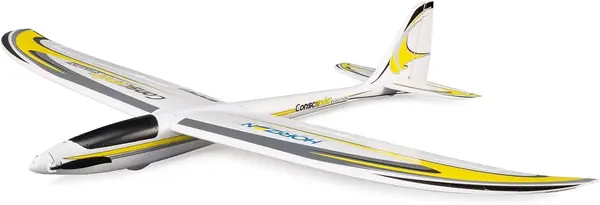
E-flite Conscendo Evolution 1.5m Best for Sport Flying and Aerobatics

E-flite Conscendo Evolution 1.5-meter white foam glider with long wing and folding propeller

Sport soaring and aerobatics

Track Score 84/100
Battery
3S 1300–2200mAh or 4S 1000–2200mAh
Wingspan
1.5 m
Flight Time
15 to 20-plus minutes
Completion Level
Bind-N-Fly Basic
View on Amazon

Full throttle on a 4S pack is the party trick. The Conscendo Evolution is a warmliner — a glider that trades some float for real speed — and it climbs hard, then comes back down as a clean, fast pass that a 1.5-meter span makes easy to track across the sky. That is a different animal from the slow, sinking glide of the Radian, and the difference is the entire reason to own it.

Higher-density EPO is the unglamorous change that makes the rest work. The airframe is stiffer than the older foam gliders we have handled, so it holds its shape in a dive instead of flexing, and it takes a grass landing without drama. Assembly runs about twenty minutes, and four screws take the wing off for the trip home. With a 3S pack and the motor cycled on and off, 15 to 20-plus minutes is realistic, and the telemetry ESC feeds pack voltage, current and motor RPM to a compatible radio.

What we appreciate most is that it covers two jobs in one airframe. Point it at a slope or a thermal and it will stay up; point it down the field and it goes fast enough to feel like a sport plane. After a season with it, we still reach for this one on the days with real wind, where the extra weight is an asset rather than a tax.

Worth Noting

  • Radio and battery sold separately
  • Too fast and heavy for a first glider
Our Verdict

We hand the Conscendo Evolution to pilots who already fly: it thermals, then turns into something fast enough to fill a big field.

Check Latest Price
4.

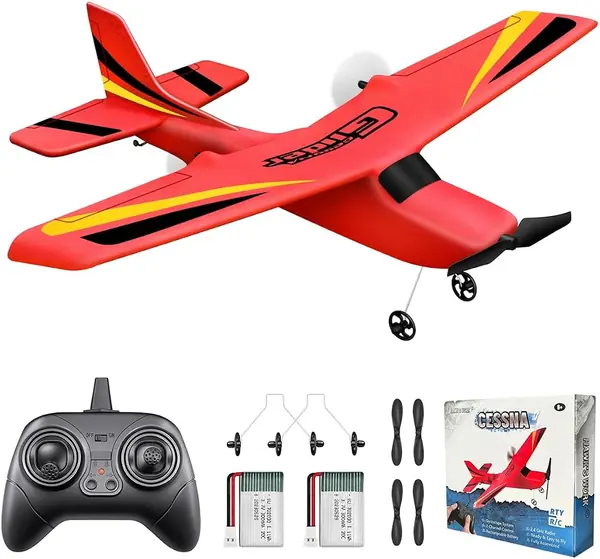
HAWK'S WORK 2CH RC Glider Best for Kids' First Flights

HAWK'S WORK red foam two-channel RC glider with propeller and small transmitter

Kids' first flights

Track Score 82/100
Channels
2
Batteries
2 × 3.7V 300mAh
Warranty
1 year airframe, 3 months battery
Recommended Age
8 years and up
View on Amazon

There is not much to this one, and that is the pitch. Throttle, a turn, and a lot of open space — that is the entire skill set, which is why we hand it to a child without a briefing longer than a minute. The built-in stabilization keeps the wings roughly level while small hands catch up, and the model is light enough that a clumsy arrival is usually a walk over and a relaunch rather than a repair.

The kit is more generous than the price suggests: two 300mAh packs, two spare propellers, a USB charging cable and the AA cells for the transmitter. The airframe carries a one-year warranty with three months on the batteries, coverage we rarely see at this end of the category, and it means the first broken wing is a message rather than a write-off. It launches from a short taxi run on pavement or a hand throw once you are confident.

Keep expectations small and this is a good buy. It is a first-hour trainer, not a soaring machine: it will not hunt lift on a slope or stretch a pack into a long, quiet glide. Once a child can hold a heading and land in grass, the Radian is the natural second step and this becomes the model you let the neighbor's kid try.

Worth Noting

  • Can stop responding altogether
  • Very light so wind decides the flight
Our Verdict

For a first radio and a first crash, we think the price and the warranty make this an easy call for a kid.

Check Latest Price
5.

DEERC 2CH RC Glider Best for Backyard Beginners

DEERC yellow foam two-channel RC glider with propeller and three included batteries

Backyard beginners

Track Score 81/100
Channels
2
Batteries
3 × 3.7V 185mAh
Control Range
164 ft
Stabilization
6-axis gyro
View on Amazon

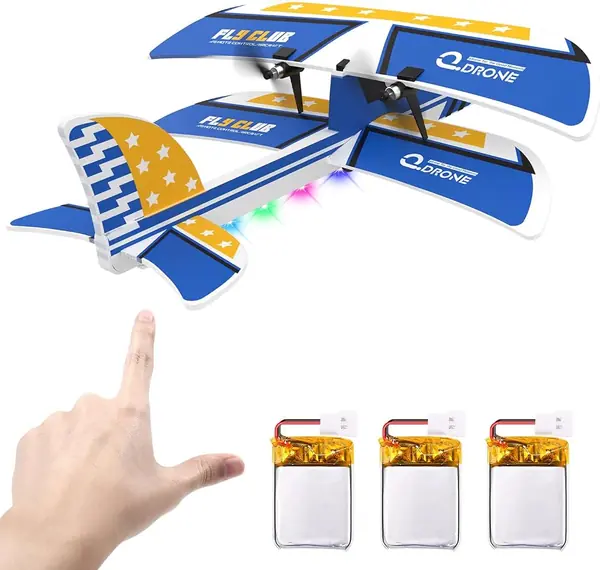
Ten inches of foam and a six-axis gyro is the whole idea here. The DEERC is the smallest model in this group, and that buys a tight turn radius — the kind of space a yard or a half-empty park actually offers — plus a model light enough that a bad landing is a walk over and a pick-up rather than a repair.

Three 185mAh packs come in the box, so a session runs on rotation rather than on a charger, and there are spare parts for the wheel-and-prop damage that comes with learning. The gyro does the stabilizing and you supply the throttle discipline. We found it climbs hard at full stick and settles quickly when you back off, which is a useful habit for a beginner to learn early rather than late.

It is a trainer, not a sailplane. There is no soaring here worth chasing — the fun is low, close and constant, and it ends when the batteries do. As a first model for a seven- or eight-year-old with an adult standing beside them, we think that is the right trade; as anything to grow into, it runs out of headroom inside a season.

Worth Noting

  • 164 ft control range keeps it close
  • Wanders when the wind picks up
Our Verdict

We keep this one for calm evenings and small yards: three batteries, a stabilizing gyro, and a price that makes crashing painless.

Check Latest Price

How We Tested RC Gliders

To build the shortlist, we started with a few dozen gliders on the market and filtered by wingspan, all-up weight, completion level, and price, aiming for a spread that ran from bind-and-fly models under 250 grams to a larger sport glider. That left 12 we flew for nine months.

Most outings started with a hand launch over grass at a local park and a school field, calm mornings for glide testing and breezier afternoons for everything else. We climbed under power, cut the motor, and watched how each plane settled: whether the nose dropped hard or the glide stretched on, how much stick it took to hold a straight line, and what a gust did to the wing. We switched between beginner and expert assist modes mid-flight to see how much bank each one allowed, and checked control range on the ground first, walking the transmitter away from a parked plane until the servos stopped answering.

Landings were not always graceful, which turned out to be useful. We noted which props snapped on a nose-over, whether dented foam could be smoothed or glued, and whether a spare prop and battery came in the box. We timed every flight per charge, counted how many batteries shipped with each plane, and timed a full recharge.

Back home, we broke each one down and checked whether it fit a trunk, a back seat, or a closet shelf. Every flight happened in open fields away from roads, people, and property, and we kept hands and faces clear of the propeller any time a battery was connected.

How to Choose an RC Glider

What Makes a Glider a Glider

A sailplane earns the name by flying on moving air rather than on its motor. In practice that means low wing loading and a wing that keeps flying after the propeller stops — the UMX Radian is the clearest example in this group, and it will stretch a single small pack into a long, quiet cycle of climbs and glides.

A warmliner like the Conscendo Evolution keeps the long wing but adds weight and power for speed, trading some float for a much wider speed range. Decide which of those two flights you actually want before you compare anything else.

Bind-N-Fly, Plug-N-Play, or Ready-to-Fly

Completion level is where a first purchase goes wrong. A Bind-N-Fly model is an airframe with a receiver installed and nothing else — no transmitter, no flight battery, no charger — so a shopper who owns no radio pays for the model twice. Ready-to-fly kits such as the Ranger600 include the radio and at least one pack, and that is the version we point a household at when nobody flies yet.

Add up radio, packs and charger before you compare two airframes on price. The bare model is often the more expensive way in.

What a Stability System Can and Cannot Do

Gyro stabilization makes a small model feel bigger: it damps bumpy air and holds a heading while your thumbs catch up. What it will not do is teach you the landing approach or tell you when to turn. The systems worth paying for are the ones you can step down — full assist for the first flights, partial assist once you can hold a line, and a manual setting that tells you whether the skills have actually arrived.

Spend a whole battery in the middle setting before switching to expert, and do not blame the model for what happens on the first flight after you do.

Weight, Wingspan, and the Field You Have

Every size has a home. Under 250 grams you can fly a gym or a yard, and in the U.S. that is also the weight below which the FAA does not require registration — the UMX Radian is listed that way. A 1.5-meter model needs a real field and a clear landing run, but it also carries its weight through wind that would ground a micro.

The trap is assuming smaller means easier. A light glider does not fight a breeze, it rides it, and a gusty afternoon can be harder on a micro than on a big wing. Match the model to your usual site, not to your ambition.

Frequently Asked Questions

Final Verdict

For most people, the answer is the E-flite UMX Radian. Nothing else here soars as well at that weight, and nothing else lets you fly in a yard, a gym or a park corner without a second thought.

If there is no transmitter in the house, buy the Volantex Ranger600 first — it is the complete package, and its three assist levels will carry a beginner through the first month. If you already fly, skip both and take the Conscendo Evolution: it thermals, and then it has the power to be interesting.