Carrera vs. Scalextric: Which Slot Car System Should You Buy?
Choose between Carrera and Scalextric, and you are not just picking a box of plastic track—you are committing to a track geometry, a rail metal, a digital electronics ecosystem, and a driving feel that shapes every lap you run at home. Both brands dominate 1:32 home slot car racing for good reason, yet they solve the hobby from opposite directions.
The decision boils down to floor space and driving style. Carrera (Evolution analog and Digital 132) builds wide, rigid, stainless-steel raceways originally engineered for huge 1:24 cars—giving 1:32 racers luxurious lane spacing to drift sideways without colliding, provided you have a generous basement, garage, or spare room. Scalextric (Sport analog and ARC digital) builds narrower, slightly flexible, high-grip track with strong ferrous-steel magnetic downforce—fitting intricate multi-corner circuits onto a standard 4 × 8-foot table and rewarding blistering, glued-down lap times.
Track width, scale and feel
Put a piece of Carrera 1:32 straight track next to a piece of Scalextric Sport track and the contrast hits you instantly. Even though both run 1:32 scale cars, their track foundations are completely different sizes.
| Feature | Carrera (Evolution / Digital 132 / 124) | Scalextric (Sport / ARC ONE / AIR / PRO) |
|---|---|---|
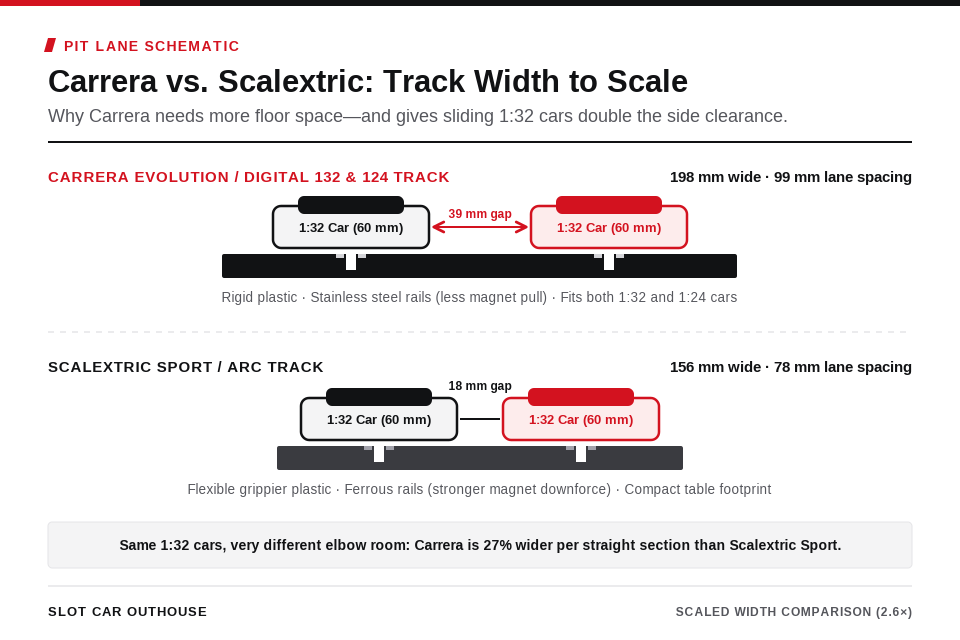
| Track Width (2-lane) | 198 mm (7.8 in) — true 1:24-scale track width | 156 mm (6.1 in) — dedicated 1:32 track width |
| Lane Spacing (Slot-to-Slot) | 99 mm (3.9 in) | 78 mm (3.1 in) |
| Plastic Construction | Thick, ultra-rigid hard plastic; needs flat floor/table | Slightly flexible matte plastic; forgives minor floor dips |
| Surface Grip | Smooth-satin finish; naturally encourages controlled sliding | Textured fine-grain matte; higher raw tire bite |
| Rail Material | Stainless steel (rust-resistant, mild magnet pull) | Ferrous coated steel (strong magnet downforce; keep dry) |
| Smallest Table Fit | Barely fits simple oval on 4 × 8 ft; shines at 6 × 10 ft+ | Packs complex technical layouts neatly on 4 × 8 ft |
| Scale Versatility | Runs both 1:32 and 1:24 cars on the exact same track | Built for 1:32 cars (1:24 cars clash side-by-side) |
| Digital Max Cars | Up to 6 cars (Digital 132) / 4 cars (Digital 124) + pace/ghost cars | Up to 6 cars (ARC PRO) |
| Entry Sub-Line (Incompatible) | Carrera GO!!! / GO!!! Plus (1:43 scale) | Micro Scalextric (1:64) / Compact (1:43) |
Why Carrera's 198 mm width changes how cars race
Carrera made a bold architectural choice decades ago: instead of maintaining separate track molds for 1:32 and 1:24 scales, it built one universal 198 mm slab with 99 mm between slots. When you run a standard 1:32 GT car (roughly 60–65 mm wide) on that track, there is nearly 40 mm of open air between side-by-side doors.
That extra width does two things:
- Natural drifting without door-banging: If you dial back or remove traction magnets, a 1:32 car can swing its rear bumper out 30 degrees through a hairpin without clipping the car in the neighboring lane.
- An effortless upgrade path to 1:24: Because the track is already 1:24 width, you can run massive, weighty Carrera Digital 124 monsters on the same layout simply by adding outer shoulder borders and an 18V power supply.
The trade-off is pure real estate. A standard Carrera R1 180-degree curve spans roughly 31 inches across—and adding outer borders pushes it wider still. On a classic 4 × 8-foot sheet of plywood, Carrera feels cramped; you really want at least 5 × 10 feet or open floor space to let a Carrera circuit breathe. Before ordering extra curves, sketch your room dimensions using tools in our slot car track layout software guide.
Why Scalextric Sport fits real-world homes better
Scalextric Sport trims width to 156 mm with 78 mm lane spacing and tighter curve geometry (R1 through R4). On that same 4 × 8-foot tabletop where Carrera struggles to squeeze in a hairpin, Scalextric comfortably hosts a sweeping figure-eight with elevation changes, a chicane, and a pit straight. Its slightly compliant plastic also clips together snugly and forgives minor unevenness on bedroom floors or folding tables—whereas rigid Carrera sections demand a dead-flat surface (or underside locking clips) so joints stay flush.
Rail metal, magnets and driving character
Ask veteran slot racers why Carrera and Scalextric feel fundamentally different through the trigger, and the answer lives inside the metal power rails.
- Carrera's stainless steel rails: Stainless steel is virtually immune to rust—huge news if your track lives in a damp basement or unheated garage. Just as importantly, stainless steel is weakly ferromagnetic. A car's underside neodymium magnet pulls noticeably softer against Carrera rails than against plain steel. Combined with Carrera's smoother surface finish, cars accelerate smoothly, break traction progressively near the limit, and reward throttle modulation and drifting.
- Scalextric's ferrous coated steel rails: Scalextric uses steel alloy rails with strong magnetic attraction. Drop a magnet-equipped Scalextric car onto Sport track and it locks down like a miniature Formula 1 car on fresh slicks—blistering corner speeds, dramatic braking, and an exciting "slot-rocket" feel that kids and casual guests pick up immediately. The flip side is twofold: when a heavily magnetized car finally exceeds grip, it snaps off the slot suddenly with little warning, and ferrous rails can develop light surface oxidation if stored in humid garages (a quick wipe with rail cleaner or light oil keeps conductivity crisp).
Of course, advanced racers on either brand often remove traction magnets altogether, add outer track borders, fit soft urethane rear tires, and tune weight balance—at which point both tracks turn into pure scale-physics driving simulators.
Digital ecosystems: Carrera Digital 132 vs. Scalextric ARC
Both brands offer classic analog sets (two lanes, two cars, simple wall power) as well as full lane-changing digital systems—see our digital vs. analog slot cars guide if you are still deciding between the two formats. If you want multi-car digital racing, the two ecosystems take distinct philosophies:
Carrera Digital 132 / 124 — Hardware-first racing
Carrera's Control Unit manages the entire race right from physical buttons on the powerbase—no phone or tablet required:
- Race up to 6 cars simultaneously on two lanes (plus autonomous Ghost Cars that learn a lap speed you program, and a Pace Car that peels out during cautions).
- Program each individual car's top speed (10 steps—brilliant for handicapping an adult against a seven-year-old) and braking force right at the track.
- Add the Pit Lane accessory for simulated fuel consumption, refuel stops, and realistic race strategy, plus dedicated Wireless 2.0 handheld controllers and an optional AppConnect Bluetooth dongle if you want lap timing on a tablet or third-party race software like SmartRace.
Carrera's hardware-first approach feels rock-solid and boots up in three seconds without pairing headaches. The downside is footprint and accessory cost: Carrera lane changers and pit lanes are physically long and eat up straightaway space fast.
Scalextric ARC (ONE, AIR, PRO) — App-driven immersion
Scalextric built its modern lineup around ARC (App Race Control), linking a Bluetooth powerbase directly to a free smartphone or tablet app:
- ARC ONE: Wired analog (2 cars) with app-based lap timing, fuel/tire wear, and arcade/endurance race modes.
- ARC AIR: Wireless analog (2 cars) with rumble-feedback throttles and app race management.
- ARC PRO: Full digital (up to 6 cars on two lanes) with wireless controllers, pit-stop strategy, KERS boost, dynamic rain/weather events that change throttle response, and custom championship tracking.
If you love rich telemetry, audible race-engineer callouts, and instant setup for varied party modes, Scalextric ARC PRO is deeply engaging—just remember that your tablet or phone is the heart of the experience, and ARC PRO ships with a single power supply out of the box (adding a second power supply is recommended when running 4–6 power-hungry cars at once). Note also that Scalextric's older Digital (C7042) powerbase is legacy hardware replaced by ARC PRO, though the track pieces themselves remain compatible.
Entry-level lines: Carrera GO!!! vs. Scalextric Micro
Both brands sell affordable toy-aisle starter lines aimed at younger kids and tight budgets:
- Carrera GO!!! / GO!!! Plus (1:43 scale): Smaller cars, steep loops, jump ramps, and turbo-boost buttons. Fun for kids ages 6–9, but 100% incompatible with Carrera Evolution or Digital 132 track and cars.
- Micro Scalextric (1:64) & Scalextric Compact (1:43): Ultracompact sets built for bedroom floors and small budgets, also completely separate from 1:32 Scalextric Sport track.
Important buying rule: If you suspect you (or your kids) will want to expand into real hobby-grade cars from Slot.it, NSR, Sideways, or RevoSlot down the road, skip the 1:43/1:64 sub-lines and jump straight into a 1:32 Carrera Evolution or Scalextric Sport/ARC starter set from our slot car sets collection. You will never have to throw away your track to upgrade.
Cross-brand car compatibility: can they share a track?
One of the best parts of 1:32 analog slot racing is that you are not locked into one brand's cars. Whether you buy Carrera track or Scalextric track, you can race analog slot cars from Carrera, Scalextric, Slot.it, Fly, Ninco, Policar, NSR, and Revell—with two crucial gotchas to know upfront:
- The guide blade (keel) check: Carrera's track slot is slightly wider and deeper than Scalextric Sport's slot. That means Scalextric cars drop onto Carrera track and run effortlessly right out of the box. Going the opposite direction—putting a Carrera car onto Scalextric Sport track—often causes the thicker, deeper Carrera black guide keel to bind in tight corners or scrape the slot bottom. The fix takes two minutes: swap in a slightly thinner aftermarket/red guide blade or lightly sand the bottom and sides of the Carrera guide with fine sandpaper.
- Digital chips are brand-locked: Analog cars cross over easily; digital decoders do not. A Carrera Digital 132 car will not register lane changes on a Scalextric ARC PRO track (and vice versa) unless you install a compatible decoder chip or use a switchable third-party chip (like a Slot.it SP43 or Carson/Frankenslot conversion). Almost all modern Carrera Digital 132 cars do include a handy underside switch to run in analog mode on any standard two-lane track—a great perk if you visit a friend's Scalextric circuit.
Practical buying rules: picking your winner
- Choose Carrera (Evolution or Digital 132) if: You have a dedicated space of at least 6 × 10 feet (or open basement/garage floor), you store track in a humid room where stainless rails prevent rust, you prefer progressive tail-out drifting over heavy magnet grip, you want standalone hardware digital racing without relying on an app, or you ever plan to run huge 1:24 cars.
- Choose Scalextric (Sport, ARC AIR, or ARC PRO) if: Your layout must fit a 4 × 8-foot table or compact spare bedroom, you want high-grip cornering speed straight out of the box, you love app-driven race modes with weather and telemetry, or you want instant plug-and-play compatibility with almost every boutique 1:32 car brand without trimming guide blades.
- Plan borders and track accessories early: Whichever camp you pick, budget for extra inner/outer borders on tight hairpins—see our slot car track and accessories guide—so cars can slide naturally without hooking their rear tires off the edge of the plastic.
Sources
- Carrera Toys — Digital 132, Digital 124 & Evolution System Specifications
- Scalextric (Hornby Hobbies) — Sport Track Geometry & ARC System Guide
- Slot Forum International — Track Dimensions, Rail Metallurgy & Guide Compatibility Reference
- SmartRace — Carrera Digital 132/124 AppConnect & Race Control Documentation
Frequently Asked Questions
Scalextric Sport is substantially better for a 4 × 8-foot table. Its narrower 156 mm track width and tighter curve radii let you build a flowing multi-corner circuit with passing zones and borders on 4 × 8, whereas Carrera's massive 198 mm 1:24-width track barely fits a basic oval with curves and leaves little room for scenery or pit lanes.
On analog tracks, yes: Scalextric 1:32 cars run on Carrera track straight out of the box. Putting a Carrera 1:32 car on Scalextric Sport track works too, though you may need to swap or lightly sand down Carrera's slightly deeper, thicker guide blade so it doesn't bottom out or bind in tight curves. On digital tracks, cars only change lanes and count laps on their matching brand unless retrofitted with a compatible decoder chip.
No. Carrera Digital 132 runs completely standalone using the buttons on the trackside Control Unit to program cars, adjust speed/braking, run Ghost Cars, and manage pit fuel stops. An optional Bluetooth AppConnect dongle lets you add tablet race dashboards if you want them, whereas Scalextric ARC PRO relies heavily on its companion app for full race features.
Two physical factors create that feel: Carrera uses stainless steel rails (which exert weaker magnetic pull on chassis magnets than Scalextric's ferrous steel rails) paired with a smoother track surface finish. That combination lets cars slide their tails earlier and more predictably, while Scalextric's steel rails and grippier matte plastic keep magnet-equipped cars glued tightly to the slot.
No. Carrera GO!!! is a smaller 1:43 scale entry system with completely different track width, connectors, and power requirements. If you want to expand into hobby-grade 1:32 racing later without starting over, skip GO!!! (and Micro Scalextric) and begin with a 1:32 Carrera Evolution or Scalextric Sport starter set.