Gunpla Grades Explained: EG, HG, RG, MG, PG and Every Scale
Every Bandai Gundam plastic model kit—better known as Gunpla—carries a two- or three-letter grade badge on the box corner: EG, SD, HG, RG, FM, MG, or PG. Those letters are not a quality ranking from bad to good. Instead, they tell you three concrete things at once: how big the finished mobile suit stands, how complex its internal skeleton is, and how many hours you will spend snipping parts off plastic runners.
The core trade-off in Gunpla is mechanical density versus build time and fragility. A $12 Entry Grade clicks together in forty minutes without tools and survives endless re-posing on a desk, while a $250 Perfect Grade spreads 700-plus interlocking components across weeks of bench sessions. If you are browsing model kits and wondering which box belongs on your workbench first, this guide decodes Bandai's entire grade lineup—plus the basic tools, decal types, and upgrade path that make every kit look twice as sharp.
Gunpla grades at a glance
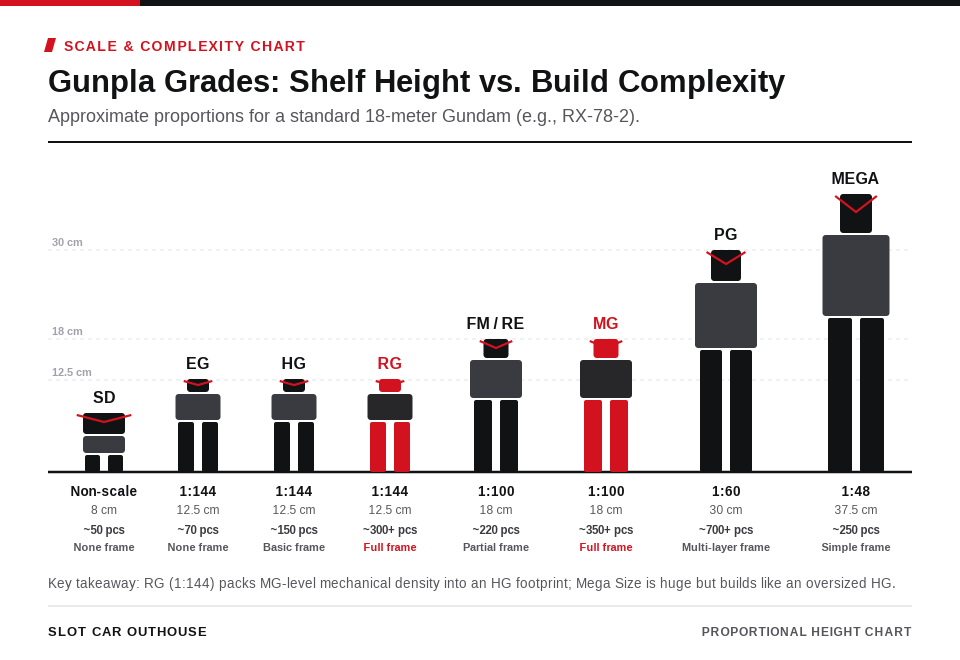
Scale determines physical height (a standard 18-meter Gundam stands roughly 12.5 cm tall at 1:144, 18 cm at 1:100, and 30 cm at 1:60), while grade determines engineering complexity inside that size. Think of it like car models: you can build a 1:24 snap-together curbside coupe in an hour, or a 1:24 full-detail racer with individual suspension springs and braided engine lines.
| Grade | Scale | Finished Height (Typical) | Typical Part Count | Inner Frame | Typical Build Time | Best For |
|---|---|---|---|---|---|---|
| EG (Entry Grade) | 1:144 | ~12.5 cm (5 in) | 60–90 | None (layered armor) | 30–60 min | Absolute beginners, kids, zero-tool builds |
| SD / SDCS | Non-scale (chibi) | ~8–10 cm (3–4 in) | 50–120 | Optional basic frame (SDCS) | 1–2 hrs | Cute desk buddies, quick painting practice |
| HG (High Grade) | 1:144 | ~12.5 cm (5 in) | 120–250 | Minimal / localized joints | 2–5 hrs | Huge suit selection, first "real" Gunpla, customizers |
| RG (Real Grade) | 1:144 | ~12.5 cm (5 in) | 250–450 | Full intricate inner frame | 8–15 hrs | High-detail lovers with small shelf space |
| FM / RE/100 | 1:100 | ~18 cm (7 in) | 180–300 | Simplified mechanical frame | 4–8 hrs | Big 1:100 presence without MG build time |
| MG (Master Grade) | 1:100 | ~18 cm (7 in) | 300–600 | Full mechanical inner frame | 10–25 hrs | Hobby gold standard; deep engineering & articulation |
| MGEX / MGSD | 1:100 / Non-scale | ~18 cm / ~11.5 cm | 400–700+ | Extreme / full MG frame | 15–35 hrs | Showpiece gimmicks (LEDs, plated frames, detailed SD) |
| PG / PGU (Perfect Grade) | 1:60 | ~30 cm (12 in) | 500–1,000+ | Multi-layer skeleton, pistons, LEDs | 30–60+ hrs | Centerpiece display, veteran builders |
| Mega Size | 1:48 | ~37.5 cm (15 in) | 200–300 | Hollow / scaled-up HG joints | 4–6 hrs | Giant dramatic statue without complex assembly |
Entry Grade (EG) — 1:144
Bandai engineered Entry Grade specifically to remove every barrier for a first-time builder. The runners use touch-gate tabs—thin, tapered attachment points designed to pop cleanly off the sprue with thumb pressure alone, requiring no nippers and no stickers for major color blocks. Color separation is clever: even the dark outlines around the Gundam's eyes are formed by shadow gaps cast by layered colored plastic rather than fussy foil decals. The catalog is still compact (RX-78-2, Strike, Nu Gundam, Lah Gundam), making EG the ultimate $10–$15 test drive.
SD & SDCS (Super Deformed / Cross Silhouette) — Non-scale
SD kits condense mobile suits into stylized two-head-tall proportions with oversized helmets and chunky weapons. Standard SDEX and SD World Heroes kits are fast, inexpensive, and rely heavily on foil stickers for color accents. SDCS (Cross Silhouette) elevates the line by introducing a swappable inner skeleton—choose a short cute frame or a taller, knee-jointed frame for better action poses.
High Grade (HG) — 1:144
High Grade is the backbone of the entire Gunpla universe, with hundreds of releases spanning Universal Century (HGUC), Witch from Mercury, Iron-Blooded Orphans, SEED, and 00. Standing about five inches tall, an HG hits the sweet spot between price ($15–$35), quick gratification, and impressive articulation. Modern post-2015 HGs—especially the Witch from Mercury line—feature crisp C-clip and KPS joints, smart seam-line hiding, and solid color separation straight out of the box. If you want to collect a whole squad or learn airbrushing and weathering without risking an expensive kit, HG is where you live.
Real Grade (RG) — 1:144
Real Grade answers a single design question: what happens if you shrink a Master Grade down to 1:144 scale and dial up the surface detail? An RG kit sits in the palm of your hand yet boasts multi-tone armor panels, sliding hatch gimmicks, articulated pistons, and realistic warning markings.
Two important eras separate RG kits. Early RGs (roughly kits #01 through #24, 2010–2017) relied heavily on pre-molded Advanced MS Joint inner frames—single-piece flexible skeletons molded from two plastics at once. They looked wild in 2010, but those joints tended to loosen over time and small armor pieces popped off easily during posing ("early RG syndrome"). Modern RGs (roughly #25 Unicorn onward, especially Sazabi, Nu, Hi-Nu, Force Impulse, God Gundam, and RX-78-2 Ver. 2.0) switched largely to buildable, rock-solid inner frames that rival Master Grades in stability. Even modern RGs, however, contain microscopic millimeter-wide parts that vanish instantly into carpet if dropped—build an HG or two first to sharpen your nipper control.
Full Mechanics (FM) & RE/100 — 1:100
Want the imposing 7-inch shelf presence of a 1:100 scale mobile suit without spending twenty hours assembling internal hydraulic piping that gets covered by armor anyway? That is exactly what RE/100 (Reborn-One Hundred) and Full Mechanics deliver. Think of them as supersized High Grades with sharper exterior surface engraving and simplified, sturdy internal frames. Modern Full Mechanics kits like the Aerial and Forbidden Gundam offer jaw-dropping exterior detail in half the build time of a Master Grade.
Master Grade (MG) — 1:100
For decades, Master Grade has been the benchmark of mecha model engineering. At roughly seven inches tall, parts are large enough to handle comfortably without tweezers, yet detailed enough to include a full mechanical skeleton, opening cockpit hatch with a tiny seated pilot figure, sliding knee armor that shifts as the leg bends, and weapon storage gimmicks. Bandai frequently revisits classic designs with Ver. 2.0 or Ver. Ka (designer Hajime Katoki's sharper proportions and heavy waterslide decal sheets). If you enjoy the meditative engineering rhythm of building a machine from the bones outward, MG is Gunpla perfection.
MGEX & MGSD — Specialty Master Grades
- MGEX (Master Grade Extreme) takes the 1:100 MG blueprint and pushes one single theme to the limit—such as a flexible full-body LED sheet inside the MGEX Unicorn Gundam, or multi-layered metallic gold electroplating across the inner frame of the MGEX Strike Freedom.
- MGSD (Master Grade Super Deformed) applies full Master Grade engineering—working inner frame, clear reflective lens parts, sliding armor, and tight articulation—to the compact, stylized SD silhouette. They are unexpectedly rewarding builds with zero stickers required for core details.
Perfect Grade (PG) & PG Unleashed — 1:60
Standing nearly a foot tall, Perfect Grade is Bandai's flagship showcase. Expect 500 to over 1,000 parts, multi-stage mechanical frames, metal springs, etched foil stickers, opening maintenance hatches, and integrated LED units that illuminate the eyes and chest vents. PG Unleashed (PGU) modernized the formula with a layered truss skeleton, metallic-molded outer armor frames, and magnetic/LED beam sabers that assemble surprisingly smoothly despite the massive scale. PG kits are not necessarily harder per step than an RG—the parts are much bigger—but they demand patience, workspace, and a $200–$350 budget.
Mega Size — 1:48
Mega Size models tower nearly fifteen inches tall, dwarfing even Perfect Grades on a shelf. Yet inside, they are deliberately simple: thick hollow armor shells, click-lock joints designed to hold weight, and minimal tiny parts. Builders love Mega Size kits either as striking centerpiece statues or as giant blank canvases for bold airbrush shading and battle-damage weathering.
Why Gunpla needs zero glue—and what basic tools actually help
Traditional aircraft, tank, and ship kits require liquid polystyrene cement to weld parts together and full primer-and-paint sessions because the sprues come molded in monochrome gray. Bandai broke that mold decades ago using multi-color injection molding and tight snap-fit engineering. A single plastic runner can contain red, yellow, white, and clear green parts simultaneously, and internal pegs friction-fit so securely that glue is unnecessary (and often counterproductive if you ever want to disassemble armor for painting).
Most kits mix three plastics: PS (Polystyrene) for crisp armor, KPS (soft polystyrene) for durable friction joints, and occasionally ABS on older inner frames. Note that enamel thinners and harsh lacquer solvents can make stressed ABS or KPS joints brittle and crack—a crucial detail covered in our model paint brands guide.
Even though glue is optional, four inexpensive tools transform a rough snap build into a crisp display model—check our hobby tools section when assembling your starter kit:
- Flush-cut hobby nippers: Never twist parts off the runner (except touch-gate EGs). Use the two-cut method: make your first cut 2–3 mm away from the part to relieve plastic stress, then make a second flush cut right against the armor surface. Upgraded single-blade nippers (like GodHand SPN-120 or DSPIAE ST-A) slice cleanly like a scalpel and drastically reduce white stress marks.
- Hobby knife or glass nano-file: Shave or buff away the tiny remaining nub cleanly without gouging curved armor.
- Panel line marker or accent wash: Real machines have dark seams where armor plates meet. Running a fine-tip Gundam Marker (gray on white armor, black on dark colors, brown on red/yellow) along recessed panel lines takes ten minutes and instantly makes flat plastic look three times more detailed.
- Matte topcoat spray: A quick mist of flat clear coat knocks down that shiny "toy plastic" sheen and blends stickers or decals smoothly into the surface. Once you get hooked on custom paint schemes, stepping up to an airbrush from our best airbrush brands guide opens endless color possibilities.
Stickers, dry transfers and waterslide decals
Every Gunpla box includes markings, and knowing which type is inside prevents torn emblems:
- Foil stickers: Thick, shiny metallic stickers used on HG and SD kits for eyes, sensors, and missing color spots. Great for glowing green eyes; mediocre on large curved armor where edges peel.
- Marking stickers (Tetron seals): Clear, thin peel-and-stick decals common in RG and standard MG kits. Easy to apply, though their clear border can catch the light on dark plastic unless dulled under a matte topcoat.
- Dry transfer decals: Found in many older MG boxes. You tape the sheet flat over the armor and rub the back with a burnisher or fingernail until the ink transfers cleanly—zero visible border, zero second chances if it slips.
- Waterslide decals: The gold standard included in MG Ver. Ka kits and sold separately by Bandai, Delpi Decal, and G-Rework. Soak in water for ten seconds, slide onto the armor with a damp cotton swab, position freely until perfect, and lock down with decal setter and topcoat for a painted-on finish.
The best first-kit path (so you don't burn out)
If you have never built a model kit before, resist the urge to buy a $300 Perfect Grade or a notoriously finicky early Real Grade on day one. Follow a simple three-step ramp:
- Kit #1 — Entry Grade or modern HG ($12–$28): Pick an EG RX-78-2, EG Nu Gundam, or any Witch from Mercury HG (like Aerial, Calibarn, or Schwarzette). Learn the two-cut nipper technique, panel line the seams, and enjoy finishing a poseable robot in one weekend afternoon.
- Kit #2 — Master Grade or modern RG ($45–$75): Once you know you love the rhythm of snipping and snapping, jump to a modern MG (such as MG Barbatos, MG Freedom 2.0, or MG Dynames) for a full mechanical skeleton, or a post-2018 RG (like RG Force Impulse, Nu Gundam, or Hi-Nu) if you prefer 1:144 scale.
- Kit #3 — Upgrade your finish, not just your grade: Before chasing massive part counts, try panel-lining, waterslide decals, and a matte topcoat on a $25 HG—those finishing habits elevate a kit far more dramatically than moving up a scale alone.
Sources
Frequently Asked Questions
Entry Grade (EG) or a modern High Grade (HG) is the best starting point. Entry Grade requires zero tools and finishes in under an hour for around $10–$15, while modern HG kits (especially The Witch from Mercury line) introduce proper nipper work and panel lining without overwhelming part counts.
No. All modern Bandai Gunpla kits are engineered to snap together cleanly without cement and come molded in multiple accurate colors. You can build a sharp, fully poseable model straight out of the box with nothing more than a pair of side cutters, then add panel lining, topcoat, or paint later if you wish.
In day-to-day handling, yes—Real Grade is often trickier than Master Grade. Even though an MG usually has more total parts, its 1:100 pieces are noticeably larger and easier to grip. Real Grade squeezes comparable mechanical complexity into 1:144 scale, meaning tiny parts, tight clearances, and more patience required during assembly.
"Ver. Ka" stands for Version Katoki, meaning the kit was redesigned and supervised by famed mechanical designer Hajime Katoki. Ver. Ka kits are part of the 1:100 Master Grade line and are known for sleeker, longer proportions, extra transforming or hatch gimmicks, and extensive waterslide decal sheets.
Scale tells you the physical size ratio compared to the fictional full-size mobile suit (1:144 is roughly 5 inches tall; 1:100 is roughly 7 inches; 1:60 is roughly 12 inches). Grade tells you the complexity, part count, and internal engineering—which is why both an Entry Grade and a Real Grade share the exact same 1:144 scale despite having wildly different detail levels.