Best Soldering Irons of 2026

Touch a hot iron to a wire and watch the solder sit there in a gray lump, and you learn what a soldering iron is for. It isn't melting solder; it is moving heat into the joint faster than the joint drains it. An iron that can't keep up makes cold joints that look fine and fail a month later.

Wattage on the box matters less than how the iron recovers on the second joint, when the tip is already hot and the wire is thicker than the first. We put 12 irons, from pencil irons and digital stations to a USB-C mini and a butane cordless, through real repairs: a cracked guitar cable jack, a lamp cord and a dead capacitor on an old receiver board. The seven picks handle that recovery in different ways, and one will suit the metal in front of you.

Our Top Picks

The Best Soldering Irons

1.

Weller WE1010NA Digital Soldering Station Best Overall
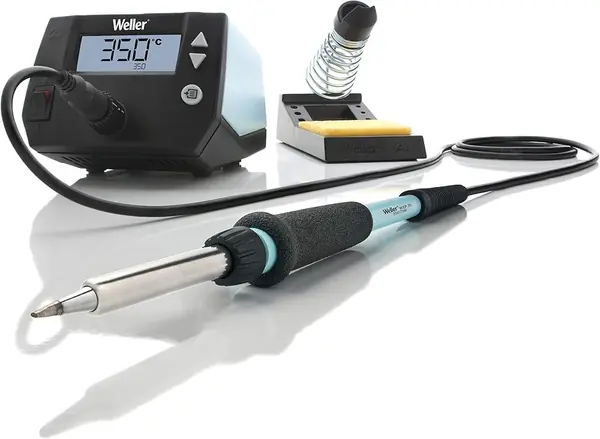
Weller WE1010NA digital soldering station with LCD screen and safety rest

Daily bench work

Track Score 94/100
Temperature Range
200–850°F
Wattage
70 watts
Display
LCD with three-button control
Temperature Stability
±4°F
View on Amazon

Two figures do most of the persuading here: 70 watts and a stated temperature stability of plus or minus 4°F. Together they explain what a station buys you over a pen iron. After each joint the tip climbs back to the set temperature instead of sagging, so the tenth joint behaves like the first, and the 200–850°F range stretches from a fine board pad to a spliced 14-gauge wire.

We made it our top pick because it takes the guesswork out without making you learn a menu. The LCD and three buttons set a temperature, the temperature lock holds it so a nudged control can't cook a board, and the front-panel switch kills the heat without a reach for the plug. ESD-safe construction and a heat-resistant silicon cable are the details you stop noticing until you work on something static-sensitive.

Changing a tip is a twist of the knurled nut on the soldering pencil, done by hand, with no second tool to hunt for. The PH70 rest supports the iron at the back so it sits rather than balances, which matters in a shop where the iron is parked between every joint. Weller's ET series tips are the standard shape, so adding a finer conical is a small purchase rather than a search.

The box holds the station, the WEP70 iron, the rest with sponge, and a 1.6 mm screwdriver tip, so the only extras are solder and flux. At 5.5 pounds and 12.5 inches deep it is furniture, not a travel tool: measure the bench before you commit the space.

Worth Noting

  • Premium price next to the other stations here
  • Heating-element failures are the recurring fault
Our Verdict

We recommend it to anyone who solders more than once a month — the temperature lock, ±4°F stability, and hand-changeable tips turn good joints into repeatable ones.

Check Latest Price
2.

YIHUA 939D+ Digital Soldering Station Best Value Station

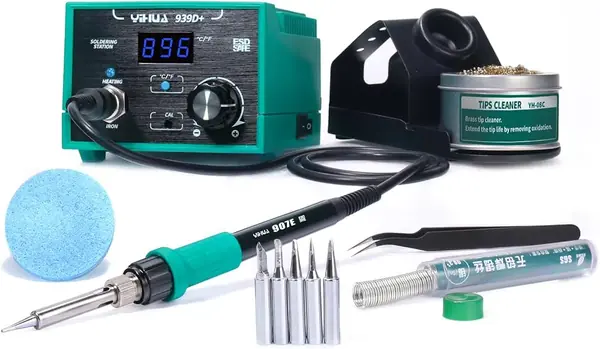
YIHUA 939D+ green digital soldering station with detachable iron and brass cleaner

Budget bench station

Track Score 93/100
Temperature Range
392–896°F
Iron
Detachable 907E handle
Control
PID loop with digital °F/°C display
Tip Cleaning
Brass cleaner and sponge
View on Amazon

The gap between this station and our top pick is the first thing a shopper notices, and in practice it is narrower than the prices suggest. The 939D+ runs 392–896°F on a PID control loop, shows set and actual temperature in Fahrenheit or Celsius, and parks a detachable 907E iron in a metal holder with a brass tip cleaner standing beside it. YIHUA covers it for twelve months.

Brushed aluminum across the front panel is a small thing that turns out to matter: it doesn't scorch and it wipes clean when flux spits. The holder is heavy enough to stay where you put it, and the brass cleaner scours a tip back to shiny without the thermal shock a wet sponge delivers. The iron unplugs from the base, which is the arrangement you want if a handle ever needs replacing.

We recommend it to anyone soldering a few evenings a week rather than a full shift. The honest trade-off is accuracy: on this class of station the displayed number can drift from what the tip actually delivers, and the built-in calibration exists for a reason. Check the tip against a meter before you trust the readout on a heat-sensitive board, and it does everything a hobbyist asks of it.

Worth Noting

  • Durability is this station's weak spot
Our Verdict

Our value pick: PID control, a brass tip cleaner, and a detachable iron for a fraction of a premium station's price, with accuracy you should verify.

Check Latest Price
3.

PINECIL Smart Mini Portable Soldering Iron Best Portable

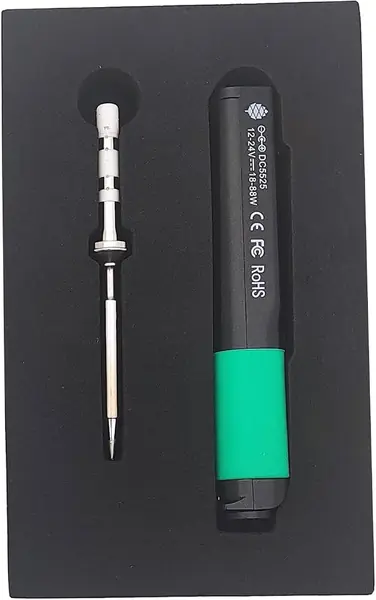
PINE64 Pinecil mini portable soldering iron with stainless steel barrel and OLED display

Toolbag and travel

Track Score 92/100
Temperature Range
100°C to 400°C
Heat-up Time
12 seconds
Weight
2.12 oz
Power Input
USB-C PD/QC 3.0 or DC5525 barrel
View on Amazon

At 2.12 ounces and about six inches long, the Pinecil looks like a marker, and the 12-second warm-up PINE64 quotes is the reason it isn't a novelty. What struck us when we first handled one is the balance: the mass sits in the barrel behind the tip, so it steers like a pencil instead of hanging off a cord.

It is a 65-watt iron that runs on USB-C Power Delivery or QC 3.0, or on a DC5525 barrel supply, and it will not run from a phone charger. You need a brick that delivers 12 or 20 volts at 3 amps — a laptop supply is the usual answer, and it is not in the box. Temperature sets between 100°C and 400°C on the small OLED, and standby is handled by the firmware when the iron sits idle.

Where it earns a place in a toolbag is reach: the tip sits at the end of a short barrel, so you can get into a guitar cavity or a tight enclosure without the whole iron looming over the work. Tips unscrew by hand, which means a conical for boards and a wider one for wire can live in the same small roll, and the stainless handle stays comfortable for the length of a repair.

Worth Noting

  • Long-term reliability is inconsistent
Our Verdict

For soldering away from a bench, this is the one we carry: a 2.12-ounce pencil that heats in seconds from a USB-C brick you already own.

Check Latest Price
4.

LEXIVON LX-770 Butane Soldering Iron Kit Best Cordless

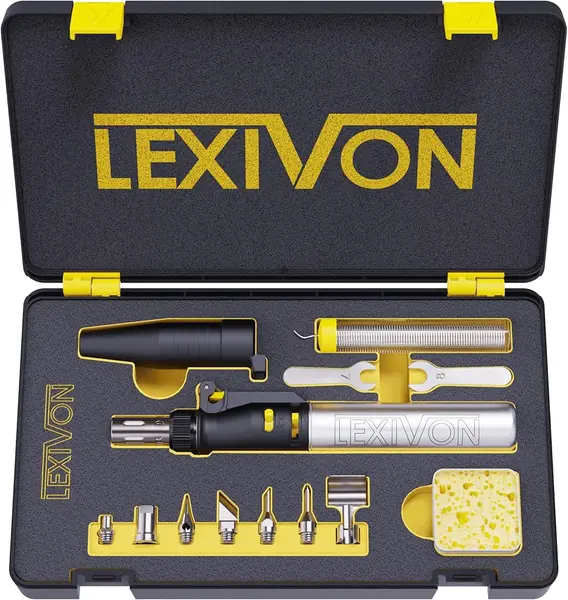
LEXIVON LX-770 butane soldering iron kit with trigger ignition and assorted tips

Cordless field work

Track Score 91/100
Kit Contents
13 pieces including seven tips
Runtime
Up to 75 minutes per fill
Refill Time
10 seconds
Max Temperature
Up to 2,400°F flame, 1,100°F with tips
View on Amazon

Picture a junction box on a fence post, a trailer harness, or a heat-shrink splice under a dash — the jobs where the nearest outlet is a hundred feet away. This kit is built for them: a self-igniting trigger with a flame lock, a flame that adjusts from about a half inch to two and a half inches, and a metal tank rated for roughly 75 minutes of work that refills in about ten seconds from a standard butane can.

We keep coming back to it because it is two tools in one case. With a soldering tip fitted, the flame is rated to about 1,100°F at the tip and will tin a splice or shrink tubing with no cord in the way; with a torch tip on, the 2,400°F flame heats a rusted bolt or a seized fitting in seconds, which no pen iron here can do at all. What you give up is precision: there is no temperature to set, only a flame to judge, so you read the solder instead of a display, and it is clumsy on dense boards where a fine tip and a held temperature matter. Butane is not included, so order a can with the kit.

Worth Noting

  • Flame size instead of a set temperature
Our Verdict

Where there's no outlet, this is the kit: instant butane heat, a 75-minute tank, and torch tips for the jobs solder can't touch.

Check Latest Price
5.

Plusivo 60W Soldering Iron Kit Best Starter Kit

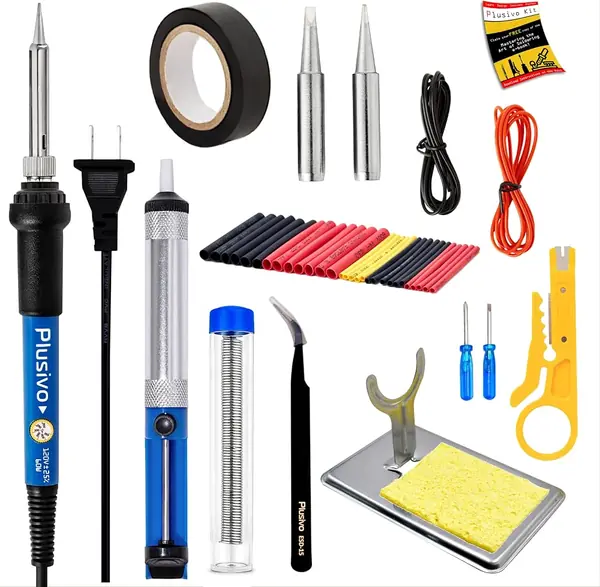
Plusivo 60W soldering iron kit with spare tips, solder wire, and desoldering pump

First soldering kit

Track Score 90/100
Temperature Range
392–842°F
Wattage
60 watts
Kit Contents
15 pieces including solder wire and desoldering pump
Heating Element
Ceramic
View on Amazon

Open the carton and there is a first project inside: a 60-watt iron with a stand and sponge, spare tips, a roll of 0.8 mm solder wire, a desoldering pump, heat-shrink tube, and a small box to keep it all in. For someone who has never soldered, it means starting tonight instead of after another order arrives.

The iron itself is honest rather than clever. A knob sets 392–842°F, a ceramic element does the heating, and four vent holes in the barrel keep the handle from cooking your hand during a long session. It is the kit we hand over without an explanation, and the pump — the accessory people actually forget to buy — is the one that makes a mistaken joint fixable.

We recommend it for a first project or a repair every few months, and not as a daily driver. The knob gives you a setting to aim at rather than a readout to trust, and the stand is a folded wire cradle that does its job and nothing more. For the money that is the right trade: you get working tools, a way to undo mistakes, and a box that keeps them together until the next thing breaks.

Worth Noting

  • Analog dial with no temperature readout
Our Verdict

The kit we hand a first-timer: an adjustable 60-watt iron plus solder, a desoldering pump, and spare tips in one box.

Check Latest Price
6.

Weller D550PK Soldering Gun Kit Best for Heavy-Duty Joints

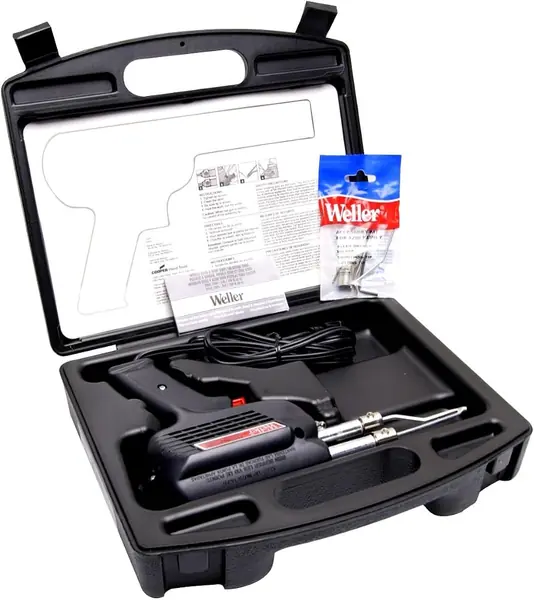
Weller D550PK soldering gun kit with pistol grip and molded carrying case

Heavy wire and lugs

Track Score 89/100
Wattage
260W high, 200W low
Heat-up Time
About 6 seconds
Kit Contents
Three tips, solder, flux brush, carrying case
Temperature
900–1,100°F
View on Amazon

Pull the trigger and the D550 reaches working heat in about six seconds, which is the whole argument for a gun. There are two settings under your finger, 260 watts and 200 watts, the tip runs 900–1,100°F, and two LEDs sit either side of it so your own shadow doesn't fall across the joint. That combination is why we keep one in the shop even with stations on the bench.

It wins the joints a pencil iron loses: battery lugs, chassis grounds, coax connectors, 10-gauge wire into a terminal block. The mass behind the tip pushes heat into a big copper lug faster than any 60-watt iron here, and the trigger lets you cut the heat the instant the solder flows instead of leaving a hot tip parked on a connector. It is not a board iron — the tip is large and the heat is savage on a small pad.

The kit is unusually complete: solder, smoothing, and cutting tips, a flux brush, a soldering aid, a coil of lead-free solder, and a molded case. We treat it as the second iron in a workshop rather than the only one, and Weller's limited lifetime warranty is half the argument — keep the receipt inside the case.

Worth Noting

  • Heavy pistol grip tires in long sessions
  • Element and switches are the failure points
Our Verdict

When the joint is a battery lug or a coax connector, we grab this gun: 260 watts, working heat in six seconds, and two settings under the trigger.

Check Latest Price
7.

Q-MING 80W LCD Soldering Iron Kit Best for Occasional Repairs

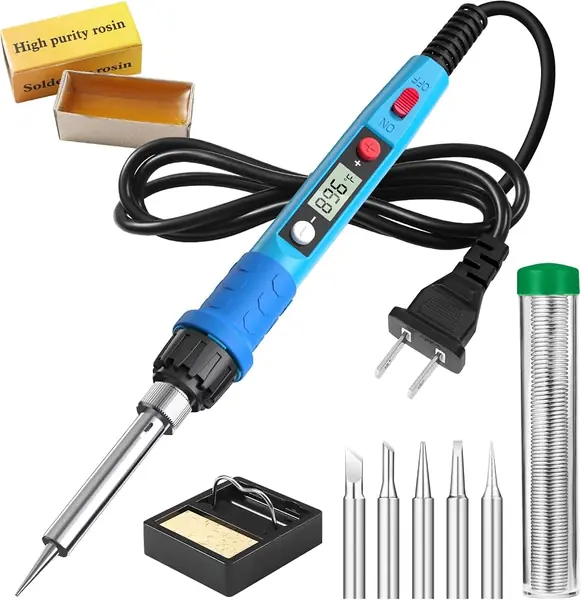
Q-MING 80W soldering iron pen with LCD display, stand, and five spare tips

Occasional repairs

Track Score 88/100
Temperature Range
356–896°F
Wattage
80 watts
Heat-up Time
About 20 seconds
Display
LCD
View on Amazon

It is the least expensive iron here, and the only one at that end of the range with a screen on the barrel. The LCD shows the set temperature anywhere from 356°F to 896°F — a wider spread than the Plusivo kit offers — and 80 watts behind a ceramic element brings it up to heat in about 20 seconds.

The kit is basic but complete enough to start: the iron, five tips, a stand, a sponge, a small spool of solder wire, and a tub of flux paste. Nothing in it is generous. The stand is light and the solder is enough to learn on rather than to finish a project with, but you can open the box and make a joint without ordering anything else.

Where a readout earns its keep is repeatability. Going back to 700°F for the second joint instead of guessing where a blank dial was left lets you learn to solder instead of learning to work around your tools, and it is a real advantage over the kits with no number on them.

Our take: this is the iron for the occasional fixer — an RC connector, a guitar jack, a toy that stopped working — rather than a daily bench, where a station's thermal mass and a heavier rest earn their keep. For very little money it is the shortest path to a screen, 80 watts, and a set of tips in one order.

Our Verdict

A screen, 80 watts, and five tips for very little money — we like it for occasional repairs, not for a daily bench.

Check Latest Price

How We Tested Soldering Irons at the Bench

We built the shortlist from the irons people actually buy for bench work and repair, then filtered by power source, temperature range, tip style, and what comes in the box — a bare iron versus one with a rest, solder, and a pump. We also read up on the parts that wear out, since an element or tip that quits in three months changes the value math. Twelve irons made the cut, and each one stayed in rotation for eight months.

Every iron went to a bench in front of an open window with a small fan pulling flux smoke away from the face — never across the joint. We tinned stranded wire, soldered and desoldered through-hole parts on scrap boards, spliced a lamp cord, and swapped a jack on a guitar cable. Heavier work meant terminals and a trailer harness, and the portable and butane models went into a toolbag for a driveway and a dim closet. We timed how long each iron took to reach working temperature, then laid down a run of joints and watched where the tip stalled on a ground plane and how quickly it came back.

Tips came off mid-project to see whether a swap took seconds or a wrench, and we tracked how the plating held up on the ones we used most. Between joints, every iron went back to its rest with the cord pushed clear of the tip, and we washed hands after handling leaded solder. Butane models were refueled only when cold and away from anything that could light them, and we noted that the fuel can isn't in the box.

We didn't score kits by tip count. We scored them by whether the rest held the iron steady and whether we could finish a repair with what came in the case.

How to Choose a Soldering Iron

Match the iron to the metal in front of you

For circuit boards, connectors, and wire up to about 18 gauge, a 60–80 watt temperature-controlled pen or a 70-watt station is plenty, and the shape of the tip matters more than the last 10 watts. For battery lugs, chassis grounds, and 10-gauge cable, no soldering pencil will keep up: you need the thermal mass of a 200-watt-plus gun or a station with a big chisel tip.

Wattage is not temperature — it is how fast the tip replaces the heat a joint steals. A 60-watt iron that recovers quickly beats an 80-watt iron that sags, which is why a cheap high-wattage pen is not automatically the stronger tool.

Decide how much temperature control you need

Three levels are on offer: a plain dial with no number, a dial with a display, and a closed-loop station that holds a set temperature and can be calibrated. A displayed number is not proof of what the tip is doing, since the sensor sits in the heater rather than in the joint, so calibration or a check against a known melting point is what makes a readout meaningful.

For most hobby work a display and a temperature lock are enough; for repeat work or heat-sensitive parts, pay for the station. We rank stability above range, because 850°F you never need is worth less than holding 700°F steady through a joint.

Pick a power source for where you work

Corded 110–120V irons are the cheapest route to real wattage and they never run out. USB-C irons trade some of that for a pocket-sized tool that heats in seconds, but the charger decides everything: you need a Power Delivery or QC 3.0 supply that delivers 12 or 20 volts at 3 amps, and a phone brick will not do it.

Butane suits junction boxes, trailers, and anywhere the outlet is a long walk, and it doubles as a torch — at the cost of a set temperature and a fuel can you have to remember.

Judge a kit by its rest, not its tip count

Kits advertise tip counts because tips are cheap to include; what changes your day is the stand. A folding wire cradle lets a hot iron roll, while the weighted holders and integrated rests on stations keep a 700°F barrel exactly where you left it. Toolless tip changes sound like a luxury until you swap shapes three times on one board.

Buy a kit for the rest and the pump, and check that its tips are a standard shape you can reorder. A desoldering pump you will actually use is worth more than a bag of heat-shrink.

Plan for the parts that wear out

Tips are consumables, not accessories: they oxidize, they pit, and eventually they stop taking solder no matter how well you tin them. That makes tip availability and price the quiet specification that separates a tool you keep from one you replace. Sleep and standby functions stretch tip life by dropping the heat when the iron sits idle, and a temperature lock protects a joint from a knocked knob.

On a station the heating element is the other wear item, which is why a stated warranty — twelve months, a year, limited lifetime — belongs on your list of features.

Frequently Asked Questions

Final Verdict

We recommend the Weller WE1010NA as the default for anyone who solders with any regularity. The ±4°F stability, the temperature lock, and hand-changeable tips make good joints repeatable, and the ESD-safe build means you are not gambling with the parts you are repairing.

If budget decides the purchase, the YIHUA 939D+ does the same job with fewer refinements for a fraction of the price. And if your work happens where there is no outlet at all, the LEXIVON butane kit is the one that leaves the bench.